Priya Ramanathan had been VP of Talent at a Series D SaaS company for eleven months when she finally opened the dashboard she had been avoiding. Sixty-three requisitions open beyond sixty days. Twelve hiring managers who had stopped responding to recruiter check-ins. An offer acceptance rate that had slid from seventy-eight percent to sixty-one percent in two quarters. The board was asking why engineering headcount was forty percent below plan, and the CFO was asking why agency spend had tripled. Priya had hired strong recruiters, replaced two underperforming sourcers, and signed an AI sourcing contract that everyone had assured her would change everything. Nothing had changed. The numbers just kept getting worse. The problem, she realized as she traced one requisition all the way back to its origin, was not any individual recruiter or any single tool. The problem was the workflow itself—the chain of handoffs, approvals, queues, and status meetings that connected an open requisition to a closed hire. Each link in the chain looked reasonable in isolation. Together, they produced a system that was mathematically incapable of hitting its targets, and no amount of recruiter effort or tool investment could fix a system whose design was the problem.
Where Hiring Workflows Actually Break
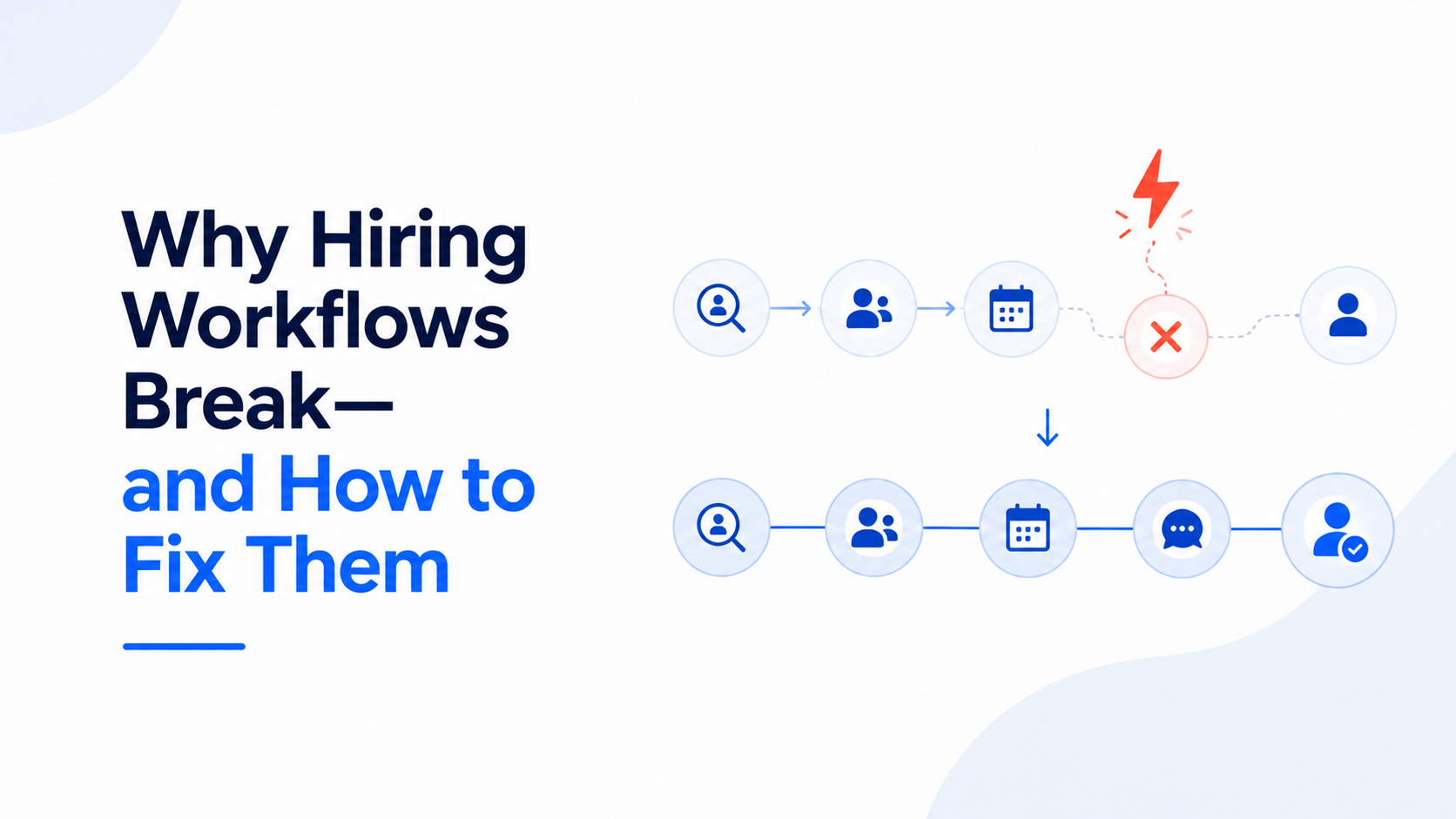
A hiring workflow is not a single process. It is a sequence of seven distinct phases—requisition, sourcing, screening, interview, decision, offer, onboarding—each with its own owner, tools, and failure modes. Most talent leaders cannot name all seven, let alone tell you which one is responsible for the bulk of their hiring delays. When a requisition sits open for ninety days, the instinct is to blame the recruiter or to demand more sourcing activity. In reality, the bottleneck is usually two or three phases upstream of where the pain is felt, and the metric that surfaces the pain is too aggregated to point to the cause. A workflow diagnostic begins by separating each phase and measuring its conversion rate, cycle time, and drop-off independently, because only this segmentation reveals which handoff is actually broken.
The seven failure modes are remarkably consistent across companies. Requisition failure happens when the job description does not match the market. Sourcing failure happens
when the platform produces volume but not signal. Screening failure happens when qualified candidates are filtered out by overloaded reviewers. Interview failure happens when calendars and unstructured evaluations turn a two-week process into a six-week one. Decision failure happens when approval chains lengthen and candidates accept competing offers. Offer failure happens when compensation ranges were never pre-aligned. Onboarding failure happens when the new hire is dropped into a team that was never prepared for them. Each of these is a workflow defect, not a recruiter defect, and each requires a structural fix, not a behavioral one.
The temptation, when the dashboard turns red, is to add another tool. As our analysis of more tools, same hiring problems argues, most companies that stack new tools on top of broken workflows see no measurable improvement in time-to-fill or quality-of-hire, because the tool is being asked to compensate for a process defect that no tool can fix. The companies that do improve are the ones that diagnose the specific phase where the workflow breaks, redesign that phase end to end, and only then introduce a tool that supports the redesigned process. Tool-first thinking produces dashboards full of metrics and requisitions that still sit open. Workflow-first thinking produces a hiring system that compounds in efficiency over time, because each phase that is redesigned properly removes a bottleneck that was silently consuming cycle time and qualified candidates alike.
The Requisition Phase: Where Requirements Become Fantasies
The requisition phase is the most under-diagnosed failure point in the entire hiring workflow, because its failures manifest downstream where they are attributed to sourcing or screening rather than to their actual cause. A requisition that lists twelve required qualifications for a role that realistically requires six is a requisition that cannot be filled efficiently, no matter how strong the sourcing team is. The hiring manager who insists on a senior engineer with eight years of experience in a specific framework that has only existed for four years is asking for a candidate who does not exist, and the workflow will spend weeks producing candidates who are all rejected for the same impossible requirement before anyone questions the requisition itself. The first fix to any broken workflow is to fix the requisitions, because every downstream phase inherits the defects of the requisition that produced them.
The most common requisition defect is the kitchen-sink job description, which accumulates requirements as it passes through stakeholders until it describes a candidate who could not be hired at any salary. According to McKinsey research on hiring effectiveness, forty-three percent of job descriptions contain at least three requirements that the hiring manager would waive if pressed, and these non-negotiables are typically added by stakeholders who do not actually interview the candidate but who feel the need to assert their preferences in the requisition document. The result is a requisition that filters out qualified candidates at the sourcing stage, because sourcing tools treat every requirement as mandatory, and the workflow produces a pipeline that is too small and too narrow to fill the role.
The fix is a structured intake process that separates mandatory requirements from nice-to-haves and that requires the hiring manager to defend each mandatory requirement with a specific job duty that requires it, because this discipline alone exposes the requirements that are preferences dressed up as non-negotiables.
The second most common requisition defect is unrealistic seniority, which happens when a hiring manager asks for a senior candidate at a mid-level budget or asks for a candidate with more experience than the role actually requires. The hiring manager who asks for ten years of experience for a role that needs five is asking for a candidate who will be bored, underpaid, or both, and the workflow will produce candidates who withdraw as soon as they understand the role's actual scope. According to SHRM data on job description quality, companies that have implemented structured requisition intake with mandatory market-data calibration have reduced their average time-to-fill by twenty-two percent and improved their quality-of-hire scores by fourteen percent, because the discipline of calibrating the requisition against market reality produces a role that can actually be filled with a candidate who can actually do the work. The requisition is the foundation of the entire workflow, and a workflow built on a defective requisition cannot be fixed by any downstream intervention, which is why the requisition phase is the highest-leverage phase to fix first when a workflow is broken.
The Sourcing Phase: Volume Without Signal
The sourcing phase fails in two opposite ways, and most TA teams suffer from both simultaneously without realizing they are different problems. The first failure is insufficient volume, where the sourcing team cannot generate enough candidates to fill the pipeline, and the requisition sits open because there is no one to interview. The second failure is excessive volume without signal, where the sourcing team generates hundreds of candidates per requisition but the vast majority are unqualified, and the screening team is overwhelmed by noise that prevents them from finding the qualified candidates who are actually in the pipeline. These two failures require opposite fixes, and treating them as the same problem is one of the most expensive mistakes a TA leader can make, because adding more sourcing to a noise problem makes the noise worse, while restricting sourcing to a volume problem starves the pipeline further.
The signal-to-noise problem has gotten dramatically worse in the last three years as AI sourcing tools have made it trivial to generate high-volume outbound campaigns. According to LinkedIn talent research on sourcing effectiveness, the average response rate to outbound recruiter messages has fallen from twelve percent in 2021 to six percent in 2025, because candidates are receiving five to ten times more outreach than they were three years ago and have learned to ignore most of it. The sourcing teams that are still effective in this environment are the ones that have shifted from volume-based metrics to quality-based metrics, measuring the percentage of sourced candidates who actually engage in a conversation rather than the raw number of contacts generated. This shift in
measurement forces the sourcing team to optimize for targeting precision rather than reach, and the result is a smaller but more responsive pipeline that the screening team can actually evaluate without being overwhelmed by noise that masks the qualified candidates in the pipeline.
The structural fix for the sourcing phase is to move from a sourcing-only model to a recruiting platform model, where the same system that identifies candidates also engages them, assesses their fit, and maintains the relationship through the hiring process. As our analysis of AI sourcing vs AI recruiting explains, sourcing tools that simply aggregate candidate profiles produce pipelines with response rates that are three to five times lower than recruiting platforms that engage candidates with personalized outreach, because engagement data and behavioral signals create richer candidate profiles that produce more accurate matching and higher response rates. The sourcing phase is not a phase that can be fixed by working harder at it. It is a phase that must be redesigned around the candidate's experience of being sourced, and the redesign requires a platform that treats sourcing as the beginning of a relationship rather than as a one-time contact that the candidate has already learned to ignore.
The Screening Phase: Where Qualified Candidates Disappear
The screening phase is where the largest number of qualified candidates are lost in the entire hiring workflow, and the loss is almost entirely invisible to the talent leader because the candidates who are screened out are never tracked. A recruiter who spends an average of thirty seconds per application is not reading the resume; they are scanning for keywords that match the job description, and any candidate whose resume uses different terminology to describe the same qualification will be screened out without ever being evaluated. Studies that have re-reviewed screened-out applications using structured evaluation criteria have found that between fifteen and twenty-five percent of screened-out candidates were actually qualified, which means that for every requisition that receives three hundred applications, the screening phase is silently discarding between forty-five and seventy-five qualified candidates who would have been strong hires if they had been evaluated properly rather than scanned superficially.
The screening failure is fundamentally a time problem, not a recruiter skill problem. According to Gartner research on talent acquisition process design, the average recruiter-to-candidate ratio has fallen from one to eighty in 2019 to one to one hundred and forty in 2025, while the average application volume per requisition has tripled. The math does not work. A recruiter who is responsible for thirty open requisitions and receives an average of two hundred applications per requisition is responsible for screening six thousand applications per quarter, which at thirty seconds per application requires fifty hours of pure screening time per quarter, which is roughly twenty-five percent of the recruiter's total available time. The remaining seventy-five percent is consumed by intake meetings, hiring manager updates, interview scheduling, and offer coordination, leaving no time for the
careful evaluation that screening actually requires and producing the structural screening failure that quietly erodes the pipeline of every TA team operating at modern application volumes.
The fix is not to ask recruiters to screen faster or to hire more recruiters. The fix is to redesign the screening phase so that the recruiter's time is spent on the judgment-intensive decisions that humans are best at, while the high-volume initial screening is handled by an AI-augmented system that can evaluate every application against the job requirements consistently. As our guide on how to evaluate an AI sourcing tool details, the most effective screening systems use AI to rank candidates by predicted fit and to surface the top twenty percent for human review, which gives the recruiter enough time per candidate to evaluate them properly. According to Deloitte workforce analytics on screening efficiency, companies that have implemented AI-augmented screening have reduced their average screening time per qualified candidate by sixty percent while improving their qualified-candidate yield by thirty-five percent, because the system finds the qualified candidates that human screeners were missing under time pressure. The screening phase is the most leveraged phase in the entire workflow, because every qualified candidate lost at screening is lost forever, and every qualified candidate saved at screening flows through the rest of the workflow as a potential hire.
The Interview Phase: Decision Paralysis and Calendar Chaos
The interview phase is where the workflow most visibly breaks down, because the failures are public—the hiring manager can see that interviews are not being scheduled, the candidate can feel the gaps between rounds, and the recruiter knows that every day of delay increases the probability that the candidate accepts a competing offer. The two failure modes in the interview phase are calendar chaos, where the scheduling of interviews becomes a multi-week negotiation between hiring manager, interviewers, and candidate, and decision paralysis, where the interview panel cannot reach a confident decision and the process loops through additional rounds that produce no additional information. Both failure modes compound, because a candidate who waits two weeks between rounds is more likely to accept a competing offer, which forces the workflow to start over with a new candidate who then goes through the same broken process that lost the previous one.
The calendar chaos problem is fundamentally a coordination problem, and it is solvable through process design. According to EY research on hiring process efficiency, companies that have implemented structured interview scheduling—with pre-defined interview slots, automated scheduling tools, and a maximum twenty-four-hour scheduling turnaround—have reduced their average interview-to-offer cycle time by forty percent. The structured scheduling forces the hiring manager and interview panel to commit to availability at the beginning of the process rather than negotiating it round by round, and the automation eliminates the back-and-forth that consumes recruiter time and candidate goodwill. The decision paralysis problem is solvable through structured interviews, where every candidate
is asked the same predetermined questions and evaluated against the same scoring rubric. According to McKinsey meta-analysis on structured interviews, structured interviews improve the predictive validity of hiring decisions by thirty to fifty percent, which directly reduces the number of additional rounds needed to reach a confident decision and shortens the interview phase from weeks to days.
The structural fix for the interview phase is to cap the number of rounds at four for most professional roles, to require a structured interview guide for every round, and to hold a calibration session at the end of the process where the panel discusses the candidate against the rubric rather than sharing subjective impressions. As our analysis of agentic AI platforms vs automated ones demonstrates, the platforms that deliver the greatest interview-phase improvement are those that use AI agents to manage the entire interview workflow—scheduling, guide generation, feedback collection, and calibration—because the end-to-end automation eliminates the handoff delays and inconsistent evaluations that cause the interview phase to expand without producing better decisions. The talent leaders who have implemented these structural fixes report interview-to-offer cycle times of two weeks or less for most roles, compared to the industry average of five to seven weeks, and the cycle time reduction directly translates to higher offer acceptance rates because candidates are not lost to competing offers during the interview phase.
The Offer Phase: Friction That Loses the Best Candidates
The offer phase is the phase where the workflow most reliably loses its strongest candidates, because the strongest candidates are the ones with the most competing offers and the least patience for a slow or unresponsive offer process. The two failure modes are approval friction, where the offer requires multiple approvals that take days or weeks to secure, and compensation misalignment, where the offer is below market because the range was set at the beginning of the process and was never updated to reflect the candidate's actual expectations or the market's actual movement. Both failure modes are preventable through process design, and both are expensive when they occur, because the cost of losing a finalist candidate at the offer stage includes all of the sourcing, screening, and interview investment that produced them, plus the cost of restarting the workflow with a new candidate who may also be lost at the offer stage if the structural defect is not addressed.
The approval friction problem is solvable through pre-alignment, where compensation ranges are approved before the interview process begins and the recruiter is empowered to extend offers within the approved range without additional sign-off. According to SHRM research on offer process efficiency, companies that have implemented three-day offer turnaround from final interview have improved their offer acceptance rates by six to ten percentage points without increasing average offer amounts, because speed itself is a competitive advantage that candidates value independently of compensation. The compensation misalignment problem is solvable through real-time market data, where the recruiter checks the current market range for the role and the candidate's specific experience level
before finalizing the offer, rather than relying on a range that was set months earlier when the requisition was opened. According to Deloitte compensation benchmarking research, companies that use real-time market data in offer construction have first-offer acceptance rates that are twenty-five percent higher than companies that use static ranges, because the offer is calibrated to the candidate's actual market value rather than to a budget that was set in a different market.
The structural fix for the offer phase is to have the hiring manager deliver the offer personally, either by phone or video call, rather than delegating offer delivery to a recruiter or HR administrator. The hiring manager is the person the candidate has most closely evaluated during the interview process, and receiving the offer from that person signals organizational commitment that a recruiter-mediated delivery cannot replicate. As our guide on building the recruiting dashboard every TA team needs outlines, the offer phase should be measured not just by offer acceptance rate but by first-offer acceptance rate, by time-from-final-interview-to-offer, and by offer-decline-reason category, because these three metrics together reveal whether the offer phase is failing due to speed, compensation, or candidate experience, and the diagnosis drives the fix. The talent leaders who measure the offer phase this way are the ones who consistently produce acceptance rates above eighty percent, because they have designed a workflow that does not lose candidates at the moment of greatest investment.
Building a Workflow That Actually Works
The seven phases of the hiring workflow are connected, and a fix to one phase without attention to the others often produces a new bottleneck elsewhere. A company that fixes its screening phase without fixing its interview phase will produce more qualified candidates who then wait longer for interviews, and the cycle time will not improve. A company that fixes its interview phase without fixing its offer phase will produce more confident decisions that then lose candidates to slow offers, and the acceptance rate will not improve. The workflow must be diagnosed as a system and fixed as a system, with each phase optimized to feed the next phase at the rate and quality that the next phase can absorb. This systemic view is what separates the talent leaders who produce compounding improvements over time from the talent leaders who produce isolated improvements that fade within two quarters as the next bottleneck reasserts itself.
The discipline that supports this systemic view is a quarterly workflow review, where the talent leader and the recruiting managers look at the phase-by-phase data and decide which phase to redesign next. According to LinkedIn talent research on recruiting operations, companies that hold quarterly workflow reviews are forty percent more likely to report year-over-year improvements in time-to-fill and quality-of-hire, because the cadence of review and redesign produces a workflow that is continuously adapted to the changing market. The review does not need to be elaborate. It needs to look at seven numbers—the cycle time and conversion rate at each of the seven phases—and to ask which phase is the
current bottleneck. The answer drives the next quarter's process redesign work, and the discipline of asking the question every quarter is what keeps the workflow healthy as the company grows and the market shifts.
The companies that have built workflows that actually work share three structural commitments. First, they have a single owner for each phase, accountable for the phase's metrics, because shared ownership produces a workflow that no one is responsible for improving. Second, they measure cycle time and conversion rate at each phase separately, because aggregate metrics hide the specific defect that drives the aggregate number. Third, they treat the workflow as a product that is continuously improved rather than a process that is set once and forgotten, because hiring volume, role mix, and market conditions change every quarter and the workflow must change with them. The talent leaders who have made these three commitments report workflows that improve every quarter, that produce cycle times thirty to forty percent shorter than the industry average, and that produce quality-of-hire scores that compound year over year. The workflow is the unit of improvement, not the recruiter, and the talent leaders who understand this are the ones whose hiring systems scale with their companies rather than breaking under the load.