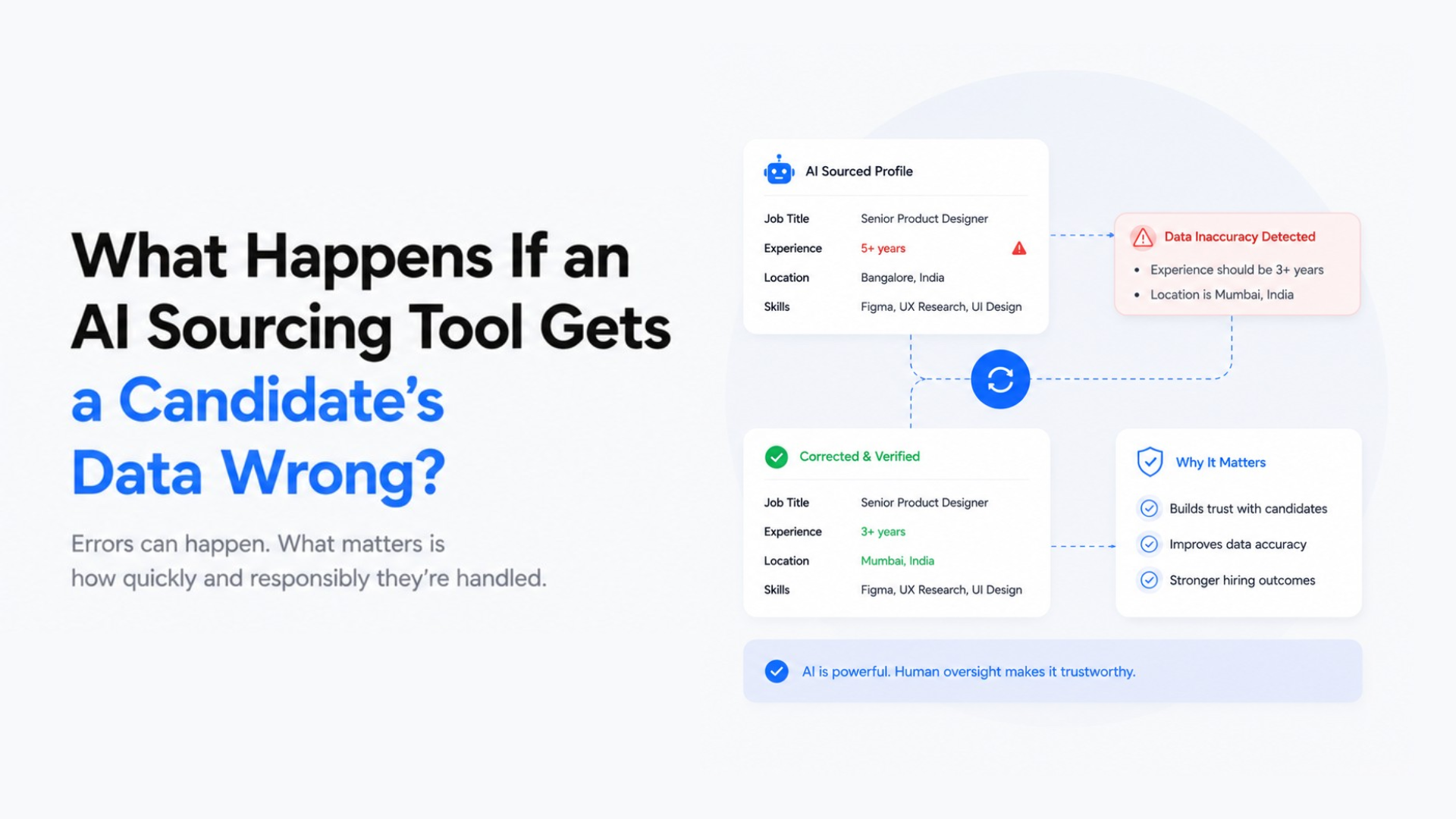
An AI sourcing tool finds a candidate who appears perfect for an open role.
The profile shows seven years of experience.
The candidate appears to work at a target company.
The system identifies several relevant skills.
A match score places the person near the top of the search results.
The AI generates personalized outreach explaining why the candidate’s current work appears connected with the opportunity.
There is one problem.
The information is wrong.
The candidate left the company two years ago.
One of the listed skills belongs to a previous team rather than the candidate.
The contact information is outdated.
The AI interpreted an old job title as a more senior position than it actually was.
The candidate who looked perfect may not be the candidate the system described.
This is not a theoretical problem unique to artificial intelligence.
Recruiting data has always contained errors.
Resumes become outdated.
Professional profiles are incomplete.
Job titles vary between companies.
Contact information changes.
Public sources disagree.
Recruiters write incorrect notes.
Candidates sometimes describe experience in ambiguous ways.
AI changes the scale and speed of the problem.
When an AI sourcing tool gets candidate data wrong, the immediate mistake can spread across the recruiting workflow. Incorrect information may influence candidate matching, contact enrichment, personalized outreach, screening questions, recruiter judgment, and future hiring decisions. The strongest systems therefore need more than large candidate databases. They need source visibility, confidence signals, correction workflows, human review, and safeguards that prevent uncertain information from becoming permanent candidate truth.
The most important question is not whether an AI sourcing platform will ever contain an error.
Every large candidate-data system will encounter incomplete, outdated, conflicting, or incorrect information.
The important question is what happens next.
Does the error remain one questionable data point?
Or does the system use it to create five additional conclusions?
That difference determines whether the technology helps recruiters manage uncertainty or simply automates misinformation.
Why Candidate Data Is Difficult to Keep Perfectly Accurate
Professional information changes constantly.
A candidate changes jobs.
They receive a promotion.
Their responsibilities expand.
They move to another city.
They learn a new skill.
A company changes its name.
A startup is acquired.
A work email stops functioning.
A candidate removes an old project from their public profile.
The information inside a sourcing database can become outdated even when it was correct when originally collected.
There is also a difference between incomplete information and incorrect information.
A candidate profile may not mention a skill.
That does not prove the candidate lacks it.
A resume may show a job title without explaining the scope of the role.
The title may be accurate while the system’s interpretation is wrong.
Different sources can also disagree.
One source may show that a candidate still works at a company.
Another may show a newer employer.
A professional profile may contain one location while a conference biography contains another.
The sourcing system needs to decide which information deserves greater confidence.
AI can help reconcile these signals.
It cannot make uncertainty disappear.
This is why candidate-data quality should not be understood as a binary choice between correct and incorrect.
Some information is directly observed.
Some is verified.
Some is outdated.
Some is inferred.
Some is uncertain.
A trustworthy sourcing system should preserve these differences.
The First Type of Error Is Outdated Information
Outdated employment information is one of the most common sourcing problems.
A candidate may have changed jobs several months ago.
The sourcing database still shows the previous employer.
This can affect several parts of the workflow.
The candidate may be included in a search because the recruiter specifically targeted professionals from the old company.
The AI may create a match explanation based on work the person no longer performs.
Contact enrichment may search for an email address at the previous employer.
The outreach message may mention the wrong current role.
The candidate immediately sees that the recruiter is working from stale information.
One old employment record has now affected discovery, matching, contact information, and communication.
This illustrates the central problem.
Data errors compound.
The sourcing platform should therefore pay attention to freshness.
When was the information last observed?
Are several sources consistent?
Is the employment status directly stated or inferred?
Has a newer signal appeared?
Recruiters do not need every candidate profile to update in real time.
They do need enough visibility to understand when important information may be stale.
The Second Type of Error Is Identity Confusion
Two professionals may have the same name.
They may work in the same industry.
They may even live in the same city.
A data system can accidentally connect information belonging to different people.
This is one of the more serious sourcing errors.
The wrong employer may be attached to the candidate.
The wrong education may appear.
A contact detail may belong to another person.
The AI may combine experience from two separate professional identities into one unusually strong profile.
The recruiter sees a candidate who does not actually exist.
Identity resolution is therefore a critical part of AI sourcing.
The system should use multiple signals.
Name alone is rarely enough.
Employer history can help.
Location can help.
Professional links can help.
Company domains can help.
Career chronology can help.
The stronger the agreement between independent signals, the greater the confidence in the identity match.
Huntlo’s guide to How Do AI Recruiting Tools Find Verified Contact Details? explains why candidate identity needs to be established before contact information can be treated as reliable.
A wrong identity creates more than a bad email.
It can create a false candidate record.
The Third Type of Error Is Skill Inference
AI sourcing tools increasingly try to understand more than explicit keywords.
This can improve search.
A candidate may have relevant experience without listing the exact skill the recruiter entered.
The system can identify related technologies, adjacent responsibilities, and transferable experience.
The same capability creates risk.
The AI may infer too much.
Suppose a candidate worked on a product that used machine learning.
The system may conclude that the candidate personally built machine-learning models.
They may have managed the product instead.
A professional may work at a company known for Kubernetes infrastructure.
The AI may assume the person has Kubernetes expertise.
Their actual role may have had no connection with infrastructure.
A candidate may have led a team that achieved a result.
The system may attribute every technical contribution directly to that individual.
These errors are subtle because the conclusion appears plausible.
The AI is not inventing information randomly.
It is making a connection that may be wrong.
This is why inferred skills should not be presented with the same certainty as directly stated experience.
The recruiter should be able to understand why the system believes the candidate has a capability.
The Fourth Type of Error Is Title Interpretation
Job titles are unreliable.
A Vice President at one company may manage hundreds of people.
A Vice President at another may be an individual contributor.
A Head of Product may own the complete product organization.
Another person with the same title may lead one small product area.
A software engineer may perform senior-level responsibilities without having the word senior in the title.
AI sourcing can improve traditional title search by using company context and career history.
It can also misunderstand the role.
A title may be interpreted as more senior than it was.
The system may underestimate a candidate because the title sounds junior.
The AI may assume two titles are equivalent when the actual responsibilities are very different.
A sourcing system should therefore avoid turning titles into facts about capability.
Titles are evidence.
They are not complete explanations.
Company size, career progression, responsibilities, projects, and other context may provide a stronger picture.
The Fifth Type of Error Is Wrong Contact Information
A sourcing tool may find the correct candidate and still provide the wrong contact route.
The email address may be outdated.
It may belong to another employee.
The candidate may have changed companies.
The domain may have changed.
The address pattern may have been guessed incorrectly.
The phone number may no longer belong to the person.
Contact errors create obvious operational problems.
Emails bounce.
Recruiters waste outreach capacity.
Sender reputation can be affected.
Another person may receive a message intended for the candidate.
The recruiter may assume the candidate ignored the opportunity when the message never reached them.
This is why contact discovery and contact verification should be treated as different processes.
Finding a possible address is not the same as establishing confidence that the address is usable.
A system should ideally use verification signals and communicate uncertainty rather than presenting every discovered contact as equally reliable.
For small recruiting teams, this distinction can have significant economic value. Huntlo’s guide to Can Small Agencies Afford Enterprise-Grade AI Sourcing Tools? explains why poor data quality can make an apparently affordable sourcing platform expensive through wasted recruiter time and unsuccessful outreach.
One Wrong Data Point Can Damage Candidate Matching
Candidate matching depends on input data.
If the inputs are wrong, the recommendation can also be wrong.
Suppose an AI sourcing tool incorrectly believes that a candidate has five years of cybersecurity experience.
The hiring requirement strongly prioritizes cybersecurity.
The candidate receives a high match score.
The recruiter spends time reviewing the profile.
Outreach begins.
The candidate replies that they have never worked in cybersecurity.
The matching model may have performed exactly as designed.
The underlying data was wrong.
This is an important distinction.
Recruiting teams often evaluate AI accuracy only at the model level.
Was the algorithm good at ranking candidates?
The complete system depends on data quality.
A highly sophisticated matching model cannot rescue incorrect candidate information.
Huntlo’s guide to How Does AI Candidate Matching Actually Work? explains why match scores should be treated as estimates built from several professional signals.
The quality of those signals matters as much as the intelligence of the matching model.
Incorrect Data Can Create Embarrassing Personalized Outreach
AI-personalized outreach is powerful because it can explain why a candidate appears relevant.
The same capability can make errors more visible.
A generic message may say that the recruiter found the candidate’s profile.
An AI-personalized message may congratulate the person on a role they left two years ago.
It may praise a project they never worked on.
It may describe expertise they do not have.
It may mention the wrong company.
The candidate immediately knows that the personalization is artificial.
The problem is not only that the message is inaccurate.
The recruiter appears careless.
AI personalization raises the standard for data quality because candidate information becomes visible inside the communication.
Huntlo’s guide to Do Candidates Respond Better to AI-Personalized Outreach? explains why relevance can improve candidate responses while inaccurate personalization can create the opposite effect.
The strongest outreach system should therefore prefer one high-confidence professional connection over several uncertain details.
More personalization is not always better.
Errors Can Spread Into Screening
The candidate responds.
The recruiting workflow continues.
If the original data remains uncorrected, the mistake can influence the next stage.
Suppose the sourcing system believes the candidate has managed a team of 50 people.
The AI screening workflow creates questions around large-team leadership.
The candidate spends time explaining that they never managed a team of that size.
The recruiter receives a screening summary.
The summary may say that the candidate lacks the expected leadership experience.
The candidate is now being evaluated against an expectation created by incorrect data.
The original sourcing error has become a screening disadvantage.
This is why connected recruiting systems need correction propagation.
When an important candidate fact changes, downstream stages should not continue using the old version.
A connected workflow is valuable because candidate context moves between stages.
The same connection can spread errors if the system does not manage corrections properly.
Wrong Data Can Influence Recruiter Judgment Even After Correction
The first information a recruiter sees can shape how they interpret everything that follows.
Suppose an AI system labels a candidate as highly relevant.
The recruiter may search for evidence that confirms the recommendation.
Another candidate receives a low match score because of incorrect information.
The recruiter may spend less time reviewing the profile.
Later, the data is corrected.
The original impression may remain.
This is one reason correction alone is not always enough.
The system should consider which downstream conclusions were based on the incorrect information.
Did the match score change?
Did the candidate ranking change?
Was outreach generated from the wrong fact?
Did screening criteria rely on it?
Were recruiter notes influenced?
A mature correction workflow should not only edit one field.
It should understand the consequences of the change.
The Difference Between a Fact and an AI Inference Matters
Candidate profiles increasingly contain several kinds of information.
A candidate may explicitly state that they work at a company.
That is one type of evidence.
A public source may report the same information.
That adds another signal.
The AI may infer that the candidate has a particular skill because of their role.
That is different.
The system may estimate that the person is senior enough for a role.
That is also different.
A recruiter should not see all of these items as equally certain.
The interface should ideally distinguish between direct data and system interpretation.
For example, “candidate lists Python on their profile” is different from “AI believes Python experience is likely based on previous work.”
The first statement can still be outdated.
The second contains an additional layer of uncertainty.
A trustworthy AI sourcing tool should not hide that distinction.
AI becomes more useful when it helps recruiters reason about evidence.
It becomes risky when it converts every possibility into a confident fact.
Confidence Scores Can Help, but They Are Not Proof
Some recruiting tools use confidence scores.
A contact detail may receive a high-confidence label.
A candidate match may receive a percentage.
An inferred skill may appear with a probability.
These signals can help recruiters prioritize.
They should not be mistaken for truth.
A 95% confidence score does not guarantee that the information is correct.
The recruiter should understand what the score represents.
Does it reflect agreement across several data sources?
Does it reflect a model prediction?
Does it reflect technical email verification?
Does it reflect similarity with other candidates?
The number is only useful when its meaning is clear.
False precision can be dangerous.
A score such as 87.4% looks scientific.
The underlying data may still be incomplete.
The strongest systems should use confidence to communicate uncertainty.
They should not use numbers to make uncertainty disappear.
Source Visibility Makes Errors Easier to Catch
A recruiter sees that a candidate has worked with a particular technology.
Where did the information come from?
If the system can show the source, the recruiter can evaluate it.
Perhaps the skill appears directly in the candidate’s professional profile.
Perhaps it came from a conference biography.
Perhaps the AI inferred it from the candidate’s employer.
These are different levels of evidence.
Source visibility also makes correction easier.
If the candidate says the information is wrong, the recruiting team can understand how the mistake entered the system.
Without source visibility, every correction becomes a mystery.
The company knows the output was wrong.
It does not know why.
This makes the same error more likely to happen again.
AI sourcing platforms should therefore aim for traceability where practical.
The recruiter does not need a technical log of every model operation.
They do need enough context to understand important candidate claims.
What Should Happen When a Recruiter Finds an Error?
The first step should be correction.
The recruiter should be able to update the candidate record.
The second step should be propagation.
The corrected information should influence relevant downstream processes.
The match score may need to be recalculated.
The candidate ranking may change.
Future outreach should stop using the incorrect detail.
Screening context may need to update.
The third step should be provenance review.
Where did the wrong information come from?
Was the source outdated?
Was the identity match wrong?
Was the AI inference too aggressive?
Was the data entered manually?
The fourth step should be prevention.
Can the system reduce the chance of repeating the same mistake?
A correction workflow should improve the individual candidate record.
A stronger system also learns operationally from the type of error.
What Should Happen When the Candidate Finds the Error?
The situation becomes more important when the candidate notices incorrect information.
The person may say that the recruiter has the wrong employer.
They may correct a job title.
They may explain that an email address is outdated.
They may challenge an inaccurate candidate profile.
The recruiting team should not argue with the database.
The candidate is often the strongest source for their own current professional information.
The company should have a clear way to receive and process corrections.
Depending on the applicable privacy framework and circumstances, legal rights may also be relevant.
Under the GDPR, accuracy is a data-protection principle, and individuals have a right to seek rectification of inaccurate personal data. The European Commission similarly explains that people can ask for incorrect, inaccurate, or incomplete personal data to be corrected.
India’s Digital Personal Data Protection framework also provides rights around correction, completion, updating, and erasure of personal data within the statutory framework.
The operational lesson is useful even outside a specific legal obligation.
A correction request should be treated as a data-quality event.
Data Accuracy Is Also a Privacy Issue
Recruiting teams sometimes separate privacy and data quality.
Privacy is treated as a legal issue.
Accuracy is treated as a product issue.
The two overlap.
Incorrect personal data can affect the person.
A wrong employer may create inappropriate outreach.
A false skill may influence a screening decision.
An incorrect contact detail may expose recruiting communication to someone else.
A mistaken identity may combine information from different people.
The GDPR’s data-protection principles include accuracy, and its right to rectification provides a route for correcting inaccurate personal data.
India’s DPDP framework also recognizes correction and updating rights, while the final DPDP Rules were notified in November 2025 as part of the framework’s implementation.
Recruiting teams should therefore avoid treating candidate-data correction as a customer-support inconvenience.
The ability to identify and correct important errors is part of responsible data governance.
AI-Generated Opinions Can Also Be Wrong
A candidate’s employer can be objectively incorrect.
AI-generated recommendations create a more difficult problem.
Suppose the system says the candidate is a weak match.
Is that personal data?
Is it an opinion?
Can it be corrected?
The answer depends on the context and applicable law, but the operational problem remains.
An AI recommendation may be based on wrong facts.
The candidate may have relevant experience that the system missed.
The job requirement may have been interpreted incorrectly.
The model may overvalue one criterion.
Recruiting teams should not hide behind the idea that a score is merely an opinion.
The underlying evidence should still be examined.
If the system says the candidate lacks a skill because the profile did not mention it, the recruiter should understand the difference between “not found” and “does not exist.”
This distinction is essential.
Absence of evidence is not always evidence of absence.
AI Sourcing Tools Should Avoid Permanent Candidate Labels
A candidate may be a weak match for one role.
That does not make them a weak candidate.
A person may lack one requirement today.
That may change.
A candidate may have been incorrectly scored because the available information was incomplete.
Permanent labels can create long-term problems.
“Not qualified.”
“Low quality.”
“Poor communicator.”
“Not senior enough.”
These classifications may follow the candidate into future searches.
The next recruiter may trust the old conclusion without reviewing the original context.
A stronger system should keep recommendations connected with the specific role and evidence.
The candidate was a low match for this requirement at this time based on the available information.
That is different from saying the person is permanently low quality.
Context protects both accuracy and fairness.
Errors Become More Dangerous in Automated Workflows
Manual recruiting contains natural friction.
A recruiter sees the candidate.
They review the profile.
They decide whether to contact the person.
They conduct a screen.
Several human checkpoints exist.
Automation can remove these checkpoints.
The AI finds the candidate.
The system enriches the contact.
Outreach begins.
A response triggers screening.
A score determines the next action.
The workflow becomes faster.
A data error can now travel further before anyone notices.
This does not mean automation is inherently less safe.
It means automated systems need explicit controls.
Which actions can happen automatically?
Which data requires higher confidence?
When should uncertainty trigger review?
What happens when sources disagree?
Which decisions should remain human?
The faster the workflow, the more important these questions become.
The NIST AI Risk Management Framework provides a broader model for identifying and managing AI risks over time rather than assuming a system remains trustworthy simply because it performed well once.
For recruiting teams, the principle is practical.
Data quality needs continuous monitoring.
More Data Does Not Automatically Create More Accuracy
A sourcing platform may collect information from many sources.
This can improve coverage.
It can also create contradictions.
One source shows the candidate at Company A.
Another shows Company B.
A third has not been updated in three years.
The system needs a method for resolving conflict.
Simply collecting more information does not solve the problem.
The platform should consider freshness.
It should consider source reliability.
It should consider agreement across independent signals.
It should preserve uncertainty when the evidence is unclear.
Recruiting vendors often compete on database size.
Accuracy requires a different set of capabilities.
Identity resolution.
Freshness.
Verification.
Provenance.
Correction.
Confidence.
The biggest database is not automatically the most trustworthy database.
Recruiters Should Verify High-Impact Facts Before Acting
Not every candidate data point deserves the same level of verification.
A minor outdated skill may have little consequence.
A wrong identity is serious.
A contact detail should have enough confidence before outreach.
A mandatory qualification should be verified before rejection.
A claim that strongly affects candidate ranking deserves greater scrutiny.
The level of verification should match the consequence.
This is a useful principle for AI recruiting.
Low-impact actions can tolerate more uncertainty.
High-impact decisions require stronger evidence.
The recruiter does not need to manually verify every fact about every candidate.
The workflow should identify where errors matter most.
Candidate Matching Should Show Reasons, Not Only Scores
A recruiter sees a candidate with a 91% match.
The number is difficult to challenge.
A stronger system explains why.
The candidate has relevant industry experience.
They have worked at the required scale.
Two core skills appear in the profile.
One preferred qualification is uncertain.
The recruiter can now inspect the recommendation.
If one important fact is wrong, the problem becomes visible.
Explainability therefore supports data-quality control.
It is not only an AI ethics feature.
A score hides errors.
Reasons expose them.
This is especially important for unusual candidates.
A non-traditional career path may not produce a perfect score.
The recruiter may still see strong evidence worth reviewing.
AI should help direct attention.
It should not make candidate data harder to question.
Wrong Data Can Affect Diversity and Fairness
Data-quality errors are not always distributed evenly.
Some candidates have highly detailed professional profiles.
Others have limited public information.
Some industries use standardized titles.
Others do not.
Some career paths are easy for AI systems to interpret.
Others are less conventional.
Candidates with incomplete data may receive weaker match scores.
Professionals returning from career breaks may appear outdated.
People moving between industries may have transferable skills that are not obvious from titles.
International job titles may be interpreted incorrectly.
The system may therefore be more accurate for some candidate groups than others.
This creates a fairness question.
Recruiting teams should not evaluate only average accuracy.
They should examine where the system fails.
Which profiles are frequently misunderstood?
Which candidates require more manual correction?
Which career patterns produce weak recommendations?
The most important AI errors may be systematic rather than random.
A Correction Should Not Become Another Unverified Fact
Recruiters can also enter incorrect information.
A candidate says something during a call.
The recruiter misunderstands.
The note becomes part of the profile.
Another recruiter sees the note later.
Human-entered corrections should therefore also preserve accountability.
Who changed the information?
Why?
Was the update based on the candidate’s statement?
Was it based on a verified source?
The goal is not to make every profile impossible to edit.
The goal is to preserve enough context for important changes.
Candidate data quality is a shared responsibility between systems and people.
AI is not the only source of error.
How Connected Recruiting Systems Can Handle Corrections Better
A fragmented recruiting stack creates a difficult correction problem.
The candidate exists in the sourcing tool.
A copy exists in the CRM.
Another copy exists in the outreach platform.
Screening data exists somewhere else.
The recruiter corrects the sourcing profile.
The other systems remain wrong.
A connected workflow can reduce this problem.
The candidate can remain one continuous record across discovery, engagement, qualification, and interview progression.
An important correction can influence later stages.
This is one reason Huntlo’s guide to How Does an AI Hiring OS Connect Sourcing, Screening, and Interviews? matters to data quality.
Connection can improve correction propagation.
It can also amplify errors.
The system architecture is not enough.
The workflow needs rules for how candidate information is updated and reused.
Where Huntlo Fits Into Candidate Data Accuracy
Huntlo approaches recruiting as a connected workflow across candidate discovery, matching, engagement, screening, and interview progression.
Data quality matters at every stage.
A sourcing result should not be valuable simply because the candidate appears in the database.
The professional evidence needs to support the hiring requirement.
Candidate matching should help explain why a person appears relevant.
Contact information should be treated according to the confidence available.
Personalized outreach should be grounded in credible professional context.
Candidate responses should be able to update what the system knows.
Screening should collect new evidence rather than blindly repeating assumptions from the sourcing stage.
Recruiters should remain able to review important information.
For teams evaluating Huntlo or any other AI sourcing platform, the right questions are practical.
Where does candidate information come from?
How fresh is it?
How does the system handle conflicting sources?
Which data is directly observed and which is inferred?
How are contact details verified?
Can recruiters correct errors?
Do corrections affect downstream workflows?
Can AI recommendations be traced back to evidence?
What happens when the system is uncertain?
No responsible sourcing platform should promise perfect candidate data.
The stronger promise is a workflow that manages uncertainty well.
What Recruiting Teams Should Ask AI Sourcing Vendors
Recruiting teams should begin with provenance.
Can the vendor explain where important candidate information comes from?
The next question is freshness.
How does the system identify outdated professional data?
Identity resolution matters.
How does the platform avoid combining information from different people?
The team should ask about inference.
Which candidate attributes are directly sourced and which are predicted?
Contact quality should be examined.
How are email addresses or other contact routes verified?
Correction workflows matter.
Can recruiters update incorrect information?
Candidate corrections matter too.
How can the organization respond when a person challenges inaccurate data?
Downstream effects should be clear.
Does correcting one fact recalculate matching or stop future outreach from using the old information?
The vendor should also explain uncertainty.
Does the platform communicate confidence, or does every data point appear equally certain?
A large candidate database is easy to market.
Error handling reveals more about product maturity.
How Recruiting Teams Should Respond to a Serious Data Error
The first step is to stop relying on the incorrect information.
If automated outreach is using the data, the relevant sequence may need to pause.
If screening is based on the error, the candidate should not be disadvantaged by the incorrect assumption.
The second step is to correct the record.
The third is to identify where the information has already traveled.
Was it exported?
Was it added to a CRM?
Did it influence a match score?
Did it appear in recruiter notes?
The fourth step is to examine the source of the problem.
Was it outdated data?
Identity confusion?
A model inference?
Manual entry?
The fifth step is to improve the workflow.
A serious error should produce learning.
Otherwise, the system will repeat the same pattern with another candidate.
Common Mistakes When Candidate Data Is Wrong
The first mistake is assuming that AI-generated information is more accurate than human-entered information.
The second is treating every candidate attribute as equally certain.
The third is confusing an inferred skill with a confirmed skill.
The fourth is assuming that a missing skill means the candidate does not have it.
The fifth is allowing outdated employment data to drive personalized outreach.
The sixth is using unverified contact information at scale.
The seventh is correcting one profile field without updating downstream recommendations.
The eighth is allowing old candidate labels to influence future roles.
The ninth is ignoring candidate corrections because the database says something different.
The tenth is measuring database size while ignoring freshness and identity accuracy.
The eleventh is hiding candidate matching behind one unexplained score.
The final mistake is expecting zero errors.
The stronger objective is fast detection, clear correction, limited propagation, and better future prevention.
Can AI Help Correct Its Own Data Errors?
Potentially.
AI can compare several sources.
It can identify contradictions.
It can detect impossible career timelines.
It can flag unusual changes.
It can notice that a work email domain no longer matches the current employer.
It can identify when a candidate’s latest information conflicts with an older record.
The system can then request review.
This is a better use of AI than pretending uncertainty does not exist.
AI can help manage candidate-data quality.
The technology should not be the final authority over its own accuracy.
Independent signals, recruiter review, candidate input, and correction workflows remain important.
The strongest system is not one that never expresses doubt.
It is one that knows when doubt matters.
Conclusion: The Real Risk Is Not One Wrong Fact but What the System Does With It
An AI sourcing tool will sometimes encounter wrong candidate data.
The candidate may have changed jobs.
A public source may be outdated.
Two identities may be confused.
A skill may be inferred incorrectly.
A contact detail may no longer work.
A title may be misunderstood.
The existence of an error does not automatically make the sourcing system useless.
The real question is what happens after the error enters the workflow.
Does it create a false match score?
Does it produce inaccurate personalized outreach?
Does it influence screening questions?
Does it affect recruiter judgment?
Does it remain attached to the candidate for future roles?
One wrong fact becomes dangerous when the system repeatedly treats it as truth.
Responsible AI sourcing therefore needs more than candidate coverage.
It needs data freshness.
It needs identity resolution.
It needs verification.
It needs source visibility.
It needs confidence.
It needs correction.
It needs downstream updates.
It needs human judgment.
The strongest recruiting systems should also understand that candidate data is not static.
People change jobs.
They gain skills.
They change direction.
Their professional story cannot be reduced to one permanent database record.
AI can help recruiters understand more candidates faster.
It should also make uncertainty easier to see.
The objective is not a system that claims perfect knowledge about every professional.
The objective is a system that uses the best available evidence, shows recruiters why it reached a conclusion, allows important mistakes to be corrected, and prevents one error from deciding the candidate’s complete journey.
That is the standard reliable AI sourcing should meet.
Frequently Asked Questions
Can AI sourcing tools have incorrect candidate data?
Yes. Candidate information can be outdated, incomplete, incorrectly matched, or inferred inaccurately. No large professional database should be assumed to be perfectly accurate.
What is the most common AI sourcing data error?
Outdated employment information, incorrect contact details, identity confusion, skill inference, and title interpretation are common categories of error.
Can wrong candidate data affect AI matching?
Yes. Candidate matching depends on input information. Incorrect skills, employers, seniority, or experience can create misleading rankings and recommendations.
What happens if AI-personalized outreach uses wrong information?
The message may mention an old employer, incorrect skill, or project the candidate never worked on. This can damage recruiter credibility and reduce candidate trust.
Should candidates be able to correct recruiting data?
Organizations should have practical correction processes. Depending on the applicable legal framework and circumstances, candidates may also have rights related to correction or rectification of personal data.
Does GDPR require candidate data to be accurate?
GDPR includes accuracy as a data-protection principle, and individuals have a right to seek rectification of inaccurate personal data.
Does India’s DPDP framework allow people to correct personal data?
Yes. The DPDP framework provides rights related to correction, completion, updating, and erasure within its statutory requirements.
Are AI confidence scores proof that candidate data is correct?
No. Confidence scores can help communicate uncertainty, but they do not guarantee that information is accurate.
Should recruiters verify every candidate data point manually?
Not necessarily. Verification effort should be proportional to the consequence. High-impact facts and decisions deserve stronger evidence.
What should happen after a candidate profile is corrected?
Relevant downstream processes should also update. This may include match scores, candidate rankings, outreach personalization, screening context, and future recommendations.
Related Topics
Learn how candidate recommendations are created from professional evidence in How Does AI Candidate Matching Actually Work?.
Understand how identity matching and verification affect candidate contact quality in How Do AI Recruiting Tools Find Verified Contact Details?.
Explore how incorrect candidate information can affect outreach relevance in Do Candidates Respond Better to AI-Personalized Outreach?.