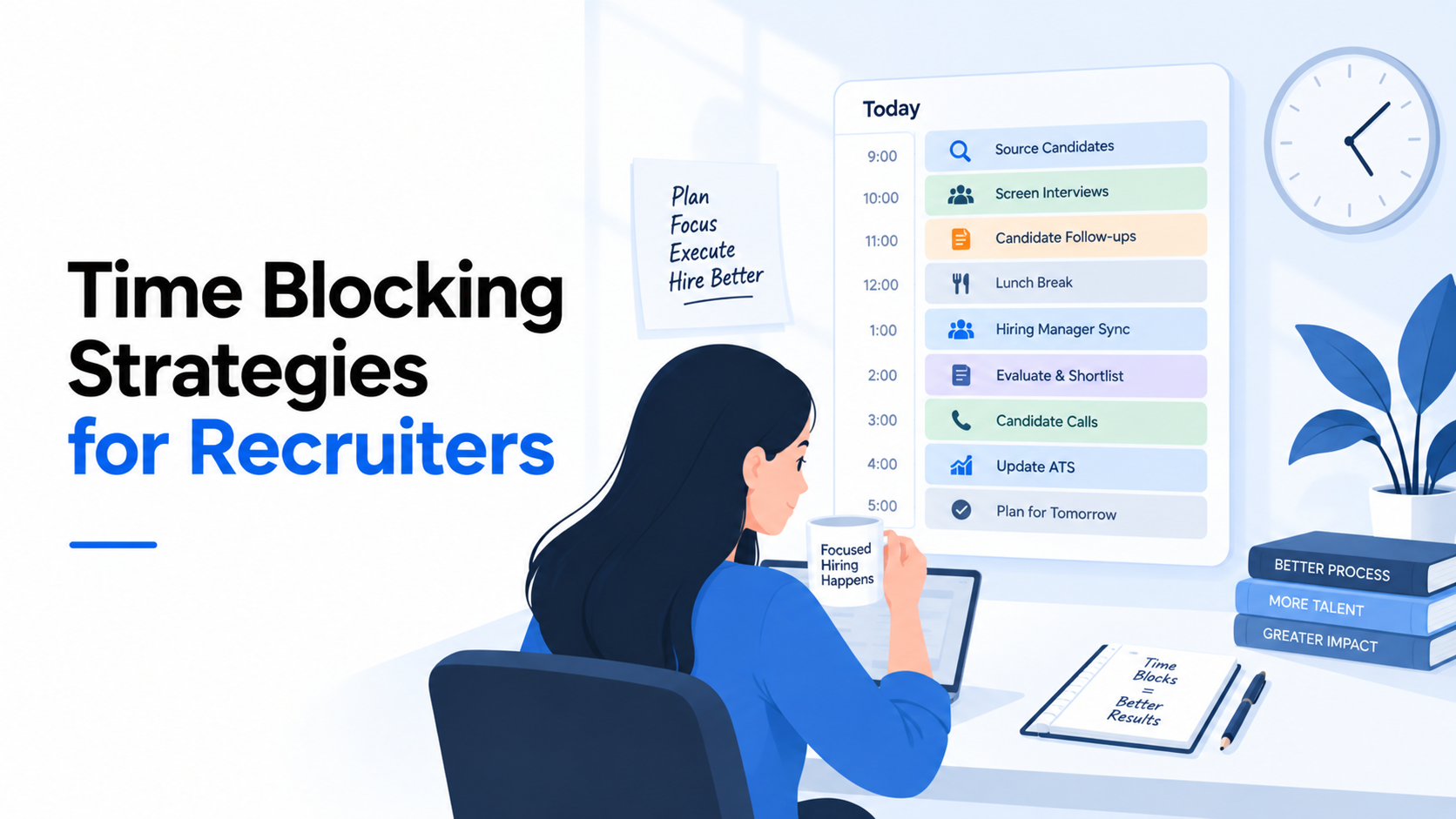
The modern recruiter's calendar is a war zone. Interviews are scattered across the day. Hiring managers drop meeting requests with no notice. Urgent emails arrive every ten minutes. And somewhere in the chaos, the recruiter is supposed to find time to source passive candidates, evaluate applications, and build relationships with people who might change companies if the right conversation happens at the right moment.
This chaos is not inevitable. It is the result of a calendar that reacts to incoming demands rather than protecting the work that matters most. Time blocking is the practice of dividing the day into dedicated segments for specific types of work, and it is the single most effective tool for reclaiming focus in a role that is designed to fragment it.
The research on context switching is unambiguous. According to a study from the University of California, Irvine, it takes an average of 23 minutes to return to full focus after an interruption. For a recruiter who switches tasks every 15 minutes, full focus is never achieved. The work gets done, but it gets done shallowly. Resumes are scanned, not evaluated. Outreach messages are sent, but not crafted with the personalization that gets responses. Screening calls are completed, but the recruiter is already thinking about the next fire before the current conversation is finished.
The problem is compounded by volume. According to Greenhouse's 2026 Hiring Benchmarks Report, applications per recruiter have surged from 146 in 2022 to 746 in 2025, a 411% increase. Meanwhile, recruiter headcount has dropped 56%. The same person who managed a manageable portfolio in 2022 now juggles three times as many requisitions with half as much support. Without deliberate time management, the recruiter's day becomes a series of reactive sprints that never add up to meaningful progress.
Time blocking does not solve the volume problem. But it makes the volume manageable by ensuring that the most important work gets protected time, that similar tasks are batched to reduce switching costs, and that the calendar reflects priorities rather than just demands.
The Morning Sourcing Block
The first principle of time blocking for recruiters is to protect the morning for sourcing. This is when energy is highest, distractions are lowest, and the creative work of finding and engaging passive candidates is most effective. Sourcing is not administrative work. It is strategic work that requires research, personalization, and judgment. It deserves the best hours of the day.
A typical morning sourcing block runs from 9:00 AM to 12:00 PM. During this block, the recruiter does not check email. They do not take meetings. They do not respond to Slack messages. They source. They research candidates on professional networks and technical communities. They craft personalized outreach messages that reference specific work and demonstrate genuine understanding. They review pipeline health and plan follow-up sequences.
According to Bullhorn's GRID 2025 research cited by StaffingHub, AI and automation can give recruiters up to 17 hours back per week. But those hours are only valuable if they are used for work that automation cannot do. Sourcing is that work. A recruiter who spends three focused hours every morning on proactive candidate discovery will build a pipeline that reactive recruiters cannot match.
The key to making this block work is to treat it as non-negotiable. Block it on the calendar. Mark it as busy. Turn off notifications. And communicate to the team that this time is protected. The first few weeks will feel uncomfortable. Urgent requests will pile up. But over time, the team will adapt, and the recruiter will discover that most urgent requests are not actually urgent. They just feel urgent because they are loud.
The Afternoon Coordination Block
If the morning is for proactive work, the afternoon is for reactive work. This is when emails are answered, meetings are held, scheduling is coordinated, and hiring managers are updated. The afternoon coordination block runs from 1:00 PM to 4:00 PM, and it is designed to contain the administrative and interactive work that otherwise fragments the entire day.
The principle here is batching. Similar tasks are grouped together and completed in a single session rather than scattered across the day. All emails are answered at once, not one at a time as they arrive. All scheduling is handled in a single session, not in a dozen separate back-and-forths. All hiring manager updates are prepared and delivered together, not ad-hoc throughout the day.
Batching reduces the cognitive cost of context switching. When a recruiter answers one email, they must orient themselves to that thread, recall the history, compose a response, and then switch to something completely different. When they answer twenty emails in a single session, they stay in email mode. The mental setup cost is paid once, not twenty times.
According to Pin's 2026 recruitment funnel benchmarks, only 6% of job views become applications, and only 3% of applicants get interviews. The recruiter's job is to move the right candidates through this narrow funnel, and that requires sustained attention to pipeline management. Batching coordination work into a defined afternoon block ensures that pipeline management happens every day, not just when the recruiter remembers.
The Deep Work Protection Rule
The most important time blocking strategy is not about how time is allocated. It is about how time is protected. Deep work — the sustained, focused effort that produces high-quality outcomes — requires protection from interruption. And interruption is the default state of modern recruiting.
The deep work protection rule is simple: no meetings, no emails, no Slack, no notifications during blocked focus time. This sounds radical in a culture of constant availability. But it is essential for work that requires judgment.
Sourcing requires deep work. A recruiter who is scanning LinkedIn while checking email is not sourcing. They are browsing. The difference is the difference between finding a candidate who matches a nuanced profile and missing them because the search was superficial. Screening requires deep work. A structured screening conversation that probes capability and motivation requires full attention. A screening call taken while answering emails is a waste of both the recruiter's time and the candidate's.
According to Cal Newport's research on deep work, knowledge workers who protect focused time produce more and better output than those who work longer hours in a fragmented state. The recruiter who works six focused hours will outperform the recruiter who works ten fragmented hours. The math is not about hours. It is about attention quality.
The practical implementation is to use calendar settings that mark focus blocks as busy, to set status messages that communicate unavailability, and to use technology that blocks distracting websites and notifications during focus time. The first week will feel uncomfortable. The second week will feel liberating. By the third week, the recruiter will wonder how they ever worked any other way.
The Weekly Review Ritual
Time blocking is not a set-it-and-forget-it system. It requires regular review and adjustment. The weekly review ritual is a dedicated block, typically Friday afternoon, for reflecting on the week, planning the next, and improving the system.
The ritual has three parts. First, review the week's calendar. Did the blocks happen as planned? Where did the schedule break down? What interruptions were legitimate, and which could have been prevented? This is not self-criticism. It is data collection. The goal is to understand where the system leaks so it can be patched.
Second, plan the next week's blocks. Look at the hiring pipeline. Which roles need sourcing attention? Which candidates need follow-up? Which interviews need coordination? Allocate the morning sourcing blocks to the highest-priority activities. Schedule the afternoon coordination blocks around known meetings and deadlines. Protect at least one deep work block for strategic work that does not fit the daily rhythm.
Third, improve the system. Based on the week's experience, adjust the block structure. Maybe the morning sourcing block needs to start earlier to avoid East Coast hiring manager requests. Maybe the afternoon coordination block needs to be split into two shorter sessions to accommodate different time zones. Maybe a new type of block is needed for interview debriefs, which require both focus and group coordination.
According to David Allen's Getting Things Done methodology, the weekly review is the most important practice for maintaining productivity systems. Without it, the system degrades. Tasks slip through cracks. Priorities drift. And the calendar reverts to reactive mode. The weekly review is what keeps time blocking alive.
The Energy Management Dimension
Time blocking is not just about scheduling tasks. It is about aligning work with energy. Recruiting requires different types of energy at different times. Sourcing requires creative energy. Screening requires interpersonal energy. Coordination requires administrative energy. Scheduling requires all three in the wrong order.
The energy-aware time block matches work type to energy state. Morning blocks, when cognitive energy is highest, are for sourcing and strategic evaluation. Midday blocks, when social energy peaks, are for screening calls and hiring manager meetings. Afternoon blocks, when administrative tolerance is highest, are for scheduling, data entry, and email.
This alignment is personal. Some recruiters are night owls who do their best sourcing at 10:00 PM. Some are early birds who prefer 6:00 AM. The principle is not the specific schedule. It is the match between work type and energy state. A recruiter who schedules screening calls during their afternoon slump will have worse conversations, make poorer evaluations, and damage candidate experience. A recruiter who aligns calls with their peak interpersonal energy will have richer conversations, better evaluations, and stronger relationships.
According to Daniel Pink's research on chronotypes, most people experience a peak, a trough, and a recovery in their daily energy cycle. The peak is for analytic work. The trough is for administrative work. The recovery is for creative work. Recruiters who understand their own chronotype can design blocks that match their natural rhythms rather than fighting them.
The Team Synchronization Block
Individual time blocking is powerful, but recruiting is a team sport. The recruiter works with sourcers, coordinators, hiring managers, and interviewers. If everyone blocks time independently, the team becomes a collection of individuals who never meet. If nobody blocks time, the team is constantly interrupting each other.
The solution is a team synchronization block. This is a defined window, typically mid-morning or early afternoon, when the entire recruiting team is available for real-time collaboration. During this window, debriefs happen, escalations are handled, and quick questions are answered. Outside this window, everyone is in focus mode.
The synchronization block serves two purposes. It concentrates interactive work into a defined period, reducing the random interruptions that fragment individual focus time. And it creates a predictable rhythm that the rest of the organization can rely on. Hiring managers know that recruiter questions will be answered during the sync window, not instantly. Interviewers know that debriefs will be scheduled during that window, not scattered across their calendars.
According to Pin's research on recruiting team structure, coordinators manage 27 openings at peak, nearly double a recruiter's load, because their work is per-touch, not per-search. The synchronization block is particularly valuable for coordinators, who need real-time access to recruiters and hiring managers to resolve scheduling conflicts and candidate questions. Without a defined window, coordinators are constantly chasing people. With a defined window, coordination becomes efficient.
The Boundary Between Work and Recovery
The final time blocking strategy is not about work. It is about not working. Recruiting is a relationship business, and relationships do not respect business hours. Candidates respond to emails at 9:00 PM. Hiring managers send urgent requests on Saturday. The boundary between work and personal time is constantly under assault.
Without deliberate boundaries, recruiters burn out. They answer emails at dinner. They schedule calls during their child's bedtime. They wake up at 3:00 AM worried about a candidate who has gone cold. The work expands to fill all available time, and the recruiter's energy, judgment, and relationships suffer.
The boundary strategy is to define work blocks and non-work blocks with equal clarity. The workday ends at a specific time. After that, the recruiter does not check email, respond to messages, or schedule calls. The phone goes on do not disturb. The laptop stays closed. The time is protected for recovery, relationships, and sleep.
This sounds impossible in a culture of constant availability. But it is essential for sustainable performance. A recruiter who works 12 hours a day, seven days a week, will make worse decisions than a recruiter who works 8 focused hours and recovers fully. The research on sleep, decision fatigue, and burnout is clear: recovery is not a luxury. It is a performance requirement.
According to the American Psychological Association's research on burnout, chronic work stress without adequate recovery leads to emotional exhaustion, reduced performance, and detachment from work. In recruiting, this manifests as rushed evaluations, impersonal outreach, and poor candidate experience. The recruiter who protects recovery time is not slacking. They are preserving the capacity for high-quality work.
The Bottom Line
Time blocking is not a productivity hack. It is a system design choice that recognizes the reality of modern recruiting: too much work, too many interruptions, and too little time for the activities that actually produce hires. The recruiter who blocks time deliberately does not get more hours in the day. They get more value from the hours they have.
The morning sourcing block protects the proactive work that builds pipelines. The afternoon coordination block contains the reactive work that otherwise fragments the day. The deep work protection rule ensures that judgment-intensive tasks get the focus they require. The weekly review ritual keeps the system improving. The energy management dimension matches work to capacity. The team synchronization block enables collaboration without constant interruption. And the boundary between work and recovery preserves the recruiter's capacity for sustained performance.
The teams that implement these strategies do not just work more efficiently. They work more sustainably. They make better hires. They build stronger relationships. And they avoid the burnout that destroys recruiting careers. Time blocking is not about doing more. It is about doing what matters, when it matters, with the full attention it deserves.