Most hiring failures are not dramatic. They are quiet. A step skipped here. A handoff missed there. A decision made without the right context. By the time the failure is visible — a bad hire, a missed deadline, a withdrawn offer — the root cause is buried under ten subsequent decisions that all seemed reasonable at the time.
A checklist does not prevent every failure. But it prevents the predictable ones. It ensures that the steps that matter are not forgotten, that the handoffs that create risk are explicit, and that the decisions that shape outcomes are made with the right information at the right time.
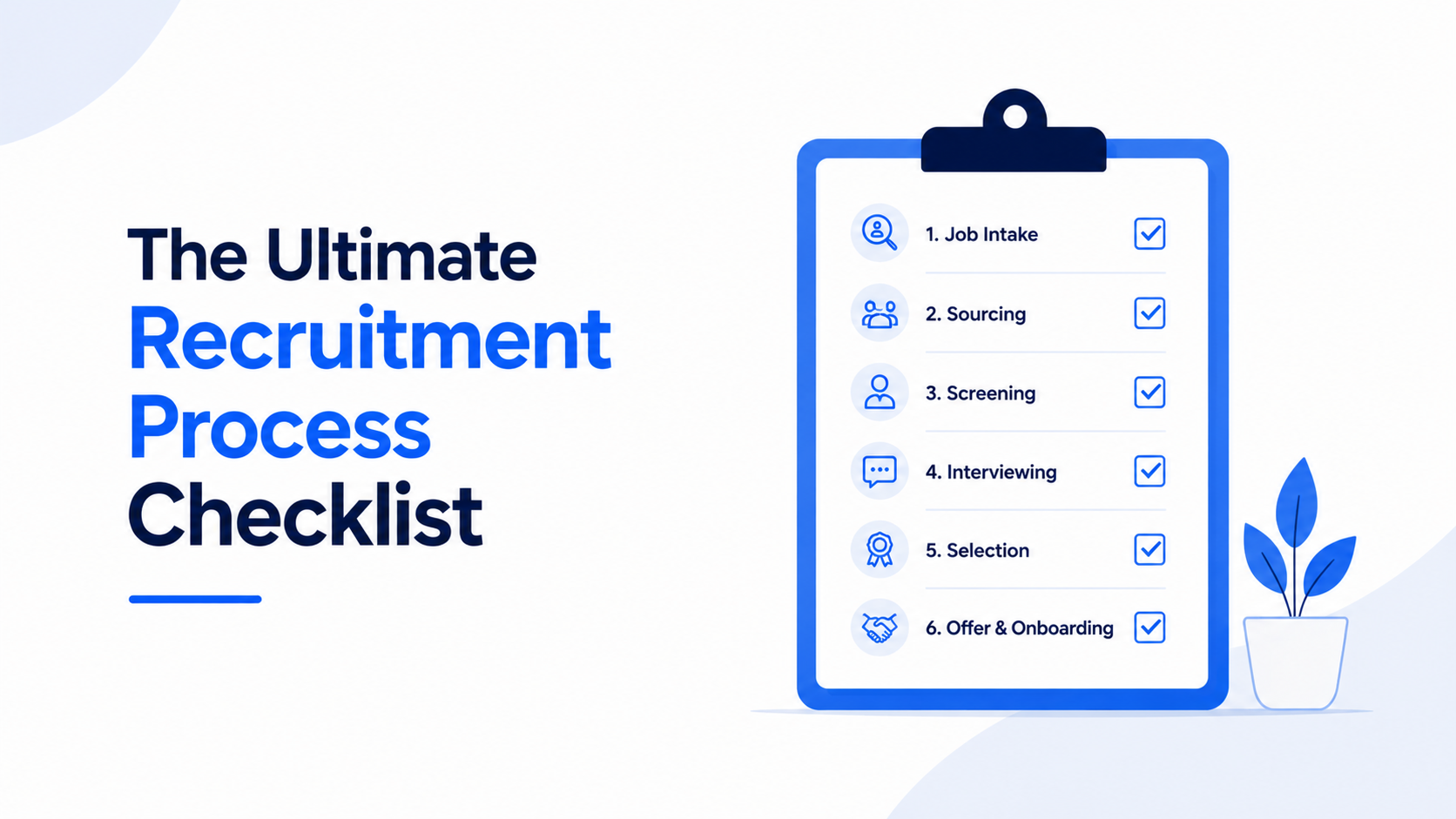
This checklist covers the full recruitment lifecycle from requisition to onboarding. It is designed to be used in two ways: as an audit tool to identify gaps in your current process, and as a implementation guide to build a standardized system that delivers consistent results.
Phase One: Intake and Planning
The intake phase is where hiring outcomes are determined. A poorly defined role will produce poor candidates no matter how good the sourcing, screening, and interviewing. This phase is also where most teams rush, because the hiring manager is impatient and the recruiter is eager to start searching.
Define the Role
[ ] Document the business need. Why is this role being opened now? What problem will this person solve? What happens if the role is not filled?
[ ] Define the scope. What will this person own? What are the boundaries of their responsibility? What is explicitly not their job?
[ ] Identify the essential skills. What capabilities are non-negotiable? What can be learned on the job? Distinguish between must-haves and nice-to-haves.
[ ] Set the seniority level. What level of independence, judgment, and leadership is required? How does this map to your internal leveling framework?
[ ] Determine the compensation band. What is the target salary? What is the range? How does this compare to internal peers and market data?
[ ] Define the start date. When does this person need to be productive? Work backwards to set milestones for each hiring stage.
Align the Hiring Team
[ ] Identify the hiring manager. Who will this person report to? Who makes the final hiring decision?
[ ] Assign the recruiter. Who owns candidate sourcing, screening, and pipeline management?
[ ] Select the interview panel. Who will evaluate candidates? What perspective does each interviewer bring? Avoid panels larger than four people.
[ ] Schedule the intake meeting. Bring together the hiring manager, recruiter, and key stakeholders to align on role definition, evaluation criteria, and process timeline.
[ ] Create the scorecard. Define the specific criteria each interviewer will evaluate. Use behavioral indicators, not vague traits like culture fit or communication skills.
Prepare the Requisition
[ ] Write the job description. Focus on outcomes, not requirements. Describe what the person will do, not just what they need to have done.
[ ] Post the role internally. Give existing employees the first opportunity to apply or refer. This also surfaces internal candidates who may be ready for promotion.
[ ] Open the requisition in the ATS. Ensure all required fields are complete: title, level, compensation band, start date, hiring manager, and interview panel.
[ ] Set up the hiring workflow in the ATS. Define the stages, the criteria for advancing, and the automatic triggers for each step.
Phase Two: Sourcing and Outreach
Sourcing is where the talent pool is created. Most teams underinvest here, relying on inbound applications rather than proactive candidate discovery. The result is a shallow pool of active candidates who may not be the best fit.
Build the Sourcing Strategy
[ ] Define the target profile. What companies employ people with relevant experience? What adjacent titles should be considered? What industries create transferable skills?
[ ] Select the sourcing channels. Which platforms will you use? How will you allocate effort across channels? Consider professional networks, technical communities, employee referrals, industry events, and internal talent pools.
[ ] Set the sourcing targets. How many candidates need to be contacted to generate one hire? Use historical conversion data to set realistic targets.
Execute Sourcing
[ ] Search for candidates. Use semantic search, not just keyword matching. Look for evidence of capability, not just credential alignment.
[ ] Evaluate profiles against the scorecard. Does this person have the essential skills? Is there evidence of the required experience? Would they be a credible fit?
[ ] Prioritize candidates. Rank by likelihood of fit, interest, and availability. Focus effort on the highest-potential candidates first.
Conduct Outreach
[ ] Personalize every message. Reference specific work, achievements, or context that demonstrates genuine research. Avoid template language.
[ ] Explain why the role matters. Connect the opportunity to the candidate's career trajectory. Make it clear why this conversation is worth their time.
[ ] Provide enough information. Include role scope, company context, and next steps. Vague messages get ignored.
[ ] Track response rates by channel, message type, and candidate segment. Use this data to optimize future outreach.
Manage the Pipeline
[ ] Log every touchpoint in the ATS. Ensure candidate records are complete and up to date.
[ ] Follow up on non-responses. Set a cadence for follow-up messages. Know when to stop.
[ ] Nurture interested but not-ready candidates. Maintain relationships with people who are relevant but not available now. Schedule future check-ins.
Phase Three: Screening and Evaluation
Screening is where the talent pool is narrowed. Most teams rush this phase, using resume review as a proxy for capability evaluation. The result is false negatives — great candidates rejected because their resume did not match the expected pattern.
Initial Screening
[ ] Review the candidate against the scorecard. Evaluate evidence of capability, not just credential alignment.
[ ] Conduct a structured screen. Ask the same core questions to every candidate. Evaluate responses against predefined criteria.
[ ] Assess interest and availability. Is the candidate genuinely interested? What is their timeline? What would it take for them to move?
[ ] Document the screening outcome. Record the decision, the rationale, and any concerns in the ATS.
Skills Validation
[ ] Select the appropriate assessment method. Use work samples for technical roles, case studies for analytical roles, and role-play scenarios for customer-facing roles.
[ ] Design the assessment around actual work. The task should mirror what the candidate would do on the job, not an abstract test.
[ ] Evaluate against predefined criteria. Use a rubric, not gut feel. Ensure every candidate is assessed on the same dimensions.
[ ] Provide feedback to the candidate. Even rejected candidates should understand how they were evaluated.
Background and Reference Checks
[ ] Verify employment history. Confirm dates, titles, and responsibilities with previous employers.
[ ] Conduct structured reference calls. Ask specific questions about performance, behavior, and fit. Avoid generic questions that produce generic answers.
[ ] Check for red flags. Verify credentials, check for gaps, and investigate any concerns raised during the interview process.
Phase Four: Interviewing and Selection
Interviewing is where the final evaluation happens. Most teams treat this as an art, relying on interviewer intuition. The best teams treat it as a structured process with defined criteria, calibrated evaluators, and documented outcomes.
Design the Interview Process
[ ] Define the interview stages. How many rounds? Who interviews at each stage? What is evaluated at each stage?
[ ] Assign specific evaluation areas to each interviewer. Avoid having every interviewer evaluate everything. One person assesses technical skills, another assesses collaboration, another assesses strategic thinking.
[ ] Create structured interview guides. Define the questions, the follow-up probes, and the evaluation criteria for each interview.
[ ] Set the timeline. How long should the full process take? Communicate this to candidates upfront.
Conduct the Interviews
[ ] Prepare the interviewer. Share the candidate's background, the role context, and the specific evaluation areas before the interview.
[ ] Use structured questions. Ask every candidate the same core questions. This enables comparison and reduces bias.
[ ] Take detailed notes. Record specific examples, not general impressions. Notes should be detailed enough to support a hiring decision weeks later.
[ ] Submit feedback immediately. Require interviewers to submit scorecards within 24 hours, while the conversation is fresh.
Run the Debrief
[ ] Schedule the debrief within 48 hours of the final interview. Decisions made quickly are more accurate than decisions made after delay.
[ ] Review each interviewer's evaluation. Discuss specific evidence, not general impressions.
[ ] Calibrate against the scorecard. Did the candidate meet the criteria? Where did they exceed? Where did they fall short?
[ ] Make a decision. Hire, no-hire, or additional evaluation. Avoid maybe — it prolongs the process and frustrates the candidate.
Phase Five: Offer and Negotiation
The offer phase is where the hiring decision converts into a hired employee. Most teams underinvest here, treating the offer as a formality rather than a critical conversion point.
Prepare the Offer
[ ] Determine the offer package. Base salary, equity or bonus, benefits, start date, and any special arrangements.
[ ] Align with the compensation band. Ensure the offer is fair relative to internal peers and market data.
[ ] Prepare the offer letter. Include all terms, conditions, and contingencies. Ensure legal review if required.
Extend the Offer
[ ] Call before emailing. A personal call demonstrates commitment and allows for real-time questions.
[ ] Explain the rationale. Why this offer? How was it determined? What is the growth path?
[ ] Set a response deadline. Give the candidate reasonable time to decide, but not so much that the process stalls.
Handle Negotiation
[ ] Listen to the candidate's concerns. What matters to them? Compensation, title, flexibility, growth opportunities?
[ ] Evaluate requests against policy. What can you accommodate? What is non-negotiable?
[ ] Respond quickly. Delayed responses signal disorganization and erode trust.
Close the Hire
[ ] Confirm acceptance in writing. Ensure the candidate signs and returns the offer letter.
[ ] Begin the background check if not already completed. Verify any remaining contingencies.
[ ] Notify the interview panel. Close the loop with everyone who invested time in the process.
[ ] Update the ATS. Move the candidate to hired status and trigger onboarding workflows.
Phase Six: Onboarding
Onboarding is where the hire converts into a productive employee. Most teams treat this as an HR function, separate from recruiting. The best teams treat it as the final stage of the hiring process, owned by the same people who made the hire.
Pre-Boarding
[ ] Send welcome materials. Company handbook, team directory, first-week schedule.
[ ] Prepare the workspace. Equipment, accounts, access permissions, desk setup.
[ ] Assign a buddy. A peer who can answer questions, provide context, and accelerate social integration.
[ ] Schedule the first week. Meetings, trainings, and early deliverables. Avoid an empty calendar.
First Week
[ ] Conduct the orientation. Company mission, values, structure, and key policies.
[ ] Introduce the team. Formal introductions with context about each person's role and how they will work together.
[ ] Set early goals. What should the new hire accomplish in the first 30, 60, and 90 days?
[ ] Check in daily. Brief, informal conversations to surface questions and concerns early.
First 90 Days
[ ] Schedule regular 1:1s with the manager. Weekly at first, then biweekly. Focus on progress, blockers, and support needs.
[ ] Provide structured training. Technical skills, company processes, and role-specific knowledge.
[ ] Assign increasing responsibility. Start with small, well-defined tasks. Gradually increase scope and ambiguity.
[ ] Gather feedback. What is working? What is confusing? What does the new hire need that they are not getting?
90-Day Evaluation
[ ] Assess performance against the 90-day goals. Did they meet expectations? Exceed them? Fall short?
[ ] Gather feedback from the team. How is the new hire integrating? What is their working style?
[ ] Document the evaluation. This becomes the baseline for ongoing performance management and the data point for quality-of-hire analysis.
[ ] Adjust the onboarding plan. What needs to change for future hires based on what you learned?
Phase Seven: Process Review and Improvement
The final phase is the one most teams skip. Without it, the process never improves. The same mistakes repeat. The same gaps persist. And the system stagnates while the business evolves.
Conduct the Hiring Retrospective
[ ] Review the timeline. How long did each stage take? Where were the delays?
[ ] Analyze the funnel. How many candidates entered at each stage? What were the conversion rates? Where did candidates drop out?
[ ] Gather feedback from the hiring manager. Was the process smooth? Did the final hire meet expectations?
[ ] Gather feedback from the interview panel. Was the evaluation process clear? Were the decisions well-supported?
[ ] Gather feedback from the candidate. What was their experience? Would they refer a friend?
Identify Improvements
[ ] List what worked. What should be preserved and replicated?
[ ] List what did not work. What caused delays, confusion, or poor outcomes?
[ ] Prioritize changes. Focus on high-impact, low-effort improvements first.
[ ] Assign owners and deadlines. Every improvement needs someone responsible and a date for completion.
Update the Process Documentation
[ ] Revise the process map. Incorporate the changes into the standard workflow.
[ ] Update the templates. Job descriptions, outreach messages, scorecards, interview guides.
[ ] Retrain the team. Ensure everyone understands the changes and why they were made.
[ ] Measure the impact. Did the changes produce the expected improvement? If not, why not?
How to Use This Checklist
This checklist is not a mandate to implement every item immediately. It is a framework for identifying what matters and what is missing.
Start by auditing your current process against the checklist. Mark each item as implemented, partially implemented, or missing. Count the gaps. The areas with the most missing items are your highest-priority improvements.
Then implement in phases. Do not try to fix everything at once. Start with the intake phase, because it determines everything that follows. Then move to sourcing, screening, interviewing, offers, and onboarding. Finally, build the review and improvement phase, because without it the system will stagnate.
The goal is not perfection. It is consistency. A process that is followed 80% of the time is better than a perfect process that is followed 20% of the time. Build the system, train the team, measure adherence, and improve over time.
The Bottom Line
A great hire is not an accident. It is the result of a deliberate process executed consistently. This checklist provides the framework for that process. It ensures that the steps that matter are not forgotten, that the handoffs that create risk are explicit, and that the decisions that shape outcomes are made with the right information.
The teams that use this checklist as a living document — auditing regularly, implementing iteratively, and improving continuously — build hiring systems that scale. The teams that treat it as a one-time exercise get the same results they have always gotten, which is exactly what their competitors are counting on.