Elias, a world-class systems architect with a reputation for solving impossible scaling problems, sat in his home office staring at five different offer letters. Each one was meticulously crafted, promising "unparalleled autonomy," "a culture of innovation," and "the chance to shape the future of the industry." On paper, the opportunities were identical, but Elias felt a profound sense of skepticism. Throughout the interview processes, he had noticed small, systemic cracks: a recruiter who forgot the time of a call, a hiring manager who couldn't define what success looked like in six months, and a set of "company values" that felt like they had been generated by a committee. Elias declined every single offer, not because of the compensation or the technology, but because the companies had failed to establish the one thing a sovereign professional requires before making a career bet: trust.
The failure these organizations experienced is a systemic byproduct of the "Transactional Trust" model. Most companies treat trust as a byproduct of a successful "sales pitch," assuming that if they can convince a candidate that the company is great, trust will naturally follow. This approach prioritizes the image of the organization over its operational reality, resulting in a disconnect between the promise and the practice. When a recruiter uses polished corporate language to mask structural chaos, they are not building trust; they are creating a "Trust Gap." For a high-maturity professional, this gap is a red flag that signals a low-trust environment where "innovation" is a buzzword and "autonomy" is a facade.
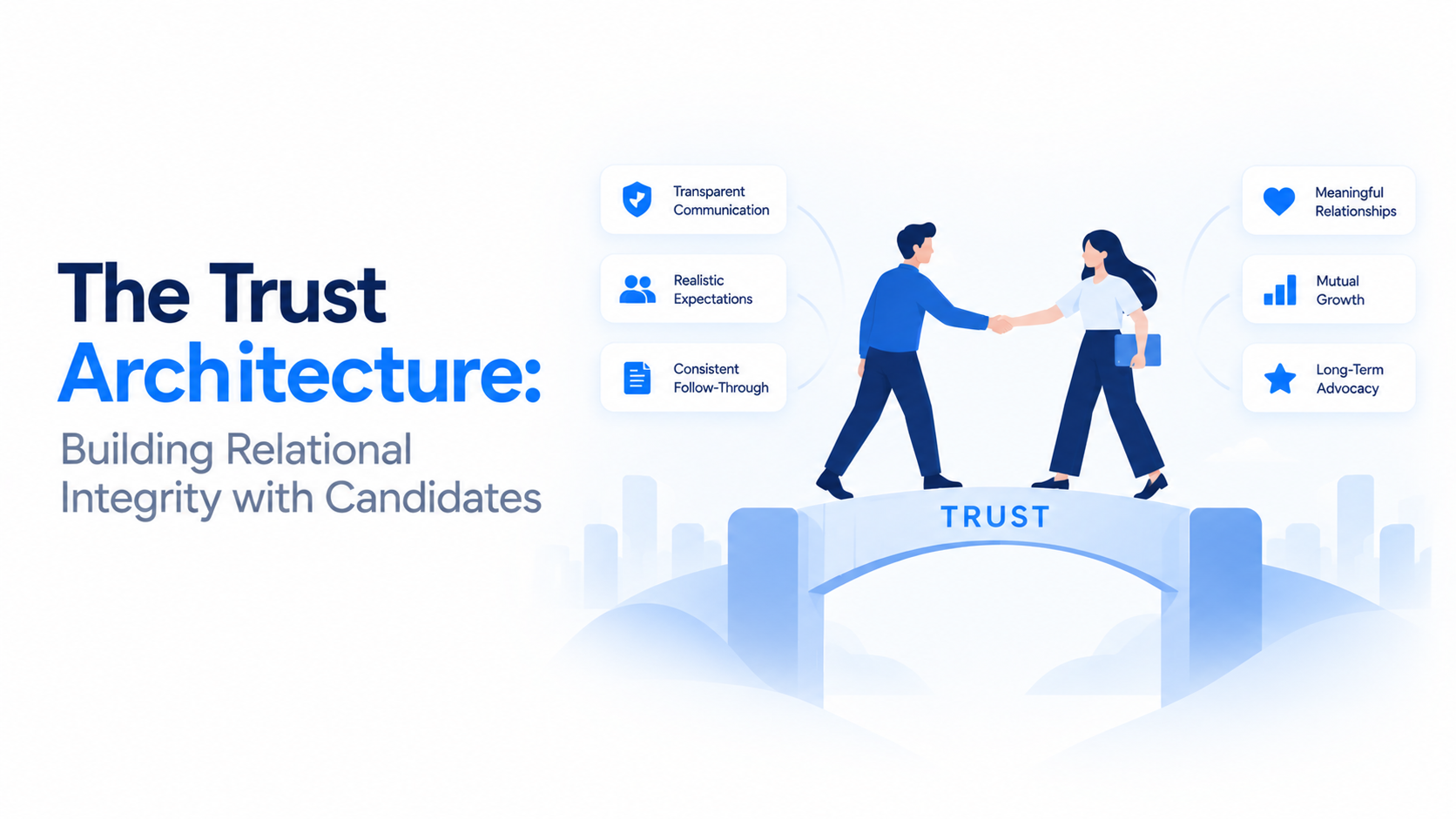
To move beyond this, leadership must transition from "Selling the Dream" to "Demonstrating the Reality." Trust is not built through persuasive language, but through operational precision. In a relational model, trust is the result of a consistent alignment between a company's words and its actions across every single touchpoint of the candidate journey. This requires a shift from treating candidates as "applicants" to be managed toward treating them as "partners" to be aligned. By focusing on relational integrity rather than transactional persuasion, organizations can build the structural trust necessary to attract and secure sovereign partners.
The Trust Deficit: Why Transactional Recruiting Repels High-Impact Talent
The primary reason most recruitment processes fail to build trust is that they are built on the logic of the transaction rather than the logic of the partnership. Recruiters are often trained to "manage" the candidate, which involves controlling the narrative and hiding the company's flaws to ensure the candidate doesn't "drop off." However, for a sovereign professional, this type of management is perceived as manipulation. The polished narrative is what the recruiter is using to produce a favorable impression, and that favorable impression is what the candidate is using to identify a lack of operational honesty.
When a company hides its structural challenges, it inadvertently signals that it lacks the maturity to solve them. High-value partners are not looking for a perfect company; they are looking for a company that is honest about its problems and has a clear plan to optimize them. Relational hiring requires a total rejection of the "corporate veneer" in favor of "Radical Transparency." Instead of claiming the environment is "seamless," a high-maturity organization describes the specific frictions the partner will be expected to resolve. This honesty transforms the recruitment process from a sales pitch into a professional consultation.
This failure of trust is often rooted in a lack of operational maturity within the talent function. If the recruiting team is not given the authority to be honest about the company's struggles, they default to a script of generic positives. This creates a cycle of misalignment where the candidate joins the company based on a fantasy, only to experience a total collapse of trust during their first ninety days. The reliance on a sanitized narrative is what the organization is using to produce an initial attraction, and that attraction is what the partner is using to justify a decision they will later regret.
The impact of this trust deficit is most evident in the quality of the final candidate pool. When the process is based on "selling," the company attracts people who are easily swayed by polish, while the sovereign professionals—who prioritize integrity over imagery—disengage. According to SHRM's research on candidate engagement, the most successful organizations are those that build trust through transparency and consistency. This transition allows the company to move from a "processing" mindset to a "partnership" mindset, ensuring that the people who join are aligned with the reality of the work.
Operational Precision: Using Consistency as a Proxy for Trust
For a high-maturity professional, the "small things" are actually "big things." A missed meeting, a vague email, or a contradictory answer from two different interviewers are not just administrative errors; they are proxies for the company's internal operational health. When a candidate experiences a fragmented process, they conclude that the company's internal operations are equally fragmented. The fragmented user journey is what the candidate is experiencing as a lack of operational maturity, and that lack of maturity is what the professional is using to disqualify the organization.
True trust is built through operational precision. This means ensuring that every touchpoint of the candidate journey is a seamless expression of the company's values. When a recruiter provides a detailed agenda for every call, follows up exactly when they said they would, and provides a clear roadmap of the process, they are signaling a high-trust environment. This consistency is what the organization is using to produce a feeling of professional respect, and that respect is what the sovereign professional is using to envision a high-functioning work environment.
Integrating this level of precision requires a shift in how the recruitment process is managed. It is no longer enough to be "friendly"; the team must be "precise." This means replacing vague timelines ("We'll get back to you soon") with definitive commitments ("You will have a decision by Thursday at 5 PM"). When the organization's actions consistently match its commitments, trust is established as a structural fact rather than a marketing claim. The precision of the process is what the leadership is using to produce credibility, and that credibility is what the partner is using to commit to the mission.
This commitment to operational precision is a critical part of creating a memorable candidate experience. When the process is frictionless and transparent, the candidate can focus entirely on the strategic alignment of the role rather than worrying about the logistics of the hire. This allows the professional to evaluate the "Sovereignty Gap" the company is trying to fill without being distracted by administrative chaos. The removal of friction is what the infrastructure is using to produce a high-conversion path, and that path is what the organization is using to secure high-maturity talent.
Radical Transparency: The "Sovereignty Gap" as a Trust Builder
The most powerful tool for building trust with a sovereign professional is the explicit disclosure of the "Sovereignty Gap." This is the specific intersection where the company's greatest structural need meets a professional's greatest strength. While traditional recruiting tries to hide the "messy middle" of the company, relational recruiting highlights it as a professional invitation. By being honest about the structural debts, the organizational frictions, and the failures of the past, the company builds immediate, high-fidelity trust.
When a company says, "Our current deployment pipeline is unstable, and it is costing us three days of velocity per sprint," they are not admitting weakness; they are providing a professional challenge. A sovereign professional is not deterred by a problem; they are deterred by the absence of a plan to solve it. The transparency of the problem is what the organization is using to produce trust, and that trust is what the partner is using to justify the risk of a career move. This honesty filters out those who are looking for a comfortable job and attracts those who enjoy the process of optimization.
This level of transparency requires a fundamental shift in the power dynamic of the interview. Instead of an interrogation to see if the candidate "fits," the interview becomes a mutual consultation to see if their capabilities align with the gap. The hiring manager and the candidate work together to map out how the partner's expertise will produce a specific business outcome. This collaborative approach signals that the company views the hire as a peer and a partner, rather than a resource. The shift to a consultation model is what the brand is using to produce a feeling of agency, and that agency is what the sovereign professional is using to envision their future within the organization.
Furthermore, this transparency must extend to the "hard parts" of the culture. If the company is in a high-pressure growth phase where boundaries are blurred, the brand should be honest about that reality. Promising "work-life balance" while expecting 80-hour weeks is a brand lie that destroys trust instantly. By being transparent about the demands of the role, the company attracts partners who are aligned with the pace and repels those who are not. The honesty of the signal is what the organization is using to produce authenticity, and that authenticity is what the candidate is using to assess the cultural fit.
The Relational Loop: Nurturing Trust Beyond the Interview
Trust is not a binary state achieved at the moment of the offer; it is a continuous loop that must be maintained throughout the entire candidate journey. Many companies build trust during the interviews only to destroy it during the "offer-to-onboarding" gap. This is the period where communication often drops off, and the candidate is left in a void of silence. This silence is what the candidate is perceiving as a lack of interest, and that lack of interest is what the professional is using to reconsider their decision.
To maintain trust, organizations must implement a "Relational Nurture" strategy. This means maintaining a high-fidelity connection with the partner even after the offer is signed. This can include introducing them to future peers, sharing internal documents that provide a deeper look at the current challenges, or involving them in a strategic conversation before their start date. By treating the pre-boarding period as an extension of the partnership, the company reinforces the trust established during the interview. This continuity of engagement is what the infrastructure is using to produce a memorable candidate experience, as the process focuses on mutual value.
This approach also allows the company to manage the "Cold Feet" phase, where high-value partners are often tempted by counter-offers from their current employers. When a partner feels a genuine relational bond with the hiring team, they are less likely to be swayed by a simple increase in compensation. They are moving toward a partnership, not just a new paycheck. The depth of the relational bond is what the organization is using to produce loyalty, and that loyalty is what the partner is using to reject transactional counter-offers.
Moreover, a relational nurture strategy allows the company to build a "talent sovereignty" database of professionals who may not have joined today, but who respect the organization's operational maturity. By maintaining a high-trust relationship with "silver medalist" candidates, the company ensures that its future pipeline is already pre-aligned. This transforms the act of recruiting from a reactive search into a proactive invitation. The delivery of relevant, high-value insight is what the system is using to produce a candidate nurturing strategy that wins the best talent.
Systematizing Trust: How a Hiring OS Ensures Relational Integrity
As an organization scales, the challenge of maintaining relational integrity across every hire becomes a structural problem. If trust is left to the individual discretion of recruiters, it becomes inconsistent, leading to the "Trust Gap" mentioned earlier. To solve this, the company needs a structural way to deliver a high-trust experience to every candidate. This is where a Hiring OS becomes essential. A Hiring OS does not just manage a pipeline; it synchronizes the "Sovereignty Promise" of the brand with the operational reality of the intake process.
Huntlo serves as this essential infrastructure, moving the process of building trust from a series of individual efforts to a continuous operational workflow. By treating the recruitment process as an OS, companies can ensure that the principles of operational precision and radical transparency are baked into every touchpoint. The system can track response velocity and candidate sentiment in real-time, allowing the organization to identify and fix "Trust Leaks" before they result in candidate drop-off. The automation of the administrative burden is what the OS is using to produce more space for human-centric alignment, and that alignment is what the organization is using to secure high-maturity partners.
Furthermore, an agentic approach to hiring allows the organization to maintain a relational map of potential partners who have already signaled alignment with the company's operational philosophy. Instead of starting from scratch with every role, the Hiring OS keeps a record of the trust already established with these professionals. This transforms the "first touch" from a cold outreach into a warm continuation of a professional relationship. The proactive mapping is what the system is using to produce a high-conversion pipeline, and that pipeline is what the leadership is using to ensure structural stability.
Integrating trust-building into a Hiring OS also enables a more sophisticated approach to referrals. When a current partner refers a peer, they are essentially vouching for the company's operational maturity. The OS ensures that the referred candidate is treated with the same level of precision and transparency as any other partner, reinforcing the trust of both the referrer and the candidate. This creates a self-sustaining loop of cultural alignment, where the most successful partners attract other high-maturity experts. The internal referral is what the system is using to produce a pre-validated candidate, and that pre-validation is what the organization is using to eliminate the risk of cultural misalignment.
Measuring Trust: From Application Volume to Alignment Density
The final evolution in building trust is to move from intuitive measurements to operational metrics. In a transactional system, success is measured by "Offer Acceptance Rates," but this is a lagging indicator that can be skewed by over-payment. In a relational system, the only metric that matters is "Alignment Density"—the percentage of high-maturity partners who feel a genuine structural alignment with the company. If a company has a high acceptance rate but a high first-year attrition rate, the trust was built on a lie. The attrition rate is what the manager is using to produce a diagnostic of the trust failure, and that failure is what the company is using to trigger a structural update.
To measure true trust, organizations must track the "Time to Impact" and "New Hire Sentiment." If a partner is attracted by a relational signal and hits their ninety-day goals faster than previous hires, the trust was based on an accurate alignment of capabilities. This data allows the company to stop investing in generic "branding" and start investing in high-fidelity transparency. The evidence of impact is what the talent function is using to produce a strategic budget, and that budget is what the organization is using to build an elite workforce.
This iterative approach is the only way to reduce candidate drop-off rates and ensure the long-term health of the pipeline. By analyzing the "Bounce Rate" of candidates during the interview process, the company can identify exactly where the trust is breaking down. If candidates drop off after the second interview, the company knows there is a disconnect between the recruiter's promise and the manager's reality. The identification of the friction is what the organization is using to produce a structural update, and that update is what the company is using to eliminate the risk of losing top talent.
Ultimately, building trust with candidates is not about "being nice"; it is about "being precise." It requires the courage to stop selling a fantasy and to start broadcasting an operational truth. It requires the discipline to move from a transactional "Recruitment Process" to a relational "Alignment Journey." When an organization views its hiring process as the construction of a partnership, it ceases to struggle with a lack of talent. Instead, it finds itself surrounded by sovereign professionals who are not just working for a salary, but are invested in the structural success of the mission. The commitment to relational integrity is what the organization is using to produce a world-class team, and that team is what the company is using to dominate its market. This is the only way to align with the shift to career architecture that defines the next decade of global talent acquisition.