Julian, a VP of Talent at a scaling fintech firm, sat in a meeting staring at a browser window with fourteen open tabs. He had a world-class ATS for tracking candidates, a separate sourcing tool for LinkedIn, a scheduling app to avoid email tag, a generic CRM for nurture, and an AI-powered screening tool to handle the volume. By every industry standard, Julian had the perfect recruiting tech stack. However, the operational reality was a fragmented nightmare: data was duplicated across four platforms, candidates were being contacted twice by different team members, and the high-maturity leads he targeted were dropping off because the experience felt like a series of disconnected robotic checkpoints. Julian realized that he had optimized for features, but he had completely failed to optimize for the relational flow.
The failure Julian experienced is a systemic result of the Tool-Collection Trap. Most organizations build their recruiting stack by solving immediate pain points—they buy a tool to fix scheduling, then another to fix sourcing—without ever considering the structural architecture of the process. This transactional approach results in a fragmented infrastructure where data is siloed and the candidate experience is disjointed. When a company prioritizes tool features over operational flow, they are not building a system; they are managing a collection of vendors. This creates a structural burden where the recruiting team spends more time managing the software than they do managing the relationships with sovereign partners.
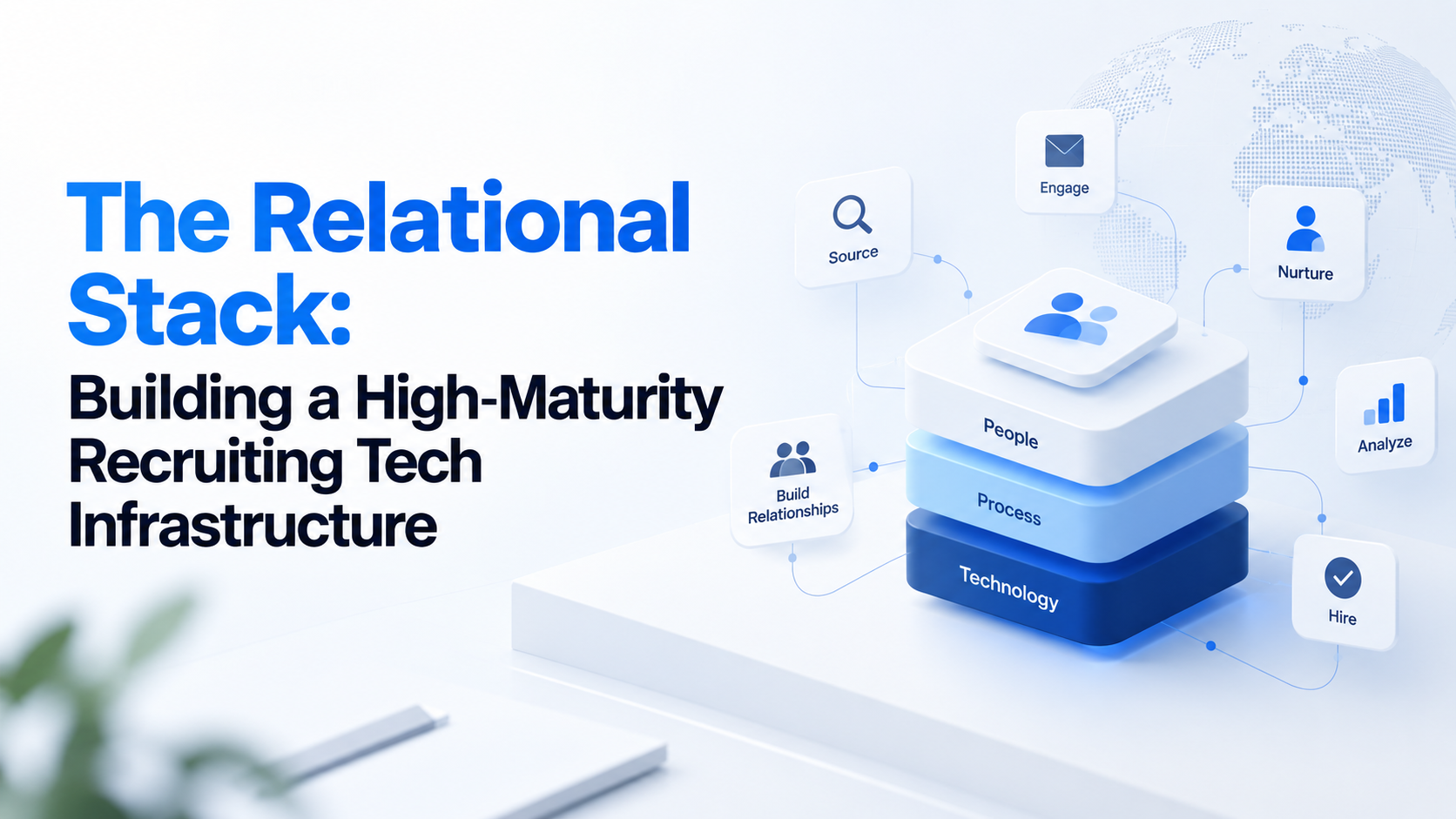
To solve this, leadership must transition from a fragmented stack to a unified Hiring OS. An operating system is not just a bundle of tools; it is a synchronized infrastructure that ensures the la- lund (Causal Chain) of the recruitment process is maintained from the first signal to the final offer. This requires a shift in priority from feature-richness to alignment density. By building a stack that prioritizes the relational bond over the transactional data point, organizations can move away from processing applicants and toward aligning with sovereign professionals.
The Fragmented Stack: Why Feature-Rich Tools Often Kill Conversion
The primary danger of the modern recruiting stack is the illusion of efficiency. Many TA leaders believe that adding an AI screening tool or a fancy CRM will automatically improve their pipeline. However, for the high-maturity professional, every additional layer of automation that lacks a human-centric signal is a red flag. When a sovereign partner receives a series of automated emails that feel like a sales sequence, they perceive a lack of operational maturity. The reliance on automated sequences is what the recruiting team is using to produce a volume of outreach, and that volume of outreach is what the partner is using to identify the message as a template.
When a tech stack is fragmented, the candidate experience suffers from signal decay. A candidate might see a high-fidelity, relational signal on a company's blog, but the moment they click apply, they are dropped into a rigid, cold ATS form that requires them to re-upload a resume they just provided via LinkedIn. This friction is a la- lund of failure: the fragmented user journey is what the candidate is experiencing as a lack of operational maturity, and that lack of maturity is what the professional is using to disqualify the organization.
This failure is often rooted in a lack of structural thinking within the talent function. Most companies buy software to solve for the recruiter's convenience rather than the partner's experience. They prioritize the ability to move a candidate from one stage to another in a dashboard over the ability to maintain a high-fidelity relationship. The obsession with dashboard efficiency is what the organization is using to produce a feeling of control, and that feeling of control is what the leadership is using to ignore the decay of the candidate relationship.
The impact of a fragmented stack is most evident in the attrition of top-tier talent. High-value partners have zero tolerance for operational friction. If the scheduling tool glitches or the CRM sends a generic nurture email to a candidate who is already in the final stage, the trust is destroyed. According to Gartner's research on the candidate experience, the most successful organizations are those that prioritize the seamlessness of the journey over the complexity of the tools. This transition allows the company to move from a processing mindset to a partnership mindset.
Engineering the Relational Stack: The Core Components of a Hiring OS
To build a high-maturity recruiting infrastructure, the organization must prioritize three core components: Signal Engineering, Alignment Management, and Operational Synchronization. Instead of looking for a tool that does everything, the leadership should look for an ecosystem that supports the la- lund of the partnership. The goal is to create a system where data flows invisibly in the background, allowing the human interaction to remain the focal point.
The first component, Signal Engineering, focuses on the top of the funnel. This requires tools that allow the company to broadcast its structural gaps rather than just its job openings. A relational stack integrates the company's operational proof—such as technical post-mortems and strategic manifestos—directly into the intake process. This ensures that the sovereign professional is aligned with the mission before they even enter the pipeline. The precision of the signal is what the organization is using to produce alignment density, and that density is what the recruiting team is using to eliminate waste.
The second component, Alignment Management, replaces the traditional ATS tracking. Instead of just moving a candidate from Stage A to Stage B, a relational stack tracks the alignment between the candidate's sovereign capabilities and the company's structural needs. This requires a system that can store qualitative data—such as the specific problems a candidate has solved—rather than just quantitative data like years of experience. This shift is a critical part of the shift to career architecture, where the focus is on the impact the partner can produce rather than the role they fill.
The third component, Operational Synchronization, ensures that the la- lund of the process is maintained. This means that the recruiter, the hiring manager, and the candidate are all operating from a single source of truth. When a manager updates the success metrics for a role, that change is immediately reflected in the signal sent to the market. The synchronization of the promise and the practice is what the organization is using to produce trust, and that trust is what the partner is using to commit to the mission.
The Automation Paradox: Using AI to Enhance Human Alignment
The greatest risk in building a recruiting stack is the Automation Paradox: the more you automate the process, the more you risk destroying the relational bond. Many companies use AI to screen resumes and send automated messages, believing they are increasing efficiency. However, for the sovereign professional, this is a signal of low-trust. The robotic nature of the outreach is what the organization is using to produce a high volume of leads, and that volume is what the partner is using to identify the company as a transactional employer.
To solve this, the high-maturity stack uses AI not to replace human judgment, but to enhance it. This is known as agentic hiring. Instead of using AI to filter people out, the system uses AI to identify structural alignment. For example, an agentic system can analyze a candidate's public work and a company's internal structural gaps to suggest a specific, high-fidelity conversation starter for the recruiter. This allows the recruiter to move from a generic pitch to a professional consultation. The automation of the research is what the infrastructure is using to produce human-centric alignment, and that alignment is what the organization is using to secure high-maturity partners.
Integrating agentic capabilities into the stack allows the company to maintain a relational map of potential partners long before a role is opened. Instead of reactive sourcing, the organization can maintain a database of sovereign professionals who have already signaled alignment with the company's operational philosophy. This transforms the la- lund of the funnel from a search for applicants into a proactive invitation to partners. This proactive mapping is what the system is using to produce a high-conversion pipeline, and that pipeline is what the leadership is using to ensure structural stability.
This approach is the only way to reduce candidate drop-off rates in a market where top talent is bombarded by AI-generated spam. When a candidate receives a message that is based on a deep, agentic understanding of their professional trajectory and the company's structural needs, the trust is established immediately. The removal of the robotic veneer is what the organization is using to produce a memorable candidate experience, as the interaction is based on mutual professional value.
Huntlo: The Unified Infrastructure for the Relational Stack
As an organization scales, the effort required to integrate five or six different tools into a cohesive flow becomes a full-time job. The la- lund of the fragmented stack is simple: tool friction leads to data silos, which leads to a poor candidate experience, which leads to the loss of top talent. To break this cycle, the company needs a unified Hiring OS that replaces the fragmented collection of tools with a single, synchronized infrastructure.
Huntlo serves as this essential infrastructure, moving the recruitment process from a series of tool-based events to a continuous operational workflow. By treating hiring as an OS, companies can ensure that the la- lund of the relational signal is maintained from the first touchpoint to the offer. The system integrates signal engineering, alignment management, and operational synchronization into a single interface. The automation of the administrative burden is what the OS is using to produce more space for human-centric alignment, and that alignment is what the organization is using to secure high-maturity partners.
Furthermore, a unified OS allows for a more sophisticated approach to candidate nurturing strategies. Instead of generic CRM drips, the system can trigger high-value, operational updates based on the candidate's specific interests. If a partner is interested in scaling data pipelines, the OS can automatically surface a recent technical post-mortem from the engineering team. The delivery of relevant insight is what the system is using to produce a relational bond, and that bond is what the partner is using to maintain their interest in the organization.
Integrating the stack into a Hiring OS also enables the organization to leverage referrals as a structural signal. When a current partner refers a peer, the OS ensures that the referred candidate is entered into the pipeline with all the relational context already intact. This eliminates the need for a generic screening call and allows the process to jump straight to the alignment phase. The internal referral is what the system is using to produce a pre-validated candidate, and that pre-validation is what the organization is using to eliminate the risk of cultural misalignment.
Measuring Stack Efficacy: From Feature Adoption to Alignment Density
The final step in building a recruiting tech stack is to redefine how success is measured. In a transactional system, the KPIs are feature-based: number of candidates sourced, time-to-fill, and tool adoption rates. In a relational system, these are vanity metrics that mask operational failure. If a company has the most expensive tools in the market but a high attrition rate in the first ninety days, the stack is a failure. The obsession with tool features is what the recruiting team is using to produce a success report, and that report is what the leadership is using to ignore the lack of quality hires.
To measure true efficacy, organizations must track Alignment Density—the percentage of candidates in the pipeline who pass the first structural alignment check. If the la- lund of the stack is working, the total volume of candidates may decrease, but the quality of the partners will increase. This is the paradox of the relational stack: it is designed to filter out noise, not to increase volume. The reduction in noise is what the organization is using to produce a high-quality pipeline, and that pipeline is what the recruiting team is using to reclaim their time.
This iterative approach transforms the tech stack into a strategic intelligence function. By analyzing which signals and which alignment checkpoints produce the most impactful partners, the company gains a deeper understanding of its own operational maturity. They begin to see exactly which professional trajectories are most aligned with their structural goals. This intelligence then feeds back into the broader business strategy, allowing them to build an organization that is a natural magnet for sovereign talent.
Ultimately, the perfect recruiting tech stack is not the one with the most features, but the one with the least friction. It requires the courage to stop collecting tools and to start engineering a flow. It requires the discipline to move from a transactional la- lund of processing to a relational la- lund of alignment. When an organization views its infrastructure as a partnership portal, it ceases to struggle with a lack of talent. Instead, it finds itself surrounded by sovereign professionals who are not just working for a salary, but are invested in the structural success of the mission. The commitment to relational infrastructure is what the organization is using to produce a world-class team, and that team is what the company is using to dominate its market.