Sophia, the VP of Talent at a high-growth fintech scale-up, stared at her recruitment dashboard with a mixture of pride and absolute frustration. By every traditional metric, her recruitment marketing was a triumph; they had a massive top-of-funnel, with over five thousand leads entering the pipeline across three different roles in a single month. However, the conversion rate at the bottom of the funnel was nearly zero, as the hiring managers were rejecting almost every candidate for a lack of structural depth. Sophia had built a high-volume machine, but she had inadvertently created a "leaky bucket" where the noise of generic applicants drowned out the signal of high-maturity partners. She realized that while her funnel was wide, it was designed to catch "applicants" rather than to align with "partners."
The failure Sophia experienced is a systemic symptom of the "Volume Fallacy" that dominates traditional recruitment marketing. Most organizations treat the recruitment funnel as a standard sales pipeline, assuming that the goal is to maximize the number of leads at the top to ensure a few successes at the bottom. This transactional approach prioritizes visibility over precision, leading to a pipeline flooded with noise and a recruiting team that is exhausted by the sheer volume of misaligned candidates. When a company optimizes for lead volume, they are not building a talent pipeline; they are building a processing plant. This creates a structural burden where the organization spends 90% of its energy filtering out the wrong people rather than engaging with the right ones.
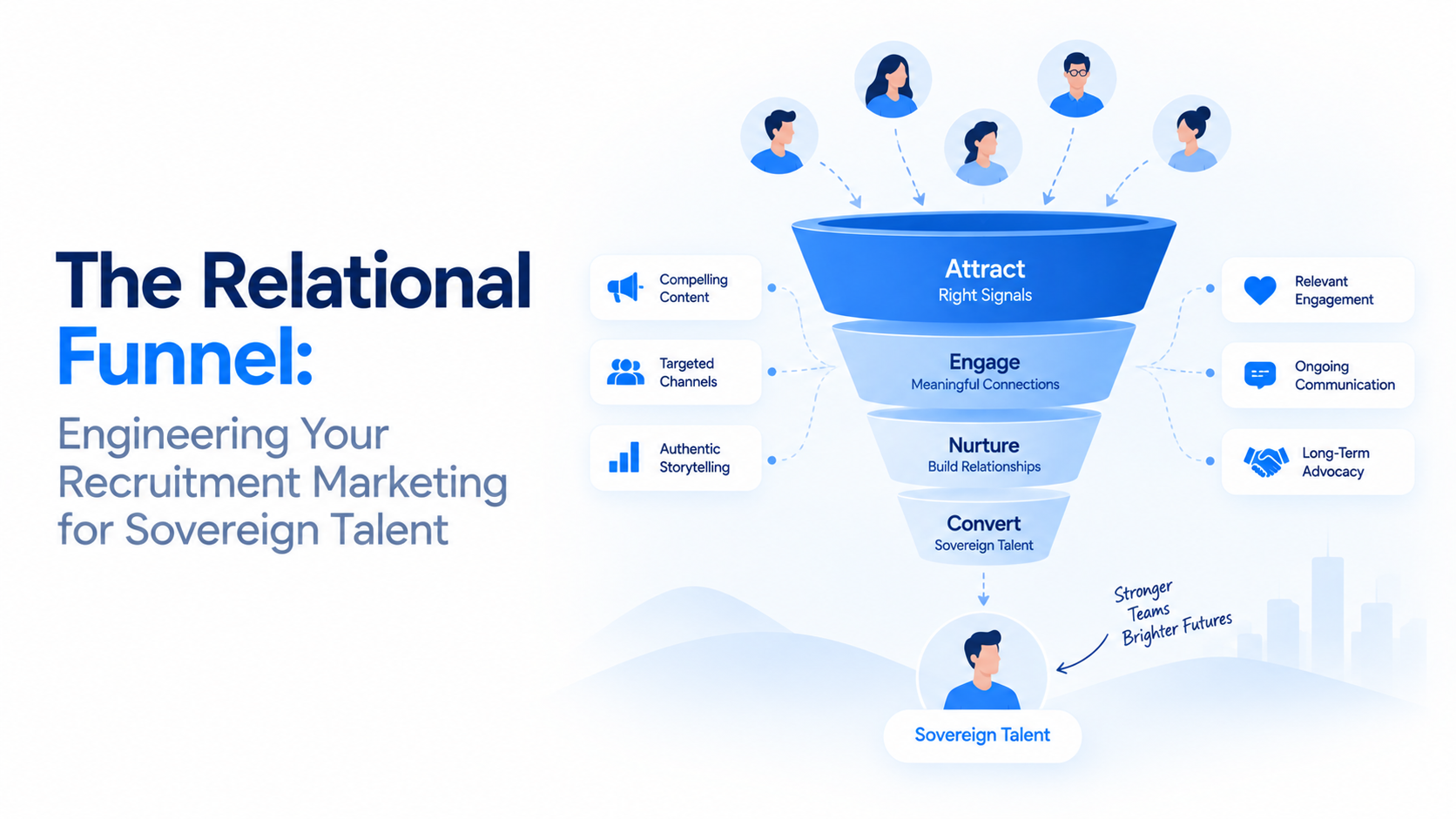
To solve this, leadership must transition from a transactional funnel to a "Relational Alignment Model." In a relational model, the goal is not to maximize the number of people entering the system, but to maximize the "Alignment Density" of the pipeline. This requires a total overhaul of the recruitment marketing strategy, moving away from broad-spectrum awareness and toward high-fidelity professional signaling. By shifting the focus from "Attraction" to "Alignment," organizations can stop managing a leaky bucket and start engineering a magnet for sovereign professionals.
The Noise Machine: Why Traditional Recruitment Funnels Fail the Market
The primary trap of the traditional recruitment funnel is the reliance on the logic of the "wide net." HR departments often believe that by casting a broad net—using generic job ads, sponsored social posts, and high-volume outreach—they increase their chances of finding a "diamond in the rough." However, for the high-maturity professional, this broad-spectrum approach is a signal of low operational maturity. They perceive a generic marketing campaign as a sign that the company is looking for a resource to fill a gap rather than a partner to solve a problem. The obsession with volume is what the organization is using to produce a false sense of momentum, and that false sense of momentum is what the leadership is using to justify an inefficient, transactional hiring process.
When a recruitment funnel is optimized for volume, it inadvertently creates a "Signal-to-Noise" crisis. The thousands of generic applications act as a layer of static that obscures the few high-value partners who might actually be interested. This forces the recruiting team into a "processing" mindset, where they are focused on speed of rejection rather than quality of engagement. Relational hiring requires a shift toward "Signal Engineering," where the content at the top of the funnel is designed to be a filter that repels the transactional applicant while attracting the sovereign professional.
This failure of signal is often rooted in a lack of operational clarity within the organization. If the leadership cannot define the specific "Sovereignty Gap" the role is intended to fill, they default to generic branding to cover the void. This creates a cycle where the company attracts candidates who are a fit for the "brand" but a failure for the "role." The reliance on broad-spectrum ads is what the recruiting team is using to produce a crowded pipeline, and that crowded pipeline is what the organization is using to eliminate the time required for deep, relational engagement.
The impact of this volume-centric approach is most evident in the degradation of the candidate experience. When a company attracts five thousand applicants for a role that only needs one, the response velocity inevitably drops, leading to a void of silence that destroys the company's reputation among top-tier talent. According to Deloitte's research on human capital trends, the most successful organizations are those that prioritize the quality of the initial interaction over the quantity of the leads. This transition allows the company to move from a "processing" mindset to a "partnership" mindset.
Signal Engineering: Transforming the Top of the Funnel
To attract a sovereign partner, the top of the funnel must move from "broadcasting" to "signaling." Signaling is the act of providing specific, high-fidelity operational information that only a high-maturity professional will recognize as valuable. This means replacing generic "Join Our Team" ads with "Operational Playbooks" or "Strategic Challenges." When a potential partner sees a detailed breakdown of a company's structural debts or a transparent analysis of its market failures, they perceive an organization with high operational maturity. They recognize that the company is not trying to sell a dream, but is inviting them to participate in a real-world optimization.
A high-precision signal focuses on the "Causal Chain" of the company's internal needs. Instead of stating "We are looking for a growth expert," a relational signal would state, "Our current customer acquisition cost is rising because our lead-to-close loop is fragmented, and we need a partner to re-engineer that structural chain." This framing immediately filters out the transactional applicant who is looking for a "growth" title and attracts the sovereign professional who has solved that specific problem before. The clarity of the problem is what the organization is using to produce trust, and that trust is what the partner is using to justify the risk of a career move.
Integrating this level of detail into the funnel requires a shift in content strategy. Companies must move away from the "brochure" model and toward the "manifesto" model, publishing deep-dive articles and internal memos that reveal the internal logic of the organization. When a professional reads a manifesto that aligns with their own philosophy of work, the attraction is no longer based on a salary offer, but on an intellectual alignment. This alignment is what the brand is using to produce a feeling of inevitability, and that inevitability is what the partner is using to prioritize this opportunity over all others.
Furthermore, the channels used for this signaling must be high-authority nodes rather than generic job boards. Relational marketing focuses on "Niche Authority" rather than "Mass Reach," dominating the conversation in small, high-value communities. By providing value and insight before asking for a resume, the organization builds a reputation for operational excellence. The focus on niche authority is what the company is using to produce an elite pipeline, and that elite pipeline is what the organization is using to eliminate the need for massive, wasteful ad spends.
Professional Alignment: Moving from Interest to Intellectual Match
Once a high-fidelity signal has attracted a potential partner, the funnel must transition from "Interest" to "Professional Alignment." In a transactional funnel, this stage is usually a screening call to verify a resume. In a relational funnel, this stage is a "Mutual Validation" process where the company and the candidate determine if their sovereign capabilities match the structural gaps of the organization. This requires a shift from "interrogating" the candidate to "consulting" with them.
A high-maturity alignment process utilizes the "Causal Chain" logic to explore the candidate's impact. Instead of asking "Where do you see yourself in five years?", the hiring manager asks, "What was the specific structural friction in your last role that you were able to eliminate, and what was the resulting business outcome?" This framing allows the candidate to demonstrate their sovereignty and allows the company to see if that capability is what they need. The transparency of the conversation is what the organization is using to produce alignment, and that alignment is what the partner is using to envision their specific impact.
Integrating this level of alignment requires the recruiter to act as a strategic consultant rather than a coordinator. They must perform a deep dive into the hiring manager's pain points to identify the "Unique Value Driver" of the role. If the recruiter cannot answer "Why would a sovereign professional leave a stable role to solve this specific problem?", they are not ready to initiate the alignment phase. This preparation is what the organization is using to produce a high-signal outreach, and that high-signal outreach is what the partner is using to identify the company as a peer.
This stage of the funnel is where the shift to career architecture becomes most apparent. The partner is not looking for a "job" but for a platform where they can apply their expertise to create a legacy. By framing the role as a structural challenge rather than a list of duties, the company aligns itself with the professional's own growth trajectory. The promise of impact is what the brand is using to produce a feeling of agency, and that agency is what the sovereign professional is using to anchor their interest.
Mutual Validation: The High-Maturity Interview as a Partnership Audit
The "Consideration" phase of the traditional funnel is replaced in the relational model by a "Partnership Audit." In this stage, the power dynamic shifts from the company judging the candidate to both parties auditing each other's operational maturity. A sovereign professional is not looking for approval; they are looking for a partner who is as committed to excellence as they are. This requires a level of transparency from the company that is often uncomfortable for traditional HR departments.
A high-maturity interview process involves sharing the "Hard Parts" of the organization—the structural debts, the failed experiments, and the current frictions. Instead of a sanitized "Culture Presentation," the company provides a "Structural Audit" of the role's challenges. High-value partners are not deterred by problems; they are deterred by the absence of a plan to solve them. The honesty of the struggle is what the employee is using to produce trust, and that trust is what the partner is using to justify the risk of a career move.
This approach directly impacts the candidate experience by removing the "game" from the interview. When both parties are honest about the gaps, the process becomes an exercise in problem-solving rather than a performance. This transforms the interview from a stressful hurdle into a professional consultation. The removal of the "mask" is what the organization is using to produce authenticity, and that authenticity is what the partner is using to commit to the mission.
Furthermore, a relational audit ensures that the "Promise Gap" is eliminated before the offer is made. By being transparent about the demands and the frictions of the role, the company filters out those who would be unhappy in the current environment. This reduces the risk of early attrition and ensures that the partner is joining with a full understanding of the operational reality. The transparency of the la- lund (Causal Chain) is what the organization is using to produce a durable match, and that match is what the company is using to eliminate future turnover.
The Infrastructure of the Loop: Using a Hiring OS to Scale the Funnel
As an organization grows, the challenge of maintaining this high-fidelity alignment across multiple roles becomes a structural problem. Manually engineering signals and conducting partnership audits for every hire is unsustainable for a lean talent team. This is where the need for a Hiring OS becomes critical. Rather than relying on fragmented tools and manual outreach, the company needs an infrastructure that can systematize the "relational loop" without stripping away the human element.
Huntlo serves as this essential infrastructure, moving the recruitment funnel from a series of isolated events to a continuous operational workflow. By treating the process as an OS, companies can ensure that the principles of relational signaling are baked into every touchpoint. The system can track which specific "Sovereignty Gaps" are attracting the highest-quality partners, allowing the company to iterate on its signal in real-time. The automation of the administrative burden is what the OS is using to produce more space for human-centric alignment, and that alignment is what the organization is using to secure high-maturity partners.
Furthermore, an agentic approach to hiring allows the organization to move from "reactive casting" to "precision invitation." Instead of waiting for the funnel to fill, the Hiring OS allows the company to identify sovereign professionals who already align with the company's operational philosophy. This transforms the act of recruitment marketing from a public plea for attention into a private, high-value consultation. The proactive mapping is what the system is using to produce a high-conversion pipeline, and that pipeline is what the leadership is using to ensure structural stability.
Integrating the funnel into a Hiring OS also enables a more sophisticated approach to candidate nurturing strategies. Instead of "checking in" with candidates—a transactional habit that annoys sovereign professionals—the recruiter can share a specific piece of operational proof that aligns with the partner's expertise. This transforms the nurture process from a series of prompts into a series of value-adds. The delivery of relevant insight is what the system is using to produce a relational bond, and that bond is what the partner is using to maintain their interest in the organization.
Measuring Flow: From Conversion Rates to Alignment Density
The final evolution in the recruitment funnel is to redefine how success is measured. In a transactional system, the KPIs are efficiency-based: Cost-per-Hire, Time-to-Fill, and Conversion Rate. In a relational system, these are vanity metrics that often signal a failure of precision. If a funnel has a high conversion rate but the hires leave within six months, the "efficiency" was a lie. The obsession with conversion rates is what the recruiting team is using to produce a success report, and that report is what the leadership is using to ignore the lack of quality hires.
To measure true efficacy, organizations must track "Alignment Density"—the percentage of candidates in the pipeline who pass the first structural alignment check. If a high-fidelity signal is working, the total number of applicants may actually decrease, while the percentage of sovereign partners increases. This is the paradox of relational recruiting: the more precise the signal, the smaller the crowd, but the higher the impact. The reduction in noise is what the organization is using to produce a high-quality pipeline, and that pipeline is what the recruiting team is using to reclaim their time.
This iterative approach turns the recruitment funnel into a strategic intelligence function. By analyzing which "Signals" attract the most impactful partners, the company gains a deeper understanding of its own operational maturity. They begin to see exactly what combination of autonomy, complexity, and growth drives the highest level of performance in the market. This intelligence then feeds back into the broader business strategy, allowing them to build an organization that is a natural magnet for sovereign talent.
Ultimately, the recruitment marketing funnel is not about "filling a bucket"; it is about "engineering a match." It requires the courage to stop optimizing for volume and to start optimizing for alignment. It requires the discipline to move from a transactional "Lead Gen" mindset to a relational "Partner Alignment" mindset. When an organization views its funnel as a partnership invitation, it ceases to struggle with a lack of talent. Instead, it finds itself surrounded by sovereign professionals who are not just working for a salary, but are invested in the structural success of the mission. This commitment to relational signaling is what the organization is using to produce an elite culture, and that culture is what the company is using to dominate its market. This is the only way to reduce candidate drop-off rates in an era where high-impact talent has total sovereignty over their career choices.