David Park had been head of talent operations at a four-hundred-person enterprise AI company for two years, and the tool audit he had been avoiding was finally on his calendar. The team had seventeen tools in its recruiting stack, costing a combined six hundred thousand dollars a year, and no one could explain with confidence what each tool did, whether it was being used, or whether it was producing the value it was purchased to produce. The tools had been added over four years by three different heads of talent, each responding to a specific pain point with a specific purchase, and the cumulative result was a stack that no one had ever looked at as a whole. David spent six weeks auditing the stack, interviewing each tool's primary users, examining usage data, and mapping the integrations between tools. What he found was not surprising to anyone who has done a similar audit. Three tools were paid for but not used at all. Four tools duplicated functionality that other tools already provided. Two tools were used for a different purpose than they were purchased for. The total waste was roughly two hundred thousand dollars a year, and the total integration debt—the cost of maintaining the connections between tools that should have been consolidated—was producing recruiter friction that was costing the team an estimated twenty percent of its capacity. The audit was the start of a stack redesign that took nine months and produced a leaner, more integrated, more effective tech stack that cost forty percent less and produced more value. Here is the framework David used to think about the stack, and the one that any TA operations leader can use to do the same.
The Seven Layers of a Modern Recruiting Tech Stack
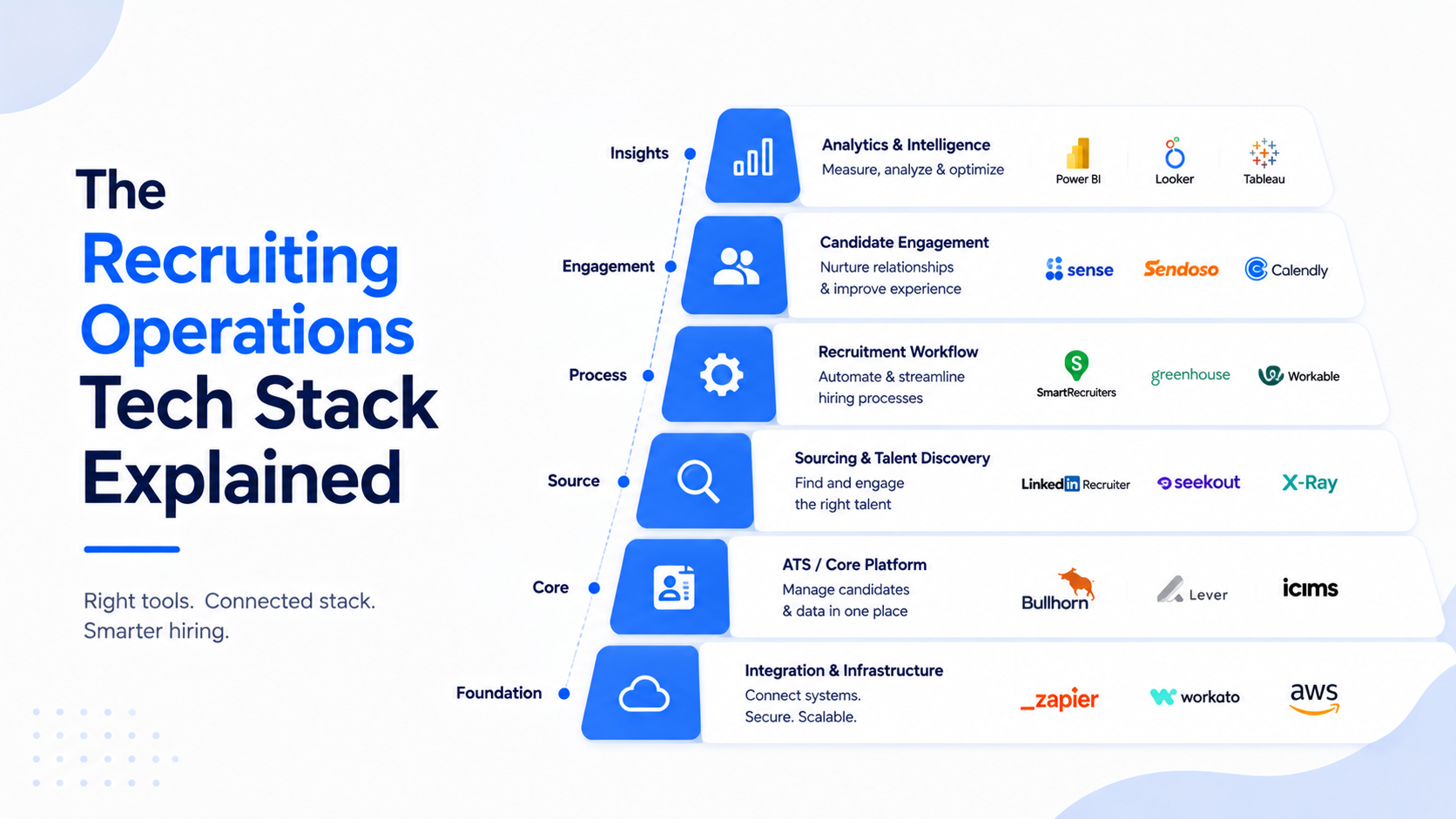
A modern recruiting tech stack is not a collection of point tools. It is a layered architecture where each layer serves a specific function, and the layers together form an operating system that runs the recruiting process. The seven layers are the data layer, the sourcing layer, the screening layer, the engagement layer, the interview layer, the decision layer, and the analytics layer. Each layer has a specific job, and the tools within each layer should be selected to do that job well and to integrate cleanly with the layers above and below it, because the integration is what produces the stack that works as a system rather than the stack that works as a collection of tools that do not talk to each other and that force the team to maintain duplicate data across multiple systems.
The first layer is the data layer, which is the foundation of the stack and the layer that most determines whether the rest of the stack will produce value. The data layer is the ATS, the CRM, and the candidate database, and its job is to be the single source of truth for candidate data across the entire recruiting process. According to McKinsey research on talent operations, the teams that have built a clean data layer report thirty-five percent faster cycle times and forty percent better cross-tool integration, because the clean data layer enables the other layers to access the candidate data they need without the duplicate data entry and the data reconciliation that the dirty data layer produces, and the elimination of the duplicate data entry and the reconciliation is what produces the capacity that the team can redirect to the higher-value work that the clean data layer enables and that the dirty data layer prevents.
The remaining six layers build on the data layer and serve specific functions in the recruiting process. The sourcing layer identifies and engages candidates, and it includes sourcing platforms, job boards, and referral tools. The screening layer evaluates candidates, and it includes assessment platforms, resume screening tools, and skills tests. The engagement layer manages the candidate relationship, and it includes scheduling tools, communication platforms, and candidate experience tools. The interview layer runs the interview process, and it includes video interview platforms, structured interview tools, and feedback collection systems. The decision layer manages the offer and approval process, and it includes offer management tools and approval workflow systems. The analytics layer measures the process and produces the insights that drive improvement, and it includes recruiting analytics platforms and dashboards. Each layer has a job, and the tool that does the job well and integrates cleanly with the other layers is the tool that belongs in the stack, while the tool that does the job in isolation is the tool that produces the integration debt that the audit is designed to identify and eliminate.
The Data Layer: Why Your ATS Is the Foundation of Everything
The ATS is the foundation of the recruiting tech stack because the ATS is the system of record for candidate data, and the candidate data is the input to every other tool in the stack, and the quality of the candidate data determines the quality of the work that every other tool can do. The ATS that is selected for its features rather than its data quality is the ATS that produces the stack where every other tool is working with bad data, and the bad data is what produces the duplicate entries, the conflicting information, and the missed handoffs that the rest of the stack cannot compensate for regardless of how sophisticated the other tools are. The ATS selection is the most consequential tool decision the team will make, because the ATS is the tool that every other tool will integrate with and that every recruiter will use, and the wrong selection produces the stack that no other tool can fix and that the team must live with for years because the ATS is the most expensive and most disruptive tool to replace.
The first data layer discipline is to treat the ATS as a system of record rather than a workflow tool, because the ATS that is treated as a workflow tool is the ATS that is customized to support the team's current process, and the customization produces the data model that does not support the team's future process and that the future process requires the team to either abandon the customization or to replace the ATS, and both options are expensive. According to SHRM research on ATS implementation, the ATS implementations that treat the ATS as a system of record rather than a workflow tool report fifty percent lower long-term total cost of ownership, because the system of record produces the data model that supports the team's process changes without the customization that the workflow tool produces and that the customization is what produces the lock-in that makes the ATS expensive to replace when the team's process outgrows the customized ATS.
The second data layer discipline is to integrate the other tools with the ATS rather than to duplicate the data in the other tools, because the duplicate data is what produces the data reconciliation work that consumes the team's capacity and the data conflicts that produce the errors that the reconciliation is intended to catch. As our analysis of more tools same hiring problems argues, the teams that have integrated their tools with the ATS rather than duplicating the data report forty percent less recruiter time spent on data entry and data reconciliation, because the integration produces the single source of truth that the duplicate data does not, and the single source of truth is what produces the clean data that the rest of the stack requires and that the duplicate data does not provide and that the team must reconcile manually and that the manual reconciliation is what consumes the capacity that the integration would have freed.
The Sourcing and Screening Layers: Where AI Actually Delivers
The sourcing and screening layers are the layers where AI has produced the most measurable value in 2026, because these are the layers whose volume has grown the fastest and whose work is the most repetitive, and the volume and the repetition are what AI handles well and what humans do not scale to handle. The sourcing layer uses AI to identify candidates who match the role requirements, to engage them with personalized outreach, and to maintain the relationship through the hiring process, and the AI sourcing is what produces the qualified-candidate pipeline that the human sourcer cannot produce at the same volume regardless of how hard the human sourcer works, because the volume is what the AI handles and what the human does not scale to and what the AI sourcing is what enables the human sourcer to focus on the judgment that the AI cannot provide and that the human can.
The first sourcing layer discipline is to select the AI sourcing tool based on the quality of its candidate matching rather than the volume of its candidate database, because the volume is not valuable if the candidates do not match the role requirements, and the matching is what produces the qualified candidates that the volume does not. According to LinkedIn talent research on sourcing effectiveness, the AI sourcing tools that produce the highest qualified-candidate yield are those that use behavioral signals and engagement data to match candidates to roles, because the behavioral signals and the engagement data produce the matching accuracy that the resume-only matching does not produce, and the matching accuracy is what produces the qualified candidates that the volume does not. As our guide on how to evaluate an AI sourcing tool explains, the evaluation of an AI sourcing tool should focus on the qualified-candidate yield per requisition rather than the volume of candidates surfaced, because the yield is what produces the hires and the volume is what produces the screening burden that the yield does not.
The screening layer uses AI to evaluate the candidates that the sourcing layer has produced, and the screening layer's AI is what enables the team to handle the application volume that the human screeners cannot handle at scale. The screening layer should rank candidates by predicted fit and should surface the top candidates for human review, because the AI ranking is what enables the human reviewer to spend the time per candidate that the careful evaluation requires, and the careful evaluation is what produces the qualified-candidate yield that the superficial human screening does not produce. As our analysis of AI sourcing vs AI recruiting shows, the platforms that produce the most effective screening layer are those that combine the sourcing and screening into a single integrated workflow, because the integration produces the data flow that the separate tools cannot produce and that the data flow is what enables the screening to use the sourcing data rather than to re-evaluate the candidate from scratch and that the re-evaluation is what the integration eliminates and what produces the screening efficiency that the separate tools cannot produce.
The Engagement and Interview Layers: The Candidate Experience Stack
The engagement and interview layers are the layers that most directly affect the candidate experience, because these are the layers that the candidate interacts with directly, and the candidate's experience of these layers is what produces the candidate's perception of the company and the perception is what produces the offer acceptance or the offer decline. The engagement layer manages the candidate's communication with the recruiting team, and it includes the scheduling tools that book the interviews, the communication platforms that send the updates, and the candidate portals that provide the candidate with visibility into their status. The interview layer runs the interview process, and it includes the video interview platforms that host the interviews, the structured interview tools that guide the interview questions, and the feedback collection systems that capture the interviewer's evaluation. Each of these layers serves the candidate, and the tool that serves the candidate well is the tool that produces the candidate experience that produces the offer acceptance and the candidate net promoter score that the team is measuring and that the team is trying to improve.
The first engagement layer discipline is to design the candidate communication as a journey rather than as a series of touchpoints, because the journey is what the candidate experiences and the touchpoints are what the team manages, and the difference between the two is what produces the candidate who experiences a smooth journey through the touchpoints that the team has designed as disconnected interactions. According to Gartner talent acquisition research on candidate experience, the teams that have designed their candidate communication as a journey report thirty-five percent higher candidate net promoter scores, because the journey design produces the communication that the candidate experiences as coherent and respectful, while the touchpoint design produces the communication that the candidate experiences as fragmented and transactional, and the coherent and respectful is what produces the recommendation that the fragmented and transactional does not produce.
The second interview layer discipline is to use the structured interview tools to produce consistent evaluations across interviewers, because the consistency is what produces the comparable evaluations that the decision layer requires, and the comparable evaluations are what enable the decision to be made on the basis of the candidate's actual qualifications rather than on the basis of the interviewer's subjective impression. As our analysis of agentic AI platforms vs automated ones demonstrates, the platforms that produce the most effective interview layer are those that combine the structured interview guides with the feedback collection in a single workflow, because the combined workflow is what produces the structured feedback that the decision layer can use, while the separate tools produce the feedback that is collected in one system and evaluated in another, and the separation is what produces the feedback that is not comparable across interviewers and that the decision layer cannot use without the manual reconciliation that the combined workflow eliminates.
The Decision and Analytics Layers: Where the Stack Produces Insight
The decision and analytics layers are the layers that turn the data produced by the rest of the stack into the decisions that produce the hires and the insights that produce the improvements, and these layers are what determine whether the stack produces the value it was built to produce or whether the stack produces the data that no one acts on. The decision layer manages the offer and approval process, and it includes the offer management tools that construct the offer, the approval workflow systems that route the offer for approval, and the compensation tools that calibrate the offer against the market. The analytics layer measures the process and produces the insights that drive improvement, and it includes the recruiting analytics platforms that aggregate the data from the rest of the stack and the dashboards that display the insights to the team and to the leadership. Each of these layers serves the team, and the layer that serves the team well is the layer that produces the decisions and the insights that the team can act on.
The first decision layer discipline is to design the approval workflow to minimize the cycle time between decision and offer, because the cycle time is what produces the candidate who accepts the offer and the cycle time is what produces the candidate who declines the offer to accept a competing offer that was extended faster. According to Deloitte workforce analytics on offer management, the teams that have designed their decision layer to produce offers within forty-eight hours of the final interview report twelve to fifteen percentage point higher offer acceptance rates, because the speed is what produces the acceptance that the slower process loses to the competing offer, and the loss is what the decision layer was designed to prevent and that the slow approval workflow produces despite the design. The decision layer is the layer where the cycle time is most directly controllable, because the approval workflow is the team's own process and the team can redesign it, while the cycle time of the upstream layers is partly determined by the candidate and the market and is less directly controllable.
The second analytics layer discipline is to design the analytics to drive decisions rather than to fill reports, because the analytics that fill reports are the analytics that no one acts on, while the analytics that drive decisions are the analytics that produce the improvement that the stack was built to produce. As our guide on the recruiting dashboard every TA team needs explains, the analytics layer that produces the most value is the one that is designed around the decisions the team can make, where each metric is paired with the decision it should drive and the threshold that should trigger the decision, because the pairing is what turns the analytics from a report into a tool, and the tool is what produces the improvement that the report does not. The analytics layer is the layer where the stack's value is realized, because the data that the rest of the stack produces is only valuable if it is turned into the decisions and the improvements that the analytics layer is responsible for producing, and the analytics layer that does not produce the decisions and the improvements is the layer that does not produce the value that the rest of the stack was built to deliver.
Integration: The Layer That Determines Whether the Stack Works
Integration is not a layer in the stack—it is the property of the stack that determines whether the layers work together as a system or work separately as a collection of tools, and the integration is what determines whether the stack produces the value that the layers were designed to produce or whether the stack produces the friction that the lack of integration creates. The integrated stack is the stack where the data flows from one layer to the next without manual entry, where the candidate's journey is tracked across the layers without duplication, and where the team's workflow moves from one tool to the next without the context switches that consume the team's capacity and that the integration eliminates. The integrated stack is what produces the operational efficiency that the stack was built to deliver, while the unintegrated stack is what produces the friction that the stack was supposed to eliminate and that the lack of integration reproduces in a new form.
The first integration discipline is to map the data flow across the layers and to identify the manual data entry points where the data does not flow automatically, because the manual data entry points are the points where the integration is broken and where the team's capacity is being consumed by the work that the integration should have eliminated. According to EY research on HR technology integration, the teams that have mapped their data flow and eliminated the manual data entry points report forty percent less recruiter time spent on data management, because the elimination of the manual entry is what produces the capacity that the integration was intended to free, and the freed capacity is what the team can redirect to the higher-value work that the integration enables and that the manual data entry prevented. The data flow mapping is the diagnostic that reveals the integration gaps, and the diagnostic is the first step to the integration that produces the operational efficiency that the stack was built to deliver.
The second integration discipline is to consolidate the tools that overlap in function rather than to maintain the duplicates, because the duplicate tools are what produce the duplicate data and the duplicate work that the integration was intended to eliminate and that the consolidation eliminates. The consolidation is harder than the integration, because the consolidation requires the team to choose one tool over another, and the choice produces the disruption that the team must manage and that the maintenance of the duplicate tools avoids, but the maintenance of the duplicate tools is what produces the integration debt that the consolidation eliminates and that the debt is what produces the friction that the team experiences daily and that the consolidation eliminates through the one-time disruption that the team must absorb to produce the long-term efficiency that the consolidation delivers.
Governing the Stack: The Discipline That Keeps It Healthy
A tech stack is not a one-time investment. It is an operational asset that requires ongoing governance to remain healthy and to continue producing the value it was built to produce, because the stack that is not governed is the stack that accumulates the tools that are no longer used and the integrations that are no longer maintained, and the accumulation is what produces the stack that decays over time and that the team eventually must replace at a cost that the governance would have prevented. The governance discipline is the practice of regularly examining the stack and ensuring that every tool is producing the value it was purchased to produce and that the integrations are functioning as designed, and the regular examination is what produces the stack that remains healthy over time and that the team can rely on as the foundation of its operations.
The first governance discipline is the quarterly tool audit, where the operations team evaluates every tool against its usage data and its value contribution, and the tools that are not used or that do not produce value are eliminated. According to McKinsey research on talent operations, the teams that conduct quarterly tool audits report thirty percent lower tool spend and twenty-five percent better tool adoption, because the audit produces the stack that the team actually uses rather than the stack that the team has accumulated, and the stack that the team uses is what produces the value that the stack that the team does not use does not produce. The quarterly audit is the discipline that keeps the stack lean and current, and the leanness and the currency are what produce the stack that the team can rely on as the foundation of its operations rather than the stack that the team must work around as the obstacle that the unmanaged accumulation produces.
The second governance discipline is the annual stack architecture review, where the operations team examines the stack as a whole and asks whether the architecture still serves the process that the team is running, because the process that the stack was designed to support may have changed, and the stack that has not been updated to reflect the process change is the stack that is producing the friction that the architecture review is designed to identify and eliminate. The annual review should examine each layer of the stack and ask whether the layer's tools are still the right tools for the team's current process, whether the integrations are still functioning as designed, and whether the gaps in the stack that the process has revealed are being addressed, and the examination is what produces the stack that is continuously aligned with the team's process and that the alignment is what produces the stack that produces the value that the team's process was designed to deliver. As our analysis of more tools same hiring problems demonstrates, the teams that have built the most effective stack governance are those that treat the stack as an operational asset that requires the same discipline as the process, and the discipline is what produces the stack that compounds in value as the team grows and that the team can rely on as the foundation of its operations and that the team's recruiting function was built to deliver.