Every talent leader will tell you that quality of hire is their most important metric. Ask them to define it precisely, and the conversation stalls. Ask them how they calculate it, and the room goes quiet. This is not a failure of understanding. It is a reflection of the genuine difficulty of measuring something that is inherently multidimensional, partially subjective, and fully visible only months after the hiring decision has been made. Unlike time to fill, which has a clear start point and end point, quality of hire has no universal definition, no standard measurement methodology, and no widely accepted benchmark. Some organizations define it as first-year retention. Others use hiring manager satisfaction surveys. Still others rely on performance review scores collected six to twelve months after the hire starts. Each of these approaches captures a real dimension of quality, but each also misses critical aspects that the others capture. The result is a metric landscape where two organizations reporting identical quality-of-hire scores may be measuring fundamentally different things, making benchmarking meaningless and improvement difficult. The organizations that solve this problem do not do so by choosing a single definition. They do so by building composite measurement frameworks that capture multiple dimensions of quality and track them as an integrated system.
Why Quality of Hire Remains the Hardest Recruiting Metric to Crack
The fundamental difficulty with quality of hire is temporal. Most recruiting metrics measure events that occur during the hiring process: how fast a req was filled, how much it cost, how many candidates were sourced. Quality of hire measures an outcome that unfolds over months or years after the process ends. A new hire's true performance, cultural contribution, and retention trajectory are not fully visible until they have been in the role for six to twelve months, which means that the quality data for hires made in any given quarter is not available until the following year. This time lag creates a fundamental disconnect between the recruiting activity that produced the hire and the quality data that evaluates it, making it difficult to connect specific recruiting decisions to specific quality outcomes. According to SHRM, only thirty-one percent of organizations measure quality of hire systematically, and among those that do, sixty percent rely on a single measure rather than a composite framework, which means the majority of organizations that attempt to measure quality are capturing only a fraction of the construct they intend to evaluate.
The second difficulty is attribution. When a hire performs well, it is difficult to determine how much of that performance is attributable to the quality of the hiring decision versus the quality of the onboarding experience, the effectiveness of the hiring manager, the clarity of the role definition, and the support systems available to the new employee. A brilliant candidate placed in a poorly defined role with an ineffective manager may underperform not because the hiring decision was wrong but because the organizational context failed to support the hire's success. Disentangling recruiting quality from organizational context is analytically complex, and most organizations do not have the data infrastructure or the statistical sophistication to do it rigorously. According to McKinsey, organizations that invest in the data infrastructure needed for quality attribution, including structured interview scoring, onboarding milestone tracking, and manager effectiveness assessments, are forty-five percent more likely to improve their quality-of-hire scores over time, because the attribution clarity enables them to distinguish between recruiting problems and organizational problems and to address each with the appropriate intervention.
The third difficulty is the resistance to measurement itself. Quality of hire, when measured rigorously, inevitably reveals that some hiring decisions were poor. This creates organizational discomfort, particularly when the data is segmented by hiring manager, because the segmentation may show that certain managers consistently make worse hiring decisions than others. The political sensitivity of this data causes many organizations to measure quality of hire at an aggregate level that obscures the variation needed for meaningful improvement. Our analysis of more tools same hiring problems shows that organizations willing to segment quality data by manager, by team, and by sourcing channel improve their quality-of-hire scores thirty to forty percent faster than organizations that measure quality only in the aggregate, because the segmentation reveals the specific sources of quality variation that aggregate measurement conceals. The organizations that make the fastest progress are those that treat quality data as a diagnostic tool for improvement rather than a performance evaluation mechanism for individual managers.
The Four Dimensions of Quality Every Measurement Framework Must Capture
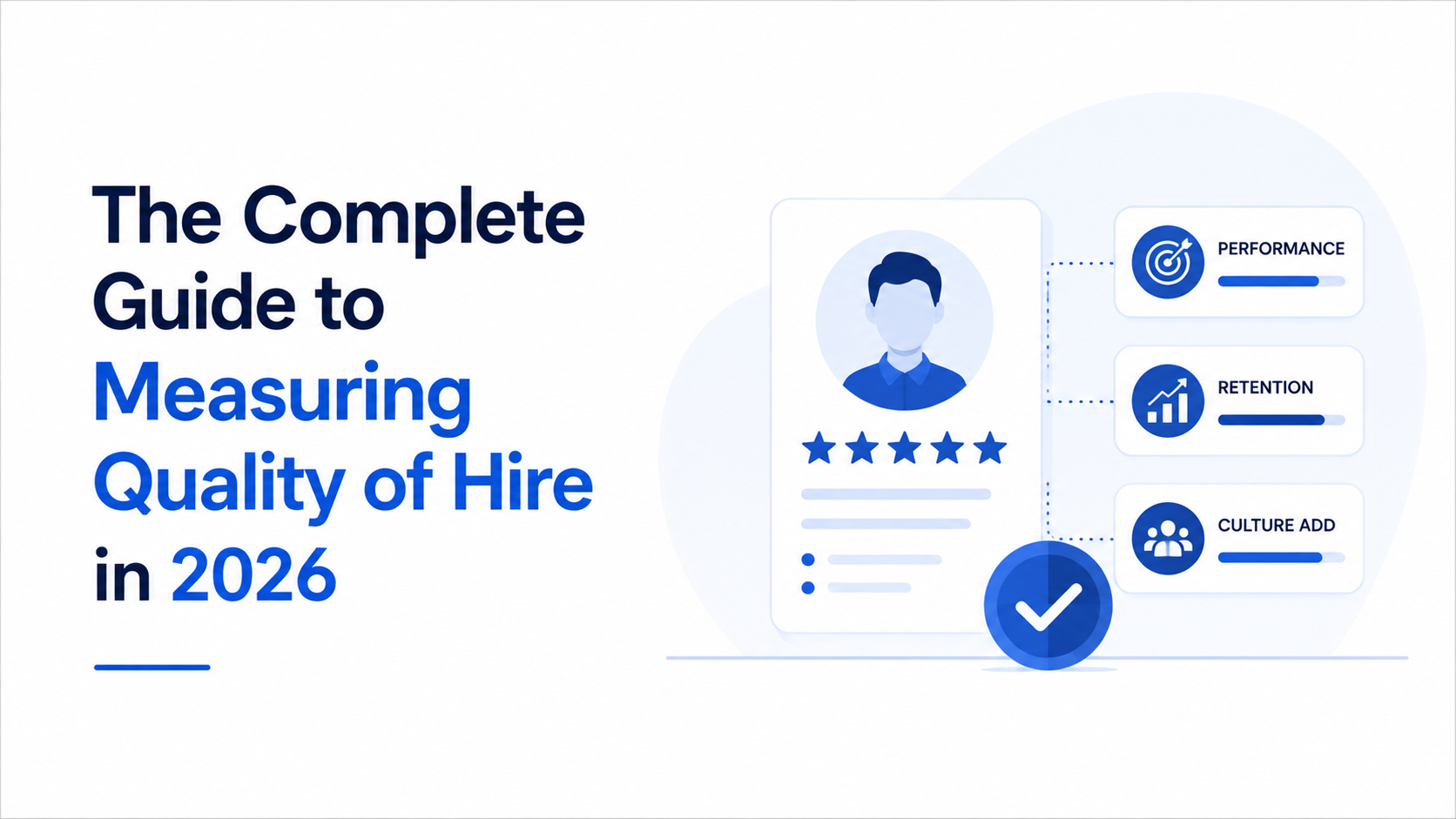
A rigorous quality-of-hire framework must capture at least four distinct dimensions. The first is job performance, which measures whether the hire is meeting the performance expectations established for the role. This dimension should be assessed through a combination of objective output metrics where available, such as sales targets, code quality scores, or customer satisfaction ratings, and structured manager assessments using a standardized rubric that is applied consistently across all hires. The key is that the performance assessment must be calibrated against the expectations that were defined during the hiring process, not against an absolute standard, because the quality of the hiring decision is determined by how well the hire matched the role's requirements, not by how the hire compares to all employees in the organization. According to LinkedIn, organizations that use calibrated performance assessments tied to pre-hire expectations report twenty-five percent higher quality-of-hire score stability over time, because the calibration eliminates the rating drift that occurs when managers use inconsistent standards across different hires.
The second dimension is retention and tenure, which measures whether the hire stays with the organization long enough to deliver a return on the hiring investment. First-year retention is the most commonly used retention metric, but it is insufficient on its own because a hire who stays for thirteen months and then leaves has a similar profile to a hire who stays for twelve months and leaves, even though the extra month provides minimal additional value. A more meaningful retention measure is the eighteen-month retention rate, which captures whether the hire has moved past the initial learning curve and established themselves as a productive contributor. The third dimension is ramp-up speed, which measures how quickly the hire reaches expected productivity levels. Two hires may achieve the same performance level at the twelve-month mark, but the hire who reached that level in three months delivered nine months of additional value compared to the hire who took nine months to reach the same level. Ramp-up speed is particularly important in fast-moving organizations where delayed productivity has a direct revenue impact.
The fourth dimension is team and cultural impact, which measures whether the hire strengthens the team's performance and dynamics or whether they create friction, reduce collaboration, or drive turnover among existing team members. This dimension is the hardest to measure objectively, but it is often the most important in practice, because a hire who performs well individually but damages team cohesion creates net negative value for the organization. The most effective approach is to measure team-level performance trends before and after each new hire, looking for changes in team output, collaboration metrics, and existing team member retention. According to Deloitte, organizations that include team impact in their quality-of-hire framework identify fifteen to twenty percent of their quality failures that would have been missed by individual performance metrics alone, because team impact captures the relational and collaborative dimensions of hiring quality that individual performance assessments cannot detect.
How to Build a Quality-of-Hire Composite Score That Actually Works
The composite score approach combines multiple quality dimensions into a single number that can be tracked as a trend line and benchmarked across the organization. The first step is to assign weights to each dimension based on the organization's strategic priorities. A rapidly scaling technology company might weight ramp-up speed most heavily because speed to productivity directly affects growth velocity. A mature enterprise might weight retention most heavily because the cost of turnover is the dominant quality concern. The weights should be determined collaboratively with business leaders, because the relative importance of each quality dimension reflects the organization's strategic context, not a universal standard. The most common weighting in organizations that have built composite frameworks is thirty percent job performance, twenty-five percent retention, twenty percent ramp-up speed, and twenty-five percent team impact, but this distribution varies significantly by industry and organizational context.
The second step is to normalize each dimension to a common scale, typically zero to one hundred, so that the weighted components can be combined meaningfully. Normalization requires defining what a score of one hundred means for each dimension. For job performance, a score of one hundred might represent performance that exceeds expectations by twenty percent or more. For retention, a score of one hundred might represent the hire remaining with the organization for at least twenty-four months. For ramp-up speed, a score of one hundred might represent reaching expected productivity within the first quarter. The normalization process forces the organization to be explicit about what good looks like for each dimension, which is itself a valuable exercise because it aligns the recruiting team, hiring managers, and business leaders on a shared definition of quality. According to Gartner, organizations that go through the normalization process report thirty percent greater alignment between recruiting outcomes and business leader expectations, because the process of defining scoring thresholds creates a shared language for quality that did not exist before.
The third step is to calculate the composite score quarterly and track it as a trend line segmented by role family, seniority, sourcing channel, and hiring manager. The trend line is more valuable than any single quarter's score, because it reveals whether the organization's hiring quality is improving, stable, or declining over time. Segmentation reveals where quality is strongest and where it needs attention, enabling targeted interventions rather than blanket improvement initiatives. Our guide on how to evaluate an AI sourcing tool emphasizes that the composite quality score is the single most important metric for evaluating whether a recruiting platform is delivering strategic value, because it captures the outcome that ultimately justifies the platform's cost and the organizational investment in AI-augmented recruiting.
The Role of AI in Making Quality of Hire Measurable and Predictable
AI recruiting platforms address two of the three core difficulties with quality-of-hire measurement. The temporal difficulty is addressed by using predictive models that estimate quality at the point of hire based on candidate data, assessment results, and engagement patterns. These predictions are not perfect, but they provide a real-time quality estimate that can be compared against actual quality outcomes as they become available, enabling the organization to calibrate its predictions and improve its accuracy over time. The attribution difficulty is addressed by tracking the complete candidate journey from first engagement through hiring decision and onboarding, which creates the data trail needed to connect specific recruiting actions, such as the sourcing channel used, the assessment methodology applied, and the timeline followed, to specific quality outcomes. According to McKinsey, AI platforms that provide both predictive quality estimates and full-journey attribution data enable organizations to improve their quality-of-hire scores twenty to thirty percent faster than organizations using traditional measurement approaches, because the combination of prediction and attribution creates a closed feedback loop where every hiring outcome informs the next hiring decision.
The most advanced capability that AI platforms bring to quality-of-hire measurement is the ability to identify the candidate attributes and process characteristics that predict quality outcomes. By analyzing thousands of historical hiring decisions and their outcomes, AI models can identify which candidate characteristics, such as specific skill combinations, career trajectory patterns, and engagement behaviors, are most strongly correlated with high-quality outcomes for specific role families. This analysis enables the platform to prioritize candidates who are not just qualified on paper but statistically likely to succeed in the specific role and organizational context. As explored in our analysis of agentic AI platforms vs automated ones, the platforms that deliver the highest quality-of-hire scores are those that use AI agents to continuously refine their prediction models based on actual hiring outcomes, creating a self-improving system where every hire makes the next hire more likely to succeed.
The practical implication for talent leaders is that AI platforms make it possible to move from retrospective quality measurement to prospective quality optimization. Rather than discovering months after a hire that quality was poor, talent leaders can use AI-predicted quality scores to make real-time adjustments during the hiring process, such as expanding the candidate pool, adjusting the assessment methodology, or reallocating recruiter resources to roles where the predicted quality of the current pipeline is below target. Our comparison of AI sourcing vs AI recruiting shows that platforms operating across the full recruiting lifecycle generate more accurate quality predictions than sourcing-only tools, because the broader data footprint from engagement, assessment, and hiring outcomes provides richer training data for the quality prediction models.
How to Segment Quality-of-Hire Data for Actionable Insights
Aggregate quality-of-hire scores provide a general sense of whether the recruiting function is performing well, but they do not provide the specificity needed for targeted improvement. The most valuable segmentation dimensions are role family, because different roles require fundamentally different candidate profiles and hiring approaches; sourcing channel, because different channels attract candidates with different quality profiles; hiring manager, because manager skill in evaluating candidates varies significantly; and time period, because quality trends reveal whether the recruiting function is improving or deteriorating. According to Deloitte, organizations that segment quality-of-hire data across at least three dimensions are fifty percent more likely to identify specific, actionable improvement opportunities than organizations that rely on aggregate scores alone.
The most powerful segmentation analysis is the intersection of sourcing channel and quality outcome. When quality data is segmented by sourcing channel, talent leaders can calculate the quality per channel, which combined with the cost per channel enables a true cost-per-quality-hire analysis by source. This analysis frequently reveals that the channels producing the highest volume of hires are not the channels producing the highest quality hires, and vice versa. A channel that produces twenty percent of hires at the lowest cost but the lowest quality score may be a net negative when replacement costs for failed hires are included. A niche channel that produces five percent of hires but the highest quality scores may be significantly undervalued and deserving of increased investment. According to EY, organizations that reallocate sourcing budget based on quality-per-channel data improve their composite quality-of-hire score by fifteen to twenty percent within two quarters, because the reallocation concentrates resources on the channels that demonstrate the strongest correlation with successful hiring outcomes.
Segmenting by hiring manager is the most politically sensitive dimension but often the most actionable. When quality-of-hire data reveals that certain managers consistently hire lower-quality candidates, the intervention is not to penalize those managers but to provide them with better assessment tools, more structured interview processes, and training on evidence-based evaluation. According to LinkedIn, organizations that use hiring manager quality data to drive targeted assessment improvement report twenty percent higher quality scores for previously underperforming managers within six months, because the data-driven approach removes the defensiveness that typically accompanies subjective feedback about hiring decisions. The key is to frame the data as a support tool rather than an evaluation mechanism, emphasizing that the goal is to give every manager the tools and process support they need to make consistently great hiring decisions.
Connecting Quality of Hire to Business Outcomes and Recruiting ROI
The ultimate purpose of measuring quality of hire is to demonstrate the business impact of the recruiting function and to justify continued investment in recruiting capabilities. The connection between quality and business outcomes operates through multiple pathways. High-quality hires reach full productivity faster, which accelerates project timelines and revenue generation. They stay longer, which reduces the recurring cost of replacement hiring. They perform better, which directly improves team output and business results. And they strengthen team dynamics, which creates positive cascading effects on the performance and retention of the people around them. According to Gartner, a ten-point improvement in the quality-of-hire composite score translates to a two to four percent improvement in business unit revenue for customer-facing roles and a fifteen to twenty percent reduction in team turnover for knowledge-work roles, because the quality of new hires has a measurable amplification effect on the performance of the teams they join.
To make this connection tangible, talent leaders should build a recruiting ROI model that connects quality-of-hire data to financial outcomes. The model should calculate the revenue or productivity impact of high-quality hires relative to low-quality hires, the cost savings from reduced turnover, and the compounding value of team-level performance improvements. When this model is populated with actual organizational data, it produces a dollar figure for the value of each quality-point improvement, which gives talent leaders a concrete business case for investing in quality-improving initiatives like AI platforms, assessment tools, and hiring manager training. Our analysis of more tools same hiring problems demonstrates that organizations with quality-to-ROI models receive thirty to forty percent larger recruiting budgets than organizations that justify spending based on volume metrics alone, because the financial clarity of the quality-ROI connection makes the business case for recruiting investment visible and credible to finance leaders and executives who evaluate all functions in terms of return on invested capital.
The most forward-thinking talent leaders present quality-of-hire data alongside business outcome data in quarterly business reviews, making the recruiting function's strategic contribution visible at the highest levels of the organization. This presentation shifts the recruiting function's perceived value from operational efficiency, how fast and cheaply can we fill roles, to strategic impact, how effectively are we building the talent base that drives business performance. The shift in perception has profound organizational consequences. Functions perceived as strategic receive larger budgets, greater access to senior leadership, and more influence over organizational decisions. Functions perceived as operational receive flat budgets, limited access, and minimal influence. The quality-of-hire measurement framework is the tool that enables this shift, because it provides the evidence base that connects recruiting activity to business outcomes in a way that is rigorous, quantifiable, and compelling to executive audiences who evaluate all functions by the value they create rather than the activities they perform.
Common Quality-of-Hire Measurement Mistakes and How to Avoid Them
The most common mistake is measuring quality too early. Organizations that assess quality at thirty or sixty days are capturing initial impressions rather than actual performance, because new hires are still in the learning curve and have not had time to demonstrate sustained contribution. The earliest meaningful quality assessment is at the ninety-day mark, and the most reliable assessment requires a full twelve months of performance data. Organizations that measure quality at thirty days consistently overestimate quality compared to organizations that measure at twelve months, because the initial period captures enthusiasm and potential rather than demonstrated capability. The second most common mistake is relying on a single measure, typically retention or manager satisfaction, rather than building a composite framework. Single-measure approaches capture at best one dimension of quality and frequently produce misleading results. A hire who stays for two years but performs poorly has high retention quality but low performance quality, and a retention-only framework would rate this hire as a success.
The third common mistake is failing to segment quality data. Aggregate quality scores conceal the variation that is needed for targeted improvement. An aggregate quality score of seventy-two out of one hundred looks acceptable, but if that score masks a range of fifty-five to eighty-eight across different role families or hiring managers, the aggregate number is hiding significant problems that require immediate attention. The fourth mistake is measuring quality without connecting it to recruiting process data. Quality of hire is an outcome metric, and outcome metrics without process data cannot drive improvement because they tell you what happened but not why it happened or what to change. According to McKinsey, organizations that connect quality outcomes to process data, including sourcing channel, assessment methodology, timeline, and interviewer composition, are sixty percent more likely to sustain quality improvements over time, because the process connection enables them to identify the specific practices that produce the best outcomes and to replicate those practices systematically across the organization.