A highly qualified software engineer opens your initial outreach email, reads through the job description, and replies with a single, cautiously optimistic sentence expressing mild interest. For most recruiters, this initial reply triggers a sense of victory, followed immediately by the challenge of what to do next. You send over the job requirements and ask for a convenient time to speak. Then, you wait. Two days pass. You send a polite "just checking in" email. Another three days pass. The candidate has gone completely silent, and that fragile window of opportunity has slammed shut. This scenario plays out thousands of times a day across the talent acquisition industry. Securing initial interest is only the very first step in a highly delicate psychological dance. The true art of recruiting lies in the follow up, a strategic process that requires impeccable timing, genuine personalization, and relentless consistency to successfully transform a fleeting reply into a confirmed interview slot.
The Fragile Window of Candidate Interest
Candidate interest is not a permanent state of mind; it is an incredibly perishable commodity, particularly when dealing with passive talent. When a prospective hire first responds to a message, they are usually operating on a fleeting burst of curiosity rather than a firm commitment to change jobs. According to behavioral insights from LinkedIn's global talent trends, the window to engage a passive candidate effectively is remarkably narrow. If you cannot capitalize on that initial curiosity and build tangible momentum within the first few days, their inherent resistance to change will take over, and they will mentally check out of the process.
Understanding the clear difference between AI sourcing and AI recruiting is critical at this exact juncture. Sourcing is the mechanical act of finding a name and extracting contact information. Recruiting, however, is the human-centric act of guiding that person through a psychological transition from their current safe situation to a new, uncertain opportunity. When a candidate expresses initial interest, the sourcing phase ends and the recruiting phase begins. If your follow up strategy consists solely of attaching a job description and asking for their availability, you are failing to recruit them. You are simply handing them a administrative task. To keep their interest alive, your follow ups must continually reinforce the specific value proposition that caught their attention in the first place, addressing their personal career motivations before they have a chance to second-guess their initial reply.
Why Generic Follow-Ups Get Ignored
The fastest way to kill candidate interest is to send a generic follow up. Phrases like "just circling back on this," "checking to see if you had a chance to review," or "touching base" are the absolute death knell of recruiting outreach. Candidates ignore these messages not because they are inherently rude, but because these emails require zero cognitive effort to delete. A generic follow up places the entire burden of the conversation back on the candidate, signaling that the recruiter is simply going through the motions rather than genuinely advocating for them.
Furthermore, generic follow ups often fail because recruiters are working with bad intelligence. If your outreach is based on outdated information, even a well-intentioned follow up will miss the mark entirely. There is a known industry issue where some recruiting platforms suffer from outdated candidate data, causing recruiters to pitch irrelevant roles or reference past projects that no longer reflect the candidate's current expertise. When a candidate receives a follow up that feels disconnected from their actual professional reality, trust is broken instantly. Effective follow ups require deep context. They must reference specific details discussed in the first touchpoint, connect the dots between the candidate's stated career goals and the open role, and provide a clear, low-friction next step. If the message could be sent to a hundred different people with only the first name changed, it is not a follow up; it is spam.
Building Strategic Recruiting Sequences
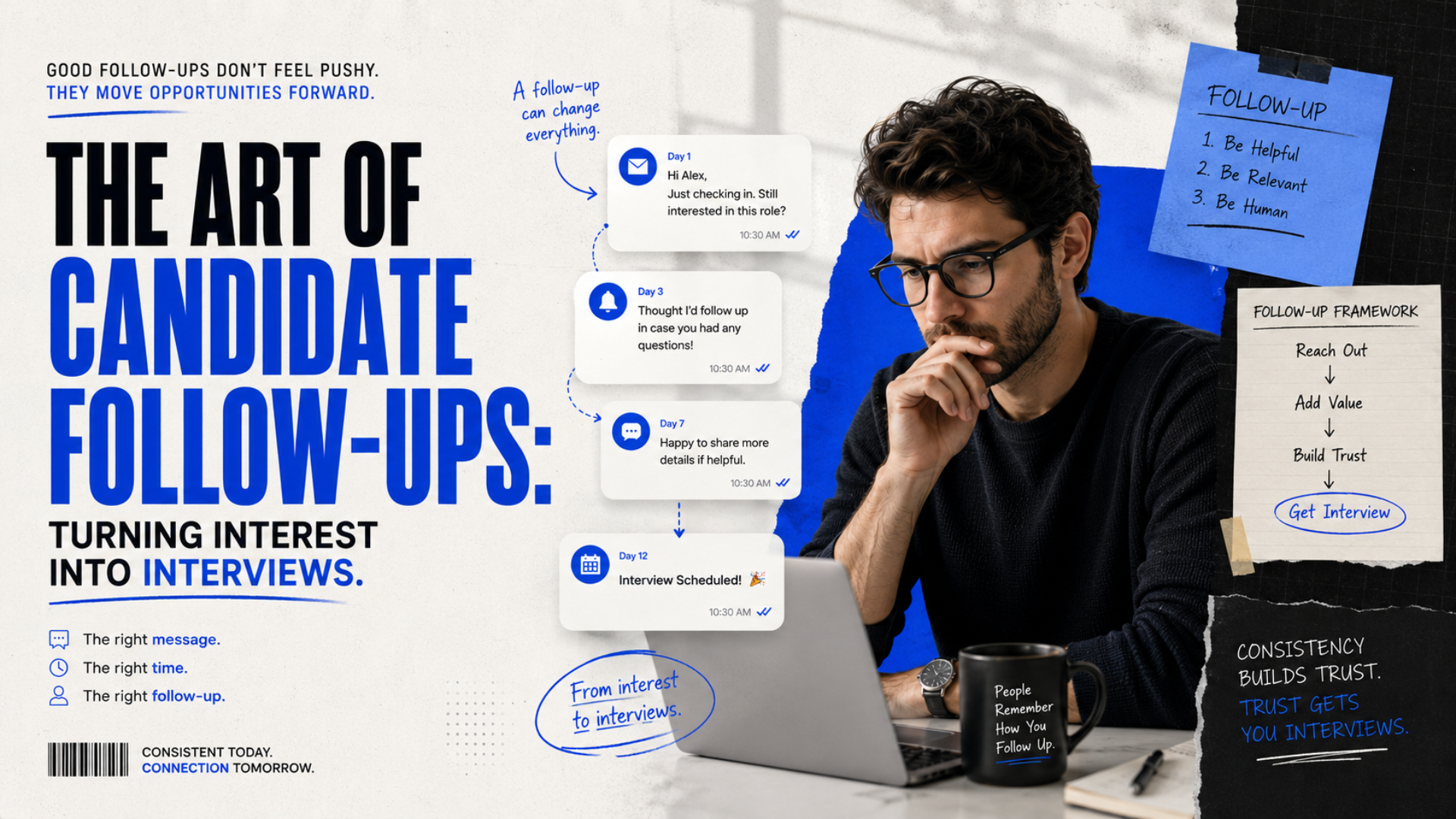
To eliminate the guesswork and inconsistency of manual follow ups, forward-thinking talent teams are turning to structured recruiting sequences. A well-designed sequence is not a single email, but a carefully orchestrated cadence of touchpoints across multiple channels, such as email, professional networks, and even targeted messaging. The goal of a sequence is to maintain a persistent, helpful presence in the candidate's inbox without crossing the line into harassment. Each step in the sequence must serve a distinct purpose, gradually escalating the value provided to the candidate.
For example, the first touchpoint in a sequence might be a simple thank you for their initial reply. The second touchpoint, sent two days later, could include a short piece of insights about the team they would be joining or a specific challenge they would be tasked with solving. The third touchpoint might shift mediums entirely, perhaps sending a connection request with a personalized note. It is a well-documented reality that referrals outperform cold outreach because they come with built-in context and trust. Your recruiting sequences should be engineered to artificially replicate that sense of context and trust over time. By systematically providing value at every stage, a strong sequence keeps the candidate engaged and gently guides them toward the ultimate goal of scheduling an interview.
The Psychological Timing of Candidate Outreach
Timing is arguably the most underestimated variable in candidate follow ups. Send your message too early, and you seem overly aggressive. Wait too long, and the candidate assumes you have lost interest or filled the role with someone else. The psychological principles of timing in recruitment are heavily influenced by the standard rhythms of the modern workweek. Research and behavioral data consistently show that Tuesday, Wednesday, and Thursday mornings typically yield the highest engagement rates for professional outreach. Messages sent on Friday afternoons or over the weekend are frequently buried and forgotten by Monday morning.
However, effective timing goes beyond just choosing the right day of the week; it involves syncing your follow ups with the candidate's actual journey through your hiring funnel. According to SHRM talent acquisition resources, candidates expect clear communication at specific milestones, such as immediately after applying, post-interview, and during offer stage transitions. If a candidate finishes a screening call on a Thursday afternoon, the optimal time to send the follow up with next steps is not the following Monday, but rather Friday morning, while the conversation is still fresh in their mind. Leveraging interview scheduling software that automatically triggers personalized follow ups based on calendar events ensures that your timing is always perfectly aligned with the candidate's experience, removing the risk of human delay.
Leveraging Automation Without Losing the Human Touch
The sheer volume of candidates in a modern talent pipeline makes manual follow up mathematically impossible for a single recruiter to execute flawlessly. This is where recruitment follow up automation and advanced candidate outreach software become indispensable. Automation ensures that no candidate falls through the cracks due to human error, illness, or simply being overwhelmed by a heavy requisition load. It guarantees that the moment a candidate takes an action, or fails to take an action, the appropriate response is generated immediately.
The fear among many recruiters is that automation will make their outreach feel robotic and cold. This was a valid concern a decade ago, but modern AI recruitment software has fundamentally changed the landscape. According to Gartner's HR technology research, the most successful talent acquisition teams are using intelligent automation to augment, rather than replace, human capabilities. The key is understanding the critical distinction between an agentic AI platform and a basic automated one. Basic automation sends static, time-triggered emails. Agentic AI, on the other hand, can analyze the context of a previous conversation, pull in relevant details about the candidate's background, and dynamically generate a follow up that sounds incredibly personal and empathetic. When implemented correctly, automation handles the logistical heavy lifting of timing and delivery, freeing the recruiter to inject strategic human insight where it matters most.
Avoiding the Trap of Tool Proliferation
As talent teams attempt to improve their follow up processes, they often fall into the trap of buying multiple disconnected point solutions. They might purchase one tool for sourcing, another for email sequences, a third for interview scheduling, and a fourth for candidate relationship management. This fragmented approach is highly counterproductive. When data lives in silos, the recruiter's ability to execute a seamless, context-aware follow up is completely destroyed. They end up constantly toggling between screens, losing the narrative thread of their conversations, and ultimately providing a disjointed experience to the candidate.
It is a common and frustrating reality that companies invest heavily in new technology but end up with more tools and the same hiring problems. To truly master the art of the follow up, recruitment leaders must demand consolidated ecosystems. The best recruitment automation software available today unifies sourcing, sequencing, scheduling, and communication into a single, cohesive workflow. When a candidate replies to an automated follow up expressing a specific concern, that concern is instantly logged in the candidate profile, and the subsequent automated touchpoints are dynamically adjusted to address it. This seamless integration is the only way to scale personalized follow ups without driving your recruiting operations team to exhaustion.
How Many Touchpoints Does It Actually Take?
One of the most frequently asked questions in talent acquisition is how many times a recruiter should attempt to contact a candidate before giving up. The answer usually surprises people. Industry data and internal analytics consistently show that a massive percentage of positive responses are generated not on the first or second attempt, but on the fifth, sixth, or even seventh follow up. Most recruiters give up after just one or two unanswered emails, mistakenly assuming the candidate is not interested. In reality, the candidate may have simply been busy, missed the email, or intended to reply later and forgotten.
Determining exactly how many followups one hire needs depends on the seniority of the role and the passivity of the candidate, but the baseline should almost always be higher than you think. The trick to high-volume persistence without fatigue lies in varying your approach. If your first three touchpoints were text-heavy emails, your fourth touchpoint could be a brief, direct message on a professional network. Your fifth touchpoint might share a relevant article or company news. By mixing the medium and the message, you remain persistent without becoming a nuisance. Automated sequences are vital here, as they ensure the recruiter hits that critical fifth or sixth touchpoint without having to manually track and execute every single step for hundreds of candidates.
Measuring and Optimizing Your Outreach Strategy
You cannot master the art of the follow up if you are not rigorously measuring your efforts. Many talent teams track basic metrics like time to fill or cost per hire, but they completely ignore the micro-metrics that dictate the success of their follow up sequences. To truly improve candidate response rates, you must dive deep into sequence analytics. Track the open rates, click-through rates, and positive reply rates of every single email in your cadence. Identify exactly where candidates are dropping off the map.
If you notice that your first follow up has a forty percent open rate but a two percent reply rate, the subject line worked but the body copy failed to provoke a response. If your third touchpoint consistently generates the highest number of booked interviews, you need to analyze what makes that specific message so effective and apply those principles to your earlier touchpoints. A/B testing is essential. Test different subject lines, different lengths of copy, different calls to action, and different send times. By treating your follow up sequences with the same analytical rigor as a marketing sales funnel, you transform recruiting from a guessing game into a precise science. Over time, this data-driven approach allows you to build highly optimized sequences that reliably turn that initial spark of interest into a booked interview, time and time again.