The average recruiter spends 7.4 seconds on an initial resume review. In that brief window, they scan for school names, company logos, job titles, and keyword matches. A candidate with a prestigious degree and a well-known company on their resume gets flagged. A self-taught developer who built a profitable side project gets overlooked because their resume does not contain the right vocabulary.
This is not a hypothetical. It is the daily reality of modern hiring. According to Gem's 2026 Recruiting Benchmarks Report, only 8% of applicants advance past initial resume screening. Yet research from Yena AI shows that 46% of resumes contain misleading information and up to 78% contain some form of inaccuracy. The document that decides who gets a chance is often the least reliable source of truth in the entire process.
The alternative — skills screening — evaluates what candidates can actually do rather than what they claim on paper. It uses assessments, work samples, simulations, and conversational evaluation to measure real capability. But it is more expensive, more time-consuming, and harder to scale.
The question is not which method is perfect. The question is which method, in which context, actually predicts who will succeed in the role. And the answer is changing faster than most recruiting teams realize.
What Resume Screening Actually Measures
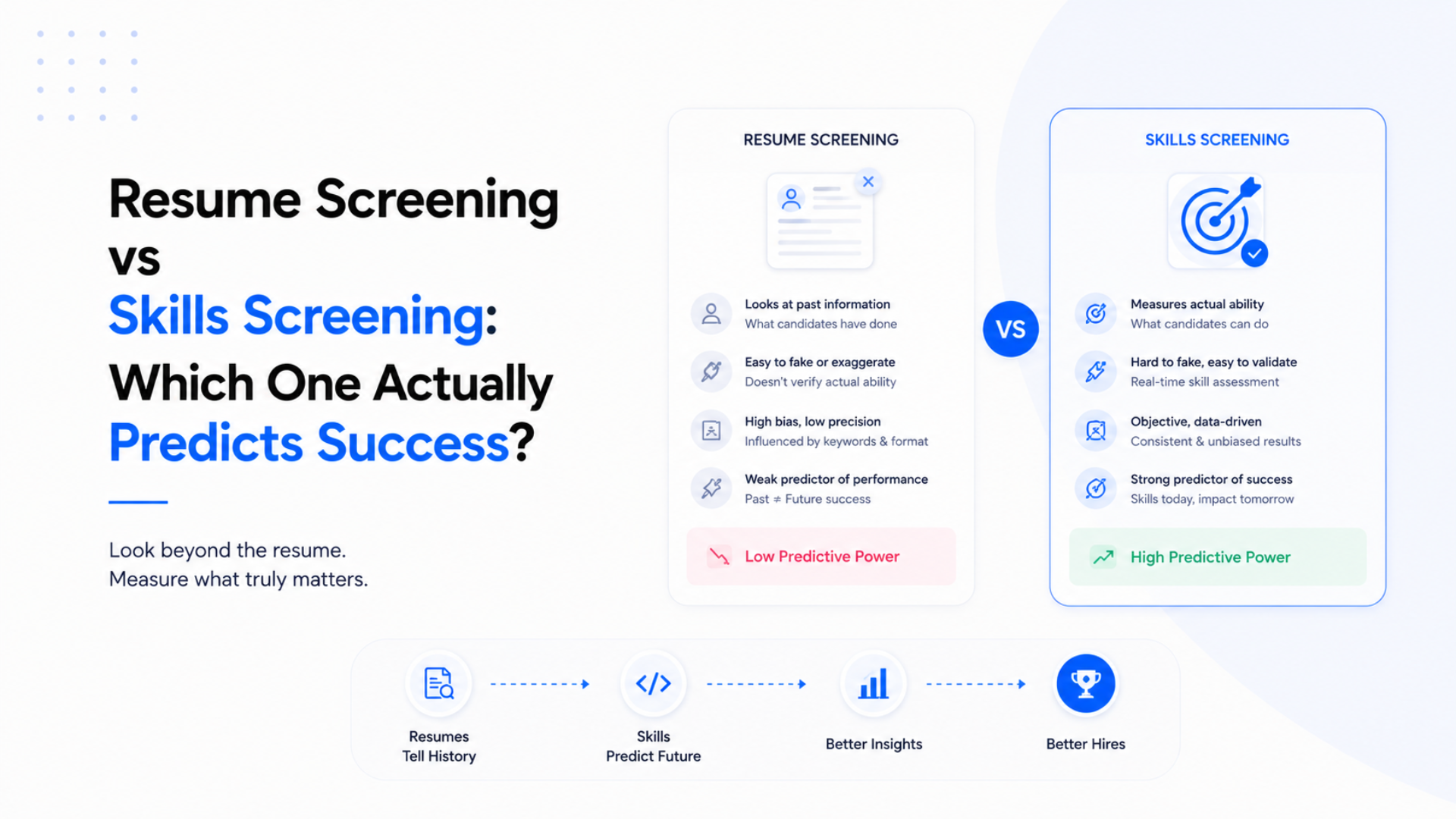
Resume screening measures four things: education, employment history, job titles, and self-reported skills. These are proxies for capability, not evidence of it.
Education is the weakest predictor of job performance. Research from the Society for Human Resource Management shows that degree requirements filter out qualified candidates without improving outcomes. When IBM removed degree requirements from half its roles, the quality of hires did not decline. The diversity of the pipeline improved. Google, Apple, Netflix, and dozens of other major employers have made similar moves. The signal that a degree once carried has been diluted by grade inflation, online credentials, and the reality that most professional skills are learned on the job, not in a classroom.
A Harvard Business School study in conjunction with the Burning Glass Institute examined over 11,000 job postings at U.S. firms from 2014 to 2023 and found that hiring of non-degree job candidates increased by just 3.5 percentage points. When researchers took into account that this applies only to the small number of jobs where the degree requirement was eliminated, it falls to less than a percentage point. Overall, fewer than 1 in 700 new hires benefited from the no-degree reforms. At companies leading the way in skills-based hiring, non-degree hires had a retention rate 10 percentage points higher than their degree-holding colleagues, and saw an average salary increase of 25%.
Employment history is slightly more predictive, but only for linear career paths. A candidate who spent five years at a single company in progressively senior roles looks stable and capable. A candidate who changed companies every two years looks like a flight risk. But in technology, the average tenure is under three years. In startups, two years is a full cycle. The resume punishes mobility in an economy that rewards it.
Job titles are notoriously inconsistent. A Senior Manager at one company might lead a team of twenty. At another, they might be an individual contributor with a fancy title. A Director at a Series A startup and a Director at a Fortune 500 company do not describe the same scope, authority, or skill set. Yet resume screening treats them as equivalent.
Self-reported skills are the most unreliable element. Candidates list skills they touched once in a training course, skills they used three jobs ago, or skills they think the job description wants to see. Without verification, a skills section is marketing, not measurement.
The fundamental problem is that a resume is a narrative document, not a data document. It tells a story the candidate wants to tell. It does not tell you whether they can solve the problems you need solved.
What Skills Screening Actually Measures
Skills screening measures demonstrated ability. It asks candidates to perform tasks, solve problems, or explain their thinking in ways that reveal actual competence.
Technical assessments evaluate coding ability, system design, data analysis, or domain expertise. Work samples ask candidates to complete a task similar to what they would do on the job — writing a marketing brief, analyzing a financial model, designing a user flow. Situational judgment tests present realistic scenarios and ask candidates how they would respond. Conversational evaluation uses structured dialogue to probe depth of knowledge, communication clarity, and problem-solving approach.
The evidence for skills-based hiring is strong. According to Eklavvya, 40% of companies have removed degree requirements from job listings, 67% of employers use structured skills assessments, and bootcamp graduates outperform traditional graduates with a 78% pass rate versus 71%. Technical roles are filled 40% faster using skills-first approaches. Skills-based hires see 25% lower turnover in their first year, and non-degree tech hires receive 23% higher ratings in hands-on tasks.
The National Association of Colleges and Employers Job Outlook 2026 survey found that 70% of employers now use skills-based hiring, up from 65% the previous year. Among this year's employers, 71% use this approach at least half of the time. The stages where employers use skills-based hiring most often are during interviewing (87%) and screening (65%). The latter is especially noteworthy as this approach has partly supplanted GPA as a screening tool. In 2019, nearly three-quarters of employers screened candidates by GPA; in 2026, just 42% are doing so.
But skills screening has its own limitations. It requires more time and resources to design, administer, and evaluate. Poorly designed assessments can introduce new biases — favoring candidates with test-taking experience or access to preparation resources. And for senior roles, where the work is strategic and relational rather than technical, traditional skills assessments may not capture the right capabilities.
The Predictive Power Question
Which method predicts success better? The answer depends on what you are predicting.
For early-career technical roles, skills screening is significantly more predictive. A coding assessment or technical challenge directly measures the ability to write software, debug systems, or analyze data. A resume cannot do this. For these roles, the correlation between assessment performance and job performance is well-established.
For senior leadership roles, the picture is more complex. Success depends on judgment, influence, vision, and the ability to navigate ambiguity. These are harder to assess through standardized tests. Resumes are also weak predictors here — a list of past titles does not reveal whether someone can lead through uncertainty. The best approach for senior roles combines structured behavioral interviews, reference checks, work sample reviews, and conversational evaluation that probes strategic thinking in depth.
For customer-facing roles, communication skills, empathy, and adaptability matter more than credentials. Skills screening through role-play scenarios or conversational AI evaluation can measure these directly. Resume screening cannot.
For specialized or emerging roles where the talent pool is small and scattered, resume screening is almost useless. There may be fifty people in the world with the exact combination of skills you need. They may not call themselves what you think they are called. They may not have the right job title. They may not even have a resume that reflects their current capabilities. Finding these candidates requires semantic AI sourcing and conversational evaluation, not document review.
Why Most Teams Still Rely on Resumes
If skills screening is more predictive, why does resume screening still dominate? The answer is a combination of inertia, cost, and scale.
Resumes are cheap to collect. Every applicant has one. They require no additional effort from the candidate beyond the initial application. They integrate easily with applicant tracking systems. They create a standardized format that makes comparison feel easy, even when the comparison is flawed.
Skills screening requires investment. Someone has to design the assessment. Someone has to evaluate the results. Someone has to manage the candidate experience so that good candidates are not deterred by a lengthy process. For a high-volume role with 500 applicants, administering a meaningful skills assessment to everyone is impractical.
This is where the false choice emerges. Teams think they must pick one or the other: fast resume screening or thorough skills evaluation. The best teams reject this binary. They use a tiered approach that combines the efficiency of initial filtering with the accuracy of deeper evaluation.
The Bias Problem in Both Methods
Neither resume screening nor skills screening is immune to bias. The question is which biases you are willing to tolerate and how you mitigate them.
Resume screening amplifies credential bias. It favors candidates from prestigious institutions, well-known employers, and linear career paths. It systematically disadvantages career-changers, self-taught professionals, immigrants with non-standard credentials, and anyone whose background does not fit the expected template.
The data is alarming. A Brookings Institution study found that out of 27 tests for discrimination across three large language models and nine occupations, gender bias was evident: men's and women's names were selected at equal rates in only 37% of cases. In the rest, resumes with men's names were favored 51.9% of the time, while women's names were favored just 11.1% of the time. Racial bias was even more pronounced — resumes with Black- and white-associated names were selected at equal rates in only 6.3% of tests. White-associated names were preferred in 85.1% of cases, while Black-associated names led in just 8.6%.
A VoxDev study of five leading large language models found that AI models systematically favor female candidates while disadvantaging Black male applicants, even when qualifications are identical. These biases could affect employment opportunities for hundreds of thousands of workers. The pro-female and anti-Black male biases persist across job types, candidate locations, and political contexts, and appear systematically across LLMs from different developers.
A University of Washington study found that unless bias is obvious, people were perfectly willing to accept the AI's biases. In one survey, 80% of organizations using AI hiring tools said they do not reject applicants without human review. Yet participants given biased AI recommendations mirrored those biases in their own decisions.
Skills screening, if poorly designed, can favor candidates with test-taking experience or access to preparation resources. It can also create barriers for candidates with disabilities, caregiving responsibilities, or limited time to complete lengthy evaluations.
The solution is not to abandon either method. It is to design systems that actively counteract bias. This means regular audits of screening outcomes by demographic group. It means structured scorecards that define criteria before candidates are evaluated. It means diverse hiring panels. It means transparency about how decisions are made. And it means giving candidates the ability to request human review of AI-driven decisions, as required by emerging regulations like the EU AI Act and Illinois HB3773.
The Compliance Landscape
The legal environment around AI hiring is tightening, and both resume and skills screening tools are affected. The EU AI Act classifies AI systems used to screen, rank, or filter job applications as high-risk, with full obligations enforceable from August 2026. Requirements include mandatory risk assessments, bias testing, human oversight, and transparency. Fines reach up to 35 million euros or 7% of global turnover.
In the United States, Illinois HB3773 requires employer notice when AI is used in hiring, prohibits ZIP codes as protected-class proxies, and imposes four-year recordkeeping. Texas TRAIGA prohibits AI deployed with intent to discriminate, with penalties of 10,000 to 200,000 dollars per violation. New York City's Local Law 144 mandates independent bias audits for AI hiring tools.
For recruiting teams, this means that any screening method — resume-based or skills-based — must produce explainable, auditable, and fair outcomes. Black-box systems that reject candidates without transparent reasoning are becoming legal liabilities. The future belongs to screening systems that can explain why a candidate was evaluated a certain way and demonstrate fairness across protected characteristics.
What the Data Says About Outcomes
The most comprehensive research on this question comes from the Harvard Business School, Burning Glass Institute, and Accenture collaboration. Their study of skills-based hiring practices found that workers hired through these methods stayed 9% longer and were more likely to be promoted. Skills-based hiring also expanded the talent pool by removing degree and experience barriers that disproportionately excluded women, minorities, and career-changers.
A meta-analysis by Sackett et al. (2021) confirmed that structured interviews have a high predictive validity of 0.42, making them among the most effective tools for assessing future job performance. Research published by the American Psychological Association demonstrates that structured interviews rank among the top procedures for predicting job performance, tied with cognitive assessments as the second-best predictor after work sample tests.
According to ECA Partners, structured interviews with preset questions are up to twice as effective at predicting job performance as unstructured counterparts. Google's internal research found that teams using structured interviews with standardized questions and evaluation rubrics saw remarkable improvements: interviewers saved an average of 40 minutes per interview, felt more prepared, and made hiring decisions that were more predictive of actual job performance. Even rejected candidates reported 35% higher satisfaction when they experienced a structured interview process.
Schmidt and Hunter's landmark 1998 meta-analysis published in Psychological Bulletin, which synthesized 85 years of personnel selection research, found that structured interviews achieve validity coefficients of 0.51 compared to 0.38 for unstructured interviews when predicting job performance.
However, the data also shows that implementation matters. Skills-based hiring programs that were poorly designed or inconsistently applied showed no improvement over traditional methods. The tool is only as good as the system around it.
The Tiered Approach: How Elite Teams Combine Both
The most effective recruiting systems do not treat resume screening and skills screening as competitors. They treat them as stages in a funnel, each optimized for a different purpose.
Stage One: Semantic Filtering
Instead of keyword-based resume screening, elite teams use semantic AI to understand meaning. The system recognizes that managing a team of ten and directing ten associates describe the same capability. It understands that a Growth Lead at a Series A startup may have more relevant experience than a Sales Manager at a Fortune 500 company. This expands the initial pool without diluting quality.
This is not resume screening in the traditional sense. It is intelligent document parsing that looks for evidence of capability rather than matching keywords. It filters out obvious mismatches without requiring human review of every application.
Stage Two: Conversational Screening
The most significant evolution in candidate evaluation is the move from static assessments to conversational screening. Instead of asking candidates to complete a separate test or questionnaire, conversational AI engages them in natural dialogue within the outreach process itself.
When a candidate responds to personalized outreach, the AI answers their questions about the role, gauges their interest, asks relevant screening questions about skills and experience, and evaluates responses in real time. This approach produces richer data than resume parsing alone. It captures communication clarity, structured thinking, and genuine interest. It adapts follow-up questions based on what the candidate says.
According to LinkedIn's 2025 hiring insights, candidates are 3.2 times more likely to complete a screening conversation embedded in an outreach exchange than a standalone assessment. The reason is simple: it does not feel like a test. It feels like a conversation.
This method also solves the false negative problem. A candidate whose resume does not contain the right keywords might reveal deep expertise in a screening conversation. A career-changer might explain how their transferable skills apply. A non-traditional candidate might demonstrate capability that a document review would never surface.
Stage Three: Targeted Skills Validation
For candidates who pass conversational screening, targeted skills assessments provide deeper validation. These are not generic tests. They are role-specific evaluations designed to measure the exact capabilities the scorecard identified as critical.
For a software engineering role, this might be a take-home project that mirrors the team's actual codebase. For a sales role, it might be a mock discovery call with a hiring manager. For a product manager, it might be a prioritization exercise using real company data. The key is that the assessment reflects the actual work, not an abstract proxy.
This tiered approach preserves efficiency at the top of the funnel while ensuring that only candidates with demonstrated capability reach the interview stage. It combines the scale of AI with the accuracy of human judgment at the moments that matter most.
Making the Choice for Your Team
The decision between resume screening and skills screening is not a philosophical one. It is a practical one that depends on your context.
If you are hiring for high-volume, entry-level roles with clear technical requirements, skills screening should be your primary method. The cost of assessment is low compared to the cost of a bad hire, and the predictive value is high.
If you are hiring for senior leadership roles, neither method alone is sufficient. You need structured behavioral evaluation, reference checks, work sample reviews, and conversational assessment that probes strategic thinking.
If you are hiring for specialized roles in a tight talent market, resume screening is almost useless. The candidates you need may not exist in your applicant pool. They may not have the right titles. They may not even be actively looking. You need semantic AI sourcing and conversational evaluation to find and assess them.
If you are a small team with limited resources, a tiered approach is the only viable path. Use semantic AI for initial filtering, conversational screening for engagement and evaluation, and targeted skills assessments for final validation. This preserves your time for the decisions that require human judgment.
The Bottom Line
Resume screening measures where someone has been. Skills screening measures what someone can do. The first is a story. The second is evidence.
For roles where the past predicts the future — stable industries, linear career paths, credential-dependent professions — resume screening may be sufficient. For roles where capability matters more than pedigree, where the work is changing faster than job titles, and where the best candidates do not fit standard templates, skills screening is essential.
The best recruiting teams do not choose one or the other. They build systems that use resume data as a starting point, not a verdict. They use semantic AI to understand meaning beyond keywords. They use conversational screening to evaluate capability in context. They use targeted assessments to validate specific skills. And they keep humans at the center of the decisions that matter.
The resume will not disappear. But its role as the primary gatekeeper to opportunity is ending. What replaces it is not a single alternative but a layered approach that combines the efficiency of automation with the accuracy of human judgment. The teams that build this approach first will hire better, faster, and more fairly than those who cling to the document.