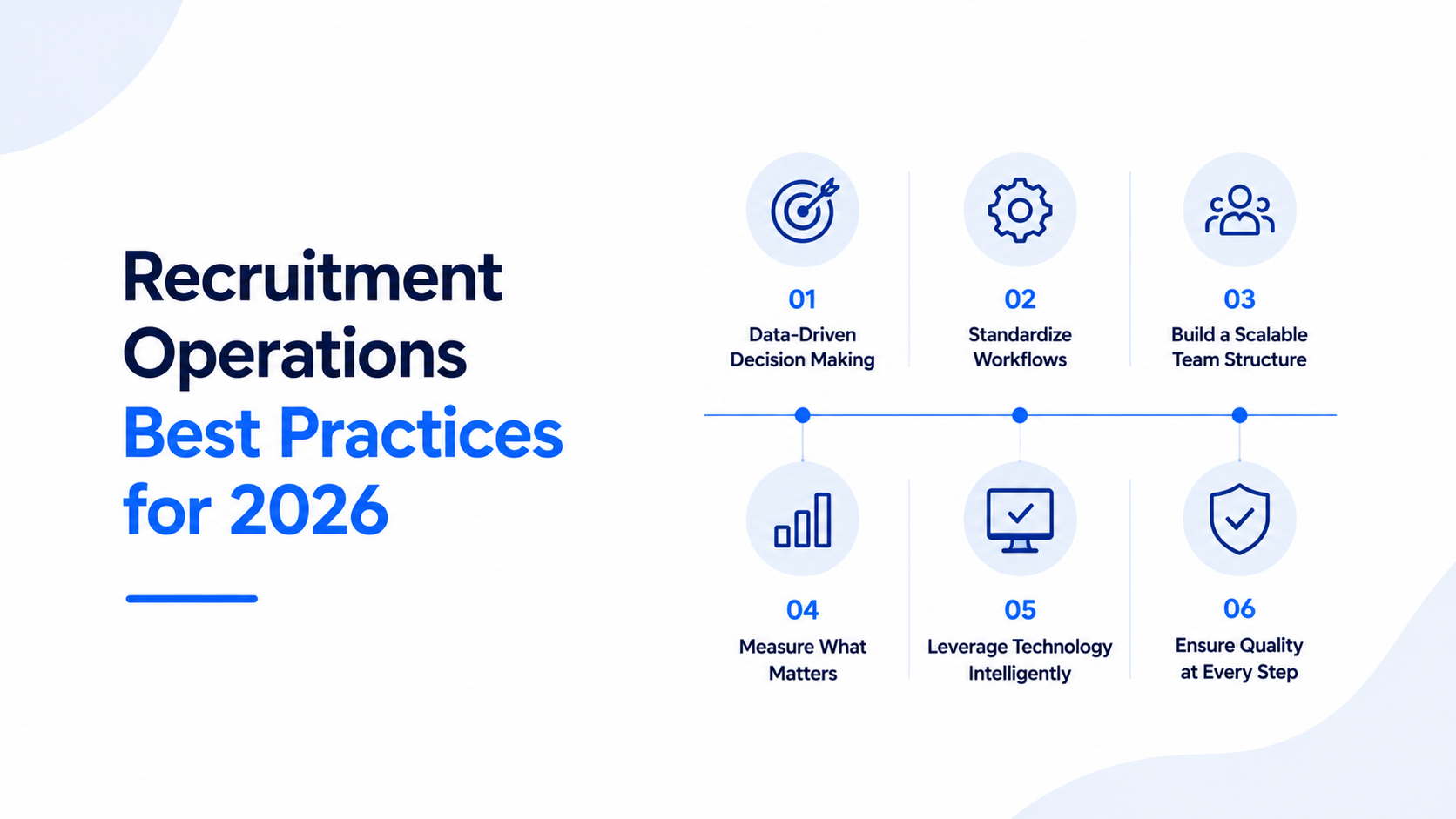
Marcus Lindqvist had rebuilt three talent acquisition functions by the time he took the VP of Talent role at a Series E fintech in early 2025. Each previous rebuild had followed the same pattern—strong recruiters, modern tools, dashboards that impressed the board—but within eighteen months each had stalled at the same ceiling of hiring volume and quality. The problem, he realized as he sat down to design the fourth rebuild, was not the recruiters or the tools. The problem was that he had been treating recruiting as a craft to be perfected rather than as an operation to be engineered. Recruitment operations—the discipline of designing, instrumenting, and continuously improving the hiring process as a system—was the missing layer, and it was the layer that separated the TA teams that scaled from the ones that hit a ceiling and stayed there. In 2026, the rules of recruitment operations are different from even two years ago. Application volumes have tripled, AI tools have multiplied, and the cost of an inefficient operation is no longer measured in recruiter hours but in lost candidates and missed hiring targets. Here are the best practices that actually move the needle in 2026.
What Recruitment Operations Actually Means in 2026
Recruitment operations is the engineering discipline behind the recruiting function. Where recruiters focus on the candidate-facing craft of sourcing, engaging, and closing, the operations function focuses on the system that makes that craft possible—the processes, data, tools, and metrics that determine whether recruiters can do their best work at scale. In 2026, recruitment operations has emerged as a distinct discipline because the complexity of modern hiring has outgrown what individual recruiters can manage through craft alone. A recruiting function without an operations discipline is a function where every recruiter reinvents the workflow, where data lives in spreadsheets and intuition, and where the talent leader cannot answer the question of whether the team is getting better or worse over time. The discipline of operations is what transforms recruiting from a collection of individual performances into a system that can be measured, managed, and improved as a whole, which is the only way that a TA function can scale beyond the capacity of its strongest individual recruiters.
The 2026 definition of recruitment operations covers four core domains that are interdependent and must be designed together. Process design defines how a requisition moves from open to hire and who owns each phase. Data infrastructure captures the metrics that reveal whether the process is working. Automation and AI integration determines which parts of the process are handled by systems and which by humans. Vendor management ensures that the tool stack supports the process rather than constraining it. A weakness in any one of these domains produces a weakness in the entire operation, because a well-designed process cannot run without good data, and good data cannot be collected without an instrumented tool stack, and a good tool stack cannot deliver value without a process designed to use it. The operations function is the function that holds these four domains together and ensures that they reinforce rather than undermine each other.
The companies that have built mature recruitment operations functions in 2026 share a common pattern: they treat operations as a peer to recruiting, not as a back-office function. According to McKinsey research on talent operations, companies with dedicated talent operations leaders report thirty-five percent faster cycle times and twenty percent higher quality-of-hire than companies where operations is a side responsibility of the TA leader. As our analysis of the recruiting dashboard every TA team needs explains, the visibility that operations provides is what enables the recruiting team to improve, because improvement requires measurement and measurement requires an operations function that owns the data and the process. The investment in operations is the investment that compounds, because every process improvement and every data instrument that the operations team builds continues to deliver value in every subsequent hiring cycle, which is the compounding effect that makes the operations function the highest-leverage investment a TA leader can make.
Process Design as the Foundation of Recruiting Operations
Process design is the foundation of recruitment operations, because every other domain—data, automation, vendor management—operates on top of the process that is designed. A poorly designed process cannot be saved by good tools, and a well-designed process can survive a weak tool stack. The first best practice in process design is to map the hiring process end to end, from requisition intake through onboarding, and to identify every handoff, every approval, every queue, and every status meeting. Most TA teams cannot produce this map from memory, which is itself a sign that the process has never been designed—it has only been inherited from the recruiters who came before. The map is the starting point for every operations improvement, because it reveals the handoffs that delay the process and the queues that consume cycle time without producing value, and these are the defects that the operations function exists to identify and eliminate.
The second best practice is to assign a single owner to each phase of the process. The reason most hiring processes degrade over time is that no one owns the process end to end, so each stakeholder optimizes their own piece without regard for the cumulative effect on the candidate or the cycle time. According to Gartner talent acquisition research, companies that have assigned phase owners with accountability for cycle time and conversion rate at each phase have reduced their average time-to-fill by twenty-eight percent within two quarters. The phase owner is not the person who does the work of the phase—they are the person who is accountable for the phase's metrics and who has the authority to redesign the phase when the metrics indicate a problem. This accountability structure is what transforms a process from a sequence of handoffs into a system that can be improved phase by phase, because without ownership, every defect becomes everyone's responsibility and therefore no one's responsibility.
The third best practice is to revisit the process design quarterly, because the process that worked at one hiring volume will not work at a different volume. The screening process that handled two hundred applications per requisition will collapse under six hundred, and the interview process that worked for ten open requisitions will not work for thirty. According to Deloitte workforce analytics, companies that hold quarterly process reviews are forty percent more likely to report year-over-year improvements in hiring efficiency, because the cadence of review and redesign keeps the process aligned with the actual hiring volume and role mix. As our analysis of agentic AI platforms vs automated ones shows, the platforms that deliver the greatest operational improvement are those that are implemented on top of a process that is already well-designed, because the platform amplifies the process rather than compensating for its defects, and a platform implemented on a broken process produces a faster broken process.
Data Infrastructure That Powers Operational Decisions
Data infrastructure is the layer of recruitment operations that most TA teams have on paper and few have in practice. Most teams have an ATS that captures requisition data and a dashboard that reports time-to-fill and cost-per-hire, and they believe this constitutes a data infrastructure. It does not. A data infrastructure is a system that captures the metrics at each phase of the process, that segments those metrics by role family and sourcing channel, and that enables the operations team to ask and answer diagnostic questions about why the process is performing the way it is. The difference between a dashboard and a data infrastructure is the difference between knowing that time-to-fill is forty-two days and knowing that the screening phase takes twelve of those days for engineering roles and four for sales roles, which is the diagnostic depth that drives actual improvement rather than just reporting.
The first best practice in data infrastructure is to instrument every phase of the process with a phase-level cycle time and conversion rate metric. According to LinkedIn talent research, companies that measure phase-level metrics are forty-five percent more likely to identify and fix the specific bottleneck that is driving their aggregate time-to-fill, because the phase-level metrics reveal which phase to improve rather than just that something needs to improve. The instrumentation does not need to be sophisticated—it can be as simple as a timestamp at each phase transition—but it needs to be consistent across every requisition so that the data can be aggregated and analyzed. The consistency is the hard part, because it requires every recruiter to follow the same process and to record the same data, which is one of the reasons that operations owns the data infrastructure rather than individual recruiters who may each have their own way of working.
The second best practice is to segment the data by the dimensions that matter for decision-making. Aggregate metrics are useful for board reporting but useless for operations, because the aggregate hides the variation that drives the diagnosis. A time-to-fill of forty-two days that represents twenty-eight days for engineering and fifty-six days for sales is a different operational problem than a time-to-fill of forty-two days that is uniform across role families, and the segmentation is what reveals which problem you have. As our guide on how to evaluate an AI sourcing tool explains, the platforms that deliver the greatest operational value are those that produce segmented data as a native output, because the segmentation is what enables the operations team to identify the specific channels and role families where the process is working and where it is not, which is the diagnostic that drives every operational improvement decision and that aggregate reporting simply cannot provide.
Automation and AI in the Recruiting Operations Stack
Automation and AI have transformed recruitment operations in 2026, but the transformation has been uneven. The teams that have done it well have used automation to remove the repetitive, low-judgment work that was consuming recruiter time, and they have used AI to handle the high-volume tasks that humans cannot do well at scale. The teams that have done it poorly have used automation and AI as a substitute for process design, expecting the technology to fix a process that was broken before the technology was introduced. The best practice is to automate only after the process is designed, because automation amplifies the process—whether it is good or bad—and automating a broken process produces a faster broken process that fails more candidates more efficiently than the original manual version ever could.
The first best practice in automation is to identify the tasks that are genuinely repetitive and low-judgment, and to automate them completely. Scheduling, status updates, application acknowledgments, and interview feedback collection are all tasks that consume recruiter time without producing differentiating value, and they should be fully automated in any modern recruiting operation. According to SHRM research on recruiting automation, companies that have automated these administrative tasks have freed up twenty-five to thirty percent of recruiter time, which can be redirected to the high-judgment work of candidate engagement and evaluation that humans are best at. The automation is not about replacing recruiters—it is about removing the work that recruiters should not have been doing in the first place, so that they can spend their time on the work that creates value and that no automated system can replicate regardless of how sophisticated it becomes.
The second best practice is to use AI for the high-volume tasks that exceed human capacity, not as a replacement for human judgment. Candidate screening at three hundred applications per requisition is a task that no human can do well, because the time per application is too short for genuine evaluation. AI screening tools that rank candidates by predicted fit and surface the top twenty percent for human review are doing a task that humans cannot do at scale, and the human review of the surfaced candidates is doing a task that AI cannot do well. As our analysis of AI sourcing vs AI recruiting explains, the most effective recruiting operations in 2026 are those that have found the right division of labor between AI and humans—AI for volume and consistency, humans for judgment and relationship—and the operations team is the function that designs and maintains this division of labor as the tools and the process evolve together over time.
Vendor and Tool Stack Management
Vendor management has become a critical recruitment operations discipline in 2026 because the tool stack has become the operating system of the recruiting function, and an operating system that is not actively managed produces a function that does not perform. The average enterprise TA team in 2026 has between eight and fifteen tools in its stack—ATS, sourcing platform, screening tool, scheduling tool, assessment platform, video interview platform, background check vendor, offer management tool, analytics platform, and various point solutions for specific role families or geographies. Each of these tools was purchased to solve a specific problem, but the cumulative effect of the stack is a system that no one is managing, and the result is a stack that produces less value than the sum of its parts because the tools are not integrated and the team is not trained to use them to their full capability.
The first best practice in vendor management is to conduct a quarterly stack audit, where the operations team evaluates each tool against its intended purpose and its actual usage. According to EY research on HR technology, the average enterprise TA team has at least three tools that are paid for but not used and at least two that are used for a purpose different from what they were purchased for. The stack audit identifies these tools and either repurposes them, consolidates them, or eliminates them, which reduces cost and simplifies the stack. The audit also identifies the tools that are delivering value and ensures that they are integrated with the rest of the stack, because an integrated stack produces more value than a collection of point solutions that do not talk to each other and that force the recruiting team to maintain duplicate data across multiple systems that should be a single source of truth.
The second best practice is to evaluate each tool against the process that it supports, not against the vendor's marketing claims. A tool that is excellent in isolation may be a poor fit for a process that was designed around a different tool, and the cost of switching tools includes the cost of redesigning the process that the tool supports. As our analysis of more tools same hiring problems argues, the teams that have built the most effective tool stacks are the ones that have started from the process and selected tools that support the process, rather than starting from the tools and trying to design a process around them. The operations team is the function that maintains this discipline, because the operations team owns the process and is therefore in the best position to evaluate whether a new tool will improve the process or complicate it, and this evaluation is the difference between a tool stack that compounds in value and one that accumulates in cost.
Team Structure and Accountability
The team structure that supports recruitment operations in 2026 looks different from the team structure of five years ago, because the operations function has emerged as a distinct discipline with its own roles and career path. The modern TA team has three functions that operate in parallel: recruiting, which owns the candidate-facing craft; operations, which owns the process, data, and tools; and business partnering, which owns the relationship with hiring managers and the alignment of hiring with business strategy. These three functions are interdependent, and a weakness in any one produces a weakness in the team, because strong recruiting cannot compensate for weak operations, and strong operations cannot compensate for weak business partnering, and strong business partnering cannot compensate for either, which is why the talent leader must invest in all three functions in parallel rather than treating one as primary and the others as supporting.
The first best practice in team structure is to have a dedicated operations leader who reports to the VP of Talent and who owns the process, data, and tools as an integrated system. According to McKinsey research on talent operations, companies with dedicated operations leaders report thirty-five percent faster cycle times and twenty percent higher quality-of-hire, because the dedicated leader has the authority to redesign the process and the accountability for the metrics that the redesign produces. The operations leader is not a project manager—they are a functional leader with the same stature as the head of recruiting, because the operations function is as important to the team's performance as the recruiting function, and a team that treats operations as a back-office function will not produce the operational excellence that distinguishes the best TA teams from the average ones regardless of how strong the individual recruiters happen to be.
The second best practice is to staff the operations team with people who have a mix of process design, data, and technology skills, because the operations function spans all three disciplines. The traditional HR career path does not produce these skills, which means that the most effective operations teams are staffed with people from operations, engineering, and analytics backgrounds who have moved into talent acquisition, because the skills are more transferable than the domain knowledge. As our analysis of the recruiting dashboard every TA team needs shows, the operations teams that produce the most useful dashboards and insights are the ones that have the analytical skills to ask the right questions and the process knowledge to know which answers are actionable, and this combination of skills is what the operations team must be built to provide if it is to deliver the operational improvements that justify its existence and its cost to the broader organization.
Measuring and Improving Operations Performance
The performance of a recruitment operations function is measured differently from the performance of a recruiting function, because the operations function's value is indirect—it enables the recruiting function to perform. The recruiting function is measured by time-to-fill, quality-of-hire, and offer acceptance rate. The operations function is measured by the health of the process, the quality of the data, the effectiveness of the tool stack, and the rate of improvement over time. These metrics are less familiar than the recruiting metrics, but they are the metrics that determine whether the recruiting function will improve or stagnate, because the operations function is what produces the conditions for recruiting improvement, and measuring the conditions is the only way to know whether the operations function is doing its job.
The first best practice in measuring operations performance is to track process cycle time and conversion rate at each phase, and to monitor the trend over time. A healthy operations function produces a process whose cycle time and conversion rate improve quarter over quarter, because the operations team is continuously identifying and fixing bottlenecks. According to Deloitte workforce analytics, companies that track phase-level cycle time trends are forty percent more likely to report year-over-year improvements in hiring efficiency, because the trend data reveals whether the operations function is improving the process or merely maintaining it. The trend is the metric that matters, because a single quarter's numbers can be the result of market conditions rather than operations performance, and the trend strips out the noise and reveals whether the operations function is actually making the system better over time.
The second best practice is to measure the operations function's contribution to the recruiting function's outcomes, because the ultimate measure of operations is whether the recruiting function is improving. The operations function should be able to point to specific process changes that produced specific improvements in time-to-fill, quality-of-hire, or offer acceptance rate, and the absence of these specific examples is a sign that the operations function is maintaining the process rather than improving it. The talent leaders who have built the most effective operations functions in 2026 are the ones who treat operations as a strategic investment with measurable returns, not as a cost center that supports the recruiting function, and this strategic framing is what produces the investment and the discipline that the operations function needs to deliver the compounding improvements that distinguish the best TA teams from the rest. Recruitment operations is not a back-office function. It is the engineering layer that turns recruiting from a craft into a system, and in 2026, the system is what scales.