AI recruiting software can discover candidates who never applied for a job.
It can collect or enrich professional information, identify possible contact routes, personalize outreach, classify candidate responses, conduct initial screening conversations, create transcripts, generate summaries, rank candidate relevance, and help recruiters decide who should move toward an interview.
This can make hiring significantly faster.
It also creates an obvious privacy question.
Is the software compliant?
The short answer is more complicated than a yes or no.
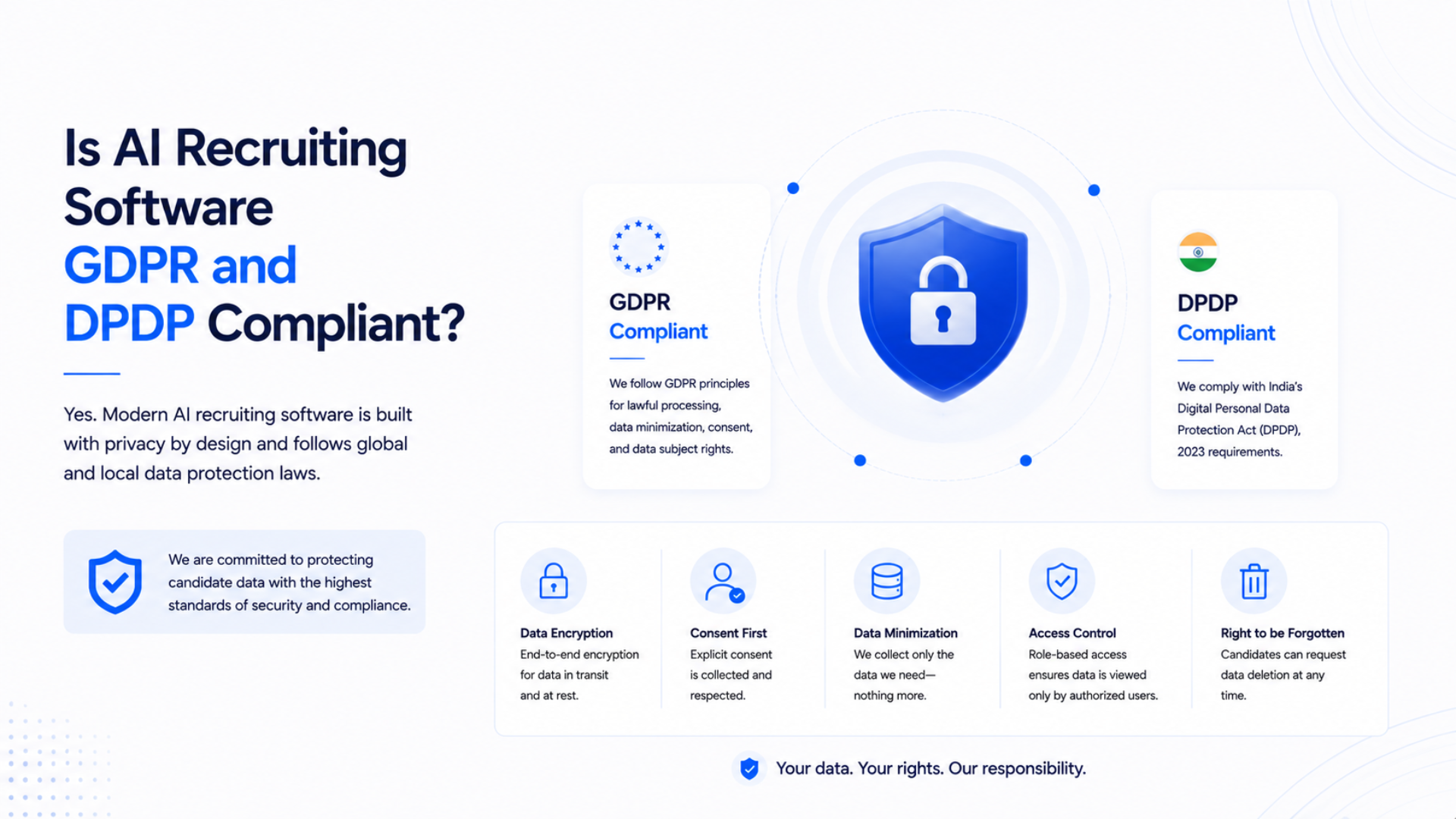
AI recruiting software can be used in ways that support GDPR and India’s Digital Personal Data Protection framework, but no platform makes a recruiting organization automatically compliant. Compliance depends on the software, the organization using it, the purpose of processing, the candidate-data sources, the configuration, the contracts, the security controls, the AI workflow, and the decisions made around candidate information.
This distinction is important because software vendors often use compliance language as a product feature.
A platform may say that it is GDPR compliant.
Another may describe itself as DPDP ready.
A third may mention encryption, secure infrastructure, consent management, or data deletion.
These capabilities matter.
They do not answer the complete question.
A recruiting platform may provide strong security controls while a customer keeps candidate information indefinitely.
A vendor may provide deletion tools while the recruiting team copies candidate records into several uncontrolled spreadsheets.
The software may allow human review while a company configures the workflow to reject candidates automatically.
A system may offer configurable notices while the organization never provides the correct information to passive candidates.
The product and the recruiting process need to be evaluated together.
This is especially important for companies recruiting across both India and Europe.
The European Union’s General Data Protection Regulation and India’s Digital Personal Data Protection framework share some broad ideas around lawful personal-data processing, transparency, security, individual rights, and organizational responsibility.
They are not identical laws.
The terminology is different.
The legal bases are different.
The operational requirements are different.
The treatment of automated decision-making is different.
A company should therefore avoid building one generic “global privacy” process and assuming it automatically satisfies every jurisdiction.
The stronger approach begins with the candidate-data journey.
What information enters the recruiting system?
Where did it come from?
Why is the company using it?
What does the AI do with it?
Who receives the output?
How long does the information remain?
What happens when the candidate asks a question, corrects information, withdraws consent where relevant, objects where applicable, or requests erasure?
These questions reveal whether the recruiting workflow is actually being governed.
Why AI Recruiting Creates a Bigger Privacy Problem Than a Traditional ATS
Traditional applicant tracking systems mainly began with candidates who entered the process themselves.
A person saw a job.
They completed an application.
They submitted a resume and contact information.
The company processed that information as part of a visible hiring relationship.
Modern AI recruiting can begin much earlier.
The candidate may never have heard of the company.
An AI sourcing tool may identify the person from professional information.
The system may compare their career history with a hiring requirement.
Contact enrichment may add a work email or another professional contact route.
AI may generate a personalized message.
The candidate may then enter a screening workflow.
Each stage creates or adds information.
The sourced profile contains one set of data.
Contact enrichment adds another.
Outreach creates communication history.
AI screening may create audio, transcripts, summaries, scores, or recommendations.
Interviewers add feedback.
The complete candidate record becomes much richer than the original profile.
This is why AI recruiting privacy cannot be reduced to one question about consent.
The company needs to understand the complete processing chain.
The official GDPR text applies to the processing of personal data and establishes obligations around principles such as lawfulness, fairness, transparency, purpose limitation, data minimization, accuracy, storage limitation, security, and accountability. India’s DPDP Act similarly creates a framework for processing digital personal data for lawful purposes while recognizing individual data-protection rights.
The practical challenge is applying these principles to a recruiting workflow that can now act faster than the people operating it.
What Candidate Information Can AI Recruiting Software Process?
The obvious data includes the candidate’s name, email address, phone number, resume, professional profile, employment history, education, skills, and location.
AI recruiting can create additional data.
A candidate-match score is information connected with a person.
A ranking is information about that person’s estimated relevance.
A screening transcript relates to the candidate.
A summary of strengths and gaps relates to the candidate.
A recruiter note relates to the candidate.
A classification such as “interested,” “qualified,” or “not suitable” can also become part of the candidate record.
The privacy question therefore extends beyond the information the candidate originally published or submitted.
AI creates derived information.
Suppose a candidate profile says that the person worked for three software companies.
The AI may infer seniority, estimate role relevance, identify likely transferable experience, and rank the person against other professionals.
Those outputs may influence whether the recruiter ever sees the candidate.
The organization needs to understand this processing.
AI-generated information should not be treated as automatically objective because software produced it.
A match score is still an estimate.
A summary can contain errors.
A recommendation depends on the criteria, data, and system design behind it.
The more influence these outputs have on employment opportunities, the more carefully they should be governed.
What Does GDPR Compliance Mean for AI Recruiting?
GDPR compliance begins with the processing activity rather than the software brand.
The organization should understand whether GDPR applies, what personal data is being processed, why it is being processed, which lawful basis is relied upon, what information needs to be provided to individuals, which vendors receive the data, how international transfers are handled, how long information is retained, and how individual rights are supported.
The official GDPR text remains the primary legal source, while the European Data Protection Board provides guidance on issues including profiling, automated decision-making, legitimate interests, and individual rights.
For recruiters, one of the most important lessons is that publicly available professional information does not automatically become unregulated information.
A candidate may publicly list a job title, employer, and skills.
A recruiting company may still need to consider its purpose, lawful basis, transparency obligations, data accuracy, retention, and the rights available to the person.
The same applies when information is enriched.
Finding a professional email address does not end the compliance analysis.
The company should understand why it needs the information, how it will use it, whether the contact is appropriate, and how the candidate can understand the processing.
This is why Huntlo’s guide to How Do AI Recruiting Tools Find Verified Contact Details? is relevant to the privacy discussion. Contact discovery is a technical process, while compliance governs the surrounding use of that information.
What Does DPDP Compliance Mean for AI Recruiting in India?
India’s Digital Personal Data Protection Act, 2023 creates a framework for the processing of digital personal data.
The Act uses terminology that differs from GDPR.
The individual is generally described as the Data Principal.
The organization determining the purpose and means of processing is the Data Fiduciary.
An organization processing personal data on behalf of a Data Fiduciary may act as a Data Processor.
The Act addresses areas including notice, consent, certain legitimate uses, obligations of Data Fiduciaries, security safeguards, breach notification, individual rights, children’s data, and additional obligations for Significant Data Fiduciaries.
The regulatory position also needs to be described accurately in 2026.
India moved beyond the original 2023 Act and the draft-rules stage. The final Digital Personal Data Protection Rules, 2025 were notified in November 2025 with phased commencement provisions, alongside implementation steps including the establishment of the Data Protection Board of India. Recruiting teams should therefore review which provisions and rules are in force for their processing activities rather than relying on older articles that still describe the framework as entirely pending.
For AI recruiting companies operating in India, the practical implication is clear.
DPDP readiness should no longer mean waiting for the law to become relevant.
Organizations need to map candidate data, understand their role, review notices and consent workflows where applicable, establish security and breach processes, manage processors, support Data Principal rights, and track the phased implementation of obligations that affect their activities.
GDPR and DPDP Are Similar in Purpose but Not Identical
Both frameworks care about responsible personal-data processing.
That does not mean a GDPR program can simply be renamed a DPDP program.
GDPR provides several lawful bases for processing personal data.
These include consent and other grounds specified in Article 6.
India’s DPDP framework is structured differently around consent and certain legitimate uses.
The terminology around individual rights also differs.
GDPR contains detailed provisions around profiling and solely automated decisions that produce legal or similarly significant effects.
The DPDP framework should not be described as containing an identical copy of GDPR Article 22.
This difference matters in AI hiring.
A global recruiting company may use the same AI screening platform in Europe and India.
The underlying software is the same.
The legal analysis may not be.
The company should understand the relevant framework for the candidate and processing context.
A good global privacy program creates common technical standards where possible.
Strong security.
Clear data mapping.
Limited access.
Defined retention.
Vendor governance.
Human oversight.
Accurate records.
Then the organization adds jurisdiction-specific legal requirements.
This is stronger than forcing every country into one legal template.
Is Candidate Consent Always Required?
No universal answer applies to every AI recruiting activity.
Under GDPR, consent is one possible lawful basis, but it is not the only one.
The appropriate basis depends on the processing activity and circumstances.
A person who applies for a role creates a different context from a passive professional identified through outbound sourcing.
The company should document why it processes the information and which basis applies.
Consent, when used under GDPR, must satisfy specific conditions.
It should not be treated as a convenient checkbox that gives the company unlimited permission to use candidate information forever.
Under India’s DPDP Act, consent also receives significant attention. The Act states that consent should be free, specific, informed, unconditional, and unambiguous, with clear affirmative action, and it provides for withdrawal of consent. The Act also recognizes certain legitimate uses, meaning the complete legal framework should be examined rather than reducing every processing activity to one consent screen.
For recruiting teams, the operational lesson is to avoid vague permission.
If the company is processing data for an active application, it should understand that purpose.
If it wants to retain the candidate for future roles, that continued use should be considered separately.
If it is sourcing a passive candidate, the organization should examine the relevant legal framework for that activity.
The answer should come from the workflow.
Can AI Recruiting Software Source Passive Candidates Legally?
Passive candidate sourcing is one of the most difficult areas because the person did not apply.
The AI may identify someone from professional information and add them to a recruiting workflow.
Under GDPR, organizations may consider different lawful bases depending on the circumstances, and legitimate interests can be relevant to some recruiting activities where the required conditions are satisfied.
This is not automatic permission to collect unlimited information.
The organization should consider the actual recruiting interest, necessity of processing, candidate expectations, impact on the individual, amount of data, and available safeguards. The EDPB’s guidance on legitimate interests emphasizes the need for a structured assessment rather than simply using the phrase as a universal justification.
Relevance matters.
Processing limited professional information to approach someone about a genuinely connected role creates a different context from collecting extensive personal information about thousands of unrelated people.
This is another reason AI sourcing quality matters.
A system that identifies relevant candidates and uses limited job-related information can support a more disciplined workflow.
A system that collects everything available because storage is cheap creates greater risk.
Huntlo’s guide to What Is Passive Candidate Sourcing? explains the recruiting side of this process, while privacy governance determines how candidate information should be handled around it.
Can AI Recruiting Tools Find and Use Candidate Contact Details?
AI recruiting tools can support contact discovery through identity matching, employer information, company domains, existing professional data, email patterns, and verification checks.
The privacy question is separate from the technical capability.
A technically valid email address does not answer whether the organization’s processing and communication are appropriate.
The recruiting team should understand where the data came from.
The vendor’s data practices matter.
The purpose of contact matters.
The candidate’s jurisdiction may matter.
The channel matters.
The company should also consider what happens after the first contact.
Can the person understand who is contacting them?
Can they understand why?
Is there an appropriate way to stop further communication?
Does the system stop automated follow-ups after a response?
A compliant workflow should not become a license for mass outreach.
Good privacy practice and good recruiting practice often point in the same direction.
Contact fewer irrelevant people.
Use better candidate matching.
Explain why the opportunity is relevant.
Respect candidate choices.
Avoid unnecessary data collection.
What Information Should Candidates Receive?
Transparency is central to both GDPR and the DPDP framework, although the specific legal requirements and terminology differ.
A privacy notice should not exist only to protect the company.
It should help the candidate understand what is happening.
Depending on the applicable framework and circumstances, relevant information may include who is processing the data, what information is involved, why it is being processed, how it may be used, relevant rights, how to contact the organization, and other required details.
The challenge becomes greater with passive sourcing.
An applicant knows they submitted information.
A passive candidate may not know that an AI system identified their profile, enriched contact information, created a relevance score, or added them to a recruiting workflow.
Recruiting teams should design transparency around this reality.
The notice should also match the actual technology.
A company should not describe the process as simple resume storage when AI is ranking candidates and generating recommendations.
The privacy explanation should be accurate enough to reflect meaningful processing.
Is AI Candidate Matching Compliant?
AI candidate matching is not automatically compliant or non-compliant.
The answer depends on how it works and how it is used.
A system may compare job-related evidence such as skills, titles, experience, seniority, industry context, and location with a hiring requirement.
The result may help the recruiter prioritize profiles.
That is different from a system that automatically excludes candidates from employment consideration without meaningful review.
The organization should understand which data enters the matching process.
The criteria should be relevant to the role.
The system should avoid using protected or inappropriate characteristics.
Recruiters should be able to understand why a candidate appears relevant.
The underlying data should be as accurate as reasonably possible.
Huntlo’s guide to How Does AI Candidate Matching Actually Work? explains why match scores should be treated as decision support rather than objective truth.
This distinction matters for compliance.
The more an AI output affects candidate opportunity, the more important oversight becomes.
Is AI Screening GDPR and DPDP Compliant?
AI screening can be used within a compliant workflow, but it deserves careful attention because the system may process richer candidate information.
A screening platform may collect answers.
A voice system may process audio.
The software may create a transcript.
An AI model may summarize evidence.
The platform may generate a score or recommendation.
The company should know exactly which of these events occur.
Recruiting teams should ask whether audio is stored.
They should understand how long transcripts remain.
They should know which AI providers receive candidate content.
They should ask whether candidate data is used for general model training.
They should understand how recommendations are created.
They should ensure that candidates receive appropriate information.
They should also avoid unnecessary analysis.
An AI screening system should evaluate job-relevant evidence.
It should not infer sensitive personal characteristics, emotions, personality, health conditions, or other unrelated attributes simply because the technology claims to be capable of doing so.
The purpose of AI screening should be clearer evidence.
Not invisible surveillance.
What About Automated Candidate Rejection?
This is one of the most important differences between simple AI assistance and high-impact automation.
Under GDPR, Article 22 and related EDPB guidance require particular attention where decisions are based solely on automated processing and produce legal effects or similarly significantly affect the person. The EDPB also explains that individuals have protections in relation to certain fully automated decisions.
Recruiting can create significant consequences.
A company should therefore examine whether AI is merely helping a recruiter review candidates or effectively determining who receives an opportunity.
The word “human-in-the-loop” is not enough.
Suppose the AI rejects 10,000 candidates and shows only 100 to the recruiter.
A human may make the final choice among those 100.
The system still played a major role in determining who became visible.
Another platform may show a rejection recommendation.
If recruiters approve almost every recommendation without examining the evidence, the human review may be weak.
Meaningful oversight requires more.
The recruiter should be able to understand the recommendation.
They should have access to relevant evidence.
They should have authority to disagree.
They should have enough time to review the decision.
For India, organizations should avoid claiming that the DPDP Act contains an identical automated-decision rule to GDPR Article 22.
However, AI hiring decisions still create issues around fair processing, accuracy, security, purpose, candidate rights, organizational responsibility, and broader employment governance.
A strong global standard is to preserve meaningful human judgment for consequential hiring decisions even where the legal frameworks differ.
Can Recruiters Keep Candidate Data Forever?
They should not assume so.
Under GDPR, storage limitation is an important principle.
Personal data should not simply remain because the software has unlimited storage.
The organization should understand why the information is still needed.
India’s DPDP framework also creates obligations around erasure when the relevant purpose is no longer served and retention is not otherwise necessary under applicable law, subject to the framework’s requirements.
This has major implications for recruiting databases.
An active candidate record may clearly serve a current hiring purpose.
A strong previous finalist may remain relevant to a future talent pipeline.
A candidate record from many years ago may contain outdated employment information, invalid contact details, and no active relationship.
Keeping everything forever can make the recruiting system less useful.
Old data damages matching.
Outdated contacts damage outreach.
Irrelevant records make candidate-rights requests harder to manage.
Retention discipline can improve both compliance and recruiting quality.
Talent Pools Need Their Own Governance
Recruiters often want to keep strong candidates for future roles.
This can be valuable.
A candidate may have reached the final stage of a previous process.
Another may have been interested but unavailable.
Another may have been highly relevant to a role that was cancelled.
The organization should understand why these records remain in the talent pool.
The retention period should not be accidental.
Candidate information should remain current enough to be useful.
The company should understand the applicable transparency, lawful-processing, and rights requirements.
A talent pool should be a managed recruiting asset.
It should not become a permanent archive of every person the AI has ever discovered.
Huntlo’s guide to How to Build a Talent Pipeline for Roles You Haven’t Posted Yet explains the operational value of future candidate relationships.
Privacy governance determines how those relationships are maintained responsibly.
What Rights Do Candidates Have?
Under GDPR, individuals may have rights including access, rectification, erasure, restriction, objection, portability, and protections relating to certain automated decisions, depending on the circumstances.
The EDPB provides guidance on respecting these rights.
India’s DPDP Act provides rights including access to information about personal data, correction and erasure, grievance redressal, and nomination within the statutory framework.
For recruiting teams, the operational challenge is locating the candidate.
Suppose one person exists in the sourcing platform.
Another copy exists in the outreach system.
A transcript exists in the screening platform.
Interview feedback exists in the ATS.
A spreadsheet exists on a recruiter’s laptop.
The company may have a privacy policy.
It still has a data-fragmentation problem.
A candidate request becomes difficult when no one knows where the complete record exists.
This is one reason connected recruiting workflows can support stronger governance.
Fewer uncontrolled copies can make data management easier.
Security Is a Core Part of Compliance
Candidate data can be valuable and sensitive.
A recruiting system may contain professional histories, contact information, applications, interview answers, compensation information, recruiter notes, and hiring decisions.
Both GDPR and India’s DPDP framework place importance on protecting personal data.
India’s Act specifically requires reasonable security safeguards to prevent personal-data breaches and includes breach-intimation obligations.
Recruiting teams should therefore evaluate more than whether the vendor uses encryption.
Who can access candidate data?
How is access authenticated?
Can permissions be limited by role?
Are actions logged?
How are incidents handled?
How are backups protected?
How are vulnerabilities managed?
What happens when an employee leaves the company?
What happens when the vendor relationship ends?
Security also needs to follow the data between systems.
A secure sourcing platform does not protect a candidate record exported into an uncontrolled spreadsheet.
The complete workflow matters.
AI Vendors and Subprocessors Need Review
Most AI recruiting platforms depend on other technology providers.
The system may use cloud infrastructure.
It may use email providers.
It may use communication services.
It may use external AI models.
It may use analytics or support tools.
Candidate information can therefore move through a wider vendor chain.
Recruiting teams should understand which organizations receive the data and why.
For GDPR, controller and processor relationships, contracts, subprocessors, and international transfers can become important.
The European Commission provides information on mechanisms used to protect personal data transferred outside the EU, including adequacy decisions, standard contractual clauses, and other safeguards.
Under the DPDP framework, organizations should also understand processing performed on their behalf and their continuing responsibilities as Data Fiduciaries.
The vendor should be able to answer practical questions.
Where is data stored?
Which subprocessors are used?
What candidate information reaches an AI model?
Is customer data used for general model training?
How does deletion work?
What happens after contract termination?
What breach process exists?
A compliance badge cannot replace these answers.
AI Model Training Is One of the Most Important Questions
Recruiters increasingly use generative AI inside hiring workflows.
Candidate profiles may be summarized.
Outreach may be personalized.
Screening transcripts may be analyzed.
Interview notes may be structured.
The company should know whether candidate information is used to train general AI models.
Different providers have different arrangements.
Some enterprise AI services may contractually restrict training on customer data.
Other products may use interactions for broader improvement.
The answer may depend on the plan, feature, region, and contract.
Recruiting teams should not assume.
They should ask.
Does the model provider retain prompts?
For how long?
Is candidate data used for training?
Can the customer disable certain uses?
Which subprocessors receive the content?
How does deletion work?
These questions become particularly important with screening transcripts because the information may be much richer than a public professional profile.
Cross-Border Recruiting Creates Additional Complexity
A company in India may recruit candidates in Europe.
A European company may use an AI recruiting platform hosted elsewhere.
A global staffing agency may process candidate information across several countries.
The location of the recruiter does not always answer which privacy rules matter.
Organizations should examine the actual processing context and territorial scope of applicable laws.
For GDPR, international data transfers can require appropriate safeguards.
For India’s DPDP framework, organizations should track the rules and government measures affecting cross-border processing.
The strongest operational approach is data visibility.
The company should know where candidate information is collected.
Where it is stored.
Which systems receive it.
Which countries are involved.
Which vendors process it.
A company cannot govern data it cannot map.
How an AI Hiring OS Can Support Better Privacy Governance
A connected AI Hiring OS can reduce some forms of data fragmentation.
The candidate can remain one continuous record across sourcing, outreach, screening, and interview progression.
The system can understand whether the person has responded.
It can stop unnecessary follow-ups.
Candidate context can move forward without repeated exports.
Retention and deletion can become easier to manage.
This is the operational advantage.
The governance responsibility remains.
A connected platform may process more stages of the candidate journey.
The organization therefore needs clear purposes, permissions, access controls, retention, security, and oversight across the workflow.
Huntlo’s guide to How Does an AI Hiring OS Connect Sourcing, Screening, and Interviews? explains the operational side of this continuity.
The privacy principle follows the same idea.
Candidate information should move where it is genuinely needed.
Connection should reduce duplication.
It should not create unlimited access.
Where Huntlo Fits Into GDPR and DPDP-Ready Recruiting Workflows
Huntlo approaches recruiting as a connected workflow across candidate discovery, engagement, qualification, and interview progression.
This means privacy needs to be considered across the complete candidate journey.
Candidate information may enter during sourcing.
Relevant professionals may move toward contact enrichment.
Outreach creates communication history.
Candidate responses create new context.
Interested candidates may move toward AI-supported screening.
Qualified candidates may move toward interviews.
The privacy question follows every stage.
For teams evaluating Huntlo or any other AI recruiting platform, the correct process is vendor due diligence.
The organization should review the platform’s current privacy documentation, security practices, contracts, data-processing terms, subprocessors, hosting arrangements, retention and deletion capabilities, AI model usage, and human-control features.
The customer should also review its own configuration.
Which candidates are being processed?
Why?
How are they informed?
Who has access?
How long is data retained?
Which decisions can AI influence?
Where is human judgment required?
No responsible AI recruiting vendor should claim that buying the software makes the customer legally compliant.
Technology can provide stronger controls.
Compliance depends on how those controls are used.
The best recruiting workflow is not the one that collects the most candidate data.
It is the one that uses relevant information for a clear hiring purpose and manages that information responsibly.
How to Evaluate a Vendor’s GDPR and DPDP Claims
Recruiting teams should begin by asking what the claim actually means.
Does the vendor provide a Data Processing Agreement?
Does it explain its role in the processing relationship?
Does it publish a clear privacy notice?
Can it identify subprocessors?
Can it explain data locations?
Can candidate information be corrected and deleted?
Can customers configure retention?
Does the system support appropriate access controls?
Are security safeguards documented?
Can the vendor explain whether customer data is used for AI training?
Can the recruiter review the evidence behind AI recommendations?
Can automated actions be controlled?
Does the vendor have a practical process for supporting candidate-rights requests?
For India, teams should also ask how the vendor is adapting to the final DPDP Rules and phased commencement framework.
The answer should be more specific than “we are compliant.”
A strong vendor can explain the data lifecycle.
Common Compliance Mistakes in AI Recruiting
The first mistake is assuming that publicly available candidate information can be used without any privacy analysis.
The second is believing that consent is the answer to every processing activity.
The third is copying a GDPR process and assuming it automatically satisfies India’s DPDP framework.
The fourth is using old articles that still describe India’s final 2025 rules as drafts.
The fifth is collecting more candidate information than the hiring process needs.
The sixth is keeping candidate records indefinitely.
The seventh is allowing AI scores to become automatic hiring decisions without meaningful oversight.
The eighth is calling a process human-reviewed when the recruiter simply approves the AI recommendation.
The ninth is failing to understand whether candidate data reaches external AI models.
The tenth is ignoring subprocessors and international data movement.
The eleventh is having no practical process for access, correction, erasure, grievance, or other applicable candidate rights.
The twelfth is buying secure software while allowing recruiters to create uncontrolled data copies elsewhere.
The final mistake is asking only whether the vendor is compliant.
The customer’s workflow matters just as much.
So, Is AI Recruiting Software GDPR and DPDP Compliant?
The most accurate answer is conditional.
AI recruiting software can provide the capabilities required to support compliant processing.
It can provide security.
It can provide access controls.
It can provide deletion tools.
It can provide configurable retention.
It can provide candidate-data workflows.
It can preserve audit information.
It can keep human review inside important decisions.
These are valuable capabilities.
The organization still needs to use them correctly.
The company needs a clear purpose.
It needs an appropriate legal basis under the relevant framework.
It needs transparency.
It needs data minimization.
It needs accuracy.
It needs retention rules.
It needs security.
It needs vendor governance.
It needs candidate-rights processes.
It needs to understand AI model usage.
It needs meaningful human judgment where decisions require it.
Compliance is therefore not a software status.
It is a relationship between law, technology, data, people, and process.
Conclusion: Compliance Depends on the Complete Recruiting Workflow
AI recruiting software is not automatically GDPR compliant.
It is not automatically DPDP compliant.
It is also not automatically non-compliant because it uses artificial intelligence.
The real answer depends on what the system does.
A sourcing platform processes candidate information.
A contact-enrichment tool adds new data.
An outreach system creates communication history.
An AI screening tool creates new evidence.
A matching system may create rankings.
An interview workflow creates decisions.
Every stage changes the candidate-data record.
The organization needs to understand this journey.
Under GDPR, teams need to examine lawful processing, transparency, data-protection principles, individual rights, vendor relationships, international transfers, and the role of profiling or solely automated significant decisions.
Under India’s DPDP framework, teams need to understand the Act, the final Rules and their phased commencement, notice and consent where applicable, legitimate uses, Data Fiduciary obligations, security, breach processes, Data Principal rights, and the organization’s wider data governance.
The two frameworks should not be treated as identical.
They can still support a common operational principle.
Use candidate information for a clear purpose.
Collect what is necessary.
Keep it accurate.
Protect it.
Explain the process appropriately.
Do not retain information without reason.
Understand what AI does.
Preserve human judgment for important hiring decisions.
Respect the rights available to candidates.
The strongest AI recruiting platform is not the one with the longest compliance page.
It is the one that gives recruiting teams enough visibility and control to understand the candidate-data workflow.
The strongest recruiting organization is not the one that simply buys that platform.
It is the one that uses the technology responsibly.
Frequently Asked Questions
Is AI recruiting software GDPR compliant?
It can support a GDPR-compliant workflow, but software alone does not make the customer compliant. The organization’s purpose, lawful basis, transparency, retention, security, vendor governance, and use of AI outputs also matter.
Is AI recruiting software DPDP compliant in India?
AI recruiting software can support compliance with India’s DPDP framework, but organizations need to evaluate the actual processing workflow and applicable obligations. Teams should also account for the final DPDP Rules, 2025 and their phased implementation.
Are the DPDP Rules still in draft form?
No. The final Digital Personal Data Protection Rules, 2025 were notified in November 2025 with phased commencement provisions. Organizations should use current official material rather than older resources that discuss only the January 2025 draft.
Does candidate consent make AI recruiting compliant?
Not automatically. Consent is only one part of data governance, and the applicable legal framework and processing context need to be considered.
Can recruiters use publicly available candidate data?
Public availability does not automatically remove privacy obligations. The organization should still consider purpose, applicable grounds for processing, transparency, accuracy, retention, security, and candidate rights.
Can AI automatically reject candidates?
Under GDPR, solely automated decisions with legal or similarly significant effects require particular attention. Recruiting teams should examine the actual workflow and preserve meaningful human involvement where required.
Does India’s DPDP Act have the same automated-decision rule as GDPR Article 22?
No. The two legal frameworks should not be described as identical. Organizations should evaluate AI hiring governance under each applicable framework separately.
Can recruiters keep candidate information for future roles?
Potentially, but the organization should understand the purpose, applicable processing grounds, transparency requirements, accuracy, and retention period rather than keeping every candidate indefinitely.
Should recruiters ask whether AI vendors train models on candidate data?
Yes. Teams should understand whether candidate or customer information is used for general model training, how long it is retained, which providers receive it, and what contractual controls apply.
Does buying a GDPR-ready or DPDP-ready platform make a company compliant?
No. The vendor can provide useful technical and organizational capabilities, but the customer remains responsible for its own use of candidate information and recruiting workflow.
Related topic
Understand why finding professionals who are not actively applying requires a different approach in What Is Passive Candidate Sourcing?.
See how proactive recruiting differs from waiting for applications in What Is Outbound Recruiting (And How Is It Different From Inbound)?.
Learn how recruiters can coordinate candidate conversations across email, WhatsApp, and other channels in How to Run Multi-Channel Outreach Without Sounding Like Spam.