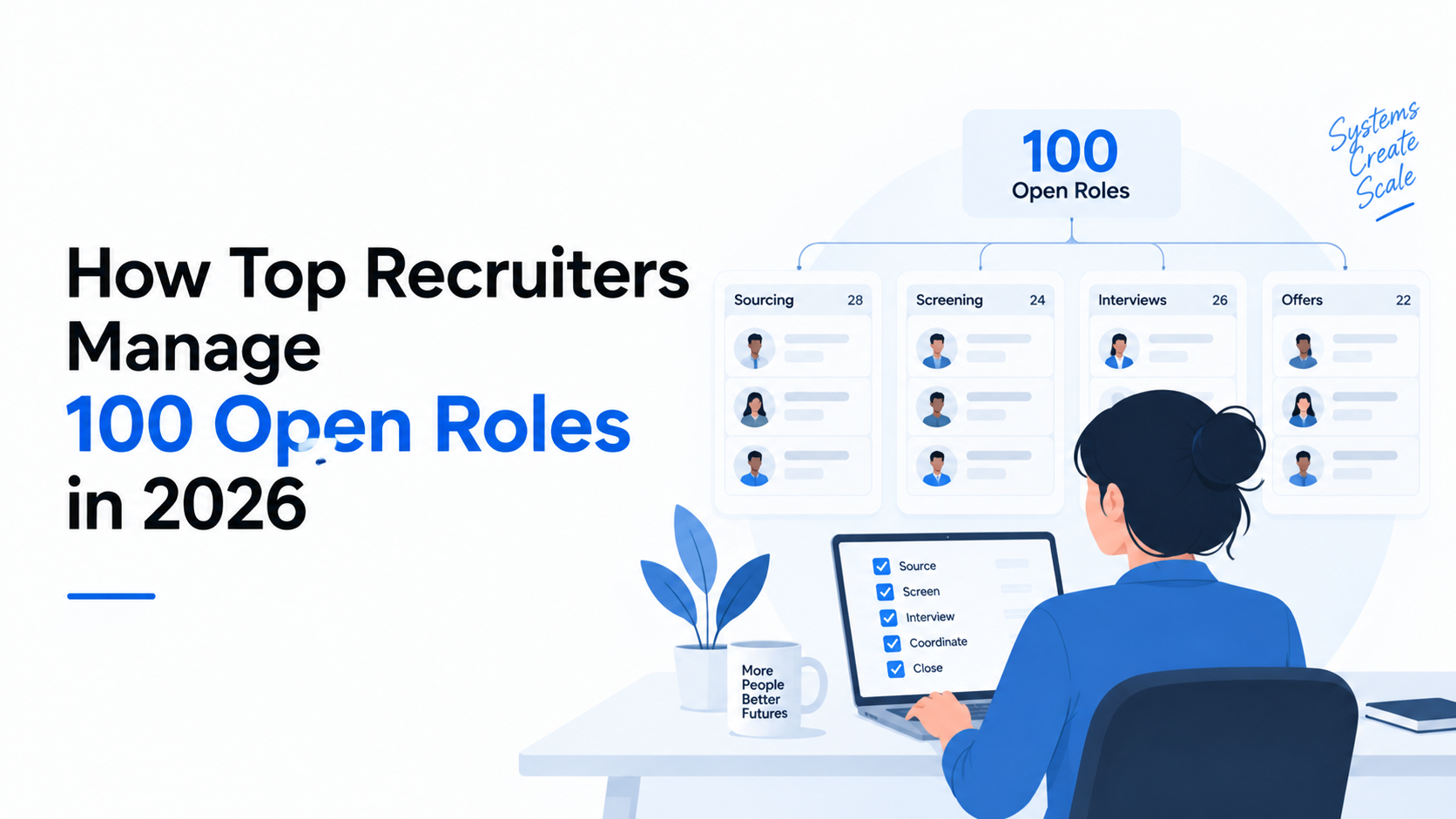
Ask a recruiter how many open roles they can handle and most will tell you that 25 to 30 is the limit. Beyond that, the story goes, quality suffers, candidates fall through the cracks, and hiring managers stop getting the attention they deserve. But some recruiters consistently manage 80, 100, or even 120 open requisitions with placement rates that match or exceed their peers carrying half the load. The difference is not superhuman stamina or a willingness to work 16-hour days. The difference is that these recruiters have built systems—prioritization frameworks, delegation models, technology leverage, and pipeline management practices—that allow them to operate at scale without trying to give every requisition equal attention. Equal attention is the trap that breaks recruiters at high volume. Top performers give every requisition the attention it needs, which is very different from equal attention and requires the discipline to classify, prioritize, and allocate effort based on where the return is highest. This post breaks down the specific strategies and systems that enable top recruiters to manage 100 open roles effectively.
The Prioritization Framework: Not All Roles Are Equal
The foundational skill for managing 100 open roles is the ability to classify and prioritize requisitions based on their business impact and difficulty level. Most recruiters approach their workload as an undifferentiated list—they work on whatever feels most urgent or whatever hiring manager is loudest. Top performers replace this reactive approach with a structured prioritization framework that categorizes every requisition along two dimensions: business criticality and fill difficulty. Business criticality measures the impact of the role on the organization—whether it is a revenue-generating position, a key technical role, or a backfill for a departing high performer. Fill difficulty measures how hard the role is to source for—based on talent availability, skill specificity, compensation competitiveness, and market conditions.
The intersection of these two dimensions creates a four-quadrant framework. High criticality, high difficulty roles are the strategic searches that require the recruiter's personal attention and deepest sourcing effort. High criticality, low difficulty roles are the quick wins that generate momentum and hiring manager goodwill. Low criticality, high difficulty roles are the traps that consume disproportionate effort for limited business return—they should be deprioritized or delegated. Low criticality, low difficulty roles are the assembly line searches that can be batched, automated, and processed efficiently. McKinsey time allocation research shows that top performers spend 50 to 60 percent of their effort on the high-criticality quadrant and less than 15 percent on the low-criticality quadrant, while average performers distribute effort roughly equally across all quadrants.
This framework should be reviewed and adjusted weekly, because both dimensions can shift. A role that was low difficulty last month may become high difficulty if the market tightens or the hiring manager changes the requirements. A role that was low criticality may become high criticality if a key project is launched or a team lead departs. Gartner talent acquisition research recommends a 15-minute weekly prioritization review where the recruiter reclassifies their requisitions, identifies any shifts in criticality or difficulty, and adjusts their effort allocation for the coming week. This disciplined weekly recalibration prevents the common drift where a recruiter spends weeks on a low-value search simply because they started working on it and never stopped to reassess.
Batch Processing: Group Similar Roles Together
One of the most powerful strategies for managing high requisition volume is batch processing—grouping similar roles together and working on them as a set rather than individually. A recruiter with 100 open roles might have 15 mid-level software engineering positions, 10 sales development roles, 8 marketing specialists, and a mix of other positions. Instead of sourcing for each role independently, the recruiter batches the 15 engineering roles together, builds a single sourcing strategy for the engineering cluster, and generates candidates who can be considered for multiple positions within the batch. This approach dramatically reduces the per-requisition sourcing effort because one sourcing pass produces candidates for 15 searches instead of one.
Deloitte workforce productivity research shows that batch processing reduces sourcing time per requisition by 40 to 60 percent for similar role types. The key is that the sourcing strategy—the channels, the search parameters, the outreach messaging—is designed once for the cluster and then refined based on results. A recruiter who sends 100 personalized outreach messages for a cluster of 15 similar engineering roles is effectively sourcing for 15 requisitions simultaneously, compared to a recruiter who would need to send 1,500 messages to achieve the same coverage by sourcing each role independently. The time savings at this scale are enormous, freeing up hours for the high-difficulty strategic searches that require individualized attention.
Batch processing works best for roles that share at least three characteristics: similar skill requirements, similar seniority level, and similar geographic market. Roles that differ on all three dimensions do not benefit from batching because the sourcing strategy for each is fundamentally different. SHRM recruiting process optimization research notes that the biggest mistake recruiters make with batch processing is trying to batch roles that are too dissimilar—grouping a senior data scientist with a junior marketing coordinator because both are "open roles." Effective batching requires honest assessment of role similarity and the discipline to create separate batches for genuinely different role families. When done correctly, batching allows a recruiter to maintain sourcing depth across 100 requisitions that would be impossible if each role were sourced independently.
Pipeline Reuse: One Candidate, Multiple Opportunities
Pipeline reuse is the natural complement to batch processing. When a strong candidate emerges in the sourcing process for one role, they are often qualified for several other open requisitions as well. A software engineer who is not quite the right fit for the frontend position might be perfect for the full-stack role that is also open. A sales candidate who lacks enterprise experience but has strong SMB credentials might be ideal for the mid-market sales role. Top recruiters managing 100 open roles treat every candidate interaction as an opportunity to fill multiple positions, not just the one that brought the candidate into the pipeline.
LinkedIn talent sourcing data shows that high-performing recruiters present an average of 1.8 job opportunities to each qualified candidate they engage, compared to 1.0 for average performers. This practice of presenting multiple relevant opportunities during the initial conversation does three things. First, it increases the probability that the candidate will find an opportunity that matches their interests and career goals. Second, it communicates that the company has multiple growth paths available, which is attractive to ambitious candidates. Third, it reduces sourcing effort because one candidate conversation serves multiple requisitions. The recruiter who mentions three relevant opportunities in every candidate interaction is effectively tripling their per-conversation sourcing yield.
The technical enabler of pipeline reuse is a well-maintained, well-tagged candidate database that allows the recruiter to quickly identify which open requisitions a candidate qualifies for. The challenge many teams face is that their candidate data is fragmented across systems, making it difficult to match candidates to multiple opportunities efficiently. AI sourcing tools can automate this matching process by analyzing a candidate's profile against all open requisitions and surfacing the best-fit opportunities, but the underlying requirement is a unified database where candidate records and requisition data can be cross-referenced. Without this infrastructure, pipeline reuse becomes a manual exercise that consumes more time than it saves.
Leveraging Technology to Multiply Your Capacity
A recruiter managing 100 open roles cannot afford to spend time on any task that technology can perform faster and equally well. The specific technology leverage points that matter most at this scale are automated sourcing, automated scheduling, automated candidate communication, and AI-powered screening. Each of these capabilities offloads work that would otherwise consume hours of recruiter time per day and enables the recruiter to focus their personal attention on the activities where human judgment creates the most value—candidate assessment, hiring manager consultation, and offer-stage management.
Agentic AI platforms represent the most significant advancement in recruiting technology for high-volume recruiters because they do not just automate individual tasks—they orchestrate entire workflows. An agentic AI platform can identify qualified candidates from multiple sources, send personalized outreach messages, manage response handling, schedule initial screens, and provide the recruiter with a prioritized list of candidates who have already been engaged and pre-qualified—all without manual intervention. This orchestration multiplies the recruiter's sourcing capacity by a factor of 5 to 10, enabling a single recruiter to maintain active pipelines across 100 requisitions that would require a team of three or four recruiters using traditional methods.
The critical distinction when evaluating technology for high-volume recruiting is between AI sourcing and AI recruiting. AI sourcing tools identify and engage candidates but stop at the top of the funnel. AI recruiting tools manage the end-to-end process from sourcing through offer. For recruiters managing 100 open roles, end-to-end automation is far more valuable because the bottleneck at this scale is not just sourcing—it is the middle and bottom of the funnel where scheduling, communication, and coordination consume the most time. The ideal technology stack for a high-volume recruiter combines AI sourcing for top-of-funnel pipeline generation with automated workflow management for the middle and bottom stages, creating a system that handles volume without requiring proportional increases in human effort.
Hiring Manager Management at Scale
One hundred open requisitions means multiple hiring managers, each with their own priorities, communication preferences, and expectations. Managing these relationships at scale is one of the most underappreciated challenges of high-volume recruiting, and it is the area where most recruiters break down. The hiring manager who receives slow feedback, missed updates, and generic communication will disengage from the process, provide less timely input, and eventually bypass the recruiter entirely. At 100 open roles, the recruiter cannot afford to have hiring managers disengage because they are the primary source of requirements, evaluations, and decisions.
The solution is a structured communication cadence that scales. Rather than managing each hiring manager relationship ad hoc—responding to emails when they come in, scheduling updates when someone asks—the high-volume recruiter establishes a standard communication rhythm for all active searches. EY talent management research recommends a tiered cadence: weekly pipeline updates for active searches, biweekly status summaries for slower-moving searches, and monthly portfolio reviews with senior hiring managers who have multiple open roles. These communications should be brief, data-rich, and proactive—sent before the hiring manager asks rather than in response to a request.
The format matters as much as the cadence. A hiring manager with six open roles does not want six separate update emails. They want a single, consolidated update that covers all their searches in a consistent format: role name, current stage, pipeline count, top candidates, and action items for the hiring manager. This consolidated format respects the hiring manager's time and makes it easy for them to provide feedback on multiple candidates in a single session. McKinsey stakeholder management research shows that consolidated, proactive updates improve hiring manager satisfaction by 30 to 40 percent compared to fragmented, reactive communication—meaning the hiring manager is more engaged, more responsive, and more likely to view the recruiter as a strategic partner rather than an administrative support function.
Delegation and Team Leverage
No single recruiter can personally execute every activity required by 100 open requisitions. High-volume recruiters succeed by building a leveraged model that divides work into tiers based on the judgment required and delegates the lower-judgment tiers to coordinators, junior recruiters, or technology. The highest-judgment activities—candidate assessment, hiring manager consultation, offer negotiation, and strategic sourcing for difficult roles—must be performed by the senior recruiter. Lower-judgment activities—initial application review, interview scheduling, candidate communication updates, offer letter preparation, and standard pipeline reporting—can be performed by recruiting coordinators or automation.
SHRM staffing models for high-volume TA functions recommend a coordinator-to-recruiter ratio of 1:2 or 1:3 for roles requiring moderate sourcing effort, meaning one coordinator supports two to three senior recruiters. This model allows each senior recruiter to focus 70 to 80 percent of their time on high-judgment activities while coordinators handle the operational workload that would otherwise consume 40 to 50 percent of the recruiter's day. The financial math is compelling: a recruiting coordinator typically costs 40 to 50 percent of a senior recruiter's compensation but frees up capacity that enables the senior recruiter to generate 30 to 50 percent more placements.
For teams without dedicated coordinators, technology serves the same delegation function. Automated scheduling replaces the coordinator who would otherwise spend hours coordinating calendars. Automated candidate status updates replace the emails the recruiter would manually send to keep candidates informed. AI-powered application screening replaces the initial review that a coordinator would perform. The principle is the same whether the work is delegated to a person or a machine: the senior recruiter's time is the scarcest and most valuable resource in the recruiting operation, and every minute of it that can be freed from low-judgment work is a minute that can be applied to the activities that actually drive placements. Deloitte workforce productivity analysis shows that senior recruiters who delegate or automate 40 to 50 percent of their operational workload consistently outperform those who attempt to handle everything themselves, even when the total hours worked are similar.
The Weekly Review That Keeps 100 Roles on Track
Managing 100 open requisitions without a weekly review is like flying a plane without instruments. You might stay airborne for a while based on feel, but eventually you will lose situational awareness and make a critical error. The weekly review for a high-volume recruiter serves three purposes: it identifies pipeline gaps before they become hiring failures, it reallocates effort based on the latest prioritization assessment, and it ensures that no requisition has gone neglected for too long. The review should take 45 to 60 minutes and should follow a consistent format that can be executed efficiently without reinventing the process each week.
The first component of the weekly review is a pipeline coverage scan. For each requisition, check the number of qualified candidates at each pipeline stage against a minimum threshold. Gartner recommends a minimum of three qualified candidates in the active pipeline for any requisition that is expected to close within 30 days. Requisitions below this threshold are flagged for priority sourcing in the coming week. This scan typically reveals 10 to 15 requisitions that need attention—far more manageable than trying to assess 100 requisitions from scratch every week.
The second component is a stale search audit. Any requisition that has not seen a new qualified candidate enter the pipeline in the past 14 days is stale and needs intervention. Stale searches are the silent killers of high-volume recruiting because they consume hiring manager patience and recruiter mental energy without producing results. The intervention might be a fresh sourcing strategy, a requirements recalibration with the hiring manager, or a decision to close the requisition temporarily until market conditions improve. The key is that stale searches are actively managed rather than allowed to linger indefinitely.
The third component is a hiring manager check-in schedule. Identify which hiring managers need a proactive conversation this week—either because they have a search approaching a critical deadline, because their feedback has been slow, or because their requirements have shifted. Scheduling these check-ins in advance ensures that hiring manager relationships are maintained systematically rather than reactively. The most effective high-volume recruiters treat the weekly review as the most important meeting of their week—more important than any individual candidate call or hiring manager meeting—because it is the session that ensures all 100 requisitions are moving in the right direction. Without it, the recruiter is managing 100 roles by feel. With it, they are managing 100 roles by system. The difference in outcomes is not incremental. It is transformational.