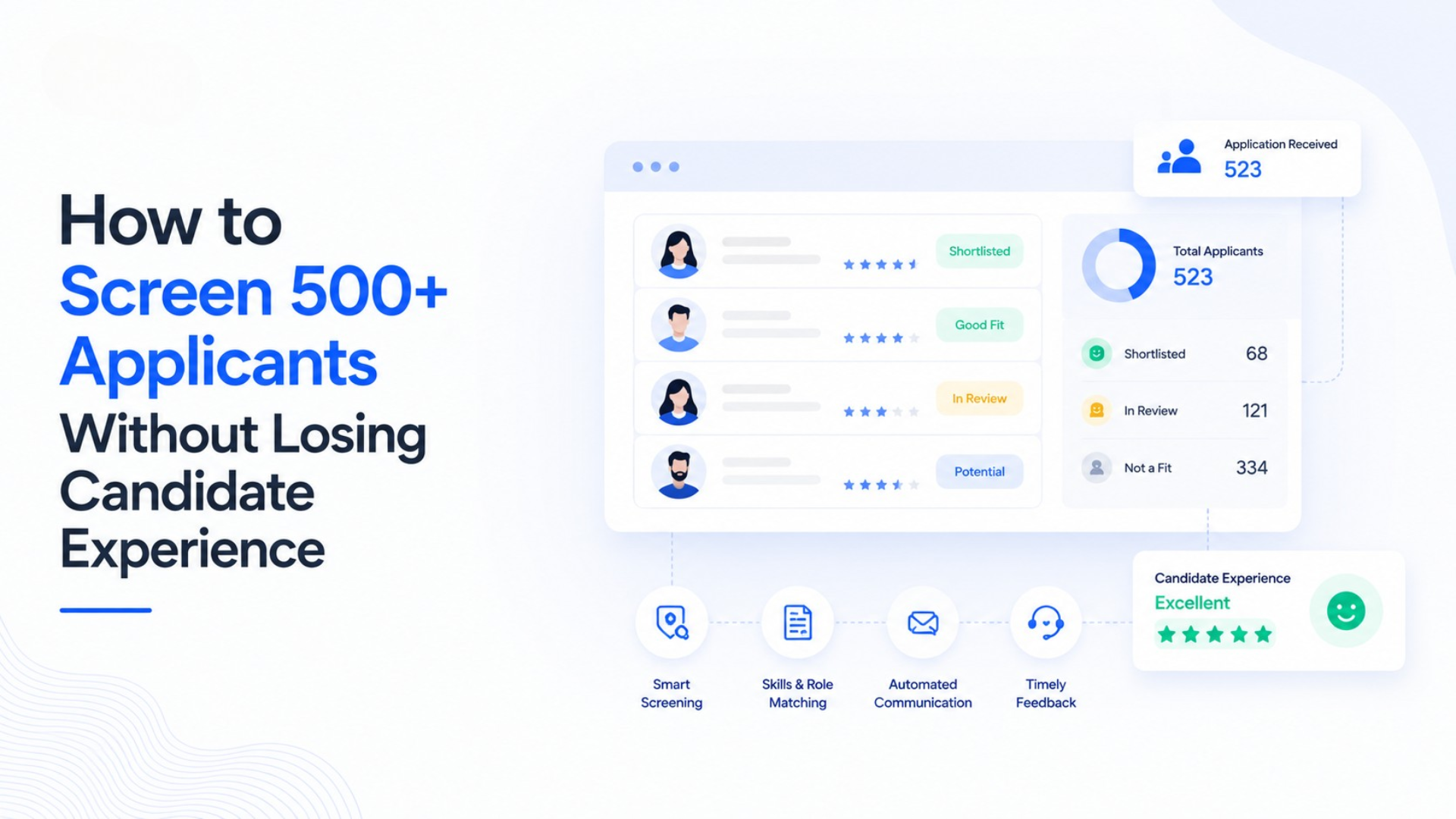
A few years ago, 400 applications for one role meant you'd posted something at a household-name company or accidentally listed a six-figure salary. In 2026, per Truffle's guide to handling application overload, it's a Tuesday. Easy-apply buttons, AI-generated resumes, and a wider remote candidate pool have turned ordinary mid-market job postings into floods of applications, and the problem was never attracting interest — it's finding the handful of people who could actually do the job somewhere under hundreds of resumes that all open with "results-driven professional."
The math on manual screening at that volume simply doesn't work. A guide from Cogn-IQ lays out the arithmetic directly: a 45-minute interview with each of 1,000 applicants requires 750 hours of recruiter and manager time — roughly 19 full work weeks — before a single offer goes out, a capacity no HR department has and no hiring budget can absorb. So every high-volume employer screens, and screens hard. The real question isn't whether to filter people out before a human ever talks to them — it's how to do that without the specific damage that shows up when volume overwhelms a team's response capacity: silence, black-hole auto-replies, and strong candidates who accept somewhere else before anyone got back to them.
Why Traditional Screening Breaks First at Volume
Traditional high-volume hiring, per a guide from Talentprise, follows a familiar playbook: post to multiple job boards, generate a large applicant pool, run keyword filtering to narrow it down, batch-schedule interviews, repeat. That playbook is built entirely around managing inbound volume, and that's exactly where it fails. Posting broadly doesn't just reach qualified candidates — it reaches everyone actively searching for anything with proximity to the posting's keywords, and keyword-based filtering then removes people who describe their real, relevant experience in slightly different language while retaining candidates who've learned to keyword-stuff a resume. The result, per that same guide, is a process that screens hard for mediocrity while capable candidates who don't fit the exact keyword pattern get rejected automatically before a human ever sees them.
A guide from Gem frames the capacity math from the other direction: a recruiter can manually screen roughly 50 applications a day, which works fine against one open role but collapses completely against twenty simultaneous openings generating a thousand applications between them. Qualified candidates get lost in that gap, and candidates left waiting weeks for any response quietly damage the employer's reputation in a market where SHRM reports 60% of job seekers abandon applications they perceive as too slow or cumbersome in the first place.
Fix the Front of the Funnel Before Screening Even Starts
The highest-leverage fix in this category happens before a single application needs screening. Metaview's framework for high-volume screening calls the intake conversation between recruiter and hiring manager the single highest-yield fix on most screening operations — not a tool, but an agreement, reached before applications start landing, on the three to five genuine must-haves for the role. Metaview's 2026 Alignment Report, surveying 505 recruiting leaders and hiring managers, found that 68% of searches start with high alignment when AI is core to the hiring process, versus 49% when it isn't — a meaningful gap that traces back to how much sharper the intake conversation gets once a team is forced to define matching criteria precisely enough for a system to apply them consistently.
Truffle's guide to handling application overload makes the same point about the job posting itself: vague language like "fast-paced environment" or "strong communicator" describes every job simultaneously and gives candidates nothing to self-select against, while explicit deal-breakers — required certifications, location constraints, shift schedules — let a candidate who doesn't meet them opt out before applying rather than after being screened out. Knockout questions extend the same logic into the application form directly: yes-or-no questions tied to genuinely non-negotiable requirements that auto-disqualify a mismatch before it ever reaches a human reviewer's queue, and before that candidate has invested time filling out a full application for a role they were never going to get.
The Signal-vs-Noise Framework
Once applications are landing, the strongest screening operations run some structured version of the same core idea: evaluate every application against the same defined signals, in the same order, so a recruiter's limited attention goes to the candidates who've actually earned a closer look rather than being spread evenly and thinly across everyone. Metaview's framework calls this signal-vs-noise, and the results reported from teams running it are substantial: Workleap cut applicant screening time in half on a pipeline that had been overwhelming them, and Brex's Head of TA Ops reported going from two to three full days screening 100 to 150 candidates for a single role down to fifteen minutes with two candidates already moved to the next stage on day one. Across the more than 4,000 organizations Metaview tracks, teams report roughly 10 hours saved weekly on documentation alone, with a 66% increase in weekly screens per recruiter when the underlying screening approach is adopted team-wide rather than by a single person.
Crucially, Metaview's data shows this shift doesn't reduce the number of humans involved in hiring decisions — it changes what they spend their time on. Teams that move from manual judgment on every application to structured signal end up with recruiters spending their week on the candidates worth an actual conversation, rather than on the queue itself. The framework's own guardrail is explicit on where automation should stop: triage can be automated, but decisions shouldn't be — the system reviews and sorts, and a person still advances, declines, or pools every candidate rather than letting a score-and-cut model make that call unsupervised.
Structured Assessments Over Resume Screening
A separate and evidence-backed shift in how the initial filter itself works is moving away from resume review as the primary screen. Cogn-IQ's guide to high-volume screening cites decades of meta-analytic research showing that cognitive ability is the strongest single predictor of job performance across virtually all roles, while resumes are among the weakest predictors available — a mismatch between what most screening processes actually measure and what predicts whether someone will succeed in the role. That guide also notes that SHRM has found organizations using validated pre-hire assessments see 39% lower turnover than those relying on unstructured resume review alone, and frames structured assessment as fairer in practice than the alternative it replaces, since resume screening is undocumented and vulnerable to bias based on a candidate's name, address, or school, in ways a validated, consistently applied assessment isn't.
Truffle's broader screening tools guide points to one-way video interviews as a related structural fix for the same problem: every candidate answers the same preset questions on their own schedule, which removes the scheduling bottleneck entirely and makes comparison across candidates far more consistent than a scattered set of live phone screens run by different interviewers on different days. AI transcribes and scores each response against defined criteria, compressing what would be a live call into a few minutes of structured review — while, per that same guide, the actual advance-or-reject decision still sits with a person reviewing the evidence, not with the AI alone.
Keeping Candidate Experience Intact Through the Filter
None of the efficiency gains above matter if the candidate on the other side of the process experiences only silence. Gem's guide to high-volume hiring frames candidate experience at scale around a single practical question: how do you respond to every applicant the same day when 500 arrive at once? The answer it lays out is straightforward layered automation — automated confirmation emails sent within minutes of every application, templated but genuinely informative rejection emails sent within 24 hours of a decision, and scheduled status updates that keep a candidate informed of where they stand throughout the process, rather than leaving them to wonder. Done well, that guide argues, this kind of automation reads as respectful and professional rather than impersonal — it signals that a candidate matters even inside a process too large for individual attention to every applicant.
A guide from iProspectCheck adds a specific operational target worth setting explicitly: clear response-time service-level agreements, defined and tracked, to keep candidates engaged and prevent talent loss during high-volume campaigns specifically, with more personalized communication and deeper evaluation reserved for executive or high-responsibility roles where the volume pressure is lower and the relationship stakes are higher. Metaview's Alignment Report gives a concrete sense of what's actually at stake in that response-time gap: 67% of recruiting teams report losing qualified candidates to faster-moving competitors every month, and most of those candidates don't disappear because an offer was wrong — they disappear because, as that report puts it, a candidate a team would have hired sits in the queue for nine days, and by day six three competitors have already reached out.
Segmenting Roles Instead of Running One Process for Everything
Not every high-volume role needs the same screening depth, and treating them identically wastes effort in both directions. Gem's guide recommends segmenting by role complexity explicitly: entry-level positions can often move through a simple screen, a group interview, and an immediate decision, while skilled or technical roles within the same overall hiring campaign warrant technical assessments, multiple interview rounds, and reference checks that would be excessive to apply uniformly across an entire high-volume requisition list. Cogn-IQ's guide flags a related, common inefficiency worth checking directly: many organizations over-interview even at the entry level, running four or five rounds for roles that could be filled effectively with two, with each additional round adding cost, extending time-to-fill, and giving the strongest candidates — the ones with other options — more opportunities to drop out before an offer is even extended.
Reducing Inbound Volume With Proactive Sourcing
A structurally different response to application overload, rather than screening it faster after the fact, is reducing how much unfiltered volume arrives in the first place. Talentprise's guide to high-volume recruiting describes this as proactive sourcing run in the opposite direction from the standard playbook: instead of posting a role and waiting for whoever sees it to apply, a team defines the candidate profile it actually needs and sources pre-matched candidates directly, which changes what lands in the pipeline from thousands of undifferentiated applications down to a curated list of people whose demonstrated skills already fit the criteria before screening ever needs to start. For a retail company needing fifty customer service hires before a peak season, that guide notes, the difference is stark: the traditional approach floods the team with applications and compresses assessment quality under the resulting time pressure, while the proactive approach starts with a smaller, pre-qualified pool sourced from candidates who've already opted in and demonstrated relevant skill.
Gem's guide reaches a similar conclusion from the staffing-model side: a team of three to four people running AI-driven sourcing, screening, and engagement together can manage more than 100 requisitions simultaneously — work that previously required five full-time recruiters — and the shift isn't really about reducing headcount, it's about reallocating time away from sourcing and screening and toward the relationship-building, interview evaluation, and closing work that actually determines hiring quality.
Measuring Whether the Process Is Actually Working
High-volume screening needs different metrics than standard recruiting, and tracking the wrong ones can hide a breaking process until it's already cost good candidates. Gem's guide draws this distinction directly: standard recruiting measures candidate experience by surveying people after an offer is made, and tracks time-to-hire in weeks; high-volume hiring needs to judge experience by response time to applications specifically — candidates in this environment expect a reply within 24 hours — and needs to track time-to-fill in days rather than weeks, since the compounding effect of delay is far larger at scale. A screening step that takes two extra days per hire, per Talentprise's guide, costs 200 extra days once multiplied across 100 simultaneous roles, which is exactly the kind of hidden multiplier that a slower but individually reasonable-looking process can produce without anyone noticing until the aggregate delay shows up in abandoned applications and lost offers.
iProspectCheck's broader screening guide recommends tracking a specific small set of numbers rather than everything available: time-to-hire, quality-of-hire measured through post-hire performance and first-year retention, cost-per-hire, candidate satisfaction gathered through short post-interview surveys, and the screening-to-interview conversion rate, which flags whether the initial filter is passing through a reasonable share of applicants or screening so aggressively that strong candidates are being cut at the first stage without ever being seen by a person.
Catching Fraud and Low-Effort Applications Without Overcorrecting
Volume brings a specific quality problem beyond simple noise: a meaningful share of high-volume applications in 2026 show patterns of AI-generated or duplicated content rather than genuine, tailored responses. Metaview's screening framework names the specific signals worth flagging at the sort stage rather than after a recruiter has already spent time on them — generic resumes that never reference the actual role, contradictory information between the resume and the application form, identical paragraphs appearing across multiple submissions in the same window, and answers phrased at a level of polish that doesn't match the candidate's stated experience. The framework's guidance is to surface these patterns to a recruiter before time gets spent reviewing them in depth, not to auto-reject on the pattern alone — since a legitimate candidate can occasionally trip one of these signals without actually being a low-effort or fraudulent application, and the fairness risk of an aggressive, unsupervised score-and-cut approach is exactly what multiple guides in this category warn against.
Where a Tool Like Huntlo Fits
Most of the tension in high-volume screening comes from the same root cause described throughout this guide: an inbound flood of undifferentiated applications forces a team to choose between screening speed and candidate experience, when the better fix is reducing how much of that flood needs manual triage in the first place. That's the specific shift Huntlo is built around.
Rather than waiting for a role to attract hundreds of unfiltered applications and screening the pile after the fact, Huntlo's agentic AI continuously sources and re-scores candidates across 50+ public platforms against a described ideal profile, then handles personalized outreach and follow-up autonomously across email, WhatsApp, and AI voice — which keeps the funnel weighted toward candidates who already fit before volume becomes a screening problem, and keeps every candidate who does apply moving through a responsive, timely process rather than sitting in a queue for the nine days Metaview's research shows is enough to lose them to a competitor. Huntlo's free trial is a practical way to test that shift directly against a real high-volume role before your next posting produces the same 500-applicant flood the old process was never built to handle gracefully.
Frequently Asked Questions
How many recruiter hours does manual screening actually cost at high volume? Cogn-IQ's guide puts it concretely: a 45-minute interview with each of 1,000 applicants requires roughly 750 hours, or 19 full work weeks, before a single offer goes out — a capacity gap that makes some form of structured screening automation a practical necessity rather than an optional efficiency gain once volume crosses a few hundred applications per role.
Does automating screening always hurt candidate experience? Not when it's built around communication rather than silence. The guides in this category consistently link poor candidate experience to non-response and delay, not to automation itself — automated confirmations, timely templated rejections, and clear status updates generally improve the experience of a high-volume process compared to the alternative of a team too overwhelmed to respond at all.
Should AI make the final hiring decision at high volume? No, according to every source covering this comparison. The consistent structure across current best practice is AI handling triage, sorting, and structured evaluation, with a person making the actual advance-or-reject call on every candidate — automating further than that introduces real fairness and legal exposure risk.
What's the single highest-leverage fix for high-volume screening quality? Sharpening the intake conversation between recruiter and hiring manager before applications start landing. Metaview's research found searches with high recruiter-hiring-manager alignment at the outset perform meaningfully better through the rest of the funnel than those without it, and that alignment costs nothing beyond a properly run kickoff conversation.
Is reducing inbound application volume a realistic alternative to screening it all? Yes, for roles where proactive sourcing is viable. Defining a candidate profile and sourcing directly against it, rather than posting broadly and filtering afterward, produces a smaller but substantially more qualified starting pool — reducing the volume that needs screening in the first place rather than only speeding up how fast it gets processed.
The Bottom Line
Five hundred applicants for a single role isn't a crisis in 2026 — it's the baseline, and trying to screen that volume with the same manual process that worked at fifty applications is where both quality and candidate experience actually break down. The fix isn't choosing between speed and experience; it's front-loading clarity into the job posting and intake conversation, running a structured signal-vs-noise triage instead of ad hoc resume review, keeping every candidate informed through automated but genuinely respectful communication, and — where the role allows it — reducing how much unfiltered volume needs screening in the first place by sourcing proactively instead of waiting for it to arrive.
If the real goal is a funnel that's already weighted toward the right candidates before volume becomes a screening problem, Huntlo's agentic AI recruiting platform is built to run that sourcing and engagement work continuously — worth testing directly against your next high-volume opening with the free trial before the next 500-applicant flood hits your inbox.
Related Reading on the Huntlo Blog
See how recruiting teams can identify and engage professionals who are not actively applying in How to Source Passive Candidates Who Aren’t Job-Searching.
Understand how candidate relationships and communication history can be preserved in What Is a Recruiting CRM? Definition and Key Features.
Learn how recruiting teams can shorten delays after candidate engagement in How to Reduce Time-to-Hire With AI Sourcing and Screening.
Explore how recruiting teams can connect sourcing, engagement, and workflow execution in What Is an AI Hiring OS? Definition and How It Works.
See how AI changes the first stage of outbound candidate discovery in What Is Candidate Sourcing Automation?.