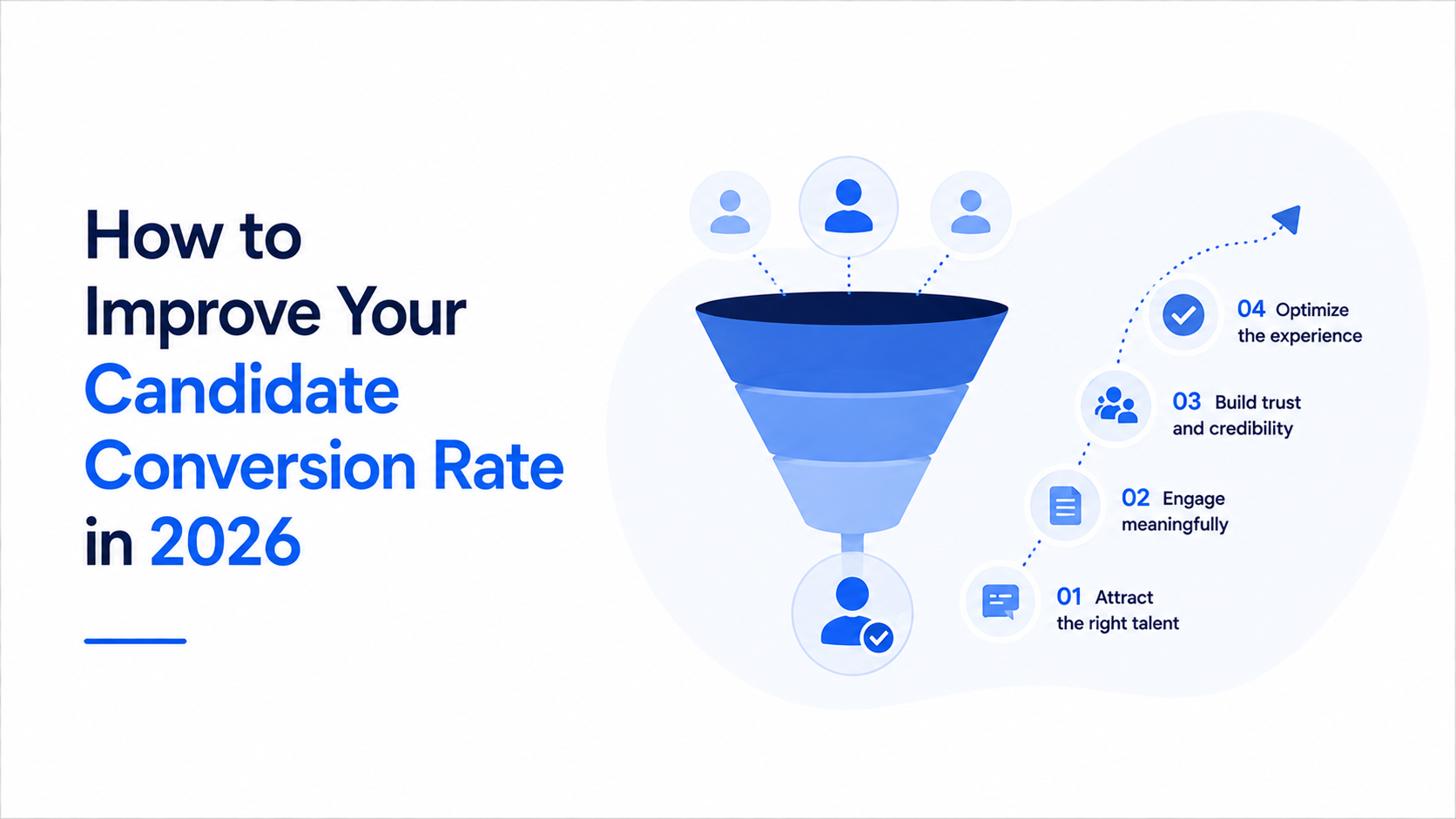
There is a number that should keep every talent acquisition leader up at night, and it is not time-to-fill or cost-per-hire. It is candidate conversion rate—the percentage of people who enter your hiring pipeline and actually make it to the offer stage. Most companies do not track this number at all. Those that do often discover something uncomfortable: their conversion rate is far lower than they assumed, sometimes dropping below 5 percent from initial application to accepted offer. For context, a 5 percent conversion rate means you need 2,000 applicants to make 100 hires. The sourcing spend, recruiter hours, and hiring manager time required to generate and process that volume is enormous. Yet most TA teams focus their optimization efforts on the top of the funnel—getting more candidates in—rather than fixing the leaks that cause candidates to drop out at every subsequent stage. This post walks through the specific, data-driven strategies that high-performing TA teams use to improve candidate conversion rates across the entire hiring funnel.
What Candidate Conversion Rate Actually Measures
Candidate conversion rate is not a single metric. It is a family of conversion ratios that measure the health of your hiring pipeline at each stage. Application conversion rate measures what percentage of career site visitors complete and submit an application. Screening-to-interview conversion measures how many applied candidates advance past the initial review. Interview-to-offer conversion tracks the percentage of interviewed candidates who receive an offer. And offer acceptance rate captures how many of those offers are signed. Each of these mini-conversions tells a different story about where your process is working and where it is broken, yet most TA teams either track only one of them or track none at all.
The reason this matters financially is straightforward. McKinsey research on talent acquisition efficiency shows that a 10 percentage-point improvement in overall candidate conversion rate can reduce cost-per-hire by 15 to 25 percent without any change in sourcing spend. The logic is simple: when more of the candidates you already attract make it through the process, you need fewer total candidates to hit your hiring targets, which means lower sourcing costs, less recruiter time spent on dead-end candidates, and faster time-to-fill. Conversion optimization is not about working harder or spending more. It is about getting more value from the candidates and investment you already have.
The challenge is that improving conversion requires a different mindset than traditional recruiting. Sourcing is about addition—finding more people, reaching out to more candidates, posting on more boards. Conversion optimization is about subtraction—removing friction, eliminating unnecessary steps, and making it easier for interested candidates to move forward. This shift from a volume mindset to a conversion mindset is what separates TA teams that scale efficiently from those that just add headcount to keep up with demand. Gartner has noted that by 2026, the most competitive TA functions will treat candidate conversion with the same rigor that marketing teams treat customer conversion—and the teams that do not will find themselves consistently outbid for talent by competitors who have figured out how to make their hiring process work smoother.
Where Most Candidates Drop Out and Why
Understanding where candidates drop out is the prerequisite to fixing the problem. Industry data consistently shows that the two biggest drop-off points in the hiring funnel are the application stage and the offer stage, but the reasons differ significantly. At the application stage, candidates abandon the process because it is too long, too complex, or asks for information they are not ready to provide. LinkedIn research found that 60 percent of job seekers who start an application do not finish it, and the average completion rate for mobile applications is even lower, hovering around 35 percent. The primary culprits are applications that take longer than five minutes to complete, require account creation before the candidate can even see the full job description, or ask for extensive work history that could be collected later in the process.
At the interview stage, drop-offs are driven by a different set of factors. Candidates who have invested time in the application and screening process abandon the pipeline when the interview scheduling process is cumbersome, when they are asked to repeat information they have already provided, or when the process drags on for weeks without clear communication. SHRM data indicates that the average hiring process for professional roles now takes 36 to 42 days, and candidate patience is wearing thin. Nearly 50 percent of candidates who drop out during the interview stage cite poor communication—long gaps between updates, lack of clarity about next steps, or feeling like the company is not seriously considering them—as their primary reason for withdrawing.
The offer stage drop-off is particularly painful because it represents the highest-cost failure in the funnel. You have invested sourcing, screening, interviewing, and hiring manager time, only to lose the candidate at the final step. Offer-stage drop-offs are typically driven by compensation misalignment, slow offer delivery, or a candidate receiving a competing offer during your extended decision process. EY talent surveys show that in competitive technology markets, the average time between final interview and offer delivery is still over five business days—more than enough time for an in-demand candidate to receive and accept another offer. Each of these drop-off points is addressable, but only if you are measuring conversion at each stage and diagnosing the specific reasons behind the numbers.
Fixing the Top of the Funnel: Sourcing and Awareness
Conversion optimization starts before a candidate ever reaches your career site. The messaging you use in job postings, social media outreach, and sourcing emails sets expectations that either align with the actual candidate experience or set up a conversion failure. If your job description promises a fast-paced, innovative environment but your hiring process takes six weeks with four interview rounds, candidates who were attracted by the initial messaging will feel baited and switch. Alignment between your employer brand messaging and the actual candidate experience is the foundation of conversion, and the gap between the two is one of the most common yet underexamined causes of pipeline leakage.
The sourcing channel itself also has a significant impact on downstream conversion. Candidates who come through employee referrals convert at two to three times the rate of candidates from job boards, partly because they enter the process with a more accurate expectation of what the role and company are like. Deloitte workforce research highlights that referral candidates not only convert at higher rates but also show stronger engagement throughout the process—faster response times, higher assessment completion rates, and lower withdrawal rates at every stage. This does not mean you should abandon job boards or paid channels, but it does mean you should factor conversion rate into your channel ROI calculations, not just volume and cost-per-applicant.
AI-powered sourcing is changing the top-of-funnel equation in a meaningful way. Modern AI sourcing tools can identify candidates whose profiles and activity patterns indicate genuine interest in a role, rather than just matching keywords. These higher-intent candidates convert at significantly higher rates because they are not being cold-messaged—they are being engaged based on signals that suggest they are already open to a move. The key is ensuring that the AI tools you deploy are genuinely intelligent about candidate intent, not just automating the same spray-and-pray approach that has driven down conversion rates for years. The difference between AI sourcing and AI recruiting matters here: sourcing tools that identify and engage the right candidates will lift your conversion rate, while tools that simply blast more messages to more people will lower it by flooding your pipeline with low-intent applicants.
Streamlining the Application Experience
The application stage is where most companies lose the majority of their potential candidates, and the fixes are often the easiest to implement. The first principle is progressive disclosure: only ask for information you genuinely need at the application stage, and defer everything else to later in the process. Name, email, phone number, resume upload, and one or two role-specific questions should be the maximum for an initial application. Requesting cover letters, detailed work histories, references, and salary expectations before the candidate has even had a conversation with a recruiter is the fastest way to kill your conversion rate. Every additional field you add to your application form reduces completion rates by 5 to 10 percent, according to multiple industry analyses.
Mobile optimization is no longer optional. LinkedIn data shows that over 60 percent of job searches now start on a mobile device, yet many companies still have application forms that are difficult or impossible to complete on a phone. If a candidate has to pinch, zoom, and scroll horizontally to fill out your application, a significant portion of them will abandon it. The mobile experience should not be a responsive afterthought—it should be a primary design consideration. Test your application flow on a phone. Time how long it takes. If it is longer than three minutes from arrival to submission, you are losing candidates who expect the same frictionless experience they get from consumer applications.
One of the highest-impact changes many TA teams can make is eliminating mandatory account creation before application submission. Requiring candidates to create a profile on your careers portal before they can apply adds a step that provides zero value to the candidate and significant friction to the process. Some companies have seen application completion rates jump by 20 to 30 percent simply by allowing candidates to apply with a LinkedIn profile or resume upload and then offering—but not requiring—account creation after submission. This is a low-tech, high-impact fix that requires no AI, no new tools, and no budget approval. It just requires a willingness to prioritize the candidate experience over internal data collection preferences.
Reducing Interview-Stage Friction
The interview stage is where conversion problems become expensive. By the time a candidate reaches this point, you have already invested significant resources in attracting and screening them. Losing them here means all of that investment is wasted. The most common source of interview-stage friction is scheduling. Coordinating calendars between candidates and multiple interviewers is a logistical challenge that can add days or even weeks to the process. Every additional day of delay reduces the likelihood that the candidate will remain engaged, particularly if they are actively interviewing with other companies. Implementing automated scheduling tools that allow candidates to self-select interview slots from available times can reduce scheduling time from days to minutes and has been shown to improve interview-stage conversion by 10 to 15 percent.
Communication cadence during the interview stage is equally critical. Candidates who hear nothing for a week between interviews assume the company is not interested, and many of them will quietly withdraw rather than wait. SHRM best practices recommend a maximum of three business days between any two touchpoints in the interview process. This does not mean every touchpoint needs to be an interview—status updates, timeline reminders, and preparatory information all count as meaningful communication that keeps the candidate engaged. The companies with the highest interview-stage conversion rates treat candidates the way they would treat a high-value customer: responsive, transparent, and proactive.
The structure of the interview process itself also affects conversion. Processes with more than four interview rounds see significantly higher drop-off rates than streamlined processes, and the marginal predictive value of additional rounds diminishes rapidly after the third interview. McKinsey has documented that companies using structured interview processes with three to four focused rounds achieve equivalent or better quality-of-hire outcomes compared to those using five or more unstructured rounds. The difference is that the streamlined process converts more candidates because it respects their time, demonstrates organizational efficiency, and reduces decision fatigue for both candidates and interviewers. If your interview process has grown organically over the years without being audited, it almost certainly contains rounds that add friction without adding predictive value.
The Offer Stage: Where Conversions Win or Lose
The offer stage is the highest-stakes conversion point in the entire funnel. Every prior investment—sourcing, screening, interviewing, hiring manager time—culminates in this moment, and failure here is the most costly of all. The most common reason for offer-stage decline is not compensation. It is timing. Candidates who have been through a four-to-six-week process have had ample time to explore other opportunities, and many of them will receive competing offers while waiting for yours. EY talent research shows that the probability of offer acceptance drops by roughly 5 percent for every business day between the final interview and the offer delivery. A five-day delay does not just slow your process—it actively reduces your chance of closing the candidate.
Compensation misalignment is the second most common offer-stage failure, and it is almost always a data problem, not a budget problem. Too many companies determine offer amounts based on internal pay bands that have not been updated to reflect current market conditions, or they rely on the candidate's current salary—which they may have been incentivized to underreport. The fix is to build real-time market compensation data into the offer process. Tools that provide regional and role-specific compensation benchmarks allow hiring managers and recruiters to make competitive offers from the first pass, rather than entering a negotiation that the candidate may perceive as lowballing. A competitive initial offer does not just improve acceptance rates—it signals respect for the candidate and sets a positive tone for the employment relationship.
The human element of the offer stage is often overlooked in the rush to get numbers right. Candidates who feel personally valued by the hiring manager—who receive a call, not just an email, who hear specific reasons why they were chosen—are significantly more likely to accept. Gartner research on candidate decision-making shows that the quality of the personal interaction during the offer stage ranks among the top three factors influencing acceptance decisions, alongside compensation and role fit. A five-minute call from the hiring manager saying "We specifically wanted you for this role because of X, and we are excited about what you will bring to the team" can be the difference between an acceptance and a decline, even when the compensation is identical to a competing offer.
Using Data to Identify Conversion Bottlenecks
Improving candidate conversion requires knowing exactly where your pipeline is leaking, and that means tracking conversion rates at every stage—not just the overall number. A company-wide conversion rate of 8 percent from application to hire tells you almost nothing useful. But knowing that your application-to-screening conversion is 45 percent, screening-to-interview is 30 percent, interview-to-offer is 40 percent, and offer-to-acceptance is 75 percent tells you precisely where to focus. In this example, the biggest opportunity is between screening and interview, suggesting that your screening criteria may be too narrow or that your screening process is taking too long and candidates are withdrawing.
Building this kind of stage-by-stage conversion analysis does not require a sophisticated analytics platform. It requires discipline in defining your pipeline stages consistently, tracking the number of candidates at each stage, and calculating conversion ratios over a rolling time period—typically monthly or quarterly. The companies that do this well often discover that their conversion problems are concentrated in one or two stages, which means targeted fixes can yield outsized improvements. Deloitte case studies show that organizations implementing stage-level conversion tracking typically identify at least one major bottleneck within the first month that had gone undetected for years, and addressing that single bottleneck improves overall conversion by 15 to 20 percent.
Segmenting conversion data adds another layer of insight that can drive significant improvements. Conversion rates vary dramatically by role type, seniority level, geography, and sourcing channel. Your conversion rate for engineering roles in San Francisco may be 12 percent while your conversion rate for sales roles in Chicago is 4 percent, and the reasons for that gap will be completely different. By segmenting conversion data, you can diagnose and fix problems specific to each context rather than applying one-size-fits-all solutions that work for some roles but not others. This is where agentic AI platforms add particular value—they can analyze conversion patterns across thousands of candidates and dozens of segments simultaneously, identifying bottlenecks that would take a human analyst weeks to surface.
Building a Continuous Optimization Loop
Conversion optimization is not a one-time project. It is a continuous process that requires ongoing measurement, experimentation, and iteration. The most effective TA teams operate a monthly conversion review where they examine stage-by-stage conversion data, identify the biggest drop-offs, hypothesize root causes, implement targeted fixes, and measure the impact. This cycle—measure, hypothesize, fix, measure again—is the same approach that high-performing marketing teams use to optimize their customer funnels, and it works equally well for hiring funnels when applied consistently.
A/B testing is a powerful tool in this optimization loop, and it applies to more than just job descriptions. You can test different application lengths, different interview formats, different communication cadences, and different offer structures. For example, you might test whether a three-question application converts at a higher rate than a seven-question application for the same role. Or whether sending a recruiter outreach message on Tuesday morning generates a higher response rate than Thursday afternoon. These small experiments, when run consistently and measured rigorously, compound into significant conversion improvements over time. However, many TA teams that try to run experiments struggle because they are adding more tools without solving underlying process issues that make consistent measurement impossible.
The final element of a successful conversion optimization program is accountability. Conversion metrics should be visible to the entire TA team, reviewed regularly in team meetings, and tied to team and individual goals. When every recruiter can see the application completion rate, the screening-to-interview conversion rate, and the offer acceptance rate for their requisitions, it creates a shared sense of ownership over the candidate experience. Teams that make conversion rate a core KPI—alongside time-to-fill and quality of hire—consistently outperform those that track it as an afterthought. The reason is simple: what gets measured and reviewed gets improved. Making candidate conversion rate a central part of your recruiting operating model is the single most impactful structural change you can make to start producing better hiring outcomes with the same or fewer resources.