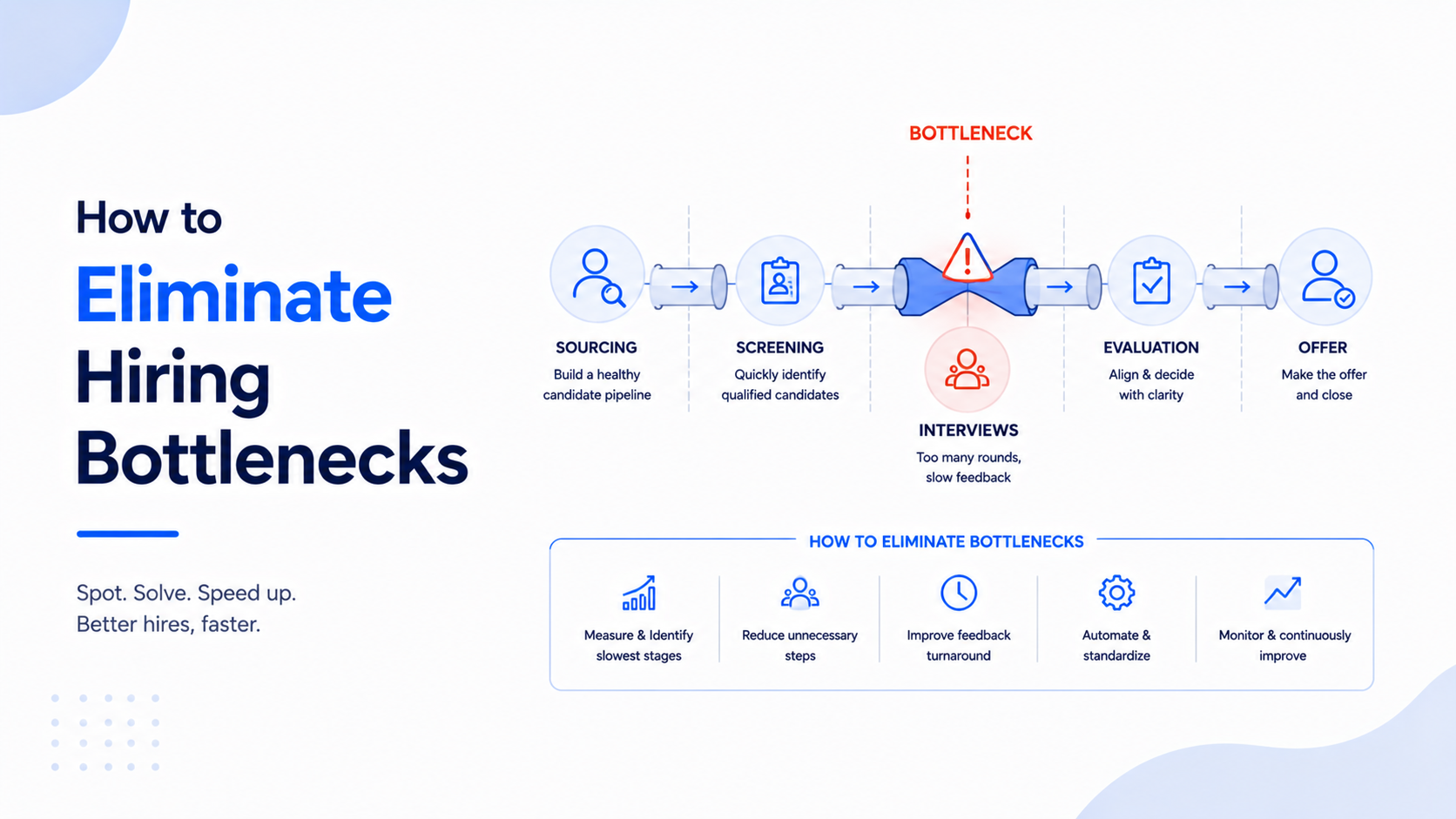
Carlos Mendoza had been Director of Talent Acquisition at a Series D e-commerce company for eleven months when he sat through his third quarterly business review where the topic was hiring throughput. The engineering organization was forty percent below plan. The product organization was three months behind on its roadmap because of unfilled roles. The CFO was asking why the recruiting budget had grown twenty-eight percent without a proportional increase in hires. Carlos had responded to each previous review with the same playbook—more sourcers, more agency spend, more job board postings—and each previous response had produced more activity without more hires. Sitting in the third review, Carlos realized he had been treating the symptom rather than the disease. The recruiting team was not under-resourced. It was bottlenecked. Somewhere in the seven-phase hiring process, a single constraint was limiting the throughput of the entire system, and no amount of additional capacity anywhere else would increase the throughput until the constraint was found and relieved. Carlos spent the next two weeks mapping the process phase by phase, measuring the cycle time and capacity at each, and identifying the single bottleneck that was silently governing the entire team's output. The bottleneck was not where he had been investing. Here is the framework he used to find and eliminate it, and how any TA leader can do the same.
What a Hiring Bottleneck Actually Is—and Is Not
A hiring bottleneck is the phase in the hiring process whose capacity is lower than the demand on it, and that therefore determines the throughput of the entire hiring process. It is not the same as a slow phase, because a slow phase may have excess capacity and therefore not be a bottleneck, while a fast phase may have no excess capacity and therefore be the bottleneck. The bottleneck is determined by the ratio of capacity to demand, not by the absolute cycle time, and the confusion of the two is what produces the investment in faster phases that do not increase the overall throughput, because the throughput is determined by the bottleneck and not by the fast phases. The Theory of Constraints, first articulated by Eliyahu Goldratt in manufacturing, applies directly to recruiting: the throughput of the system is determined by the throughput of the bottleneck, and any improvement that does not address the bottleneck is an improvement that does not increase the system's throughput.
The implication of the Theory of Constraints for recruiting is that the team's improvement effort should be concentrated on the bottleneck and not distributed across the process, because the improvement of a non-bottleneck phase is the improvement that does not increase the throughput and that therefore does not produce the value that the improvement was intended to produce. According to McKinsey research on talent operations, the teams that have identified their hiring bottleneck and concentrated their improvement effort on it report forty percent throughput improvements within one quarter, while the teams that have distributed their improvement effort across the process report eight percent improvements, because the concentrated effort produces the throughput increase that the distributed effort cannot produce regardless of the total effort invested. The bottleneck identification is the precondition for the throughput improvement, and the identification requires the measurement that most TA teams have not done.
The second implication is that adding capacity to a non-bottleneck phase is worse than useless, because it produces cost without throughput improvement and it can actually decrease throughput by increasing the inventory of candidates waiting at the bottleneck. As our analysis of more tools same hiring problems argues, the teams that have invested in tools without identifying the bottleneck have invested in capacity that the system cannot use, and the unused capacity is what produces the tool spend that does not produce the hires that the spend was intended to produce. The discipline of bottleneck elimination begins with the diagnosis, because the diagnosis is what directs the investment to the phase that will produce the throughput improvement that the diagnosis reveals is available and that the investment in the non-bottleneck phase does not produce and that the team's continued investment in the non-bottleneck phase is what produces the cost growth without the throughput growth that Carlos was experiencing in his quarterly reviews.
The Seven Common Bottlenecks in Modern Hiring Processes
The seven common bottlenecks in modern hiring processes correspond roughly to the seven phases of the hiring workflow, and each bottleneck has a characteristic cause, a characteristic symptom, and a characteristic fix. The requisition bottleneck is caused by approval chains that take longer than the market allows, and its symptom is requisitions that sit open for weeks before sourcing begins. The sourcing bottleneck is caused by channels that do not produce enough qualified candidates, and its symptom is a pipeline that is too small to fill the role. The screening bottleneck is caused by application volume that exceeds the recruiter's capacity to evaluate, and its symptom is qualified candidates who are screened out because the recruiter did not have time to evaluate them. The interview bottleneck is caused by interview capacity that is lower than the candidate volume, and its symptom is candidates who wait weeks between rounds. The decision bottleneck is caused by decision rights that are unclear or diffuse, and its symptom is candidates who wait for a decision while the panel debates. The offer bottleneck is caused by approval chains that take longer than the candidate's patience, and its symptom is candidates who decline while waiting for the offer. The onboarding bottleneck is caused by start dates that are pushed out by background checks or paperwork, and its symptom is hires who do not start when the team needs them.
The first step in eliminating a bottleneck is to determine which of the seven bottlenecks is the one that is actually limiting the team's throughput, because the bottlenecks produce similar symptoms—cycle time growth and missed hiring targets—but the fixes are different, and the fix that is applied to the wrong bottleneck is the fix that does not produce the throughput improvement that the team was trying to produce. According to Gartner talent acquisition research, the misdiagnosis of bottlenecks is the single most common cause of failed hiring improvement initiatives, because the misdiagnosis directs the improvement effort to the phase that is not the bottleneck and that the effort does not produce the throughput improvement that the team was trying to produce and that the team then concludes that the improvement initiative failed because the improvement does not work, when in fact the improvement would have worked if it had been applied to the actual bottleneck that the misdiagnosis did not identify.
The discipline of bottleneck identification begins with the measurement of capacity and demand at each phase, because the bottleneck is the phase where capacity is lowest relative to demand, and the measurement is what reveals the ratio. The measurement does not require sophisticated tools—it requires the team to track the number of candidates that each phase can process per week and the number of candidates that each phase is being asked to process per week, and the ratio is what reveals the bottleneck. As our guide on how to evaluate an AI sourcing tool explains, the platforms that produce the most useful bottleneck diagnosis are those that produce the capacity and demand data as a byproduct of the process, because the byproduct data enables the diagnosis without requiring the separate measurement that the team would otherwise have to do and that the team often does not do because the measurement is not part of the team's regular workflow and that the absence of the measurement is what produces the misdiagnosis that the regular measurement would have prevented.
Diagnosing the Bottleneck: A Step-by-Step Approach
The diagnosis of the bottleneck begins with the mapping of the process and the measurement of the cycle time and the queue time at each phase, because the queue time is the visible signal of the bottleneck and the cycle time is the visible signal of the slow phase, and the distinction matters because the bottleneck is the phase with the longest queue time rather than the phase with the longest cycle time. The queue time is the time that candidates spend waiting to be processed by the phase, and the cycle time is the time that candidates spend being processed by the phase, and the bottleneck is the phase where the queue is longest because the queue is what forms when the demand exceeds the capacity, and the formation of the queue is what reveals the bottleneck that the cycle time alone does not reveal, because the cycle time is the same whether the phase has a queue or not.
The first diagnostic step is to measure the queue time at each phase, because the phase with the longest queue time is the bottleneck, and the measurement is what reveals which phase that is. According to Deloitte workforce analytics, the queue time at the bottleneck phase averages three to five times the queue time at the non-bottleneck phases, which means that the bottleneck is typically the phase where the queue is dramatically longer than the others, and the dramatic difference is what makes the bottleneck identifiable from the queue time measurement alone, provided the measurement is done at each phase and not just at the aggregate level, because the aggregate measurement hides the queue time at the individual phases and that the hiding is what produces the misdiagnosis that the phase-level measurement prevents.
The second diagnostic step is to confirm the bottleneck by examining the capacity and the demand at the phase with the longest queue, because the queue forms when the demand exceeds the capacity, and the confirmation is what ensures that the long queue is the result of a capacity constraint rather than a one-time surge that will resolve itself. The capacity is the number of candidates the phase can process per week, and the demand is the number of candidates the phase is being asked to process per week, and the comparison is what reveals whether the long queue is the result of a structural capacity constraint or a temporary surge. As our analysis of agentic AI platforms vs automated ones demonstrates, the platforms that produce the most accurate bottleneck diagnosis are those that produce the capacity and demand data in real time, because the real-time data enables the team to monitor the bottleneck as it forms and to address it before the queue becomes the cycle time growth that the team is trying to prevent, and the prevention is what produces the throughput that the reaction does not produce.
The Requisition Bottleneck: Where Approval Chains Limit Throughput
The requisition bottleneck is the most under-diagnosed bottleneck in the hiring process, because its symptom—requisitions that sit open for weeks before sourcing begins—is often attributed to slow hiring managers or to the complexity of the role rather than to the approval chain that is actually the cause. The requisition bottleneck is caused by approval chains that require multiple sign-offs, each of which takes days, and the cumulative effect is a requisition that takes weeks to open, and the weeks are weeks of cycle time that are lost before the sourcing phase has even begun. The requisition bottleneck is the most expensive bottleneck because it is the earliest, and every day lost at the requisition phase is a day that is lost from the total cycle time, and the day that is lost from the total cycle time is a day that the role goes unfilled and that the team that needs the role is waiting for the hire that the requisition bottleneck is delaying.
The first fix for the requisition bottleneck is to separate the requisition approval from the compensation approval, because the two approvals have different cycles and different bottlenecks, and combining them creates a single bottleneck that is the sum of both. According to SHRM research on requisition management, the companies that have separated the requisition approval from the compensation approval have reduced their requisition-to-sourcing cycle time by forty percent, because the separation enables the two approvals to proceed in parallel rather than in sequence, and the parallel is what produces the cycle time that the sequence does not produce. The separation is the structural fix that eliminates the requisition bottleneck for most teams, because the compensation approval is typically the slower of the two approvals, and the separation enables the requisition to open while the compensation is being approved, and the parallel processing is what produces the cycle time that the serial processing does not produce.
The second fix for the requisition bottleneck is to pre-approve compensation ranges for common roles, so that the requisition does not require a compensation approval at all for roles within the pre-approved range, because the pre-approval eliminates the compensation approval from the requisition process and the elimination is what produces the cycle time that the pre-approval was designed to produce. As our analysis of AI sourcing vs AI recruiting explains, the platforms that produce the most effective requisition phase are those that enable the pre-approval of compensation ranges as part of the requisition intake, because the pre-approval is what enables the requisition to open immediately and the immediate opening is what produces the cycle time that the team was trying to produce and that the compensation approval was preventing and that the pre-approval eliminates.
The Interview Bottleneck: The Most Common Throughput Limiter
The interview bottleneck is the most common bottleneck in modern hiring processes, because the interview phase is the phase whose capacity is most constrained by the availability of the hiring manager and the interview panel, and the availability is the constraint that the team cannot easily expand, because the hiring manager and the interview panel have other jobs and cannot be dedicated to interviewing regardless of how many candidates need to be interviewed. The interview bottleneck is the bottleneck that Carlos had been experiencing, and it was the bottleneck that his investment in sourcers and job boards had not relieved, because the sourcers and the job boards were adding capacity to the sourcing phase and not to the interview phase, and the capacity that was added to the non-bottleneck phase did not produce the throughput improvement that the team was trying to produce.
The first fix for the interview bottleneck is to structure the interview process to minimize the number of rounds, because each round requires the candidate to wait for the interview panel's availability, and the waiting is what produces the queue that the bottleneck creates. According to LinkedIn talent research on interview efficiency, the companies that have capped their interview process at four rounds report thirty-five percent shorter cycle times than the companies that allow five or more rounds, because the cap eliminates the rounds that were not producing additional information and that were producing the cycle time that the elimination of the rounds eliminates. The cap is the structural fix that reduces the demand on the interview phase, and the reduction of the demand is what produces the throughput improvement that the team was trying to produce, because the throughput is determined by the ratio of capacity to demand, and the cap is what reduces the demand and that the reduction is what increases the throughput that the cap was designed to produce.
The second fix for the interview bottleneck is to expand the interview capacity by adding interviewers who are not the hiring manager, because the hiring manager is the constraint and the addition of interviewers is what expands the capacity. The interviewers should be trained to conduct structured interviews that produce consistent evaluations, because the structured interviews are what enable the additional interviewers to produce the same quality of evaluation that the hiring manager produces, and the same quality is what enables the additional interviewers to relieve the hiring manager of the interview load that was the constraint. As our guide on the recruiting dashboard every TA team needs explains, the dashboards that produce the most useful bottleneck diagnosis are those that display the interview capacity and the interview demand side by side, because the side-by-side display is what reveals the gap that the additional interviewers would close and that the closing is what produces the throughput improvement that the dashboard was designed to enable.
The Offer Bottleneck: Where the Best Candidates Are Lost
The offer bottleneck is the bottleneck where the cost is highest, because the candidates who are lost at the offer phase are the candidates who have already been sourced, screened, interviewed, and decided on, and the loss of these candidates represents the loss of the entire investment that the previous phases produced. The offer bottleneck is caused by approval chains that take longer than the candidate's patience, and the candidate's patience is shorter than most TA teams assume, because the candidate who is at the offer stage is the candidate who has been interviewing with other companies and who has other offers that are being extended faster than the team's offer process can produce. The offer bottleneck is the bottleneck that produces the highest cost per lost candidate, because the cost per lost candidate at the offer phase is the cumulative cost of all the previous phases, and the cumulative cost is what makes the offer bottleneck the most expensive bottleneck to leave unaddressed.
The first fix for the offer bottleneck is to pre-approve compensation ranges before the interview process begins, so that the offer can be extended within the approved range without additional sign-off, because the additional sign-off is what produces the delay that loses the candidate. According to EY research on offer process efficiency, the companies that have pre-approved compensation ranges and have empowered recruiters to extend offers within the range report twelve to fifteen percentage point higher offer acceptance rates, because the empowerment is what produces the speed that the candidate values and that the speed is what produces the acceptance that the delay loses to the competing offer. The pre-approval is the structural fix that eliminates the offer bottleneck, because the pre-approval is what removes the approval chain that was the bottleneck and that the removal is what produces the cycle time that the team was trying to produce.
The second fix for the offer bottleneck is to have the hiring manager deliver the offer personally, because the personal delivery is what produces the candidate's perception of organizational commitment that the recruiter-mediated delivery does not produce, and the perception of commitment is what produces the acceptance that the impersonal delivery does not produce. According to Deloitte compensation research, the offers delivered by the hiring manager report eighteen percent higher acceptance rates than the offers delivered by the recruiter, because the personal delivery is what produces the relationship that the acceptance is based on and that the impersonal delivery does not produce. The personal delivery does not eliminate the offer bottleneck by itself—it must be paired with the pre-approval that enables the hiring manager to deliver the offer quickly, and the pairing of the personal delivery with the pre-approval is what produces the offer process that does not lose candidates and that the team was trying to produce and that the approval chain was preventing and that the pre-approval eliminates.
Subordinating Everything Else to the Bottleneck
The Theory of Constraints says that the non-bottleneck phases should be subordinated to the bottleneck, which means that the non-bottleneck phases should be operated at a pace that matches the bottleneck's pace rather than at their own maximum pace, because operating the non-bottleneck phases at their maximum pace produces the inventory of candidates that waits at the bottleneck and that the inventory is what produces the queue that the bottleneck creates. The subordination is the discipline that most TA teams do not practice, because the team's instinct is to work as fast as possible at every phase, and the instinct is what produces the inventory that the bottleneck cannot process and that the inventory is what produces the cycle time that the team is trying to reduce.
The first subordination discipline is to throttle the sourcing phase to match the interview phase's capacity, because the sourcing that produces more candidates than the interview phase can process is the sourcing that produces the inventory that waits at the interview phase and that the inventory is what produces the queue that the bottleneck creates. According to McKinsey research on talent operations, the teams that have throttled their sourcing to match their interview capacity report twenty-five percent shorter cycle times, because the throttling is what eliminates the inventory that was producing the queue and that the queue was producing the cycle time that the throttling eliminates. The throttling feels counterintuitive to the team that has been told to source as much as possible, but the throttling is what produces the throughput that the maximum sourcing does not produce, because the throughput is determined by the bottleneck and not by the sourcing, and the throttling is what aligns the sourcing with the bottleneck and that the alignment is what produces the throughput that the misalignment did not produce.
The second subordination discipline is to schedule the screening phase to deliver candidates to the interview phase at the rate the interview phase can process them, because the screening that produces more candidates than the interview phase can process is the screening that produces the inventory that waits at the interview phase, and the inventory is what produces the queue that the bottleneck creates. As our analysis of agentic AI platforms vs automated ones shows, the platforms that produce the most effective subordination are those that enable the team to see the capacity of each phase in real time, because the real-time visibility is what enables the team to adjust the pace of the non-bottleneck phases to match the bottleneck's pace, and the adjustment is what produces the throughput that the unadjusted pace does not produce and that the team was trying to produce and that the adjustment is what produces it.
Elevating the Bottleneck: When to Add Capacity
The elimination of the bottleneck ultimately requires the elevation of the bottleneck, which means the expansion of the bottleneck's capacity so that it is no longer the constraint, and the expansion is what produces the throughput increase that the team was trying to produce. The elevation is the last step in the Theory of Constraints, because the elevation is the most expensive step and it should be taken only after the exploitation and subordination steps have been completed, because the elevation of the bottleneck without the exploitation and the subordination is the elevation that produces the capacity that the system cannot use and that the unused capacity is what produces the cost without the throughput that the team was trying to produce.
The first elevation strategy is to add capacity to the bottleneck phase, because the addition is what produces the throughput increase that the team was trying to produce. The addition of capacity at the interview phase means the addition of trained interviewers who can conduct the structured interviews that the hiring manager was conducting alone, and the addition is what produces the capacity that the bottleneck was lacking and that the lack was what produced the bottleneck and that the addition is what eliminates. The addition of capacity at the offer phase means the empowerment of the recruiter to extend offers within the pre-approved range, and the empowerment is what produces the capacity that the approval chain was limiting and that the limitation was what produced the bottleneck and that the empowerment is what eliminates.
The second elevation strategy is to redesign the bottleneck phase to require less capacity, because the redesign is what produces the throughput increase without the cost of the additional capacity, and the cost saving is what makes the redesign preferable to the addition when the redesign is possible. The redesign of the interview phase to use structured interviews that produce confident decisions in fewer rounds is the redesign that reduces the demand on the interview phase and that the reduction is what produces the throughput increase that the addition of interviewers would have produced but at a lower cost. The redesign of the offer phase to use pre-approved ranges that do not require additional sign-off is the redesign that reduces the demand on the offer phase and that the reduction is what produces the throughput increase that the addition of approvers would have produced but at a lower cost. The discipline of bottleneck elimination is the discipline of elevating the bottleneck through the redesign that reduces the demand before the addition that increases the capacity, because the redesign is the cheaper elevation and the cheaper elevation is the elevation that the team should try first and that the team should resort to the addition only when the redesign has been completed and the bottleneck persists. As our analysis of more tools same hiring problems demonstrates, the teams that have built the most effective bottleneck elimination practices are those that have followed the discipline of exploit, subordinate, elevate in that order, and the order is what produces the throughput improvement that the cost justifies and that the cost that the team was trying to avoid and that the discipline is what produces the improvement at the cost that the team was willing to pay.