Most recruiting teams do not have a system. They have a collection of habits, tools, and ad-hoc processes that accumulated over time. A recruiter finds a candidate on LinkedIn, sends them an email, schedules an interview through a separate tool, takes notes in a document, and asks a coordinator to send an offer. Every step is manual. Every step depends on individual judgment. And every step breaks when that recruiter is on vacation, leaves the company, or gets overwhelmed by volume.
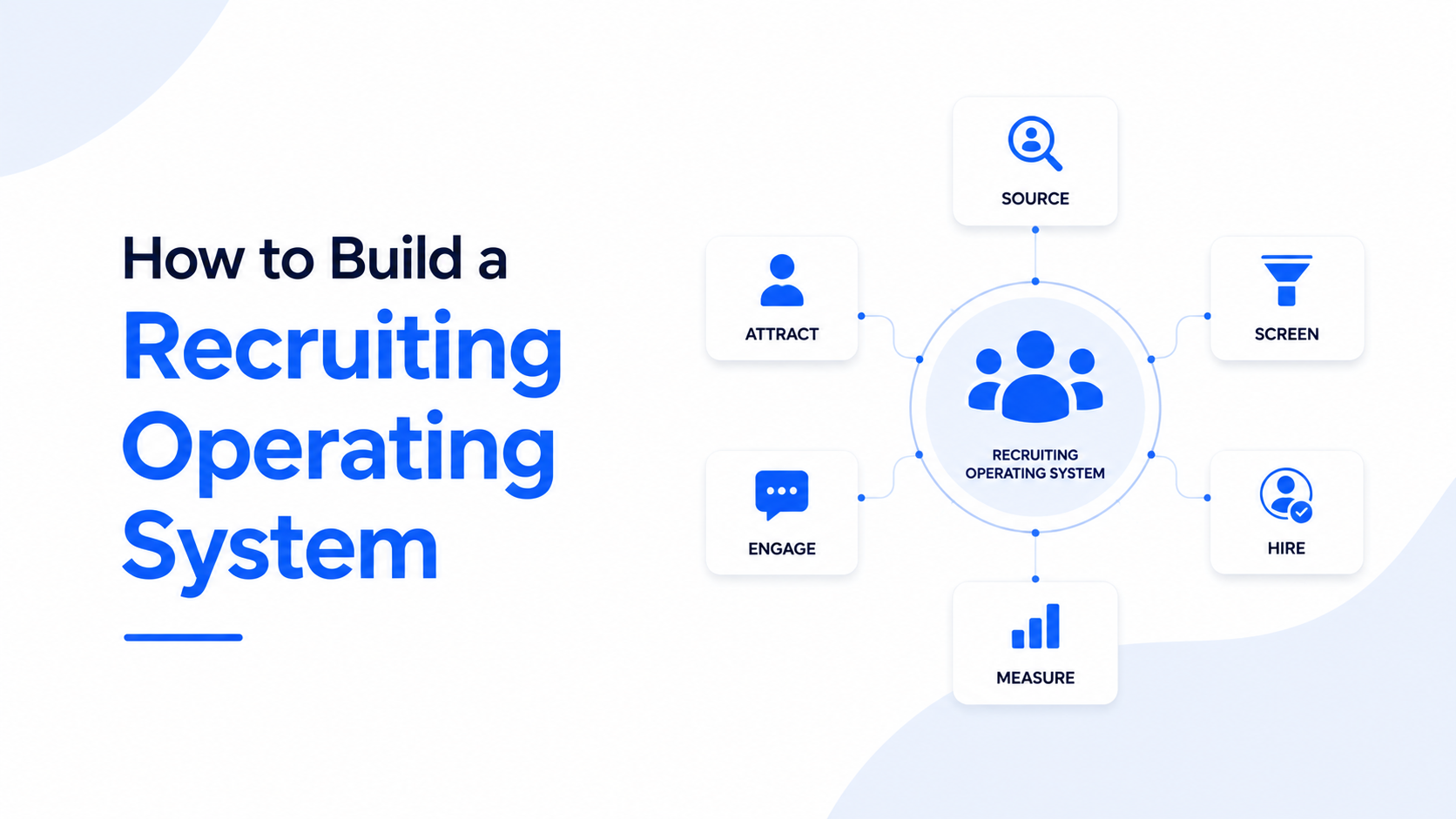
A recruiting operating system is the alternative. It is the deliberate infrastructure that makes great hiring possible at scale. It combines process design, technology architecture, data instrumentation, and team structure into a unified system that delivers consistent outcomes regardless of who is executing on any given day.
The difference between a team with an operating system and a team without one is not subtle. According to Greenhouse's 2026 Hiring Benchmarks Report, applications per recruiter have surged from 146 in 2022 to 746 in 2025 — a 411% increase. Meanwhile, recruiter headcount has dropped 56%. The teams that are thriving are not the ones working harder. They are the ones with systems that make the work easier.
What a Recruiting Operating System Is Not
It is not an applicant tracking system. An ATS is one component of the system, but it is not the system itself. A team can have a world-class ATS and still lack an operating system if the processes around it are undefined, the data capture is inconsistent, and the technology stack is fragmented.
It is not a set of standard operating procedures stored in a document nobody reads. Procedures that exist only on paper are not a system. They are a wish. A real operating system is instrumented — it captures data automatically, enforces consistency through workflow design, and improves based on what the data reveals.
It is not a one-time project. An operating system is a living infrastructure that evolves with the business. It is built iteratively, measured continuously, and improved based on outcomes.
The Four Layers of a Recruiting Operating System
A complete recruiting operating system has four layers that build on each other. Skip a layer and the system collapses.
Layer One: Process Architecture
The foundation is process design. This means defining, in writing, what happens from the moment a hiring need is identified to the moment a new hire starts their job. Every step. Every handoff. Every decision point.
According to Metaview's analysis of talent ops in 2026, the cleanest test of whether process architecture exists is simple: if a process improvement only lives in one recruiter's head, that is not recruiting operations yet. The role exists to turn ad-hoc improvements into standardized, instrumented, and inheritable infrastructure that every recruiter benefits from, including the recruiter you have not hired yet.
The key processes to define are:
Intake and requisition approval. Who can open a role? What information is required? Who approves the headcount and the job description? How does the process differ for backfills versus net-new roles versus executive hires?
Sourcing and outreach. Which channels are used for which roles? What does the outreach sequence look like? How is personalization handled? What are the response rate targets?
Screening and evaluation. What criteria are used to evaluate candidates? Who conducts initial screens? What assessment methods are used? How are decisions documented?
Interviewing and debrief. Who interviews for which roles? What is the interview structure? How are scorecards used? How are debriefs conducted and decisions made?
Offer and onboarding. Who extends offers? What is the approval process? How is compensation determined? What does the pre-boarding and onboarding sequence look like?
Each process should have a single owner, a documented workflow, and a defined success metric. Without these three elements, the process is not part of the operating system. It is a suggestion.
Layer Two: Technology Architecture
The second layer is the tech stack that executes the processes. This is where most teams go wrong. They buy tools to solve specific problems without considering how those tools fit together. The result is a fragmented stack where candidates fall through integration gaps, recruiters duplicate data entry, and leadership cannot get a unified view of performance.
According to Metaview's research, the average hiring team is running 11-plus tools by 2026. Without an architecture, every recruiter ends up running a personal stack on top of the shared one.
The technology architecture should be designed around three principles:
Integration first. Every tool must connect to the central system of record, which is typically the ATS. Data should flow automatically between systems. Candidate information entered in the sourcing tool should appear in the ATS without manual re-entry. Interview feedback from the assessment platform should populate the candidate record. If a tool does not integrate, it creates friction that compounds over time.
Single source of truth. There should be one place where the complete candidate journey is visible. Not a spreadsheet that someone updates weekly. Not a dashboard that pulls from three different systems and shows conflicting numbers. One system that every stakeholder trusts.
Workflow automation. The tools should automate routine tasks, not just store data. Scheduling should happen without back-and-forth emails. Follow-ups should trigger automatically based on candidate behavior. Screening should route candidates to the right stage based on their responses. The technology should reduce manual work, not add to it.
The core components of a modern recruiting tech stack are:
Applicant tracking system as the central system of record
AI-powered sourcing platform for candidate discovery and outreach
Conversational screening tool for initial evaluation
Interview scheduling system for logistics automation
Interview intelligence platform for feedback capture and analysis
Analytics dashboard for real-time performance tracking
Onboarding system for pre-boarding and first-day experience
Each component should be evaluated on integration capability, data flow, and total cost of ownership, not just feature lists.
Layer Three: Data Instrumentation
The third layer is the data infrastructure that makes the system measurable and improvable. Without data, the operating system is a black box. You cannot tell what is working, what is broken, or where to invest.
According to HeroHunt's analysis of AI recruiting ROI, 89% of talent professionals say measuring quality of hire is increasingly important, but only 25% feel confident actually doing it. That mismatch is the quiet reason so many recruiting investments never prove their worth: the savings may be real, but a team that never captured a baseline before the tool arrived is left arguing from belief rather than evidence.
Data instrumentation has three components:
Capture. Every touchpoint in the candidate journey should be recorded automatically. When a candidate was first sourced. Which channel they came from. When they were contacted. Whether they responded. What they said in screening. Who interviewed them. What scores they received. Whether they accepted the offer. When they started. How they performed at 90 days. This requires integrations between sourcing, ATS, assessment, and HRIS systems.
Structure. The data must be organized consistently. A candidate sourced in January should be tagged the same way as a candidate sourced in June. A hire from a referral should be categorized the same way as a hire from a job board. Without consistent taxonomy, the data cannot be compared or analyzed.
Actionability. Every metric should have an owner, a target, and a trigger. Response rate is owned by the sourcing team, with a target of 30% and a trigger to review channel mix when it drops below 25%. Time-to-hire is owned by recruiting operations, with a target of 35 days and a trigger to audit scheduling bottlenecks when it exceeds 45 days. A metric without these three elements is a number, not a management tool.
The metrics that matter most are:
Time-to-hire, tracked weekly by role category
Response rate, tracked in real time by channel and message type
Conversion rate per stage, tracked weekly to identify pipeline leaks
Quality of hire, tracked at 90 days, 6 months, and 12 months
Source effectiveness, tracked monthly by channel and role type
Cost per quality hire, tracked quarterly as a ratio of cost to performance
Candidate experience, tracked continuously at every stage
Hiring manager satisfaction, tracked monthly by recruiter and function
Layer Four: Team Structure and Roles
The fourth layer is the organizational design that makes the system executable. A perfect process, technology stack, and data model will fail if the people using it do not have clear roles, adequate capacity, and the right skills.
According to Pin's research on recruiting team structure, the shape of the team changes with scale. At 1 to 2 recruiters, the operating system is compressed into whatever the founder or first recruiter can manage. At 3 to 5 recruiters, a coordinator emerges to handle scheduling and logistics. At 10 to 20 recruiters, recruiting operations graduates into its own role. At 50-plus recruiters, the ops function becomes a team with specialized roles for process, technology, data, and program management.
The roles that make up a mature recruiting operating system are:
Recruiting operations manager. Owns process design, technology architecture, and data instrumentation. This is the systems thinker who ensures the operating system works as designed.
Sourcer. Owns candidate discovery and initial outreach. This role is separate from the recruiter in high-performing teams because sourcing requires different skills — research, market mapping, and message optimization — than relationship management and closing.
Recruiter. Owns candidate evaluation, interview coordination, offer negotiation, and hiring manager partnership. The recruiter's job is to make great matches, not to spend half their time on logistics.
Coordinator. Owns interview scheduling, candidate communication, offer paperwork, and onboarding logistics. This role is the operating backbone that keeps the system running.
Hiring manager. Owns role definition, interview participation, and final hiring decisions. The operating system should make the hiring manager's job easier, not add bureaucracy.
Each role should have a clear scope, defined success metrics, and documented handoffs to other roles. Ambiguity at the boundaries is where the system breaks down.
Building the System: A Practical Roadmap
Building a recruiting operating system is not a one-time project. It is an iterative process that unfolds over months. Here is a practical roadmap.
Month One: Audit and Baseline
Start by understanding what you have. Map every step of your current hiring process from requisition to start date. Interview every recruiter, coordinator, and hiring manager about what works and what breaks. Document the current tech stack, including tools that were purchased but never adopted. Capture baseline metrics for time-to-hire, response rate, conversion rates, and quality of hire.
The goal of this month is not to fix anything. It is to see clearly. Most teams discover that their actual process looks nothing like their documented process, that their tech stack has significant redundancy, and that their data capture is too inconsistent to trust.
Month Two: Design the Target State
Based on the audit, design the target operating system. Define the processes that need to change, the tools that need to be added or removed, and the data model that needs to be implemented. Prioritize changes by impact and effort. High-impact, low-effort changes come first. High-impact, high-effort changes come next. Low-impact changes of any effort level come last or not at all.
Create a process architecture document that defines every step, owner, and success metric. Create a technology architecture document that maps the target stack, integration points, and data flows. Create a data instrumentation plan that defines what to capture, how to structure it, and who owns each metric.
Month Three: Implement Core Processes
Implement the highest-priority process changes first. This typically means standardizing intake, defining screening criteria, and creating structured interview frameworks. These changes require no new technology and deliver immediate impact. They also create the foundation for technology implementation.
Train every team member on the new processes. Document them in a central location that everyone can access. Create templates for common tasks — intake forms, outreach sequences, scorecards, debrief formats. The goal is to make the right way the easy way.
Month Four: Consolidate the Tech Stack
With processes defined, implement technology changes. This typically means sunsetting redundant tools, configuring integrations, and rolling out new platforms. Do not try to change everything at once. Start with the tool that has the biggest gap between current state and target state.
Ensure that every tool integrates with the central ATS. Configure automatic data capture. Test the integrations with real candidate flows before declaring them complete. The most common failure mode is assuming that a vendor's integration works as advertised without testing it with your specific data model.
Month Five: Instrument the Data
With processes and technology in place, implement data instrumentation. Configure the analytics dashboard. Define targets and triggers for each metric. Train the team on how to use the dashboard and what actions to take when metrics breach thresholds.
Start with three metrics: time-to-hire, response rate, and quality of hire. Get these three trustworthy and acted upon, then layer in the rest. The right AI recruiting software will capture most of them automatically without manual logging.
Month Six: Optimize and Iterate
With the operating system live, enter optimization mode. Review metrics weekly. Identify bottlenecks. Test changes. Measure outcomes. The operating system should improve continuously based on what the data reveals.
This is not a maintenance phase. It is an active improvement phase. The teams that treat month six as the end of the project are the teams whose operating systems stagnate and become obsolete. The teams that treat it as the beginning of continuous improvement are the teams that stay ahead.
Common Failure Modes and How to Avoid Them
The most common failure is building the system in the wrong order. Teams buy technology before defining processes, then discover that the tools enforce workflows that do not match their needs. They end up customizing the tools to match bad processes, which creates technical debt and user frustration. Process first, technology second, data third.
The second most common failure is over-engineering the initial build. Teams try to instrument every metric, integrate every tool, and standardize every process in month one. The result is a system that is too complex to adopt and too fragile to maintain. Start with the three metrics that matter most. Add complexity only when the basics are working.
The third most common failure is neglecting change management. A new operating system changes how people work. Recruiters who are used to autonomy resist standardized processes. Hiring managers who are used to informal relationships resist structured scorecards. The system will fail if the people using it do not understand why it exists and how it helps them. Invest in training, communication, and feedback loops.
The fourth most common failure is treating the system as finished. An operating system is not a monument. It is a garden. It requires continuous tending. Processes that worked six months ago may not work today. Tools that were best-in-class last year may be obsolete this year. Metrics that mattered in one growth stage may not matter in the next. The system must evolve with the business.
The Bottom Line
A recruiting operating system is the infrastructure that makes great hiring possible at scale. It is not an ATS. It is not a set of procedures. It is a deliberate, instrumented, and continuously improving combination of process architecture, technology architecture, data instrumentation, and team structure.
The teams that build this system hire faster, spend less, and retain better. They deliver consistent outcomes regardless of who is executing. They scale without proportional headcount growth. And they earn their place as strategic partners to the business rather than service functions fighting for budget.
The teams that do not build this system drown in complexity. Recruiters become administrative coordinators. Tools proliferate without integration. Data exists but cannot be trusted. And the best candidates accept offers from competitors who moved faster because their operating system was better.
In 2026, the difference between great hiring and average hiring is not the quality of individual recruiters. It is the quality of the system they work within.