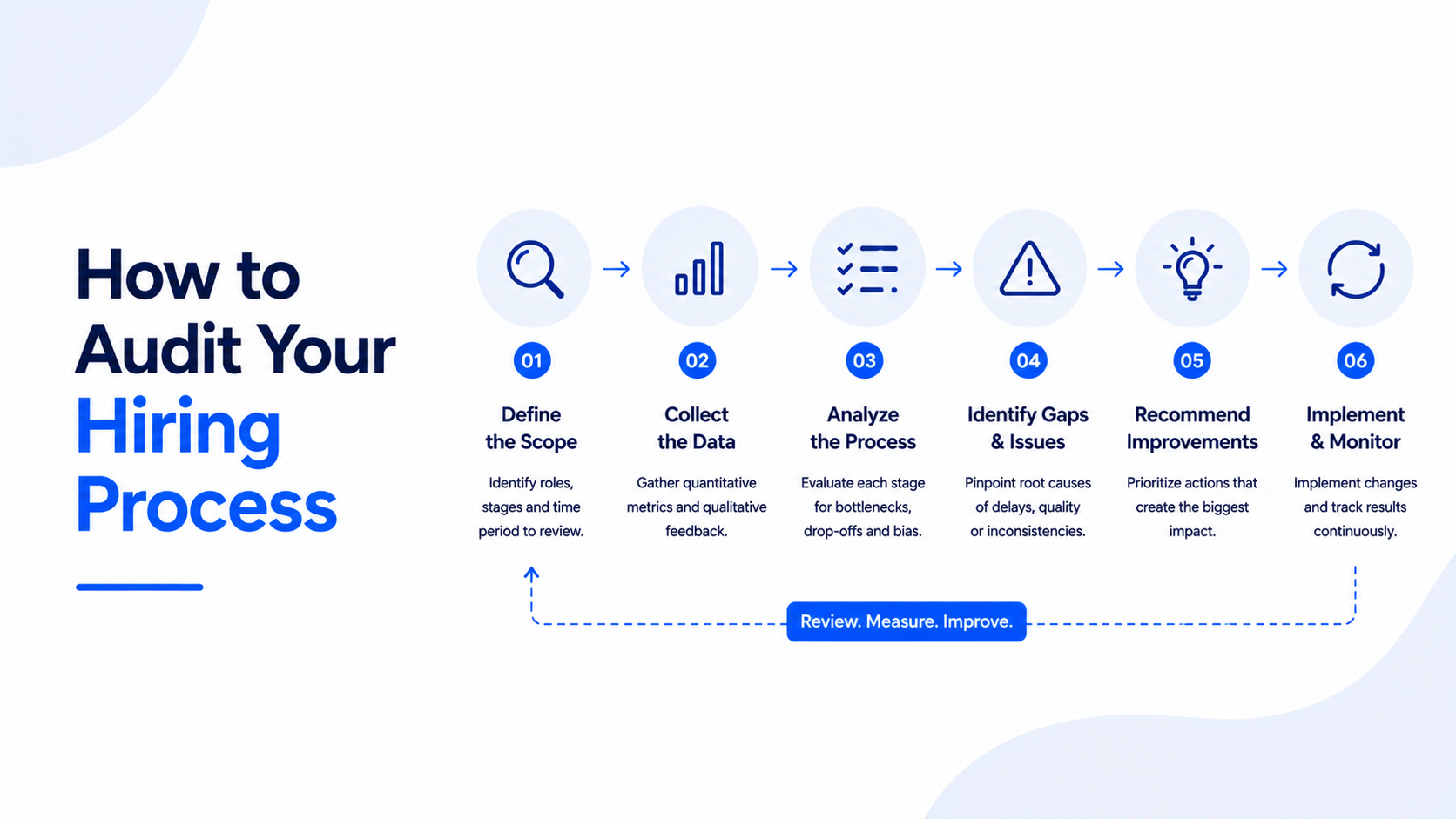
Sandra Cheng had been Chief People Officer at a twelve-hundred-person logistics company for fifteen months when the board asked her to justify the talent budget. She had a story she could tell—the team had grown, the offer acceptance rate had improved, the cost-per-hire was below the industry benchmark—but she did not have an answer to the question behind the question, which was whether the hiring process was actually working or whether the team was producing results despite a process that was quietly losing candidates and cycle time. Sandra had been in TA long enough to know that gut feelings about process health are unreliable, because the process feels healthy when the market is strong and feels broken when the market is weak, and the feelings track the market more closely than they track the process. She decided to do what she had done at her previous company: a full audit of the hiring process, end to end, phase by phase, metric by metric, with the rigor of a financial audit and the candor of an operational review. The audit revealed seven defects she had not suspected and three she had suspected but could not previously prove, and the remediation plan she built from the audit produced a twenty-three percent cycle time reduction within two quarters. Here is the audit framework she used, and the one that any TA leader can use to do the same.
What a Hiring Process Audit Actually Means
A hiring process audit is a structured, end-to-end review of the recruiting workflow that produces an evidence-based assessment of how the process is performing and a prioritized list of the defects that are limiting its performance. It is not the same as a metrics review, because a metrics review reports the numbers that the process is producing while an audit examines the process that is producing the numbers, and the difference matters because a process can produce acceptable numbers while hiding the defects that will produce unacceptable numbers when the market shifts or the volume grows. The audit is the diagnostic that reveals the defects before they manifest in the metrics, because the defects are in the process and the metrics are the symptoms, and the diagnostic that examines the process itself is the only diagnostic that can identify the defects before they become symptoms.
The audit covers five dimensions that together describe the health of the hiring process. Speed measures whether the process is fast enough to compete in the market for talent. Quality measures whether the process is producing hires who perform and stay. Cost measures whether the process is using its resources efficiently. Experience measures whether the process is producing an experience that candidates and hiring managers would recommend. Equity measures whether the process is producing outcomes that are fair across demographic groups, role families, and sourcing channels. Each of these dimensions is independent, and a process can be strong on one dimension and weak on another, which is why an audit that focuses on only one dimension—typically speed or cost—produces a partial picture that leads to improvements in one dimension and degradations in others, because the dimensions are interdependent and the improvement that does not account for the interdependence produces local optimization and global degradation.
The companies that have institutionalized hiring process audits treat them as a regular operational discipline rather than a one-time project. According to McKinsey research on talent operations, companies that audit their hiring process at least annually are forty-two percent more likely to report year-over-year improvements in time-to-fill and quality-of-hire, because the audit produces the evidence that drives the improvement, and the improvement without the evidence is a guess that may or may not target the actual defect. As our analysis of more tools same hiring problems argues, the teams that have invested in tools without auditing their process have invested blind, and the tools have produced a process that is more complex and less understood than the one they replaced, which is the opposite of the operational discipline that the audit exists to instill and that the audit is the only reliable way to maintain.
When and Why You Need to Audit Your Hiring Process
The right time to audit a hiring process is before the metrics deteriorate, because the audit that produces evidence before the deterioration is the audit that enables the team to fix the defect before it becomes a result, and the fix before the result is always cheaper than the fix after the result. Most TA teams audit their process only after a deterioration becomes visible—the offer acceptance rate drops, the time-to-fill grows, the hiring manager satisfaction falls—and the audit after the deterioration is a recovery exercise rather than a prevention exercise, and the recovery exercise always costs more than the prevention exercise would have cost. The discipline of auditing before the deterioration is the discipline that separates the teams that maintain a healthy process from the teams that cycle between health and crisis, because the prevention produces stability and the recovery produces volatility, and the stability is what enables the team to plan and execute while the volatility is what forces the team to react and rebuild.
The first trigger for an audit is a significant change in hiring volume, because the process that works at one volume will not work at a different volume, and the audit reveals the steps whose capacity will be exceeded at the new volume before the steps actually break. According to Gartner talent acquisition research, companies that audit their hiring process before a planned hiring surge report thirty-five percent fewer process breakdowns during the surge than companies that audit after the surge has begun, because the pre-surge audit identifies the bottlenecks that the surge will expose and the team can address them in advance. The audit is the preparation that turns a hiring surge from a crisis into a planned expansion, and the preparation is what enables the team to absorb the surge without the quality deterioration that an unprepared team would experience and that would undermine the very growth the surge was intended to support.
The second trigger is a change in role mix or geography, because the process that works for one type of role or one market will not work for all types of roles or all markets, and the audit reveals the assumptions that the process encodes about the roles or markets it was designed for, and the assumptions that no longer hold are the assumptions that produce the defects at the new role mix or geography. The third trigger is a change in tool stack, because the process that was designed around one tool will not work optimally with a different tool, and the audit reveals the steps that the new tool changes and the steps that the new tool does not change, and the difference is what determines whether the new tool will produce the improvement it was purchased to produce. As our guide on how to evaluate an AI sourcing tool explains, the teams that audit their process before and after a tool change are the teams that produce the tool improvement they expected, because the audit confirms that the tool is being used as designed and that the process has been adapted to use it, which is the difference between a tool that delivers and a tool that disappoints.
The Five Audit Lenses: Speed, Quality, Cost, Experience, Equity
The five audit lenses are the five perspectives from which any hiring process can be examined, and a complete audit examines the process through all five, because each lens reveals defects that the other lenses do not see. Speed is the lens that examines the cycle time of each phase and the conversion rate between phases, and it reveals the bottlenecks and the queues that are absorbing cycle time without producing value. Quality is the lens that examines the performance and retention of hires, and it reveals the sourcing channels, screening criteria, and interview practices that produce strong hires and the ones that produce weak hires. Cost is the lens that examines the resources consumed by the process—recruiter time, tool spend, agency fees, advertising—and it reveals the steps that consume cost without producing proportional value. Experience is the lens that examines the candidate and hiring manager experience of the process, and it reveals the friction that is driving candidates away and hiring managers to dissatisfaction. Equity is the lens that examines the outcomes of the process across demographic groups, and it reveals the steps where bias is producing unequal outcomes.
The speed lens is the most familiar lens because speed is the metric that most TA teams report most regularly, but the audit's speed lens goes deeper than the reported metric. The reported speed metric is typically time-to-fill, which is the aggregate cycle time from requisition to offer acceptance, but the audit's speed lens examines the cycle time of each phase and the queue time between phases, and the phase-level cycle time is the diagnostic that the aggregate time-to-fill cannot provide. According to SHRM research on talent acquisition metrics, the average time-to-fill is composed of approximately forty percent work time and sixty percent queue time, which means that the speed improvements that target queue time produce larger cycle time reductions than the speed improvements that target work time, and the audit is what reveals where the queue time is concentrated and therefore where the speed improvement effort should be directed.
The quality and equity lenses are the lenses that most audits underweight, because quality is harder to measure than speed and equity is harder to discuss than cost, but the lenses that are underweighted are the lenses where the largest improvement opportunities often hide. The quality lens requires the audit to connect hiring data to performance data, which requires a data integration that many TA teams have not built, but the integration is the prerequisite for any quality improvement because the quality improvement must target the sourcing channels and screening practices that produce weak hires, and the targeting requires the data that the integration provides. The equity lens requires the audit to examine outcomes by demographic group, which requires the candidate data that many TA teams are reluctant to collect, but the examination is the prerequisite for any equity improvement because the improvement must target the steps where bias is producing unequal outcomes, and the targeting requires the data that the examination provides. As our analysis of agentic AI platforms vs automated ones shows, the platforms that produce the greatest audit value are those that produce the data for all five lenses as a byproduct of the hiring process, because the byproduct data enables the audit without requiring a separate data collection effort that the team would otherwise have to absorb.
Gathering the Data: What to Measure and Where to Find It
The audit's data gathering is the phase that determines the audit's quality, because an audit is only as good as the data it examines, and the data that is incomplete or inaccurate produces an audit that is incomplete or inaccurate. The data must be gathered from the systems that capture the process as it runs—the ATS, the sourcing platform, the scheduling tool, the assessment platform, the offer management tool, the HRIS—because the data in these systems is the record of what actually happened, and the record of what actually happened is the only reliable basis for an audit of how the process is actually performing. The data that is gathered from interviews with recruiters and hiring managers is useful for context but unreliable for facts, because the interviews capture perceptions rather than measurements, and the perceptions are shaped by the most recent experiences rather than by the long-term patterns that the audit must examine.
The first data category is process data, which captures the cycle time and conversion rate at each phase of the process. The process data must be extracted from the ATS and the scheduling tool, and it must be segmented by role family, seniority, geography, and sourcing channel, because the aggregate process data hides the variation that the audit must examine. According to LinkedIn talent research on recruiting analytics, the segmentation of process data is the single highest-leverage analytical step in a hiring audit, because the segmentation reveals the specific segments where the process is performing well and the specific segments where it is performing poorly, and the segment-level insight is what enables the audit to produce a targeted recommendation rather than a generic improvement that does not account for the variation. The segmentation is the analytical discipline that turns the audit from a report into a diagnosis, and the diagnosis is what the audit exists to produce.
The second data category is outcome data, which captures the performance and retention of the hires the process has produced. The outcome data must be extracted from the HRIS and the performance management system, and it must be connected to the hiring data through the candidate identifier that links the ATS record to the HRIS record, because the connection is what enables the audit to examine which sourcing channels, screening criteria, and interview practices produce the hires who perform and stay. The connection is the data integration that most TA teams have not built, because the integration requires cooperation between TA and HRIS teams that is often not established, but the integration is the prerequisite for any quality audit because the quality audit must examine the process that produces the hires, and the examination requires the data that connects the hires back to the process that produced them. As our analysis of AI sourcing vs AI recruiting explains, the platforms that produce the most auditable processes are those that capture the candidate journey from sourcing through hire through performance, because the end-to-end data is what enables the audit to examine the process as a system rather than as a series of disconnected phases.
Diagnosing the Findings: From Data to Defects
The diagnosis phase of the audit is the phase where the data is examined and the defects are identified, and the diagnosis is the phase where the audit's value is created, because the data without the diagnosis is a report rather than an audit, and the report does not produce improvement while the audit does. The diagnosis begins by looking at the data through each of the five lenses and identifying the segments where the data indicates a defect—a phase with cycle time above the benchmark, a sourcing channel with quality below the average, a step with cost above the value it produces, a touchpoint with satisfaction below the threshold, a demographic group with outcomes below the average. Each of these indicators is a defect that the audit must examine, and the examination must determine whether the indicator reflects a process defect or a data anomaly, because not every indicator is a defect, and the audit that treats every indicator as a defect produces a list of false positives that distracts the team from the real defects that the audit exists to identify.
The first diagnostic principle is to distinguish correlation from causation, because the data reveals correlations but the audit must identify causes, and the causes are not always what the correlations suggest. A correlation between a sourcing channel and low quality-of-hire may reflect a defect in the channel, or it may reflect a defect in the screening that follows the channel, or it may reflect a defect in the role specifications that the channel is sourcing against, and the audit must examine the data deeply enough to distinguish these causes because the remediation differs for each. According to Deloitte workforce analytics, the audits that produce the most accurate diagnoses are those that examine each indicator through at least three causal hypotheses before concluding that the indicator reflects a specific defect, because the three-hypothesis discipline prevents the audit from jumping to a conclusion that the data supports but does not prove, and the conclusion that the data does not prove is the conclusion that produces a remediation that does not fix the actual defect.
The second diagnostic principle is to look for patterns across lenses, because the defect that appears in one lens often has its cause in another lens, and the audit that examines each lens in isolation misses the cross-lens patterns that reveal the root cause. A speed defect in the interview phase may be caused by a quality defect in the screening phase, because the screening is producing unqualified candidates who require additional interviews to evaluate, and the speed remediation that does not address the screening quality will not produce the speed improvement it targets. A cost defect in the sourcing phase may be caused by an equity defect in the screening phase, because the screening is rejecting qualified candidates from underrepresented groups who must be re-sourced at additional cost, and the cost remediation that does not address the screening equity will not produce the cost improvement it targets. As our guide to the recruiting dashboard every TA team needs explains, the dashboards that support the most accurate diagnoses are those that display the five lenses together rather than in separate views, because the together view is what enables the auditor to see the cross-lens patterns that the separate views hide.
Building the Audit Report: From Findings to Action
The audit report is the artifact that turns the audit's diagnosis into action, and the report's quality determines whether the audit produces improvement or merely produces a document that no one acts on. The report must be written for the audience that will act on it—the TA leader, the operations team, the hiring managers, the finance partner—and the audience for each finding must be named, because a finding without a named audience is a finding that no one is responsible for acting on, and a finding that no one is responsible for acting on is a finding that does not produce improvement. The report's structure must be designed for action, not for comprehensiveness, because the comprehensive report that lists every finding is a report that overwhelms the audience and produces no action, while the action-oriented report that prioritizes the findings and names the remediation for each is a report that produces the improvement it was written to produce.
The first report principle is to prioritize the findings by their impact on the dimensions the audit examines, because the remediation capacity is finite and the finite capacity must be directed at the findings whose remediation produces the largest improvement. The prioritization must be based on a quantified impact estimate, because the prioritization based on intuition is unreliable and the prioritization based on the loudest complaint is worse, and the quantified impact estimate is what enables the audit to direct the remediation capacity at the findings that matter rather than the findings that are most visible. According to EY research on HR process audits, the audits that produce quantified impact estimates for each finding are sixty percent more likely to produce remediation that actually improves the metrics, because the quantified estimate forces the auditor to think through the remediation's effect on the metric, and the thinking-through is what produces the remediation that works rather than the remediation that is intended to work but does not.
The second report principle is to pair each finding with a specific recommendation, because a finding without a recommendation is a problem without a solution, and the audience that receives a problem without a solution is an audience that does not know what to do and therefore does nothing. The recommendation must be specific enough to be actionable—the specific process step to change, the specific tool to add or remove, the specific metric to track—and the specificity is what enables the audience to act, because the specific recommendation is a recommendation that can be implemented and the general recommendation is a recommendation that requires further work before it can be implemented, and the further work is often not done because the audience does not have the time or the mandate to do it. The audit report that pairs each finding with a specific recommendation is the audit report that produces the remediation it was written to produce, because the recommendation removes the friction between the finding and the action, and the friction is what prevents most audits from producing the improvement they identify.
Turning the Audit into Continuous Improvement
An audit is a snapshot, and a snapshot is valuable only if it is compared to the previous snapshot and used to inform the next one, because the audit's value compounds only when the audit is repeated and the comparison reveals whether the process is improving or degrading over time. The first audit is a baseline that establishes the process's current state, and the second audit is a comparison that reveals whether the remediation from the first audit produced the improvement it was designed to produce, and the third audit is a trend that reveals whether the process is improving continuously or whether the improvement from the first audit has decayed and the process has returned to its pre-audit state. The compounding value of the audit is in the trend, because the trend is what enables the team to distinguish the improvements that stick from the improvements that fade, and the distinction is what enables the team to invest in the improvements that compound rather than the improvements that have to be repeated.
The first continuous improvement practice is to schedule the next audit before the current audit is complete, because the audit that is not scheduled is the audit that is not done, and the audit that is not done is the audit that does not produce the trend. According to Gartner talent acquisition research, companies that schedule their hiring audits at regular intervals—annually for stable teams, semi-annually for teams in growth or transformation—are fifty percent more likely to report sustained year-over-year improvement in their hiring metrics, because the regular cadence produces the trend data that enables the team to manage the process as a system that improves over time rather than as a series of moments that are each evaluated in isolation. The cadence is the discipline that turns the audit from a project into a practice, and the practice is what produces the compounding improvement that the audit exists to produce.
The second continuous improvement practice is to track the remediation from each audit to completion, because the remediation that is recommended but not implemented is a remediation that does not produce improvement, and the audit that produces recommendations without tracking their implementation is an audit that documents defects without fixing them. The tracking must be owned by the operations team, because the operations team owns the process and is therefore in the best position to ensure that the remediation is implemented and that the implementation produces the improvement the audit predicted. As our analysis of more tools same hiring problems demonstrates, the teams that have built the most effective audit practices are those that pair the audit with a remediation tracker that the operations team owns and reviews monthly, because the tracker is what ensures that the audit's findings become the audit's improvements, and the improvements are what justify the audit's existence and the investment it requires.
The third continuous improvement practice is to use the audit as the basis for the team's annual planning, because the audit reveals the defects that the annual plan must address, and the plan that is not based on the audit is a plan that is based on intuition rather than evidence, and the plan based on intuition is unlikely to produce the improvement the plan promises. The audit is the evidence base that turns the annual plan from a wish list into a roadmap, and the roadmap is what enables the team to commit to specific improvements and to be held accountable for delivering them, because the audit has established the baseline and the plan has established the target, and the gap between the baseline and the target is the improvement that the team has committed to deliver. The teams that have institutionalized this practice are the teams whose hiring processes improve every year, because the audit produces the evidence, the plan produces the commitment, and the tracking produces the improvement, and the three together are what turn a hiring process from a function that runs into a function that improves, which is the difference between a TA team that maintains and a TA team that leads.