AI recruiting software can process more candidate information than traditional recruiting teams could realistically manage by hand.
A sourcing system may analyze professional profiles and career histories. Contact-enrichment technology may connect candidates with work email addresses or other professional contact information. Outreach software records messages and responses. AI screening systems may process interview transcripts, candidate answers, qualification evidence, and scoring criteria. Recruiting platforms may also store recruiter notes, interview feedback, hiring decisions, and historical candidate relationships.
Each individual action may appear reasonable.
Together, they create a significant data-processing environment.
This is why data privacy cannot be treated as a small legal section inside an AI recruiting platform. Privacy affects how candidate information enters the system, what the company is allowed to do with it, how the candidate is informed, who can access the information, whether AI creates profiles or recommendations, how long records remain stored, and what happens when a candidate exercises a data right.
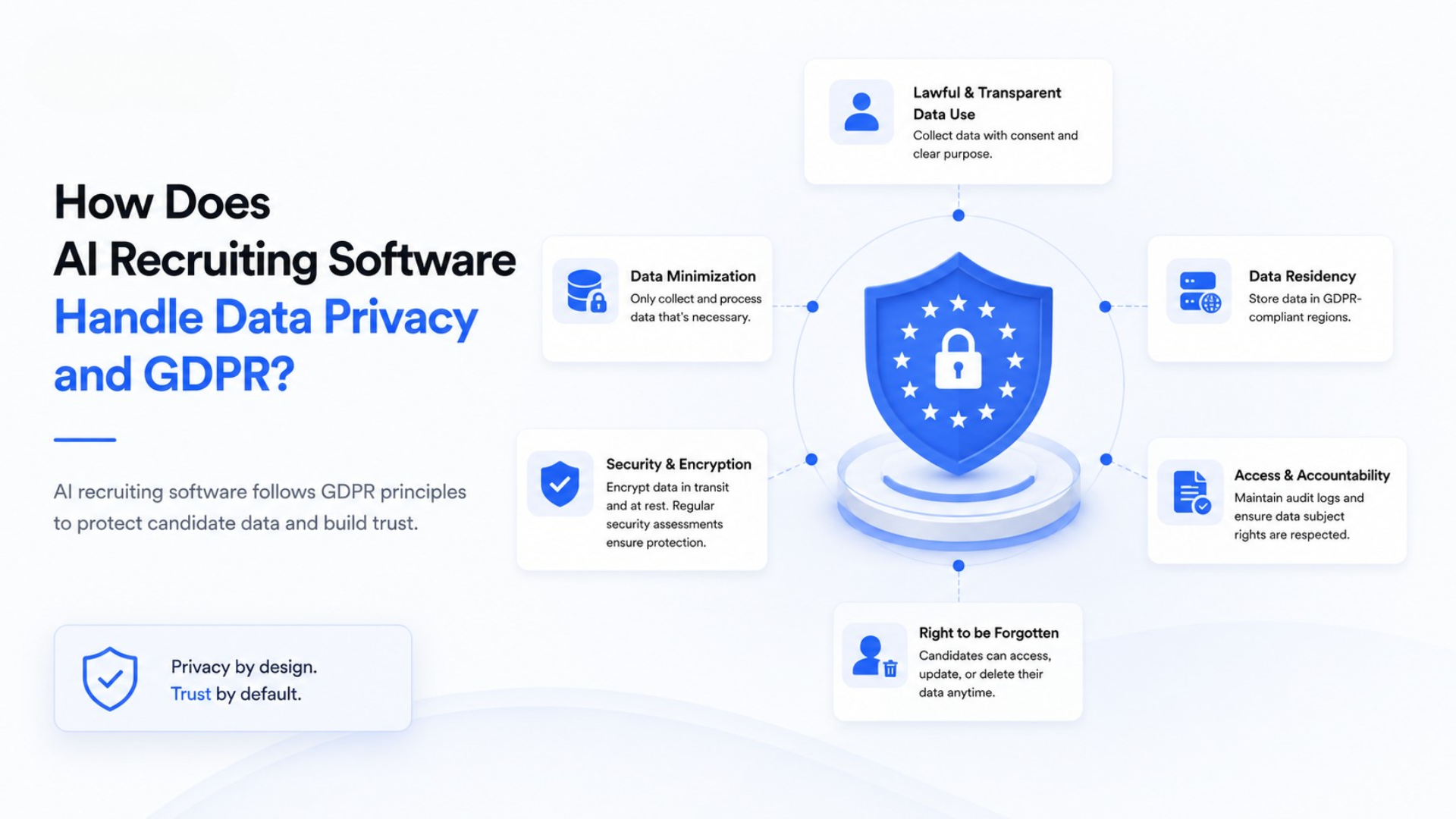
AI recruiting software handles data privacy and GDPR through a combination of lawful processing, transparency, purpose limitation, data minimization, security controls, retention policies, candidate-rights workflows, vendor governance, and appropriate oversight of automated decision-making.
The technology can support these requirements.
It cannot create compliance by itself.
A recruiting platform may provide encryption, access controls, deletion tools, audit records, configurable retention, and candidate-data workflows. The company using the software still needs to decide why it is processing the information, which lawful basis applies, what information is genuinely necessary, how candidates are informed, and how the organization responds to requests.
This distinction is essential.
Recruiting teams sometimes ask whether a particular AI tool is “GDPR compliant” as if compliance were a permanent product feature.
The better question is broader.
Can the software be used as part of a compliant recruiting process, and does the organization using it have the policies, configuration, contracts, governance, and operational discipline required for that process?
The answer depends on both the technology and the company.
This article explains the practical relationship between AI recruiting software, candidate data privacy, and the General Data Protection Regulation. It is a general explanation rather than legal advice, and organizations should obtain appropriate legal or privacy guidance for their specific jurisdictions and recruiting practices.
Why AI Recruiting Creates More Complex Privacy Questions
Recruiting has always involved personal data.
A traditional application may contain a candidate’s name, contact details, employment history, education, skills, and other professional information.
AI recruiting expands the number of ways this information can be processed.
A system may search large professional datasets to identify potential candidates who never applied. It may compare a person’s background with a job requirement. It may generate a relevance score. It may enrich a profile with professional contact information. It may analyze a candidate’s response to outreach. It may transcribe a screening conversation and structure the evidence inside the answer.
The challenge is not simply that more data exists.
The challenge is that more decisions and actions can happen around the data.
Traditional recruiting software often stores information after a recruiter enters it.
AI recruiting software can actively interpret information.
It may infer that a candidate is relevant to a role.
It may rank one professional above another.
It may classify a response as interested or uninterested.
It may summarize an interview answer.
It may recommend that a candidate deserves recruiter review.
These capabilities can improve recruiting efficiency.
They also create important questions about transparency, accuracy, fairness, human oversight, and candidate rights.
The more the system influences the candidate journey, the more carefully the company needs to understand what the software is doing.
What Counts as Personal Data in AI Recruiting?
The GDPR uses a broad concept of personal data.
Information does not need to be highly private to qualify.
If information relates to an identified or identifiable person, it may be personal data.
In recruiting, this can include obvious information such as a candidate’s name, email address, phone number, resume, and professional profile.
It can also include employment history, education, skills, location, interview notes, assessment results, recruiter comments, candidate messages, screening transcripts, and information about hiring progression.
AI-generated information can also matter.
Suppose a system creates a score estimating how closely a candidate matches a role.
That score relates to an identifiable person.
A screening summary describing the candidate’s strengths and gaps also relates to that person.
The fact that software created the information does not automatically place it outside data-protection responsibilities.
This is one reason AI recruiting privacy cannot focus only on where the original data came from.
The organization also needs to consider what new information the system creates through processing.
A candidate profile may enter the workflow with a job title and career history.
The AI may then create rankings, classifications, summaries, or recommendations around that information.
The complete candidate record becomes larger than the original source.
GDPR Is About Processing, Not Only Data Collection
Recruiting teams sometimes focus on how candidate data was collected.
That is important.
It is not the complete privacy question.
Under GDPR, processing is broader than collection.
Storing information is processing.
Organizing it is processing.
Searching it is processing.
Comparing it with a job requirement is processing.
Using it to create a candidate score is processing.
Sending recruiting outreach based on it is processing.
Sharing it with another system can be processing.
Deleting it is also part of the data lifecycle.
This means a recruiting team cannot answer the privacy question by saying that candidate information was publicly available.
Public availability does not automatically remove all data-protection responsibilities.
The company still needs to understand why it is processing the information, whether an appropriate lawful basis exists, how the person is informed where required, what rights apply, how long the information is retained, and whether the processing remains connected with the original purpose.
The full GDPR text is available through the official EUR-Lex publication of Regulation (EU) 2016/679.
The practical lesson for recruiters is simpler.
The privacy responsibility follows the workflow.
It does not end after the data enters the system.
The First Requirement Is a Lawful Basis
Organizations subject to GDPR need an appropriate lawful basis for processing personal data.
Consent is one possible lawful basis.
It is not the only one.
Other possible grounds under GDPR include processing necessary for a contract or steps requested before entering a contract, compliance with a legal obligation, protection of vital interests, performance of certain public-interest tasks, and legitimate interests where the required conditions are satisfied.
The correct basis depends on the processing activity and circumstances.
This is important because recruiting teams sometimes assume that every candidate-data activity requires consent.
That is an oversimplification.
A candidate who actively applies for a job creates a different context from a passive professional discovered during outbound sourcing.
The processing activity may also change during the candidate journey.
The company may need to distinguish between information required to evaluate a current application, information used for future talent-pipeline purposes, and information used for proactive candidate sourcing.
The European Commission explains the recognized grounds for processing personal data and notes that legitimate interests require consideration of whether the individual’s fundamental rights and freedoms override the organization’s interests.
The important operational requirement is documentation.
A recruiting team should know why it is processing candidate information.
The answer should not be invented after a privacy question appears.
Consent Is Not a Universal Solution
Consent sounds like the safest answer because it appears to give the candidate control.
In practice, valid consent has specific requirements.
It needs to be freely given, specific, informed, and unambiguous.
A company should therefore avoid treating one broad checkbox as permanent permission to do anything with candidate data.
Imagine a candidate applies for one role.
The company may want to evaluate the application.
Later, it may want to keep the candidate in a talent pool for future vacancies.
These are related activities, but the company should still understand the purpose and lawful basis for each processing activity rather than assuming the original interaction creates unlimited future permission.
The same issue appears with AI.
A candidate agreeing to participate in a recruiting process does not automatically mean every possible form of automated analysis becomes appropriate.
The organization needs to understand what the system does and provide the transparency required for that processing.
The European Data Protection Board provides guidance on lawful processing and the conditions that apply when consent is used as the legal basis.
The practical lesson is that privacy should be designed around clear purposes.
A company should not collect broad permission simply because it is easier than understanding the actual workflow.
Legitimate Interests May Be Relevant to Some Recruiting Activities
Proactive recruiting creates a difficult privacy question because the candidate may not have applied.
The recruiter may discover a professional whose experience appears relevant and process available professional information to consider whether contact is appropriate.
Depending on the circumstances, organizations may consider legitimate interests as a possible lawful basis for some recruiting activities.
This is not automatic permission.
The organization generally needs to identify a legitimate interest, show that the processing is necessary for that purpose, and consider the candidate’s rights and interests.
The context matters.
Processing limited professional information to contact someone about a genuinely relevant opportunity is different from collecting extensive unrelated personal information.
The candidate’s reasonable expectations can matter.
The amount of information matters.
The sensitivity of the data matters.
The consequences of the processing matter.
The European Data Protection Board’s guidance on legitimate interests emphasizes that organizations need to evaluate the conditions around Article 6(1)(f), rather than simply using the phrase as a universal justification.
For recruiting teams, this creates a strong reason to keep sourcing relevant.
The weaker the connection between the candidate and the opportunity, the harder it becomes to explain why the data processing was necessary for the recruiting purpose.
Good candidate targeting is therefore not only an outreach-quality issue.
It can also support a more disciplined privacy approach.
Purpose Limitation Matters Across the Candidate Journey
Candidate data should be collected and processed for clear purposes.
A recruiting team may collect information to evaluate a person for a particular role.
The company may also want to consider the person for future opportunities.
The organization should understand whether these purposes are compatible, how candidates are informed, and what lawful basis supports the activity.
Problems appear when candidate information slowly becomes a general company database with no clear boundary.
A resume submitted for one role may remain stored for years.
Interview notes may continue to exist after they have lost operational value.
Screening transcripts may be retained because nobody created a deletion rule.
AI-generated candidate scores may remain attached to the profile even after the underlying role has changed.
Purpose limitation forces the organization to ask why the information is still there.
If the answer is simply “because storage is cheap,” the privacy process needs improvement.
An AI recruiting platform should help teams connect data with defined recruiting purposes.
The company still needs to decide what those purposes are.
Data Minimization Means AI Should Not Collect Everything Possible
AI systems can process large amounts of information.
That does not mean they should.
Data minimization requires organizations to consider whether the information being processed is adequate, relevant, and limited to what is necessary for the purpose.
This principle is particularly important in recruiting because technology can make unnecessary data collection feel easy.
A sourcing tool may technically be able to collect large amounts of information about a person.
The recruiting question is whether the information is needed to evaluate professional relevance or manage the hiring process.
A screening system may be able to record and retain complete conversations.
The company should ask whether the full recording is necessary, how long it needs to remain available, and whether a structured summary could serve part of the operational purpose.
A recruiter may be able to write extensive personal notes.
The organization should ask whether those notes are relevant to the hiring decision.
AI recruiting should create more disciplined information use, not unlimited candidate surveillance.
The strongest systems help recruiters focus on job-relevant evidence.
Public Professional Data Still Requires Careful Handling
Outbound recruiting often begins with information candidates have made available in professional contexts.
A person may list their job title, employer, skills, location, and career history on a professional platform or other public source.
Recruiters sometimes assume that public data can be copied, stored, enriched, scored, and retained without further privacy consideration.
That assumption is too broad.
Public availability and unrestricted processing are not the same thing.
The organization should still consider the source, purpose, lawful basis, transparency requirements, data accuracy, retention, and candidate rights.
This becomes especially important when AI combines information from several sources.
One piece of professional data may appear harmless in isolation.
A system may combine employer history, location, skills, inferred seniority, contact details, and candidate rankings into a much richer profile.
The privacy impact comes from the complete processing activity.
Recruiting teams should therefore understand where their AI vendor obtains candidate data and how that information moves through the platform.
Huntlo’s guide to how AI recruiting tools find verified contact details explains the operational process behind identity matching, professional context, enrichment, and verification. The privacy question sits around that technical process and asks whether the data is processed appropriately.
Transparency Becomes More Important When the Candidate Did Not Apply
Applicants usually know that a company is processing their information because they intentionally entered the recruiting process.
Passive candidates create a different situation.
The person may not know that a recruiting team has collected professional information, created a candidate record, compared the profile with a job requirement, or added contact details.
GDPR transparency requirements can become particularly important when personal data is obtained from somewhere other than the individual.
The exact obligations and timing depend on the circumstances.
Recruiting teams should understand what information needs to be provided, including the identity of the organization, the purpose of processing, the relevant lawful basis, categories of data, retention information, candidate rights, and other required details.
The goal should not be to hide privacy information inside an unreadable legal document.
Candidates should be able to understand what is happening.
This becomes increasingly important as AI creates more complex workflows.
A candidate should not need to reverse-engineer how their information entered a recruiting system.
AI Candidate Matching Creates New Privacy Questions
Candidate matching compares a person’s available information with a hiring requirement.
The system may analyze skills, titles, experience, seniority, location, industry background, and other professional evidence before producing a ranking or relevance score.
This can make sourcing faster.
It also creates new personal data about the candidate.
The match score is not an objective fact.
It is an interpretation created by the system.
The organization should understand what information influences the result and how the score is used.
A low match score may simply move the candidate lower in a sourcing list.
In another workflow, it may prevent the person from receiving human review.
Those are different consequences.
Huntlo’s guide to how AI candidate matching actually works explains why matching scores should be treated as estimates rather than hiring decisions.
From a privacy and governance perspective, the important question is not only whether AI is present.
The question is what the AI output does.
The greater the consequence for the candidate, the stronger the need for careful oversight, transparency, accuracy, and review.
AI Screening Can Involve More Sensitive Candidate Context
AI screening may process more detailed information than candidate sourcing.
A candidate may answer questions about previous work, availability, compensation expectations, qualifications, career goals, or other job-related topics.
Voice screening may create audio, transcripts, summaries, extracted evidence, and candidate recommendations.
Each of these may become part of the candidate record.
Recruiting teams need to understand what is stored.
Is the audio retained?
Is a transcript created?
How long does the transcript remain?
Does the AI generate a score?
Can the recruiter review the evidence behind the score?
Can incorrect information be corrected?
Does the system use candidate data to train broader models, and under what terms?
These questions should be answered before deployment.
Huntlo’s guide to how AI interview screening scores candidates explains how structured questions and candidate evidence can contribute to a recommendation.
The privacy principle is that the system should evaluate information relevant to the role and avoid unnecessary analysis of unrelated personal characteristics.
AI screening should make candidate evidence clearer.
It should not create an invisible personality-surveillance system.
Special Categories of Personal Data Require Greater Care
Some personal data receives additional protection under GDPR.
Recruiting workflows should be designed to avoid unnecessary processing of sensitive information.
A resume, interview answer, or recruiter note may sometimes reveal information about health, religion, political views, trade-union membership, racial or ethnic origin, sexual orientation, or other protected areas.
The fact that information appears during a recruiting interaction does not mean the company should automatically use it.
AI systems can create additional risk if they analyze broad candidate information without clear boundaries.
A recruiter may ignore an irrelevant personal detail.
A machine may process every available signal unless the system and workflow are designed carefully.
This is one reason job relevance should remain central.
The company should know what the AI is evaluating.
A system should not infer or use protected characteristics simply because the technology can detect patterns.
More analysis is not automatically better assessment.
Automated Decision-Making Requires Special Attention
One of the most discussed GDPR issues in AI hiring is automated decision-making.
The concern becomes particularly significant when a decision is made solely through automated processing and produces legal effects or similarly significant effects on the person.
Recruiting can create serious consequences.
Being excluded from an employment opportunity can matter significantly to a candidate.
This does not mean every AI ranking or recommendation automatically violates GDPR.
The workflow needs to be examined carefully.
Is the AI only helping a recruiter prioritize profiles?
Does a human meaningfully review the recommendation?
Can the recruiter change the outcome?
Or does the system automatically reject the candidate without genuine human involvement?
These are different situations.
The European Data Protection Board provides specific guidance on automated individual decision-making and profiling.
The practical lesson for recruiting teams is that adding a human name to the process is not enough.
Human oversight should be meaningful.
The reviewer should have enough information, authority, and time to evaluate the AI output rather than automatically accepting it.
A Human Clicking “Approve” Is Not Always Meaningful Oversight
Companies sometimes describe a process as human-led because a recruiter clicks the final button.
The deeper question is whether the person actually evaluates the decision.
Imagine an AI system scores 5,000 candidates.
Only the top 100 are shown to recruiters.
The remaining 4,900 never receive human review.
The company should understand the role automation played in determining visibility.
Another system may recommend rejection.
The recruiter sees only the recommendation and no evidence.
If the recruiter accepts almost every AI result because reviewing the underlying information is impractical, the oversight may be weak.
Meaningful human involvement requires a real ability to question the output.
The recruiter should understand why the system reached the recommendation.
They should be able to examine relevant candidate evidence.
They should be able to change the outcome.
They should not be pressured to approve automated decisions without review.
This is also a product-design question.
Explainability should not be treated as a legal document hidden inside the platform.
It should appear in the recruiter workflow.
Data Accuracy Matters Because AI Can Amplify Errors
Candidate data is often incomplete.
Professional profiles become outdated.
Job titles vary.
Employment dates may be wrong.
Contact information changes.
A recruiter may write an inaccurate note.
An AI system can process this information quickly.
Speed does not correct the error.
It may amplify it.
Suppose a candidate’s current employer is outdated.
The sourcing system may connect the person with the wrong industry context.
Contact enrichment may find an old work email.
Candidate matching may create a weaker relevance score.
The workflow now contains several consequences from one inaccurate fact.
Data accuracy is therefore essential in AI recruiting.
Platforms should make it possible to update incorrect information.
Recruiting teams should avoid treating inferred data as confirmed fact.
AI-generated summaries should remain connected with the underlying evidence.
Candidates should have appropriate routes to exercise their rights where applicable.
A trustworthy AI workflow preserves uncertainty when the system does not know something.
It should not convert guesses into permanent candidate facts.
Candidate Rights Need Operational Workflows
GDPR gives individuals several rights in relation to personal data, depending on the circumstances.
These can include rights around access, correction, erasure, restriction, objection, portability, and certain automated decisions.
The European Commission provides an overview of individual data-protection rights, while the European Data Protection Board also publishes guidance on how organizations should respect those rights.
For recruiting teams, the important word is operational.
A privacy policy can describe a right.
The company still needs a way to fulfill the request.
If a candidate asks what information the company holds, can the organization find the data across sourcing, outreach, screening, ATS, and interview systems?
If the candidate corrects an inaccurate employment detail, can the company update the relevant record?
If deletion is appropriate, can the data actually be removed from connected systems according to the organization’s obligations?
This becomes harder when recruiting technology is fragmented.
The candidate may exist in several tools.
An AI Hiring OS or connected recruiting architecture should make candidate-data governance easier, not harder.
Data Retention Should Not Mean “Keep Everything Forever”
Recruiting teams often want to retain candidate information because the person may be relevant to a future role.
That can create genuine value.
It does not automatically justify indefinite storage.
Retention should be connected with purpose, legal requirements, candidate expectations, and organizational policy.
The European Data Protection Supervisor’s recruitment guidance emphasizes that organizations should not keep candidate information indefinitely and that unsuccessful-candidate files should not necessarily be retained for as long as successful-employee records.
The practical question is why the data remains necessary.
An active applicant may need to remain in the system during the hiring process.
A strong silver-medalist candidate may be relevant to a future talent pipeline.
A record from many years ago with outdated information and no continuing purpose may provide little value.
AI can make old data look useful because the system can search everything.
The company should still create retention limits and periodic review.
A talent database should become more useful over time.
It should not simply become larger.
Talent Pools Need Clear Privacy Rules
Talent pools are valuable because hiring demand does not always begin with a new application.
A candidate may have reached a final interview previously.
Another may have responded positively when the timing was wrong.
A recruiter may have identified someone for a future role.
Keeping these relationships can reduce future sourcing work.
The privacy question is how the organization manages the continued relationship.
Why is the candidate being retained?
How long will the information remain?
Is the person appropriately informed?
Can the record be updated?
What happens when the retention period ends?
A talent pool should not be a permanent archive of every person the company has ever encountered.
Huntlo’s guide to building a talent pipeline for roles that have not been posted yet explains the operational value of maintaining candidate relationships before hiring becomes urgent.
Privacy discipline improves that strategy.
A smaller, current, relevant talent pool can be more valuable than a massive database of stale profiles.
Security Controls Protect Candidate Information
GDPR compliance is not only about legal notices and lawful bases.
Candidate data also needs appropriate security.
AI recruiting platforms may process valuable information.
A candidate record can contain professional history, contact information, interview responses, recruiter notes, and hiring decisions.
Organizations should evaluate how the platform protects this information.
Relevant controls may include encryption, access management, authentication, audit logging, environment separation, backup practices, vulnerability management, incident response, and other technical and organizational measures.
The exact controls required depend on the risk and processing context.
Role-based access is especially important.
Not every person inside a company needs access to every candidate record.
A hiring manager may need information relevant to a specific role.
A recruiter may need broader candidate context.
An administrator may need system configuration access.
Permissions should reflect actual responsibilities.
Security should also continue when data moves between systems.
A recruiting stack is only as strong as its weakest connection.
Vendor Relationships Matter Under GDPR
Most companies do not build every recruiting system themselves.
They use ATS platforms, sourcing tools, AI services, communication providers, scheduling software, cloud infrastructure, and other vendors.
Candidate data can move across several organizations.
The company should understand the role each party plays.
Depending on the circumstances, one organization may act as a controller and another as a processor.
Contractual and governance responsibilities can follow from these roles.
Recruiting teams should work with legal, privacy, security, and procurement stakeholders to evaluate vendors appropriately.
Questions may include what data the vendor processes, where it is stored, which subprocessors are involved, how international transfers are handled, what security controls exist, how deletion requests work, what happens after the contract ends, and whether customer data is used for model training.
The phrase “powered by AI” should not reduce vendor scrutiny.
It should increase the quality of the questions.
International Data Transfers Need Attention
AI recruiting often operates globally.
A company may be headquartered in one country.
Candidates may live in several regions.
The recruiting platform may use infrastructure in another location.
Subprocessors may operate elsewhere.
This creates international data-transfer questions.
Organizations subject to GDPR should understand where candidate information moves and what transfer mechanisms or safeguards are relevant.
The exact legal analysis depends on the countries, organizations, contracts, and processing activities involved.
Recruiters do not need to become international privacy lawyers.
The company does need visibility.
A vendor should be able to explain where data is processed and which subprocessors are involved.
“Cloud-based” is not a complete answer.
AI Model Training Is a Critical Vendor Question
Recruiting teams should ask whether candidate data is used to train AI models.
The answer may vary by platform, feature, contract, and technical architecture.
A system may use a third-party model through an enterprise arrangement.
Another may train proprietary models.
Another may use customer interactions for product improvement.
The organization needs to understand what happens to candidate information.
Does the vendor use customer data for general model training?
Can the customer opt out?
How long is model-related data retained?
Can personal data be removed?
What contractual commitments exist?
What subprocessors receive the information?
This question is especially important for screening transcripts and recruiter notes because they may contain richer candidate context than a public professional profile.
Recruiting teams should not assume that all AI systems handle training data in the same way.
The vendor’s actual documentation and contract matter.
Privacy by Design Should Shape the Workflow
Privacy by design means data protection should be considered when the system and process are created rather than added after launch.
For AI recruiting, this can influence several decisions.
The system can collect only information needed for the hiring purpose.
Recruiters can receive access based on role.
Retention rules can be configured before candidate data accumulates.
AI recommendations can show supporting evidence.
Human review can be placed at important decision points.
Candidate requests can be handled through defined workflows.
Logs can show who accessed or changed information.
The organization can evaluate higher-risk processing before deployment.
This approach is more effective than trying to repair a large uncontrolled database later.
AI recruiting is still evolving.
Companies have an opportunity to design better data practices before poor habits become permanent infrastructure.
Data Protection Impact Assessments May Be Relevant
Some processing activities can create higher risks to individuals.
Depending on the circumstances, organizations may need to assess those risks through a Data Protection Impact Assessment, commonly called a DPIA.
AI recruiting can raise questions that make early privacy review especially valuable.
The system may process candidate data at scale.
It may create profiles or scores.
It may use new technology.
It may influence access to employment opportunities.
The exact legal requirement for a DPIA depends on the processing and applicable guidance.
The broader operational lesson is useful even when teams are still determining formal requirements.
Before deploying a significant AI hiring workflow, the company should understand the data, purpose, risks, safeguards, human oversight, retention, and candidate impact.
Privacy review should happen before thousands of candidates enter the system.
How an AI Hiring OS Changes the Privacy Problem
A connected AI Hiring OS can reduce some forms of data fragmentation.
Candidate sourcing, outreach, screening, and interview movement can operate around one continuous candidate context.
This can make it easier to understand where the candidate is in the workflow.
It can reduce repeated exports.
It can prevent contradictory outreach.
It can make retention and candidate-rights processes easier to manage.
However, connection also creates responsibility.
A system that coordinates several stages may process a wider range of candidate information.
The organization needs clear permissions, access controls, purposes, retention rules, and oversight across the complete workflow.
Huntlo’s guide to how an AI Hiring OS connects sourcing, screening, and interviews explains the operational benefit of carrying candidate context between stages.
The privacy principle follows the same structure.
Candidate information should move only where it is needed for the legitimate recruiting workflow.
Connection should reduce unnecessary duplication.
It should not create unlimited internal visibility.
Where Huntlo Fits Into Data Privacy and AI Recruiting
Huntlo approaches recruiting as a connected workflow across candidate discovery, engagement, screening, and interview progression.
This means privacy cannot be isolated to one feature.
Candidate data may enter the workflow during sourcing.
Relevant candidates may move toward contact enrichment and outreach.
Candidate responses can create new information.
Interested candidates may move toward qualification.
AI voice screening can create additional candidate evidence.
Qualified candidates can move toward interviews.
The privacy challenge is to manage this journey with clear purpose and appropriate controls.
A candidate should not become a disconnected copy every time the workflow changes.
A connected AI Hiring OS can reduce unnecessary manual exports and fragmented records.
The recruiting team still needs to define its lawful basis, transparency process, retention policy, candidate-rights procedures, access rules, and other compliance requirements.
Technology can support responsible processing.
The organization remains responsible for how it uses the technology.
For teams evaluating Huntlo or any AI recruiting platform, privacy review should therefore be part of vendor evaluation from the beginning.
The relevant questions include data sources, processing roles, security, subprocessors, retention, deletion, AI model usage, human oversight, and workflow configuration.
The strongest AI recruiting process is not the one that collects the most candidate information.
It is the one that uses the right information for a clear hiring purpose and manages it responsibly.
What Recruiting Teams Should Ask AI Vendors
Recruiting teams should begin with data sources.
Where does candidate information come from?
The next question is purpose.
What does the platform do with the information?
The team should understand AI behavior.
Which features create scores, rankings, summaries, or recommendations?
Human oversight should be clear.
Can recruiters understand and challenge AI outputs?
Data location matters.
Where is information stored and processed?
Subprocessors should be visible.
Which other providers may receive candidate data?
Retention and deletion need practical answers.
Can the company configure retention?
Can candidate information be deleted when appropriate?
Model usage should be understood.
Is customer or candidate data used for general AI training?
Security evidence should be reviewed.
What controls protect candidate information?
The final question is operational.
Can the software support the company’s actual privacy process, or will recruiters need to manage compliance manually across several disconnected systems?
A vendor should not answer every privacy question with one compliance badge.
The organization needs to understand how the product works.
Common Privacy Mistakes in AI Recruiting
The first mistake is assuming that public candidate data has no privacy requirements.
The second is treating consent as the only possible lawful basis without understanding the actual processing activity.
The third is collecting more information than the hiring process needs.
The fourth is keeping every candidate record indefinitely.
The fifth is allowing AI scores to influence decisions without understanding what created them.
The sixth is describing a process as human-reviewed when the human simply approves the system’s recommendation.
The seventh is failing to tell candidates how their information is being used where transparency is required.
The eighth is ignoring data accuracy because the information came from an external source.
The ninth is adding AI vendors without understanding subprocessors, data locations, security, deletion, or model-training practices.
The tenth is storing candidate information across so many systems that access and deletion requests become difficult to fulfill.
The final mistake is treating GDPR as a one-time legal project.
Recruiting workflows change.
AI capabilities change.
Vendors change.
Data practices need ongoing review.
How to Measure Better Data Governance
Privacy is not measured by the number of policy pages a company publishes.
The recruiting team should understand how data behaves in practice.
Can the organization identify where candidate information exists?
Can it explain why the data is being processed?
Are access permissions appropriate?
Are old records reviewed and removed according to policy?
Can incorrect information be corrected?
Can candidate requests be handled across connected systems?
Do recruiters understand how AI recommendations are created?
Are higher-risk decisions receiving meaningful human review?
Are vendors reviewed when their services or subprocessors change?
These questions turn privacy from a legal document into an operating discipline.
The best data-governance process should also improve recruiting quality.
Cleaner data improves candidate matching.
Current records improve outreach.
Clear retention reduces database clutter.
Transparent AI outputs improve recruiter judgment.
Privacy and recruiting effectiveness do not need to work against each other.
Conclusion: GDPR Compliance Is a Workflow, Not a Checkbox
AI recruiting software can process candidate information across sourcing, contact enrichment, outreach, screening, scoring, and interview progression.
This creates significant recruiting opportunities.
It also creates a larger responsibility to understand the candidate-data lifecycle.
GDPR compliance is not created by adding a consent checkbox.
It is not created by storing data in Europe.
It is not created by choosing a vendor that uses the word compliant.
A responsible process begins with purpose.
Why is the candidate information being processed?
The organization needs an appropriate lawful basis.
It needs transparency.
It should collect only what is relevant.
It should protect the information.
It should keep data accurate.
It should define retention.
It should support candidate rights.
It should understand vendors and subprocessors.
It should pay close attention when AI profiling or automated decisions can significantly affect candidates.
Most importantly, the company should understand the complete workflow.
A candidate may begin as a sourced professional.
They may become an outreach contact.
They may become an interested candidate.
They may complete AI screening.
They may move into interviews.
The privacy responsibility follows that journey.
The strongest AI recruiting systems will not be those that process the largest amount of candidate data.
They will be the systems that help recruiting teams use relevant information with clearer purpose, stronger controls, better transparency, and appropriate human judgment.
AI can make recruiting faster.
Good data governance determines whether that speed remains trustworthy.
Frequently Asked Questions
Does GDPR apply to AI recruiting software?
GDPR may apply when an organization processes personal data within its scope. AI recruiting can involve candidate profiles, contact details, applications, screening responses, scores, transcripts, and other personal data.
Is public candidate information protected by GDPR?
Public availability does not automatically remove GDPR responsibilities. Organizations still need to consider lawful processing, purpose, transparency, data accuracy, retention, and individual rights.
Do recruiters always need candidate consent?
No. Consent is one possible lawful basis under GDPR, but it is not the only one. The appropriate basis depends on the processing activity and circumstances.
Can legitimate interests be used for candidate sourcing?
Legitimate interests may be considered for some processing activities depending on the circumstances, but it is not automatic permission. Organizations need to evaluate necessity and the rights and interests of the individual.
Can AI automatically reject job candidates under GDPR?
Solely automated decisions that produce legal or similarly significant effects require particular attention under GDPR. Organizations should assess the specific workflow and ensure appropriate safeguards and meaningful human involvement where required.
Is an AI candidate score personal data?
A score or recommendation connected with an identifiable candidate may be personal data because it relates to that person.
How long can recruiters keep candidate data?
There is no universal retention period for every recruiting situation. Retention should be connected with purpose, applicable requirements, organizational policy, and the circumstances of the processing.
Can recruiters keep unsuccessful candidates for future roles?
Organizations may maintain talent pools where an appropriate legal and privacy framework exists. The purpose, lawful basis, transparency, accuracy, and retention period should be considered.
Should recruiters ask whether AI vendors train models on candidate data?
Yes. Recruiting teams should understand whether candidate or customer data is used for model training, what contractual terms apply, whether opt-out controls exist, and which providers receive the information.
Does using a GDPR-compliant recruiting tool make the company compliant?
No. A platform can provide useful privacy and security capabilities, but the organization using the software remains responsible for its own processing purposes, configuration, policies, lawful basis, transparency, governance, and use of the technology.
Related Topics
Understand why finding professionals who are not actively applying requires a different approach in What Is Passive Candidate Sourcing?.
See how proactive recruiting differs from waiting for applications in What Is Outbound Recruiting (And How Is It Different From Inbound)?.
Learn how recruiters can coordinate candidate conversations across email, WhatsApp, and other channels in How to Run Multi-Channel Outreach Without Sounding Like Spam.
Explore how contact enrichment fits into the wider hiring journey in How Does an AI Hiring OS Connect Sourcing, Screening, and Interviews?.