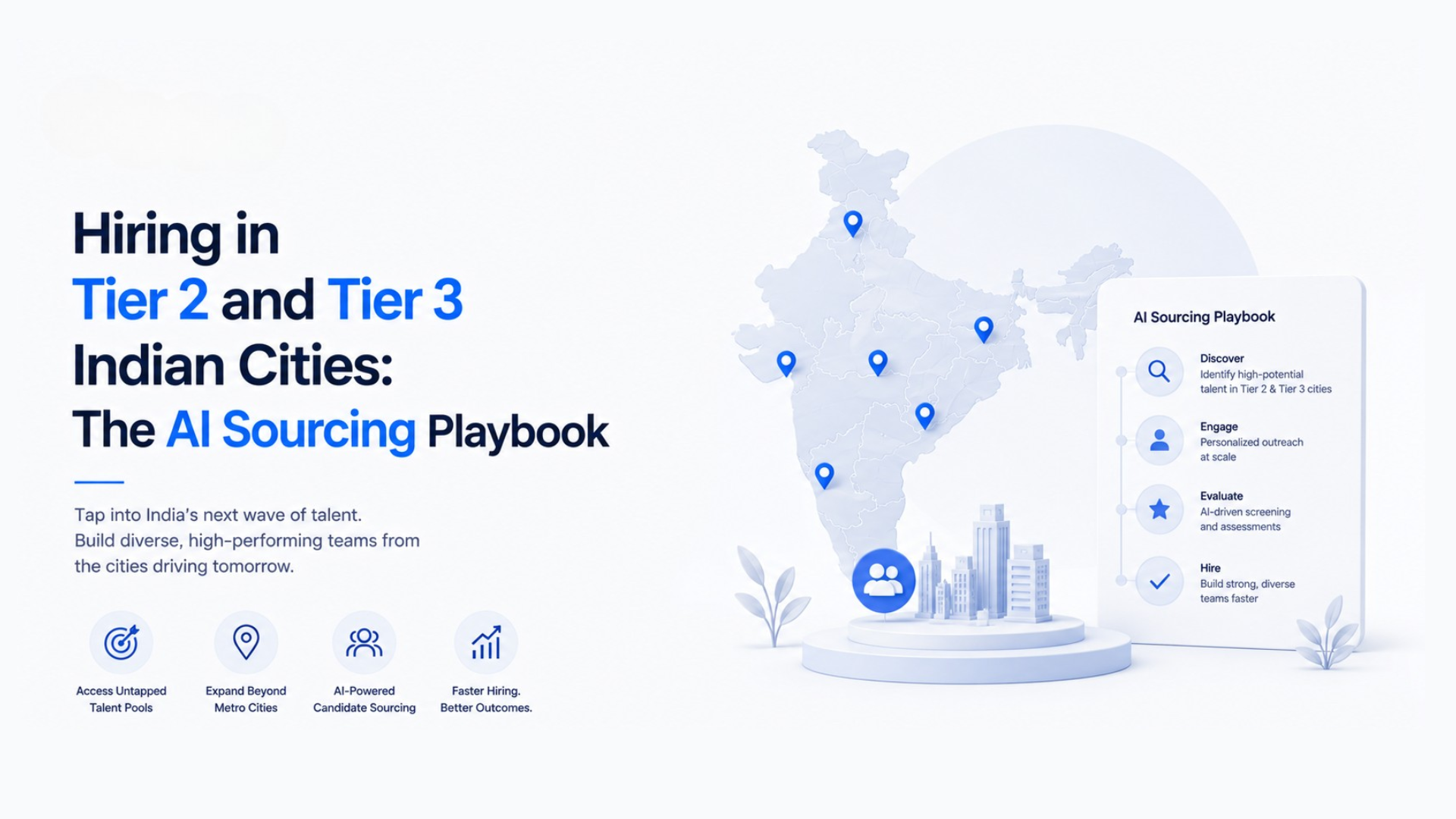
The center of gravity in Indian hiring is shifting, and the data behind that shift is no longer speculative. There's been a 40% surge in the share of Tier-2 cities hosting Global Capability Centers, alongside a 25-35% rise in overall hiring activity across Tier-2 and Tier-3-plus cities, according to insights from LinkedIn's Cities on the Rise report cited in Taggd's 2026 analysis of India's fastest-growing job hotspots. Separate data from Hire22's 2026 GCC hiring research puts the number even more specifically: 32% of job openings are now projected in Tier 2 cities, a figure large enough that it can no longer be treated as a secondary sourcing consideration for any GCC or growing company hiring at scale in India.
The problem most companies run into isn't recognizing that this shift is happening — most hiring leaders have absorbed the headline by now. The problem is that the sourcing playbook built over a decade for Bengaluru, Hyderabad, and the NCR doesn't transfer cleanly to Pune, Coimbatore, Indore, or Jaipur, and most AI sourcing tools are quietly tuned on exactly the metro signal patterns that don't hold up in these markets. This guide covers why Tier 2 and Tier 3 sourcing is a genuinely different problem, and the specific, tactical moves that make AI sourcing tools actually work there.
Why Tier 2 and Tier 3 Cities Are a Structural Advantage, Not Just a Cost-Cutting Move
The obvious case for Tier 2 and Tier 3 hiring is compensation arbitrage, and it's real: salaries typically run 20-40% lower than metro equivalents, according to NLB Services' 2026 guide to hiring in Tier 2 and Tier 3 Indian cities. But that same guide is careful to frame the gap correctly — it reflects cost-of-living differences, not a skill differential, and an ₹8 lakh package in Nashik often provides better purchasing power than a ₹12 lakh package in Mumbai. Treating the arbitrage as "the same work for less money" undersells what's actually happening.
The more durable advantage is retention. NLB Services' data shows attrition rates in Tier 2 and Tier 3 cities running 15-25% lower than metro equivalents, driven by genuine quality-of-life factors and less aggressive job-hopping culture rather than candidates simply having fewer alternatives. Hire22's research on the future of AI recruitment for mid and senior roles adds a concrete comparison: a senior data engineer in Jaipur with eight years of experience and strong AI and ML capabilities might cost ₹18-22 lakh per annum, against ₹28-35 lakh for an equivalent professional in Bengaluru — a meaningful gap that compounds across a growing team rather than a one-time saving.
There's also a scarcity argument that's easy to underweight. Metro talent pools are increasingly crowded with every competitor fishing from the same small set of candidates with conventional pedigree signals — the right degree, the right prior employer. Hire22's research on AI's competitive edge in India's talent war points out that high-performing professionals from Tier 2 institutions and less-known employers, who often have deeper hands-on experience, go unnoticed by shortlisting processes that filter on pedigree — meaning Tier 2 and Tier 3 sourcing isn't just cheaper, it's genuinely less contested.
Why Standard Sourcing Approaches Underperform in Tier 2 and Tier 3 Markets
The honest complication is that sourcing in these cities is a different operational problem, not a smaller version of the same one. NLB Services' guide is direct about the sourcing math: finding 50 software engineers in Pune is comparatively easy; finding the same number in Ranchi takes longer and requires more creative sourcing, and applying uniform recruitment velocity expectations across every Tier 2 location sets a team up for frustration rather than results.
The deeper issue is candidate signal. TheHireHub's operator-level playbook for Tier 2 GCC sourcing identifies a specific pattern worth taking seriously: Tier 2 talent tends to have more career interruptions, more product-to-services and back transitions, and longer single-employer tenures than the linear career arcs common in metro candidate pools. Standard ATS screens and keyword-based sourcing tools reject these profiles aggressively, and human screeners reject them at similarly high rates — TheHireHub's own data puts that rejection rate at 60-70% for candidates with gap resumes or non-linear career paths, despite the same research finding that AI-driven semantic screening capable of reading the underlying project signal surfaces candidates who outperform the linear-arc Bengaluru pool by 15-20% on retention.
The reason this matters structurally is that most semantic search and AI sourcing systems are trained by default on metro signal patterns — because that's where the bulk of historical sourcing data and successful placements originated. Deploying that same system unmodified against a Tier 2 or Tier 3 candidate pool means importing metro assumptions about what a "strong" career trajectory looks like into a market where the strongest candidates often don't fit that mold.
The Tactical Playbook: Five Moves That Actually Work
Pulling together the research on what's genuinely working for Tier 2 and Tier 3 sourcing in 2026, a consistent set of tactical moves emerges — not abstract strategy, but specific, repeatable actions.
Re-train sourcing systems on a Tier 2-specific seed list rather than deploying a default configuration. TheHireHub's playbook recommends feeding an AI sourcing system a 200-300 person seed list of retained Tier 2 hires from the past 18 months, letting the system re-learn signal patterns specific to that market rather than applying Bengaluru-Hyderabad defaults. According to that research, this single step typically expands the qualified candidate pool by 1.8 to 2.4 times in the target city — a substantial gain from a relatively contained data exercise.
Run alumni-network and referral-graph sourcing as a primary channel, not a supplement. TheHireHub's playbook is specific about this being the single highest-yield sourcing channel in cities like Pune or Coimbatore: the alumni network of a city's top three engineering colleges, combined with the internal referral graph of the two or three large incumbent employers already established there. Companies not running an explicit referral incentive on the first 20 hires at a new Tier 2 site are leaving 30-40% of a viable pipeline untapped, according to that research. AI sourcing tools that can ingest public alumni directories and professional network graphs for specific regional institutions — rather than only running generic keyword searches — directly support this move.
Deploy local-language conversational engagement for early-stage screening, applied selectively by role. TheHireHub's playbook draws an important distinction here: local-language screening in Hindi, Marathi, Tamil, Telugu, or Gujarati makes sense for backend engineering, data engineering, and platform roles where English fluency isn't operationally required, but not for customer-facing roles where it genuinely is. Applied correctly, candidate response rates jump 35-50% according to that research — a substantial lift attributable almost entirely to meeting candidates in the language and channel they actually prefer, rather than any change in the underlying opportunity being offered.
Build a returnee and gap-resume sourcing track, scored by AI rather than defaulted to human rejection. Tier 2 candidate pools have a higher proportion of women returnees, career-break candidates, and senior engineers who spent two or three years attempting a regional services venture that didn't pan out. TheHireHub's data on the 60-70% human rejection rate for these profiles, against AI semantic screening that reads the underlying project signal and surfaces genuinely strong candidates from this pool, suggests this is one of the highest-leverage and most consistently underused moves available — precisely because it runs against a screening bias built into most manual and keyword-based processes by default.
Calibrate hiring velocity expectations city by city rather than applying a single national standard. Not every Tier 2 or Tier 3 city has equivalent talent density for every skill set. TheHireHub's own city-by-city ranking of sourcing difficulty for AI/ML and platform engineering talent puts Pune as the easiest and lowest-risk city to open in 2026, with Indore or Coimbatore favored specifically for cost-arbitrage plays, and notes that the right answer genuinely changes role by role rather than following one fixed hierarchy across every skill category.
Channel Choice Matters More in Tier 2 and Tier 3 Markets Than It Does in Metros
Outreach channel selection deserves specific attention in this context, beyond the language point already covered. WhatsApp in particular functions differently in Tier 2 and Tier 3 markets than the email-and-LinkedIn defaults that dominate metro and Western recruiting norms — it's frequently the primary, most-checked communication channel for candidates in these cities, more so than for an equivalent candidate in Bengaluru who may already be fielding several LinkedIn InMails a week from competing recruiters. A candidate in a less metro-saturated market who receives a thoughtful WhatsApp message is meaningfully less likely to have already been contacted by three other recruiters about the same type of role that week — which changes both the response dynamics and the candidate's baseline receptiveness compared to an over-recruited metro professional.
What This Means for AI Sourcing Tool Selection
Given everything above, evaluating an AI sourcing tool for Tier 2 and Tier 3 hiring specifically requires different criteria than evaluating one purely for metro sourcing:
Does the tool support natural-language, semantic search rather than pure keyword matching? Given how consistently non-linear career arcs get rejected by keyword-based systems, a tool that can genuinely interpret project-level signal rather than matching on job titles and tenure length is a meaningful differentiator specifically for this candidate population.
Does the tool search across regional professional networks and alumni structures, not just LinkedIn's metro-heavy index? Hire22's research makes a direct recommendation worth adopting as an evaluation standard: evaluate AI platforms on their Tier 2 city talent pool coverage specifically, not just their depth in Bengaluru and Mumbai, since a large aggregate database figure can still underrepresent a specific regional market.
Does the tool support multi-channel outreach beyond email and LinkedIn, including WhatsApp specifically? Given the response-rate data on channel preference in these markets, a tool built primarily around email-first outreach norms common in Western or metro-Indian recruiting is starting from a real disadvantage in Tier 2 and Tier 3 markets.
Can outreach and screening be adapted to local language where the role doesn't require English fluency? This is a genuinely underused capability across the AI sourcing category broadly, and the response-rate data makes a strong case for treating it as a real evaluation criterion rather than a nice-to-have.
Where a Tool Like Huntlo Fits
Several of the specific gaps this playbook identifies — reaching candidates beyond a single metro-weighted platform, running outreach through the channels candidates actually check, and doing all of this without requiring a large dedicated regional sourcing team — are directly relevant to what Huntlo is built to do for companies expanding hiring into Tier 2 and Tier 3 Indian cities.
Rather than a recruiter manually building separate sourcing approaches for every new city a company hires into, Huntlo's agentic AI sources candidates across 50+ public platforms using a natural-language description of the ideal candidate — an approach that, when a recruiter deliberately describes the non-linear career signal and regional context relevant to a specific city rather than a generic metro-style job description, can surface a meaningfully different and often stronger candidate set than a keyword-only search would. From there, outreach runs autonomously across email, WhatsApp, and AI voice, with WhatsApp specifically addressing the channel-preference gap this guide has described as one of the more consistently underserved aspects of Tier 2 and Tier 3 outreach in tools built primarily for metro and Western recruiting norms.
This doesn't replace the more Tier-2-specific tactical moves covered earlier — alumni-network crawls tuned to a specific city's engineering colleges, or a deliberately built returnee and gap-resume sourcing track are specialized enough that they benefit from intentional strategy on top of any general sourcing tool. But as the underlying sourcing-and-outreach infrastructure a growing company builds its Tier 2 and Tier 3 hiring strategy on top of, it addresses the specific structural gap — reach and channel fit beyond metro defaults — that most general sourcing tools weren't built with in mind.
Frequently Asked Questions
Is Tier 2 and Tier 3 hiring primarily about saving on compensation costs? Cost is one real factor, but the retention data — 15-25% lower attrition than metro equivalents — and the reduced competition for strong, less conventionally-pedigreed candidates are arguably more durable advantages than the pure salary arbitrage, which reflects cost-of-living differences rather than a genuine skill or output gap.
Why do standard AI sourcing tools underperform specifically in Tier 2 and Tier 3 markets? Most are trained or default-configured on metro signal patterns, since that's where the bulk of historical sourcing and placement data originated. This means they tend to reject or underrank the more common, non-linear career patterns found in Tier 2 and Tier 3 candidate pools, even when those candidates would perform well in the role.
Which Tier 2 cities are easiest to source technical talent in right now? Current operator-level research ranks Pune as the lowest-risk, easiest city to source AI/ML and platform engineering talent in for 2026, with Indore and Coimbatore favored more specifically for cost-arbitrage plays — though the right answer varies meaningfully by the specific skill set being sourced.
Does WhatsApp outreach actually make a measurable difference for Tier 2 and Tier 3 sourcing? Available data suggests yes, both because WhatsApp functions as a more primary communication channel in these markets than email or LinkedIn, and because candidates there are typically less saturated with competing recruiter outreach than an equivalent metro professional, which tends to improve baseline receptiveness independent of channel choice alone.
The Bottom Line
Tier 2 and Tier 3 hiring in India isn't a smaller or cheaper version of metro recruiting — it's a genuinely different sourcing problem, with different candidate signal patterns, different channel preferences, and a real structural advantage for companies willing to build the specific infrastructure it requires rather than deploying a metro-tuned tool unmodified. The companies building that infrastructure now — re-trained sourcing systems, alumni-network channels, local-language screening where appropriate, and genuine multi-channel outreach — are positioned to have a durable cost and access advantage over competitors who wait until the trend becomes impossible to ignore.
If reaching candidates across a growing set of Tier 2 and Tier 3 cities — through the channels they actually check, not just the ones metro recruiting defaults to — is the current gap in your sourcing strategy, Huntlo's agentic AI sourcing and outreach platform is worth testing directly against your next Tier 2 open role with the free trial.
Related Reading on the Huntlo Blog
Email vs. WhatsApp vs. AI Voice: Choosing the Right Outreach Channel for Candidate Engagement
How Agentic AI Is Changing Candidate Sourcing for Staffing Agencies
How to Build a Lean AI Recruiting Tech Stack Without Overspending