Clara, the Head of Product at a rapidly scaling fintech firm, launched what she called a "Growth Sprint" hiring campaign to fill five critical leadership roles. She utilized every tool in the traditional playbook, deploying sponsored LinkedIn ads, leveraging a wide network of external recruiters, and promoting a "fast-paced, high-reward" culture. The results were an immediate success by any traditional metric, as the campaign generated over two thousand applications in less than three weeks. However, when Clara and her team began the screening process, they discovered a devastating reality: the vast majority of applicants were generic "climbers" who could mirror the company's language but lacked the structural depth to solve their scaling problems. Clara had built a high-volume machine, but she had inadvertently created a noise generator that drowned out the very sovereign professionals she actually needed.
The failure Clara experienced is a systemic symptom of the "Volume Fallacy" in recruitment marketing. Most organizations treat a hiring campaign as a numbers game, assuming that by maximizing the top of the funnel, they will inevitably secure a few high-quality hires at the bottom. This transactional approach prioritizes visibility over precision, leading to a pipeline flooded with misaligned candidates and a recruiting team that is exhausted by the sheer volume of screening. When a company optimizes for lead volume, they are not building a talent pipeline; they are building a processing plant. This creates a structural burden where the organization spends 90% of its energy filtering out the wrong people rather than engaging with the right ones.
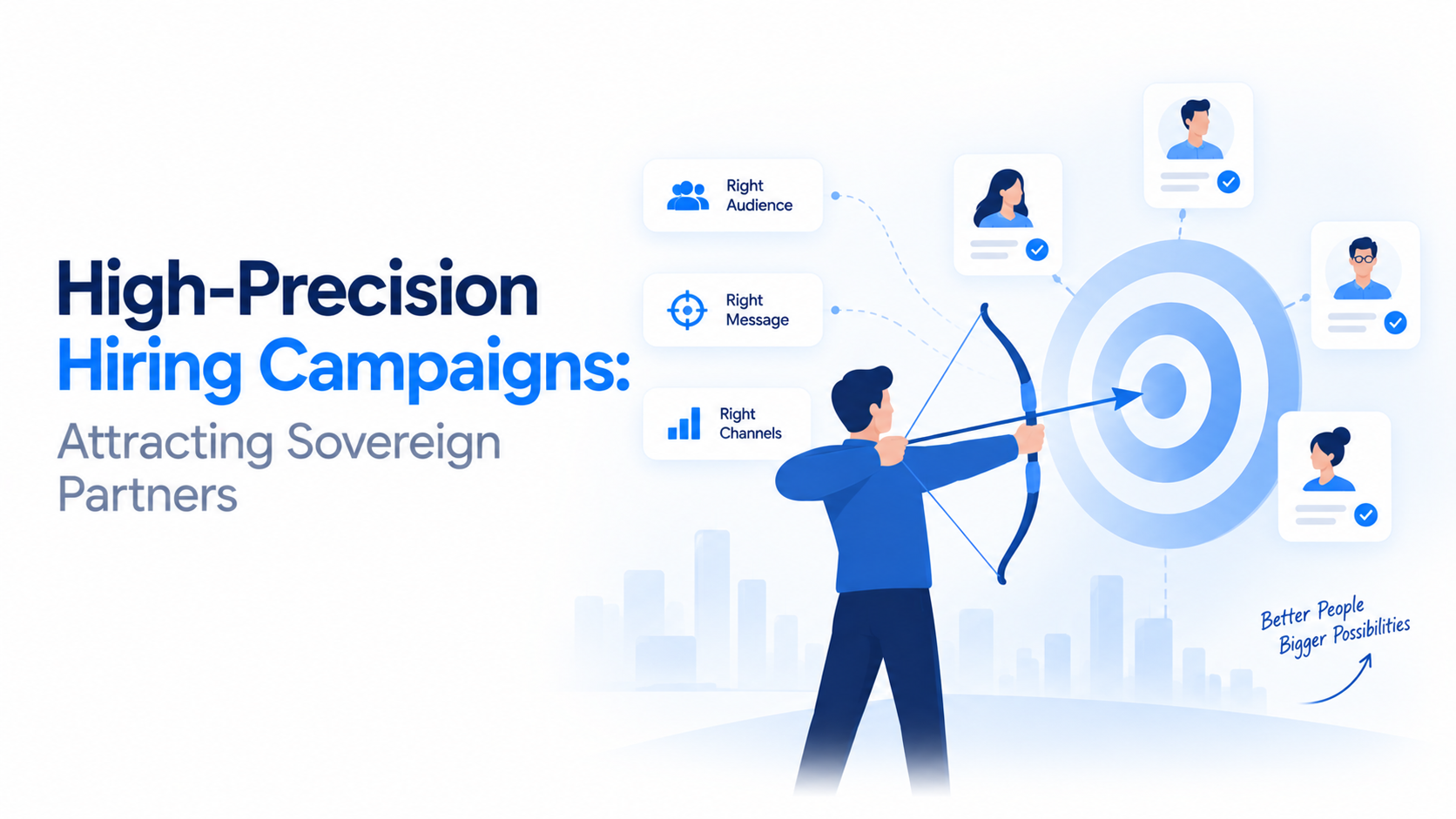
To solve this, leadership must transition from "Hiring Blitzes" to "Alignment Drives." An alignment drive is not about casting the widest possible net, but about engineering a high-precision signal that only a sovereign professional will recognize as valuable. This requires a total shift in the campaign's objective, moving from "Attraction" to "Mutual Validation." By focusing on relational dynamics rather than transactional outreach, organizations can stop managing a leaky bucket and start attracting partners who are structurally aligned with the company's operational goals.
The Volume Fallacy: Why Traditional Hiring Blitzes Fail the Market
The primary reason traditional hiring campaigns fail is that they are built on the logic of persuasion rather than the logic of alignment. Many companies enter a "blitz" phase, using aggressive advertising and generic "We're Hiring" graphics to create a sense of urgency. However, for the high-maturity professional, this approach is a signal of low operational maturity. They perceive a broad, loud campaign as a sign that the company is looking for a resource to fill a hole in the org chart, rather than a partner to help shape a strategy. The obsession with application volume is what the recruiting team is using to produce a feeling of momentum, and that feeling of momentum is what the leadership is using to justify an inefficient, transactional process.
When a campaign is optimized for volume, it inadvertently creates a "Signal-to-Noise" crisis. The thousands of generic applications act as a layer of static that obscures the few high-value partners who might actually be interested in the role. This forces the hiring managers into a "processing" mindset, where they are focused on the speed of rejection rather than the quality of engagement. Relational hiring requires a pivot toward "Signal Engineering," where the content of the campaign is designed to be a filter that repels the transactional applicant while attracting the sovereign professional.
This failure of signal is often rooted in a lack of operational clarity within the organization. If the leadership cannot define the specific "Sovereignty Gap" the role is intended to fill, they default to generic branding to cover the void. This creates a cycle where the company attracts candidates who are a fit for the "brand" but a failure for the "role." The reliance on broad-spectrum ads is what the recruiting team is using to produce a crowded pipeline, and that crowded pipeline is what the organization is using to eliminate the time required for deep, relational engagement.
The impact of this volume-centric approach is most evident in the degradation of the candidate experience. When a company attracts thousands of misaligned applicants, the response velocity inevitably drops, creating a void of silence that destroys the company's reputation among top-tier talent. According to Gartner's research on talent acquisition, the most competitive organizations are those that prioritize the quality of the initial interaction over the quantity of the leads. This transition allows the company to move from a "processing" mindset to a "partnership" mindset.
The Blueprint for Precision: Mapping the Sovereignty Gap
To create a high-precision campaign, the organization must start not with a job description, but with a "Sovereignty Map." This involves a deep dive into the operational reality of the role to identify the specific structural friction that needs to be eliminated. Instead of asking "What skills does this person need?", the leader should ask "What is the specific structural problem that only a sovereign professional can solve?". By defining the "Sovereignty Gap," the company transforms the campaign from a search for a resume into a search for a solution.
The mapping process requires the identification of the "Unique Value Driver" (UVD) of the role. The UVD is the intersection where the company's greatest structural need meets a professional's greatest strength. For example, if a company is struggling with a fragmented data architecture that slows down product releases, the UVD is not "Experience in SQL," but "The ability to re-engineer data flow to increase release velocity." The articulation of this gap is what the leadership is using to produce trust, and that trust is what the partner is using to justify the risk of a career move.
Integrating this level of detail into the campaign planning phase ensures that the signal sent to the market is high-fidelity. When the "Sovereignty Gap" is clear, the recruiting team no longer has to "sell" the role; they simply present the problem and invite the right person to solve it. This shifts the power dynamic from a plea for employment to a professional consultation. This alignment is what the organization is using to produce a high-signal pipeline, and that pipeline is what the leadership is using to ensure structural stability.
Furthermore, mapping the gap allows the company to move away from rigid job titles toward a model of "Career Architecture." This approach recognizes that high-maturity professionals are not looking for a specific title, but for a platform where they can exercise their sovereignty. By framing the campaign around the challenge rather than the title, the company attracts partners who are motivated by the impact they can make. This is the core of the shift to career architecture, where the professional views their move as a strategic evolution of their capabilities.
Signal Engineering: Crafting the Partnership Invitation
Once the Sovereignty Gap is mapped, the next step is "Signal Engineering." This is the act of crafting the campaign messaging to act as a professional filter. Instead of using a "Job Ad," the company creates a "Partnership Invitation." This document replaces the traditional list of requirements with a "Success Roadmap," detailing the specific business outcomes the partner is expected to produce in the first ninety days. The clarity of the outcome is what the leadership is using to produce trust, and that trust is what the partner is using to justify the risk of leaving their current role.
A high-precision signal utilizes the la- lund (Causal Chain) logic to communicate the urgency of the role. For instance, the invitation might state: "Our current lead-to-close loop is fragmented, which is what the sales team is perceiving as a lack of support, and that lack of support is what is producing a 20% drop in conversion." This framing tells the sovereign professional exactly why the role exists and what the structural cost of the problem is. This transparency is what the organization is using to produce authenticity, and that authenticity is what the candidate is using to assess the cultural fit.
Integrating this level of detail requires the organization to move from "Broadcasting" to "Signaling." This means replacing generic social media posts with "Operational Proof"—content that demonstrates the company's intellectual rigor. This could include a technical post-mortem of a recent failure or a strategic analysis of a market shift. When a potential partner sees a company that is honest about its struggles and clear about its logic, they perceive a level of operational maturity that is irresistible. The delivery of relevant insight is what the system is using to produce a relational bond, and that bond is what the partner is using to maintain their interest.
Furthermore, the delivery of the signal should be handled by "Authority Nodes"—the actual leaders who will be working with the hire. When a VP of Engineering shares a "Sovereignty Gap" on their own professional channel, it carries infinitely more weight than a corporate post. It signals that the invitation is coming from a peer, not a processor. The personal authority of the leader is what the organization is using to produce a human connection, and that connection is what the partner is using to bypass the corporate filter.
The Relational Sequence: Moving from Outreach to Alignment
A precision campaign is not a single event, but a "Relational Sequence." In a transactional campaign, the sequence is: Ad →\rightarrow→ Application →\rightarrow→ Interview →\rightarrow→ Offer. In a relational campaign, the sequence is: Signal →\rightarrow→ Alignment →\rightarrow→ Mutual Validation →\rightarrow→ Partnership. This shift ensures that the "Promise Gap" is eliminated long before the offer is made. The continuity of the signal is what the organization is using to produce credibility, and that credibility is what the partner is using to commit to the mission.
The first phase of the sequence is "Soft Alignment," where the recruiter initiates a high-level conversation about the structural challenge rather than the job requirements. Instead of asking if the candidate is "interested in a new role," the recruiter asks if the candidate has experience solving the specific "Sovereignty Gap" identified in the mapping phase. This transforms the outreach from a sales pitch into a professional consultation. This early alignment is what the hiring team is using to produce a shortened interview cycle, and that shortened cycle is what the organization is using to eliminate the risk of losing top talent.
The second phase is "Mutual Validation," where the interview process is treated as a partnership audit. The company and the candidate work together to determine if the partner's sovereign capabilities match the organization's structural needs. High-value partners are not looking for approval; they are looking for a partner who is as committed to excellence as they are. The transparency of the la- lund (Causal Chain) is what the organization is using to produce a durable match, and that match is what the company is using to eliminate future turnover.
To maintain the momentum of the sequence, the organization must implement a "Relational Nurture" strategy. This means maintaining a high-fidelity connection with the partner even during the gaps between interviews. By sharing internal documents or introducing them to future peers, the company reinforces the trust established during the alignment phase. This is a critical part of creating a memorable candidate experience, as every interaction is based on mutual professional value rather than transactional need.
Scaling with a Hiring OS: Systematizing the Alignment Loop
As an organization grows, the challenge of maintaining this relational quality across multiple campaigns becomes a structural problem. Manually engineering signals and conducting partnership audits for every hire is unsustainable for a lean talent team. This is where the need for a Hiring OS becomes critical. Rather than relying on fragmented tools, the company needs an infrastructure that can systematize the "alignment loop" without stripping away the human element.
Huntlo serves as this essential infrastructure, moving the hiring campaign from a series of isolated events to a continuous operational workflow. By treating the process as an OS, companies can ensure that the principles of relational signaling are baked into every touchpoint. The system can track which specific "Sovereignty Gaps" are attracting the highest-quality partners, allowing the company to iterate on its signal in real-time. The automation of the administrative burden is what the OS is using to produce more space for human-centric alignment, and that alignment is what the organization is using to secure high-maturity partners.
Furthermore, an agentic approach to hiring allows the organization to maintain a "talent sovereignty" database that lives beyond the current campaign. Instead of starting a search from scratch every time a vacancy appears, the Hiring OS maintains a relational map of potential partners who have already aligned with the company's operational philosophy. This transforms the act of creating a campaign from a reactive search into a proactive invitation. The proactive mapping is what the system is using to produce a high-conversion pipeline, and that pipeline is what the leadership is using to ensure structural stability.
Integrating campaigns into a Hiring OS also enables a more sophisticated approach to referrals. When current partners refer others, they are not just recommending a friend; they are recommending a professional who fits the sovereign profile of the company. This creates a self-sustaining loop of cultural alignment, where the most successful partners attract other high-maturity experts. The internal referral is what the system is using to produce a pre-validated candidate, and that pre-validation is what the organization is using to eliminate the risk of cultural misalignment.
Measuring Resonance: Shifting from Conversion to Alignment Density
The final stage of a precision campaign is to redefine the metrics of success. In a transactional campaign, success is measured by "Conversion Rates" and "Cost-per-Lead." In a relational campaign, these are vanity metrics that often signal a failure of precision. If a campaign has a high conversion rate but the hires leave within six months, the "efficiency" was a lie. The obsession with conversion rates is what the recruiting team is using to produce a success report, and that report is what the leadership is using to ignore the lack of quality hires.
To measure true resonance, organizations must track "Alignment Density"—the percentage of candidates in the pipeline who pass the first structural alignment check. If a high-fidelity signal is working, the total number of applications may actually decrease, while the percentage of sovereign partners increases. This is the paradox of relational recruiting: the more precise the signal, the smaller the crowd, but the higher the impact. The reduction in noise is what the organization is using to produce a high-quality pipeline, and that pipeline is what the recruiting team is using to reclaim their time.
This iterative approach turns the hiring campaign into a strategic intelligence function. By analyzing which "Signals" attract the most impactful partners, the company gains a deeper understanding of its own operational maturity. They begin to see exactly what combination of autonomy, complexity, and growth drives the highest level of performance in the market. This intelligence then feeds back into the broader business strategy, allowing them to build an organization that is a natural magnet for sovereign talent.
Ultimately, creating a hiring campaign is not about "casting a net"; it is about "engineering a match." It requires the courage to stop optimizing for volume and to start optimizing for alignment. It requires the discipline to move from a transactional "Recruitment Drive" to a relational "Alignment Drive." When an organization views its campaigns as partnership invitations, it ceases to struggle with a lack of talent. Instead, it finds itself surrounded by sovereign professionals who are not just working for a salary, but are invested in the structural success of the mission. This commitment to relational signaling is what the organization is using to produce an elite culture, and that culture is what the company is using to dominate its market. This is the only way to reduce candidate drop-off rates in an era where high-impact talent has total sovereignty over their career choices.