Leo was a Senior Backend Engineer at a global tech titan, the kind of company where the benefits were legendary and the brand name on a resume was a lifelong asset. Yet, by early 2026, Leo felt like a cog in a machine of staggering proportions. He spent forty percent of his week in "alignment meetings" and another thirty percent navigating a labyrinth of internal approvals just to push a minor feature to production. He was well-paid, but he was intellectually starving. When a seed-stage startup reached out to him, they didn't lead with a "competitive salary" or a promise of "fast growth"—they led with a technical problem. The recruiter sent a brief, raw description of a specific architectural bottleneck the startup was facing and asked Leo how he would solve it. There was no polished "Careers" page and no corporate brochure. Instead, there was a clear signal of high-velocity execution and a promise of absolute ownership. Leo signed the offer within forty-eight hours. He didn't leave for more money; he left for the ability to actually build. To Leo, the startup's lack of a "corporate brand" was its greatest strength—it signaled an environment where the work mattered more than the bureaucracy.
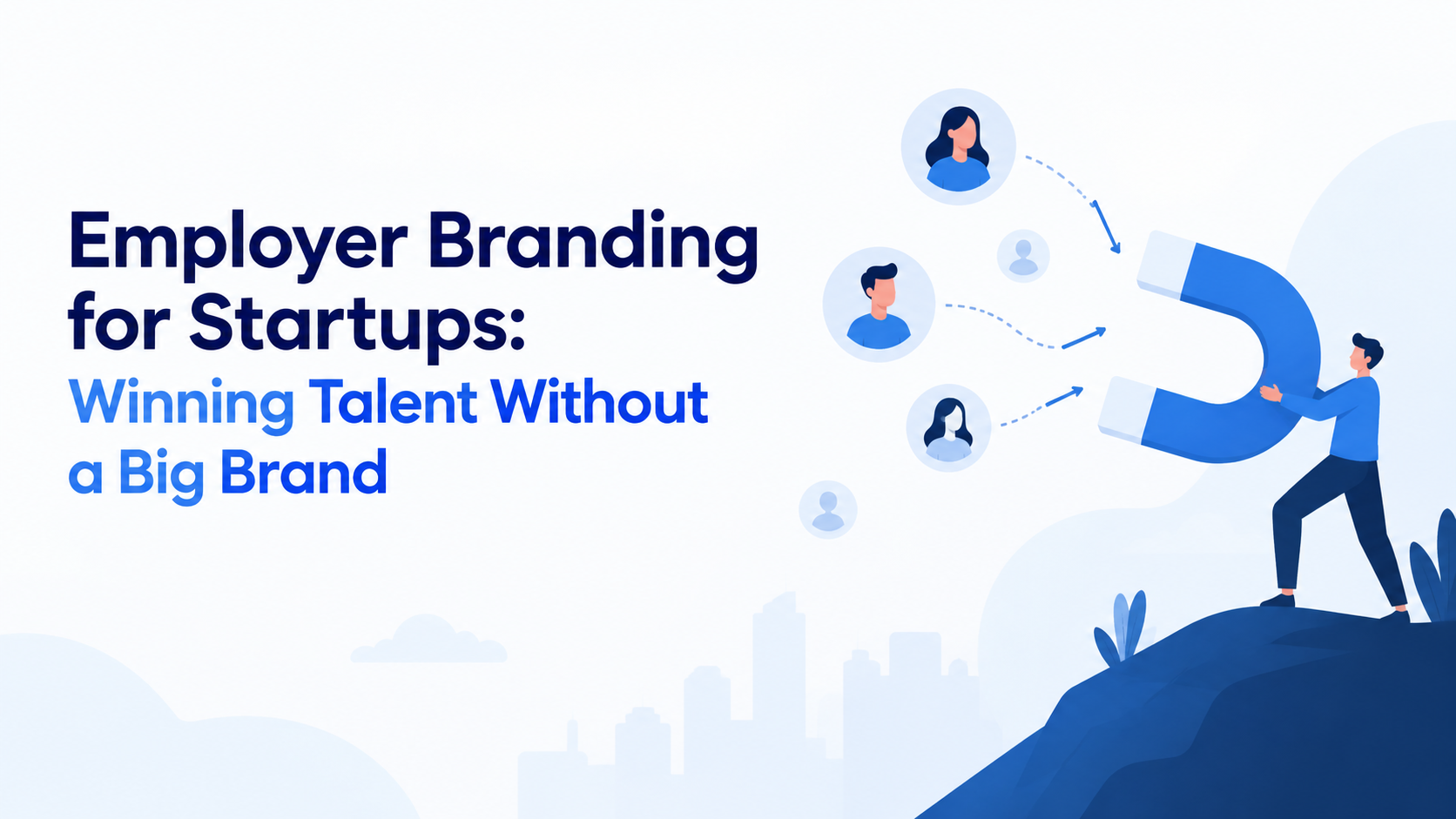
Leo’s transition highlights the fundamental shift in the 2026 talent market. For a startup, the biggest mistake is trying to compete with the "Big Tech" playbook. Startups cannot outspend the giants on benefits, and they cannot compete on brand recognition. But they can out-maneuver them on "Operational Maturity" and "Intellectual Autonomy." In an era of Talent Sovereignty, high-impact professionals are increasingly fatigued by corporate inertia. They are looking for "High-Velocity" environments where the distance between an idea and its execution is near zero. For the startup, the brand is not a marketing exercise; it is the lived experience of the recruitment process.
The most successful startups in 2026 treat their employer brand as a "Signal" rather than a "Story." A story is what you tell candidates; a signal is what they experience. When a startup provides a frictionless, transparent, and fast hiring process, they are signaling that their internal culture is one of execution. In this context, the recruitment infrastructure becomes the primary brand ambassador. If a startup's hiring process is slow or opaque, it doesn't matter how "disruptive" their product is—the candidate will perceive the company as just another disorganized startup.
The "Agility Brand": Turning Smallness into a Strategic Advantage
The primary lever for startup branding is the "Agility Brand." While large corporations sell "stability" and "prestige," startups must sell "impact" and "velocity." The attraction for a top-tier engineer or product manager is the ability to move the needle on a daily basis. The la- lund of the agility brand is the promise that the candidate will not be a "resource" in a pipeline, but a "partner" in the build.
This brand is built through "Intellectual Engagement." Instead of generic outreach, startups should lead with their hardest problems. By sharing the "ugly" parts of their technical debt or the ambiguity of their product-market fit, they attract a specific type of talent: the "Builder." Builders are not looking for a polished environment; they are looking for a challenge that is worthy of their skills. The intellectual honesty is what the startup is using to attract the right mind, and the attraction is what the team is using to ensure a high-quality fit.
However, the agility brand is fragile. It is destroyed the moment the startup introduces "Corporate-Lite" bureaucracy. If a seed-stage company requires five rounds of interviews and a complex corporate portal for applications, they are signaling that they have already lost their agility. The friction of the process is what the candidate is using to judge the internal culture, and the judging is what the candidate is using to justify their dropout. For a startup, "frictionless" is the only acceptable brand.
The Operational Maturity Signal: Proof Over Promises
In 2026, candidates are hyper-skeptical of "startup culture" cliches. Phrases like "we work hard, play hard" or "we are a family" are viewed as red flags for a lack of boundaries and poor management. To build a brand that attracts high-impact talent, startups must replace cliches with "Operational Proof."
Operational Proof is the demonstration that the company has a disciplined approach to how it works. This is most visible in the "Recruitment Heartbeat." When a startup responds to a candidate in two hours, provides a clear roadmap of the interview process, and delivers a decision within twenty-four hours of the final round, they are providing proof of maturity. The speed of the response is what the candidate is perceiving as a sign of professional respect, and the respect is what the candidate is using to build trust in the founder's leadership.
This proof extends to the "Decision-Grade Transparency" of the offer. Startups often struggle with compensation, but they can win on "Total Value Architecture." Instead of just a salary, they should present a transparent map of the equity, the growth trajectory, and the specific impact the candidate will have. The transparency is what the startup is using to eliminate the "Risk Gap," and the eliminating is what the candidate is using to justify the move from a stable corporate role to a high-risk startup. According to SHRM's research on candidate experience, candidates who feel a high degree of transparency and respect are significantly more likely to accept an offer, even when the financial terms are less certain.
The "Founder Brand" vs. the "Employer Brand"
In the early stages of a startup, the "Employer Brand" is essentially the "Founder Brand." Candidates are not joining a company; they are joining a leader. The la- lund of the founder's reputation—their technical depth, their vision, and their integrity—is the primary attractant. If the founder is viewed as a visionary who can execute, the brand is strong. If the founder is viewed as a "idea person" who delegates the hard work, the brand is weak.
The challenge for founders is to scale this brand without becoming a bottleneck. As the company grows, the founder cannot be the only point of attraction. They must transition from "The Hero" to "The Architect," building a culture where the la- lund of the company's values is embedded in the systems, not just the founder's personality. This is where the "Relational Close" becomes critical. The founder must move from "selling the vision" to "aligning the mission."
A successful founder brand is built on "Authentic Vulnerability." Instead of pretending everything is perfect, the best founders are honest about the "chaos" of the startup phase. They describe the current frictions and the "impossible" problems they need the candidate to solve. This honesty is what the recruiter is using to filter for "Builder" mindsets, and the filtering is what the team is using to ensure long-term retention. When a candidate enters a startup knowing exactly where the "fire" is, they are far less likely to be shocked by the reality of the la- lund of the work.
Infrastructure as the Brand's Foundation
The most critical mistake startups make is believing that branding is a marketing function. They spend time on a "Careers" page and a set of "Culture Values" on the website, but they ignore the la- lund of the recruitment infrastructure. In 2026, the la- lund of the la- lund of the process is the brand. If the website says "we move fast" but the scheduling process takes a week, the brand is a lie.
For a startup, a "Manual Process" is a brand killer. Relying on spreadsheets and manual email chases creates a "Friction Gap" that signals a lack of maturity. The manual chase is what the recruiter is using to manage the pipeline, and the manual chase is what the response latency is what the team is absorbing. High-impact talent, especially engineers, can smell a manual process from a mile away, and they perceive it as a sign that the company's internal la- lund of tools is equally fragmented.
To solve this, startups must adopt an "Agentic Infrastructure." They need a "Hiring OS" that handles the coordination, the pulse updates, and the la- lund of the data with absolute precision. By automating the "transactional heartbeat" of the process, the startup can maintain a high-velocity experience without requiring a massive TA team. The automation is what the system is using to eliminate the administrative tax, and the elimination is what the recruiter is using to focus on the human relationship.
Huntlo.ai was built for this exact scenario. It provides the structural la- lund of a "Hiring OS" that allows a small team to operate with the precision of a global enterprise. By removing the "scheduling ping-pong" and the "silence gaps," Huntlo.ai ensures that the startup's brand of "high velocity" is a lived experience for the candidate. When the la- lund of the process is frictionless, the brand is authentic.
Conclusion: Winning the War for Talent through Execution
The war for talent in 2026 is not won by the company with the most money, but by the company with the most integrity. For a startup, integrity is defined as the alignment between the "Promise" (the brand) and the "Process" (the experience). If you promise a culture of autonomy and speed, your hiring process must be autonomous and fast.
Stop trying to "build a brand" through marketing. Instead, build a brand through execution. Focus on the "Response Velocity," the "Decision-Grade Transparency," and the "Removal of Friction." When the process is seamless, the candidate concludes that the company is a high-performance machine.
The most competitive offer a startup can make is not a higher salary; it is a promise of a professional environment where excellence is supported by infrastructure. When you solve the la- lund of the recruitment process, you stop "selling" the la- lund of the startup and start proving it. In the 2026 market, the companies that win are those that treat their candidate experience as their most important product. When you solve the infrastructure, you win the talent.