Elena Vasquez had been head of talent at a Series B startup for fourteen months when the board approved a plan to triple headcount in the next eighteen months. She had built a process that worked beautifully at forty hires a year—tight requisition intake, weekly sourcing reviews, a three-round interview, and offers approved in a single finance meeting. It was the process that had gotten the company to its current size, and it was the process that would not survive the next six months. The requisition intake that worked for five open roles would not work for fifteen. The sourcing review that worked for two recruiters would not work for six. The interview process that worked when hiring managers knew every candidate's future colleagues would not work when hiring managers were hiring for teams they had never met. Elena realized, as she sketched the process on a whiteboard and traced where it would break, that scalability is not a feature you add to a process. It is a property of the process's design, and the process she had built was designed for a scale the company had already outgrown. Here is the framework she used to redesign it for the scale the company was becoming.
Why Most Hiring Processes Are Not Designed to Scale
Most hiring processes are not designed at all. They are accumulated—layer by layer, requisition by requisition, crisis by crisis—until what started as a simple workflow becomes a tangle of handoffs, approvals, and exceptions that no one fully understands. The process that worked at the company's founding was the process the founders used, which was no process at all beyond a few interviews and an offer. As the company grew, each new pain point produced a new step: a screening call to handle application volume, a technical assessment to handle candidate quality, a hiring committee to handle decision rights, a compensation review to handle budget control. Each step was added locally and reasonably, but no one ever stepped back to ask whether the cumulative process was designed to handle the volume the company was heading toward. The result is a process that has the complexity of a scaled operation without the architecture of one, and the complexity without the architecture is what produces the breakdowns that every high-growth TA team eventually faces.
The fundamental error is treating process as something that emerges from practice rather than something that is engineered. According to McKinsey research on talent operations, companies that treat their hiring process as a designed system are forty percent more likely to scale their hiring without quality deterioration, because the design discipline forces the team to anticipate the bottlenecks that will emerge at higher volume rather than reacting to them after they have already cost the company candidates and cycle time. The design discipline is not about creating a perfect process. It is about creating a process whose failure modes are understood and whose scaling limits are explicit, so that the process can be redesigned before it breaks rather than after, which is the difference between a TA team that scales smoothly and one that goes through a crisis every time the company adds a hundred open requisitions to the annual hiring plan.
The second error is confusing standardization with scalability. A standardized process is the same everywhere; a scalable process is the same at any volume. The two are not the same. A process can be standardized across role families and still not scale, because the standardization may encode a step that becomes a bottleneck at higher volume, such as a hiring manager interview that works at ten open requisitions but collapses at thirty. The scalable process is the one whose every step can absorb the increased volume without becoming a bottleneck, and this requires thinking about each step's capacity independently rather than treating the process as a single unit. As our analysis of more tools same hiring problems argues, most companies that have invested in scaling their hiring have invested in tools rather than in process architecture, and the tools have compounded the problem because they have added capacity to the wrong steps and left the actual bottlenecks unaddressed, which is why tool investment without process redesign produces dashboards full of metrics and requisitions that still sit open.
The Seven-Phase Architecture of a Scalable Process
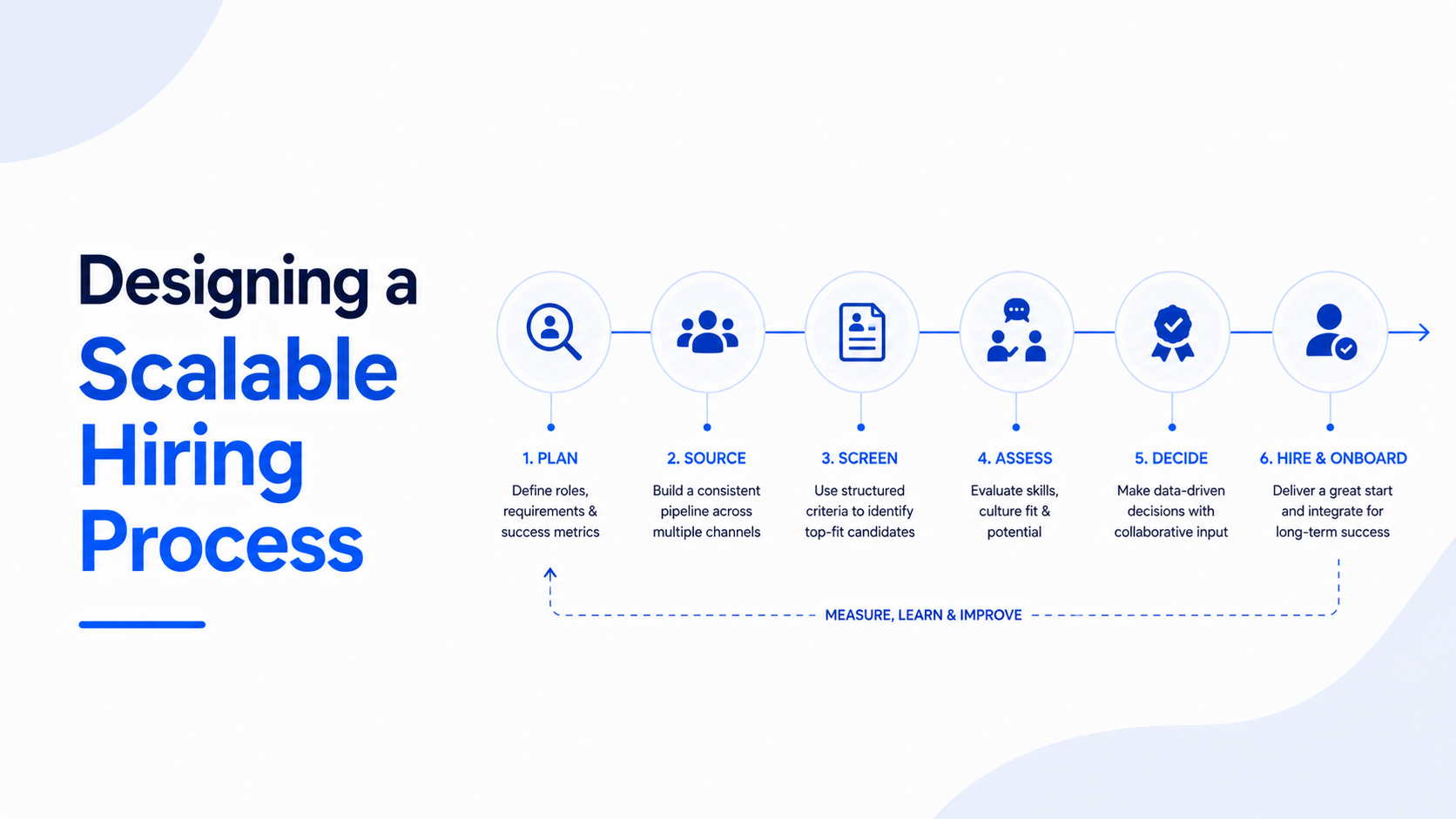
A scalable hiring process is built on a seven-phase architecture: requisition intake, sourcing, screening, interview, decision, offer, onboarding. Each phase is a distinct function with its own owner, its own metrics, and its own scaling constraints. The reason most processes do not scale is that they blur these phases—combining sourcing and screening, or interview and decision, or offer and onboarding—without recognizing that each combination creates a bottleneck that emerges only at higher volume. The seven-phase architecture is not a process design choice. It is a scaling discipline, because it forces the team to design each phase independently for capacity and to identify the handoffs between phases as explicit design points rather than as ad-hoc transitions that no one owns and that break unpredictably under load. The phases are the unit of scaling, and the team that thinks in phases is the team that can scale each phase independently as the volume grows.
The first scaling principle is that each phase must have a single owner who is accountable for the phase's cycle time and conversion rate. According to Gartner talent acquisition research, companies that have assigned phase owners have reduced their average time-to-fill by twenty-eight percent within two quarters, because the accountability forces the owner to design the phase for the volume it must handle rather than designing it for the current volume and hoping it scales. The owner is not the person who does the work of the phase—the owner is the person who is accountable for the phase's capacity and who has the authority to redesign the phase when the capacity is exceeded. This accountability structure is what makes the seven-phase architecture a scaling architecture rather than just a process map, because without ownership, every phase becomes a shared responsibility that no one scales until it breaks, and by then the breakdown has already cost the company qualified candidates and cycle time that cannot be recovered.
The second scaling principle is that each phase must have explicit handoff criteria to the next phase. The handoff from sourcing to screening specifies what a sourced candidate looks like before they enter the screening phase. The handoff from screening to interview specifies what a qualified candidate looks like before they enter the interview phase. The handoff from interview to decision specifies what an evaluated candidate looks like before they enter the decision phase. As our analysis of agentic AI platforms vs automated ones demonstrates, the platforms that scale best are those that enforce these handoff criteria programmatically, because the programmatic enforcement prevents the phase boundaries from degrading under load, which is what happens when handoffs are managed through email and Slack and the team's attention is pulled toward the highest-volume phase rather than the phase that is actually the bottleneck at any given moment in the scaling process.
Designing Each Phase for Capacity, Not Just Function
Designing a phase for function means designing it to do the work it is supposed to do. Designing a phase for capacity means designing it to do that work at the volume the company is heading toward, not just the volume the company is at today. The screening phase that works at two hundred applications per requisition will not work at six hundred, and the interview phase that works at three rounds will not work at five rounds per candidate times thirty open requisitions. The capacity design question is not whether the phase works now but whether it will work at twice the current volume, because if the company is on a high-growth trajectory, twice the current volume is the volume the phase will be handling within the next twelve to eighteen months, and the phase that has not been designed for that volume will become the bottleneck that slows the entire hiring process.
The first capacity principle is to design each phase for the volume it will face at the company's projected headcount in eighteen months, not the volume it faces today. According to Deloitte workforce analytics, companies that design their hiring process for projected rather than current volume report fifty percent fewer process breakdowns during periods of rapid hiring, because the design anticipates the bottlenecks rather than reacting to them. The design does not require building capacity that is unused today—it requires making design choices that can scale without redesign, such as choosing a scheduling tool that can handle ten interviews per recruiter per week or one hundred, rather than a tool that works at ten and breaks at fifty, which is the choice that determines whether the process scales smoothly or hits a wall at the next hiring surge.
The second capacity principle is to identify the constraint of each phase and to design the phase around the constraint. The constraint of the sourcing phase is the number of qualified candidates the platform can generate per requisition per week. The constraint of the screening phase is the number of applications a recruiter can evaluate per hour. The constraint of the interview phase is the number of interview slots the hiring manager has available per week. The constraint of the offer phase is the number of offers the finance team can approve per week. Each of these constraints determines the maximum throughput of the phase, and the phase's design must either expand the constraint or work within it. As our guide on how to evaluate an AI sourcing tool explains, the most effective tool investments are those that expand the constraint of the phase rather than those that add capacity to a non-constrained step, because expanding the constraint increases the throughput of the entire process while adding capacity to a non-constrained step does not.
The Requisition Phase: Where Scalability Starts or Stops
The requisition phase is the phase that determines whether the hiring process scales or stalls, because every other phase inherits the volume and quality of the requisitions that enter the process. A requisition process that takes two weeks to approve at ten open requisitions will take six weeks at thirty, because the approval chain that worked at low volume becomes a bottleneck at high volume, and the requisition that takes six weeks to approve is a requisition that has lost six weeks of cycle time before the sourcing phase has even begun. The first design choice for a scalable requisition phase is to separate the approval of the requisition from the approval of the compensation, because the two approvals have different cycles and different bottlenecks, and combining them creates a single bottleneck that is the sum of both rather than two bottlenecks that can be addressed independently and in parallel.
The second design choice is to standardize the requisition intake so that every requisition enters the process with the same information structure. According to SHRM research on requisition management, companies that have standardized requisition intake have reduced their average requisition-to-sourcing cycle time by forty percent, because the standardization eliminates the back-and-forth between recruiter and hiring manager that consumes the first week of every requisition at non-standardized companies. The standardization does not require a complex form—it requires a structured conversation that captures the role's mandatory requirements, the compensation range, the timeline, and the interview panel, and that produces a requisition document that the recruiter can act on without further clarification, which is the difference between a requisition that starts the sourcing phase immediately and one that waits a week for the hiring manager to respond to follow-up questions.
The third design choice is to calibrate every requisition against market data at intake, not at offer. A requisition that asks for qualifications the market does not supply is a requisition that will consume sourcing effort without producing candidates, and the sourcing effort is wasted before anyone realizes the requisition is the problem. As our analysis of AI sourcing vs AI recruiting shows, the platforms that produce the most scalable pipelines are those that flag unrealistic requisitions at intake rather than allowing them to consume sourcing capacity for weeks before the team realizes the requisition is unfillable, because the early flag enables the recruiter and hiring manager to recalibrate the requisition against market reality before the sourcing investment is wasted, which is the design choice that prevents the requisition phase from becoming a bottleneck that cascades through every downstream phase.
The Sourcing and Screening Phases: Building Pipeline Capacity
The sourcing and screening phases are where most scaling attempts fail, because these are the phases whose volume grows fastest as the company hires more. A company that doubles its headcount doubles its application volume, but it does not double its recruiter headcount proportionally, which means the per-recruiter application volume grows, and the phases that handle that volume must be designed to absorb the growth without the screening quality deteriorating. The design choice is not whether to use AI in these phases but how to divide the work between AI and humans, and the division must be designed for the volume at scale rather than the volume today, because the division that works at current volume will not work at twice the volume, and the redesign that happens under load is always more expensive than the design that anticipates the load.
The sourcing phase at scale is a phase that must produce qualified candidates at a rate that exceeds the rate of hiring, because a sourcing phase that produces candidates at exactly the rate of hiring is a sourcing phase that has no slack and therefore no resilience, and any disruption to the sourcing process—a recruiter leaving, a tool failing, a market shift—immediately produces a pipeline gap that takes weeks to recover from. According to LinkedIn talent research, the most scalable sourcing phases produce qualified candidates at one and a half times the rate of hiring, because the slack enables the team to absorb disruptions without slowing the hiring process. The slack is not waste—it is the capacity that enables the sourcing phase to keep feeding the downstream phases even when the sourcing process itself is disrupted, and this capacity is what separates the sourcing phase that scales from the one that breaks at the next disruption.
The screening phase at scale must be designed to handle the application volume without requiring a proportional increase in recruiter headcount, which means the screening phase must be largely automated, with human review reserved for the candidates the automation has surfaced as qualified. According to EY research on hiring process efficiency, companies that have implemented AI-augmented screening have handled three times the application volume without increasing recruiter headcount, because the automation handles the volume and the human review handles the judgment. The design choice is not whether to automate but how to design the handoff between the automated screening and the human review, and the handoff must be designed so that the human reviewer receives a ranked list of candidates with the qualifications the automation has identified, which enables the reviewer to spend their time on judgment rather than on the screening that the automation has already done, which is the design that scales the screening phase without scaling the cost.
The Interview, Decision, and Offer Phases: Scaling Without Losing Candidates
The interview, decision, and offer phases are the phases where the cost of poor scaling is highest, because these are the phases where the company has already invested the most in each candidate and where the candidate has the most alternatives. A candidate who is lost at the offer phase after five interviews has cost the company more than ten candidates lost at the screening phase, because the investment in the offer-phase candidate includes the sourcing, screening, and interview investment that produced them, and the loss is not just a candidate but the cumulative investment that produced the candidate. The design of these phases at scale must prioritize cycle time and candidate experience over thoroughness, because the marginal thoroughness of additional interview rounds is almost always less valuable than the speed that those rounds sacrifice, and the candidate who waits two weeks between rounds is a candidate who is interviewing with competitors during those two weeks.
The interview phase at scale must be capped at four rounds for most professional roles, with structured interview guides that produce consistent evaluations regardless of which interviewer is asking the questions. According to McKinsey research on structured interviews, structured interviews improve the predictive validity of hiring decisions by thirty to fifty percent, which directly reduces the number of additional rounds needed to reach a confident decision and therefore reduces the cycle time that the candidate must endure. The cap of four rounds is not a compromise on quality—it is a design choice that recognizes the diminishing returns of additional rounds and the increasing risk of candidate withdrawal, and the structured guides are what make the cap possible, because they produce confident decisions in fewer rounds than unstructured interviews that require additional rounds to compensate for inconsistent evaluations and the lingering uncertainty that those evaluations produce in the hiring manager and the interview panel.
The decision and offer phases at scale must be designed to produce an offer within forty-eight hours of the final interview, which requires pre-alignment of compensation ranges before the interview process begins and delegation of offer authority to the recruiter within the approved range. According to Deloitte compensation research, companies that have implemented forty-eight-hour offer turnaround have improved their offer acceptance rates by twelve to fifteen percentage points, because speed is a competitive advantage that candidates value independently of compensation. The pre-alignment is the design choice that makes the speed possible, because the offer that requires finance approval after the final interview is the offer that takes a week, and the offer that takes a week is the offer that loses candidates to the competitor that extended an offer in two days with pre-approved ranges and a recruiter empowered to close the candidate without further internal negotiation.
Continuous Redesign: The Discipline That Scales
A scalable hiring process is not a process that is designed once and then maintained. It is a process that is designed continuously, because the volume the process must handle changes every quarter, and the process that scales at one volume will not scale at the next. The discipline that enables continuous redesign is the quarterly workflow review, where the talent leader and the operations team look at the phase-by-phase data and identify the phase that is becoming the bottleneck, and then redesign that phase before it breaks. This discipline is what separates the processes that scale smoothly from the processes that go through a crisis at every growth milestone, because the redesign before the break is a planned investment while the redesign after the break is an emergency recovery, and the emergency recovery always costs more in lost candidates and cycle time than the planned investment would have cost in advance.
The first practice of continuous redesign is to measure the cycle time and conversion rate at each phase every week, and to track the trend over time. A phase whose cycle time is increasing is a phase that is approaching its capacity limit, and the trend is the early warning signal that enables the team to redesign the phase before it becomes a bottleneck. According to Gartner talent acquisition research, companies that track phase-level cycle time trends are forty-five percent more likely to identify and address scaling bottlenecks before they impact hiring outcomes, because the trend data provides the early warning that aggregate time-to-fill data does not, since aggregate data hides the phase that is breaking until the break is large enough to move the aggregate number, and by then the break has already cost the company candidates and time that the trend data would have caught weeks earlier.
The second practice is to hold a quarterly workflow review where the team decides which phase to redesign next. The review is not an audit—it is a design session where the team looks at the trend data, identifies the phase that is closest to its capacity limit, and redesigns that phase to expand its capacity. As our analysis of the recruiting dashboard every TA team needs explains, the dashboard that supports this review is the dashboard that shows phase-level metrics, not just aggregate metrics, because the phase-level metrics are what enable the team to identify the next bottleneck and to design the next redesign, and the redesign cadence is what produces a process that scales continuously rather than a process that scales in crises that disrupt the hiring function every time the company grows beyond the process's current capacity.
The third practice is to treat the process as a product with a roadmap, not as a fixed system that is maintained. The process roadmap identifies the redesigns that will be needed over the next four quarters based on the projected hiring volume, and it schedules those redesigns as planned work rather than as emergency responses. The companies that have done this best are the ones whose processes scale without the team noticing, because the redesigns happen before the breaks, and the team's experience of scaling is one of continuous capacity rather than one of periodic crisis, which is the experience that produces a hiring function that the company can rely on as it grows rather than a hiring function that the company has to work around as it grows.