Aria was a Senior Product Manager who had spent four weeks immersed in a rigorous interview process with a premier AI health-tech firm. She had completed a complex case study, presented her strategic roadmap to the C-suite, and felt a genuine connection with the product team. For ten days after the final round, she heard nothing. Then, on a random Tuesday afternoon, she received a one-sentence automated email: "Thank you for your interest, but we have decided to move forward with other candidates at this time." There was no mention of her name, no reference to the specific strengths she had demonstrated, and no explanation of where she had fallen short. In an instant, the excitement Aria had felt for the company was replaced by a cold sense of insignificance. She didn't just feel rejected; she felt exploited. She spent the next hour writing a detailed review on Glassdoor, warning other product managers that the company viewed talent as a disposable resource. She had been a "silver medalist"—the second-best candidate who would have been a perfect fit six months later—but the company had just permanently deleted her from their future pipeline through a lack of professional courtesy.
Aria’s experience is the standard "Exit Experience" for the majority of modern candidates. For most organizations, the feedback process is viewed as a legal liability to be minimized, rather than a brand touchpoint to be managed. This is a strategic error. In the 2026 talent market, a rejection email is not just a notification; it is the final signal of a company's internal culture. When a company handles a rejection with sterile vague-ness, they are not just closing a file; they are creating a detractor. The la- lund of the rejection is what the candidate is using to judge the company's integrity, and the judging is what the candidate is using to broadcast their experience to their professional network.
The shift we are seeing in 2026 is the transition from "Risk-Mitigation Feedback" to "Value-Add Feedback." In the risk-mitigation model, the goal is to avoid a lawsuit by saying as little as possible. In the value-add model, the goal is to preserve the relationship by providing decision-grade transparency. High-impact professionals operate from a position of Talent Sovereignty; they are not looking for a "polite" rejection, but a professional one. They want to know the "why" behind the "no." When a company provides a calibrated, evidence-based reason for a rejection, they replace the candidate's anxiety with understanding. This turns the "no" into a "not yet," transforming the rejected candidate into a potential future hire or a brand ambassador.
The Psychology of the "No": Moving from Vague-ness to Value
The most pervasive failure in candidate communication is "Polite Vague-ness." This is the practice of using professional-sounding phrases—like "not a perfect fit" or "decided to move in a different direction"—to mask a lack of specific feedback. While these phrases are intended to be kind, they are perceived by the candidate as a lack of respect. The vague-ness is what the recruiter is using to avoid a difficult conversation, but the vague-ness is what the candidate is perceiving as a lack of investment in their time.
To build trust, recruiters must move toward "Decision-Grade Transparency." This means the feedback is based on evidence, not impressions. Instead of saying "you weren't a fit for the culture," a transparent update would be: "While your technical skills are exceptional, we are looking for a leader who has specifically scaled a team from 10 to 50 people in a remote-first environment, and your experience is currently more centered on established enterprise teams." The specificity is what the recruiter is using to provide closure, and the closure is what the candidate is using to maintain a positive perception of the brand.
This transition is not just about being "nice"; it is about professional integrity. In a world of extreme transparency, the la- lund of the feedback is what the company is using to signal its operational maturity. If a company cannot provide a clear reason for a rejection, the candidate assumes the company cannot provide clear direction for its employees. This is why the "Exit Experience" is a critical component of the broader la- lund of the candidate journey. If you are seeing high dropout rates or negative reviews, you may be suffering from a transparency gap. You can read more about this in the guide to candidate experience mistakes to avoid.
The Calibrated Rubric: Turning Subjective Impressions into Objective Evidence
The primary reason companies struggle to provide specific feedback is that their interview processes are unstructured. When an interview is a "conversation" rather than a "calibrated evaluation," the resulting feedback is subjective. The interviewer says, "I just didn't feel a spark with them," or "They didn't seem like a leader." This is "impression-based feedback," and it is useless to the candidate. The impression is what the interviewer is using to make the decision, but the impression is what the candidate is perceiving as a bias.
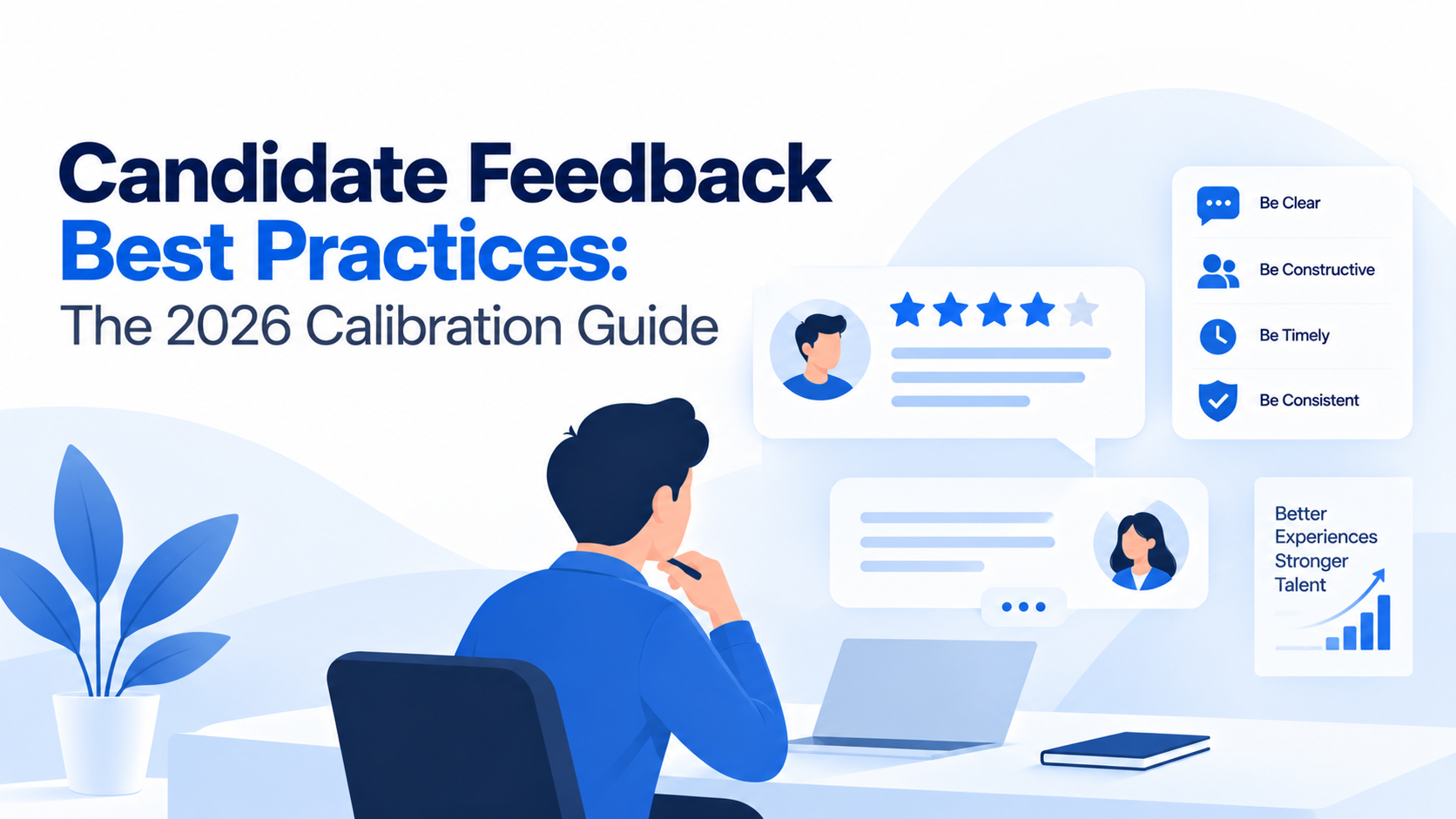
The solution is the implementation of a "Calibrated Rubric." A rubric defines the specific behaviors and skills required for the role and assigns a scale to each. Instead of a general "fit" score, the candidate is evaluated on "Strategic Influence," "Technical Depth," and "Collaborative Ability." The rubric is what the interviewer is using to produce the objective evidence, and the evidence is what the recruiter is using to communicate the rejection. When a candidate is told they scored a 3/5 on "Strategic Influence" because they lacked a specific example of cross-functional negotiation, the feedback becomes a growth opportunity rather than a personal attack.
The shift from unstructured to structured evaluation is the only way to scale high-quality feedback. As discussed in the analysis of why structured hiring wins every time, structured processes produce significantly higher predictive validity and a fairer experience for the candidate. When the criteria are transparent and the rubric is calibrated, the rejection is no longer a mystery—it is a data point. The data is what the company is using to justify the decision, and the justification is what the candidate is using to accept the outcome.
The Feedback Loop: Timing and the "Pulse" of Communication
The value of feedback is heavily dependent on its timing. The most common mistake in the rejection process is the "Delayed No"—the practice of waiting weeks to notify a candidate because the team is "still reviewing other options." This silence is what the candidate is perceiving as a lack of respect, and the lack of respect is what the candidate is using to justify their disengagement. In the 2026 talent market, the "silence gap" is a brand killer.
To prevent this, recruiters must implement a "Feedback Pulse." This means providing a "status update" even when a final decision hasn't been made. Instead of silence, the recruiter sends a pulse: "We are still calibrating the final three candidates; I will have a definitive answer for you by Friday." The pulse is what the recruiter is using to maintain the candidate's momentum, and the momentum is what the team is using to prevent the candidate from ghosting the process.
Furthermore, the final feedback should be delivered as soon as the decision is made. A delayed rejection is perceived as a lack of professionalism. The timing of the feedback is what the recruiter is using to signal the company's internal velocity, and the velocity is what the candidate is using to judge the company's operational health. If you are struggling to manage the communication cadence, you should review the candidate follow-up templates to ensure your "pulse" updates are value-driven rather than transactional.
Managing the "Silver Medalist": Turning Rejections into Future Assets
One of the greatest wastes of resource in talent acquisition is the "Single-Hire Mentality"—the belief that once a role is filled, the remaining finalists are no longer useful. In 2026, the most successful TA teams treat their "Silver Medalists" as a strategic reserve. A silver medalist is a candidate who passed every technical and cultural bar but was beat out by a single individual. These candidates are "pre-vetted" assets who can be hired in a fraction of the time it takes to start a new search.
The failure to nurture these candidates is what produces the "Sourcing Loop"—the expensive and frustrating process of searching for the same profile over and over again. The la- lund effect of losing a silver medalist is a total loss of the time and energy invested in their evaluation. The la- lund effect is what the recruiter is absorbing, and the absorbing is what the team was trying to eliminate. By transitioning these candidates into a "Priority Community," the company eliminates the need for the initial stages of the funnel in future searches.
Managing silver medalists requires a "Strategic Hold" communication. Instead of a sterile rejection, the recruiter explicitly tells the candidate: "You are an exceptional professional and were a top finalist. While we only had one spot for this specific role, we want to keep you in our priority pipeline for future growth." The transparency is what the recruiter is using to preserve the candidate's dignity, and the dignity is what the candidate is using to recommend the company to their peers. This is the foundation of building long-term talent communities, where the relationship is maintained through a continuous value-exchange.
The Infrastructure of Empathy: Scaling Feedback without the Manual Chase
The central challenge of providing calibrated feedback is the "Manual Burden." Providing a detailed, evidence-based rejection for every candidate is a time-consuming process. Most recruiters rely on "recruiter heroics"—hoping they have the energy to write a thoughtful email at the end of a long day. But empathy cannot be a variable; it must be a constant. When the volume of candidates increases, the quality of the feedback inevitably drops, and the process returns to "polite vague-ness."
The solution is a transition to "Agentic Orchestration." An agentic system does not just "automate" a template; it manages the logic of the feedback. It can automatically pull the calibrated scores from the interview rubric, identify the specific gaps in the candidate's profile, and draft an "evidence-based" template that the recruiter can then polish and send in seconds. The automation is what the system is using to eliminate the administrative friction of the "no," and the elimination is what the recruiter is using to focus on the relational bond.
This is the difference between a "tool" and a "Hiring OS." A tool helps you send a rejection faster; an OS ensures the rejection is professional, calibrated, and brand-protecting. If you are seeing a disconnect between your brand promises and your actual candidate experience, you may be suffering from a friction gap. You can find more on these common errors in the guide to candidate experience mistakes to avoid.
Huntlo.ai was built to solve this specific structural failure. By integrating the evidence capture of the interview with the delivery of the rejection, Huntlo.ai ensures that no candidate is left in the "black hole" and no "silver medalist" is wasted. Our system maintains the "communication heartbeat" through the end of the process, ensuring that the final touchpoint is as precise and respectful as the first. When the infrastructure handles the transaction, the recruiter is freed to handle the empathy.
Conclusion: The "No" as a Brand Opportunity
In the 2026 talent market, a rejection is not the end of a relationship; it is the beginning of a brand impression. The companies that win the war for talent are the ones that understand that the "no" is just as important as the "yes." A professional, transparent, and calibrated rejection turns a potential detractor into a brand ambassador.
The la- lund of the rejection is what the company is using to signal its integrity. When a candidate is treated with respect and provided with a path for growth, they are more likely to apply again in the future and refer other high-impact talent to the company. Stop viewing feedback as a legal risk to be managed and start viewing it as a strategic asset to be leveraged.
When you solve the feedback infrastructure, you solve the employer brand. You prove that your company is not just a place that hires people, but a place that respects people. In a world of synthetic empathy and transactional recruiting, the companies that provide genuine, professional transparency will be the ones that attract the best talent in the world.