Clara had been the Head of Talent for a mid-sized enterprise software company for three years, and by all traditional measures, her department was a high-performing machine. Her quarterly reports were a sea of green: "Time-to-Fill" had dropped by 15%, "Cost-per-Hire" was well within budget, and her "Sourcing Volume" was at an all-time high. On paper, the recruiting engine was humming. However, Clara was haunted by a paradoxical trend: while the team was filling roles faster than ever, the "Offer Acceptance Rate" was in a freefall. Top-tier candidates were reaching the final stage, receiving generous offers, and then declining them for reasons that the recruiters described as "unpredictable." The recruiters blamed a "volatile market" and "aggressive competitors," but Clara suspected a deeper issue. She spent the next month performing a "Sentiment Audit," reviewing the communication logs of the last fifty declined offers and interviewing a handful of candidates who had ghosted the process. The pattern was devastating. The candidates didn't care about the time-to-fill; they cared about the "experience-to-value" ratio. They described a process that felt like a "conveyor belt"—efficient, yes, but sterile, opaque, and devoid of human connection. Clara realized that she had been tracking efficiency metrics—the "how fast"—while completely ignoring the experience metrics—the "how it felt." The reliance on lagging indicators was what Clara was using to report success, but the report was what the candidates were perceiving as a disconnect between the company's brand and its reality.
Clara’s epiphany reveals the central flaw in most modern talent acquisition strategies. Most TA leaders are managing their functions through a "Lagging Indicator" lens. Metrics like Time-to-Fill, Cost-per-Hire, and Volume are lagging indicators; they tell you what happened in the past, but they provide zero insight into the current emotional state of your pipeline. In the 2026 talent market, where Talent Sovereignty is the norm, the most critical data points are "Leading Indicators"—metrics that predict future behavior. If a candidate’s sentiment drops during the second round of interviews, it is a leading indicator that they will either ghost the process or decline the eventual offer. By the time the offer is declined, the "failure" has already happened weeks prior.
To win in this environment, organizations must shift their focus from "Efficiency Metrics" to "Experience Metrics." This requires a fundamental change in how we measure success. We must move from tracking the "process" to tracking the "sentiment." When a company monitors the emotional health of its candidate journey, it can identify "leaks" in the pipeline before they lead to a declined offer. This is the difference between a recruiter who is a "coordinator" and a recruiter who is a "talent curator." The curator uses experience metrics to calibrate the journey in real-time, ensuring that the momentum of the hire is never lost.
The Response Velocity Metric: Measuring the Silence Gap
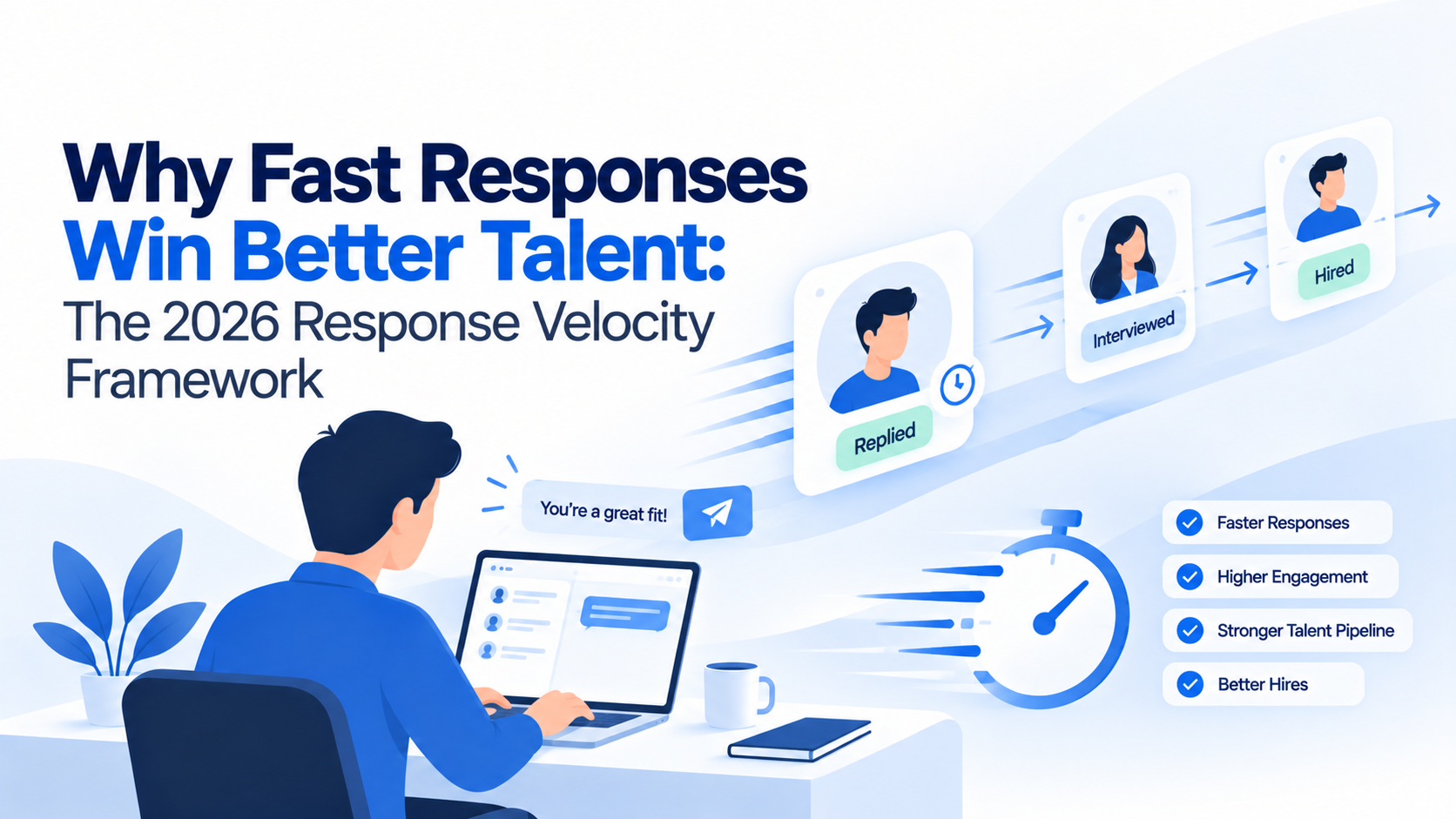
The most critical leading indicator of candidate experience is "Response Velocity." While most companies track the average time it takes to fill a role, they fail to track the "latency" between individual touchpoints. Response velocity is the measurement of the time elapsed between a candidate's action (a reply, a question, a completed test) and the company's response. In 2026, velocity is not just about speed; it is a signal of operational maturity.
When a recruiter takes three days to respond to a candidate's question, they are creating a "Silence Gap." The silence is what the candidate is perceiving as a lack of respect, and the lack of respect is what the candidate is using to justify their disengagement. If your response velocity is low, your "Candidate Dropout Rate" will inevitably be high. The la- lund of the latency is what the company is absorbing, and the absorbing is what the candidate is perceiving as a lack of interest.
To optimize this metric, companies should track "Average Response Time per Stage." If the velocity drops significantly between the second and third interview, it is a signal that the hiring manager is a bottleneck. By identifying these specific friction points, the TA leader can implement structural fixes rather than just telling recruiters to "work harder." If you are seeing a trend of high dropout rates, you may be suffering from a velocity mismatch. You can read more about how to solve this in the guide to reducing candidate drop-off rates.
Candidate Sentiment Score (CSS): The Emotional Pulse
While response velocity tracks the "how fast," the Candidate Sentiment Score (CSS) tracks the "how it felt." CSS is a qualitative metric turned quantitative. It is measured through "micro-surveys" sent at critical transition points in the journey—for example, immediately after the first interview or after the technical assessment. Instead of a long, end-of-process survey that most candidates ignore, CSS asks one simple question: "On a scale of 1-5, how respected and informed did you feel during this stage of the process?"
The sentiment score is what the recruiter is using to identify "at-risk" candidates in real-time. If a star candidate provides a 2/5 after a technical round, the recruiter knows that an "intervention" is needed immediately to save the hire. The intervention is what the recruiter is using to bridge the trust gap, and the bridging is what the candidate is using to remain committed to the process. Without this leading indicator, the recruiter only discovers the problem when the candidate ghosts the final round.
High-impact talent in 2026 expects a "partnership" experience. When the CSS drops, it is usually a signal that the process has shifted from relational to transactional. The candidate feels they are being "processed" rather than "recruited." This is particularly common when companies rely on "synthetic empathy"—AI-generated templates that look personalized but feel hollow. To maintain a high CSS, recruiters must focus on "Contextual Engagement." If you are struggling to keep your candidates engaged, you should explore the candidate engagement strategies that replace transactional outreach with relational momentum.
The Friction-to-Value Ratio: Measuring the "Administrative Tax"
One of the most overlooked metrics in recruiting is the "Friction-to-Value Ratio." This metric measures the amount of administrative effort a candidate must expend relative to the value they receive from the interaction. Friction includes things like redundant application forms, clunky scheduling portals, and repetitive interview questions. Value includes things like transparent feedback, intellectual engagement, and a clear understanding of the role's impact.
When the friction exceeds the value, the candidate experiences "Cognitive Fatigue." The fatigue is what the candidate is using to justify their dropout. For example, if a candidate is asked to fill out a five-page application form (High Friction) but only receives a generic "thank you" email (Low Value), the ratio is unbalanced. The imbalance is what the candidate is perceiving as a lack of respect for their time.
To improve this ratio, organizations must perform a "Friction Audit." This involves mapping every single touchpoint and asking: "Does this step provide value to the candidate, or does it only serve the company's administrative needs?" The removal of unnecessary hurdles is what the company is using to increase the "Value" side of the equation. If you are seeing high dropout rates during the application or testing phases, you may be imposing too high an administrative tax. You can find a detailed list of these errors in the guide to candidate experience mistakes to avoid.
Offer-to-Acceptance Ratio (OAR): The Ultimate Conversion Metric
The Offer-to-Acceptance Ratio (OAR) is the la- lund of the recruitment funnel. It is the percentage of extended offers that are accepted. While many companies track this, they often treat it as a "compensation metric"—assuming that a low OAR means the salary is too low. In 2026, this is a dangerous oversimplification. A low OAR is rarely just about the money; it is the final expression of the cumulative experience of the journey.
If a candidate has experienced a low-velocity, high-friction journey, they will be far more likely to decline an offer, even if the compensation is competitive. The offer is what the recruiter is using to close the transaction, but the journey is what the candidate is using to decide the move. When the OAR is low, it is a signal that the "Trust Gap" was never closed. The candidate may like the money, but they do not trust the operational maturity of the organization.
To increase the OAR, companies must move toward "Relational Closing." This involves uncovering the candidate's "True North"—their specific, non-monetary drivers—and aligning the offer with those drivers. The discovery of these drivers is what the recruiter is using to build the a-priori alignment, and the alignment is what the candidate is using to justify the move. If your OAR is lagging, you should review the strategies for reducing offer declines to ensure your closing process is a partnership, not a transaction.
Silver Medalist Conversion Rate: Measuring Pipeline Health
A truly sophisticated TA organization tracks the "Silver Medalist Conversion Rate." A silver medalist is a candidate who passed every bar but was beat out by a single individual. Most companies treat these candidates as "closed files," but in a community-based model, they are the most valuable assets in the pipeline. The conversion rate measures how many of these "near-misses" are successfully hired into subsequent roles.
The failure to track and nurture silver medalists is what produces the "Sourcing Loop"—the expensive process of searching for the same profile over and over again. The la- lund effect of losing a silver medalist is a total loss of the time and energy invested in their evaluation. By tracking the conversion rate of these candidates, a TA leader can measure the health of their "Talent Community." The relationship is what the recruiter is using to eliminate future sourcing costs, and the eliminating is what the team was trying to produce.
This metric is a primary indicator of whether a company is building a "database" or a "community." A database has a zero percent conversion rate for rejected candidates; a community has a high conversion rate because the alignment was already established. For a comprehensive look at how to move from a static pipeline to a living network, refer to the guide on building long-term talent communities.
Infrastructure as the Source of Truth: Scaling Sentiment
The primary challenge for TA leaders is that most of these experience metrics are "invisible." You cannot track response velocity or candidate sentiment in a standard ATS. Most teams try to solve this by sending a survey at the end of the process, but this is a "lagging" approach—the data arrives after the candidate has already ghosted. To truly manage the experience, you need real-time, integrated data.
The manual chase for sentiment is what the recruiter is using to manage the pipeline, and the manual chase is what the response latency is what the team is absorbing. You cannot scale a high-touch experience on a manual system. The solution is a transition to an "Agentic Recruiting Infrastructure." An agentic system doesn't just track the data; it manages the logic of the experience. It monitors response velocity in real-time and alerts the recruiter the moment a candidate's momentum begins to decay.
This is the difference between a "tool" and a "Hiring OS." A tool provides a report on how many people you hired; an OS provides a report on how your candidates feel. Huntlo.ai was built to provide this structural fix. By automating the "communication heartbeat" and integrating sentiment tracking into the core of the process, Huntlo.ai ensures that the experience is a mirror of the company's operational excellence. It removes the "administrative tax" and the "silence gaps," allowing the recruiter to focus on the human relationship.
In the 2026 talent market, the companies that win are not the ones with the fastest "Time-to-Fill," but the ones with the highest "Sentiment Velocity." Stop tracking how fast you can fill a role and start tracking how well you are treating the people who fill them. When you solve the experience metrics, you solve the talent war.