Two numbers from 2026 sit next to each other and tell most of this story on their own. Per GoodTime's 2026 Hiring Insights Report, cited by Klizo Solutions, 90% of companies missed their hiring goals in 2025 — nine out of ten. In the same period, per that same source, 99.8% of talent acquisition teams now use, pilot, or plan to use AI agents somewhere in their hiring process. The tools are nearly universal, and the results are still falling short for almost everyone. That gap is worth sitting with before answering whether AI can replace a recruiter, because it suggests the honest answer isn't really about whether the technology works — it's about which parts of the job it's actually solving and which parts it isn't touching at all.
This guide walks through what AI recruiting tools currently do well enough to functionally replace manual work, what specifically still requires a person, what happens when companies push automation past that line, and what the recruiter's job is actually turning into rather than whether it's disappearing.
A Task-by-Task Breakdown, Not a Yes-or-No Answer
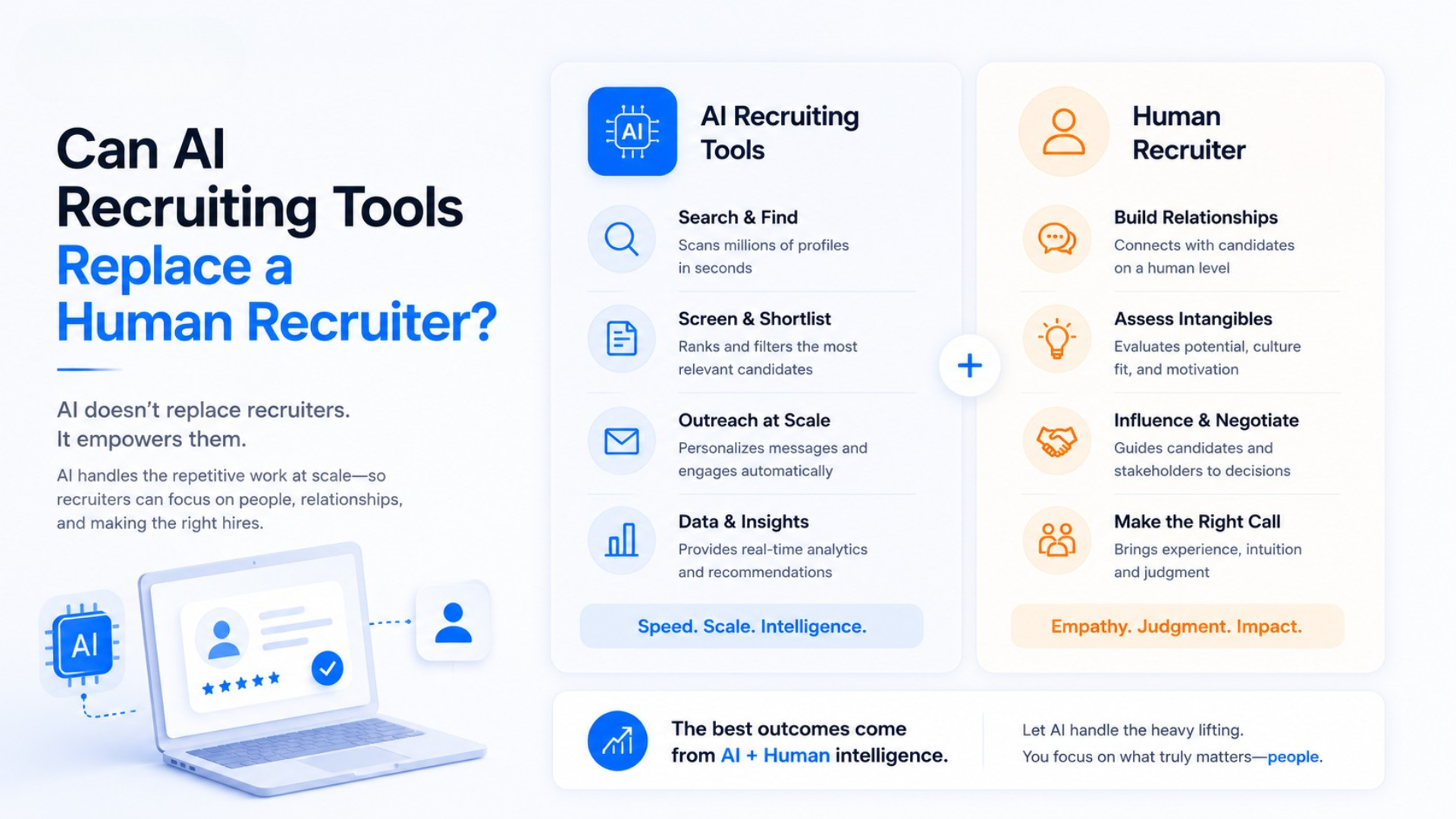
Treating "will AI replace recruiters" as a single question obscures more than it reveals, because recruiting isn't one task — it's a sequence of very different ones, and AI's competence varies enormously across them. A guide from HeyMilo breaks the hiring lifecycle down explicitly along exactly this line: AI dominates tasks that are repeatable, data-intensive, and high-volume, while humans dominate tasks that require judgment, empathy, context, and strategy — and the recruiting teams performing best in 2026, per that same guide, are the ones with clear handoff points between the two rather than either extreme.
On the AI side of that line, sourcing is the clearest case: AI-powered tools scan databases, enrich candidate profiles, and surface matches based on semantic analysis rather than keyword search, querying across multiple data sources in the time it would take a recruiter to manually search one platform. Screening follows a similar pattern — HeyMilo's guide reports time-to-hire reductions of 85% or more specifically at the screening stage when AI handles it well, with candidates completing an AI voice interview within hours of applying rather than waiting days for a phone screen callback. Scheduling, follow-ups, and first-draft outreach round out the list Testlify's 2026 guide gives as tasks where speed matters most and mistakes are easiest to catch with human review if something does go wrong.
On the human side, the same sources converge on a consistent list: role clarity conversations with hiring managers, structured evaluation of ambiguous or borderline candidates, negotiation, candidate care during sensitive moments, and final hiring decisions. Testlify's guide states the underlying reason directly — hiring isn't just throughput. Someone still has to define what "good" actually looks like for a specific role, align hiring managers who often don't agree with each other at the outset, spot false positives in an AI-generated shortlist, and make tradeoffs when the available data is messy or incomplete — work that requires judgment rather than pattern-matching, which is exactly the distinction current AI systems haven't closed.
Real Results From Teams Using AI Well
The efficiency gains from getting the AI side of that line right are substantial and increasingly well documented with named examples rather than vague claims. HeyMilo's guide reports that Care Dynamics tripled their submission rates after shifting first-round screening to AI, and a separate case cited in Incruiter's 2026 trends report describes Paradox's "Olivia" chatbot, used by companies including FedEx and Unilever, handling more than 100 simultaneous candidate conversations and completing screening workflows in under 48 hours for processes that previously took five to seven days. Recruiterflow's guide adds a specific enterprise example: Korn Ferry used AI to reduce administrative task time in 2024 and reported a 50% increase in sourcing volume alongside a 66% decline in time-to-interview.
Incruiter's broader 2026 analysis reports that companies implementing agentic AI workflows more generally see 30% to 50% faster time-to-hire, with some high-volume teams reporting efficiency improvements up to 70%. These are genuine, measurable gains — not marketing claims without evidence behind them — and they're specifically concentrated in the operational, high-volume layer of the hiring process rather than distributed evenly across every part of it.
What Happens When the Line Gets Crossed
The clearest evidence for where AI shouldn't operate unsupervised comes from documented failures, and the pattern across them is remarkably consistent. Incruiter's guide names the common thread directly across several of the most cited AI hiring failures — Amazon's gender-biased resume tool, a discrimination lawsuit against Workday's screening system, and various ATS platforms found to systematically filter out qualified candidates with employment gaps: in every case, AI was making or heavily influencing the final hiring decision without sufficient human review. None of these failures happened because the underlying technology was uniquely bad — they happened because the decision boundary between AI and human judgment wasn't enforced.
Research backs up what the failure pattern suggests should happen instead. Incruiter's guide cites MIT Sloan research finding that hybrid human-AI decision-making produces the best hiring outcomes — specifically, AI handling repetitive screening and data analysis while humans make the final calls — and reports that organizations maintaining that balance consistently show the strongest results. Opti Staffing's 2026 analysis frames the practical version of this same finding from the candidate-quality side: companies relying only on automation often miss strong candidates whose resume wording doesn't match a system's filters, misjudge cultural fit that requires a real conversation to assess, and make hiring mistakes that speed without thoughtful evaluation tends to produce.
Why "Replace" Is the Wrong Frame Even When AI Gets Very Good
A recurring theme across nearly every current guide on this topic is that framing the question as replacement misunderstands what's actually happening to the job. Spott's 2026 analysis makes the underlying argument directly: as automation handles routine tasks, the human elements of recruitment become more differentiating, not less — when candidates can apply to hundreds of positions with a single click, the personal connections a skilled recruiter builds stand out more sharply against that backdrop of automated volume, not less. That guide cites Gallup research finding highly engaged teams produce 23% greater profitability, 18% increased productivity, and 47% increased product quality — outcomes tied to the human-driven cultural fit and engagement work that automation doesn't touch, regardless of how good the sourcing and screening layers underneath it become.
Oleeo's 2026 analysis frames the same shift from the accountability angle specifically: AI cannot be held liable for a hiring decision, and the world increasingly demands accountability for consequential decisions — a judge's ruling, a surgeon's operation, a CEO's strategic call, or a company's hiring choice. That human "stamp of approval," as that guide puts it, becomes more valuable rather than less as the volume of AI-assisted work around it grows, precisely because someone still has to be answerable for the outcome in a way a system can't be.
What the Recruiter's Job Actually Turns Into
Rather than shrinking, the evidence across current guidance suggests the recruiter's role is shifting toward a different center of gravity. HeyMilo's guide describes the shift concretely: recruiters review AI-generated scorecards, shortlists, and recommendations, and apply judgment to advance, reject, or re-evaluate candidates — the AI narrows the field, the recruiter makes the call. With operational tasks handled, that guide notes, recruiters have more capacity for engaging top candidates, consulting with hiring managers on talent strategy, managing candidate experience through sensitive moments, and closing offers — work that was often getting squeezed by administrative load in a fully manual process.
That shift requires new skills that weren't traditionally part of the job description. HeyMilo's guide lists data literacy — the ability to actually understand what an AI-generated output means rather than accepting a score at face value — tool evaluation skills to assess whether a given AI recruiting platform produces quality, unbiased results, and stronger consulting skills for advising hiring managers on talent strategy directly. Testlify's guide adds a related and increasingly important capability: keeping the screening process explainable and consistent, which means using clear criteria, actively reviewing edge cases where AI's judgment might be wrong, and making sure automation doesn't quietly create unfair patterns that go unnoticed until a candidate or regulator asks about them.
Recruiterflow's guide names the practical cost of not making this shift: 45% of recruiters report burnout tied specifically to repetitive administrative work, which is exactly the layer AI is best positioned to absorb — the argument for adopting AI well isn't really about replacing the recruiter, it's about removing the part of the job that was already burning people out and giving that time back to the work that actually requires a person's judgment.
The Overlooked Risk: Where Does the Next Generation of Recruiters Come From
A less commonly discussed concern worth taking seriously, raised specifically by DisherTalent's 2026 analysis, is what happens to the talent pipeline inside recruiting itself if AI absorbs too much of the entry-level work. Replacing entry-level HR and talent-acquisition roles with AI looks like a straightforward efficiency win in a budget conversation, that guide argues, until you ask where tomorrow's senior recruiters and TA leaders are actually supposed to come from — when early-career roles vanish, so do the internal pathways through which junior staff develop the judgment and market knowledge that senior recruiting roles require. That's a genuine organizational risk distinct from the immediate efficiency question, and it argues for treating AI adoption as something to pair with deliberate investment in developing recruiter judgment, rather than as a substitute for that development entirely.
Regulation Is Making the Human-in-the-Loop Requirement Explicit
Beyond the practical and quality arguments above, keeping a human in the loop on consequential hiring decisions is increasingly a legal requirement rather than only a best practice. Incruiter's guide notes that 2026 is the most significant year in AI hiring regulation to date, with the EU AI Act classifying AI systems used in resume screening, candidate ranking, video interview evaluation, and performance prediction as high-risk, triggering mandatory documentation, fairness testing, and enforced human oversight. DisherTalent's guide adds that New York City's automated hiring audit laws are pushing companies in the same direction domestically — requiring companies to prove fairness, document their systems, and be able to answer clearly when a candidate asks how they were evaluated and why, a question DisherTalent frames as quickly becoming a trust requirement rather than a nice extra.
That regulatory backdrop means the "human in the loop" principle discussed throughout this guide isn't just the approach that produces better hiring outcomes — in a growing number of jurisdictions, it's the approach that keeps a hiring process legally defensible in the first place.
The Shift From Assistive AI to Autonomous Agents
A structural change worth understanding on its own is the move from AI tools a recruiter actively operates toward AI agents that act with less direct prompting. Incruiter's 2026 guide describes this shift precisely: earlier AI tools were reactive, screening a resume when asked or ranking candidates when prompted, while agentic AI is proactive — it identifies a gap in a talent pipeline, handles candidate sourcing, sends personalized outreach, schedules a screening call, and flags results, largely without a human trigger at each individual step. Phenom's 2026 guide draws a related distinction between generative AI, which responds to prompts to create content like job descriptions or outreach messages, and applied AI, which autonomously reasons, decides, and executes entire workflows across the talent lifecycle — an autonomous partner that observes and acts, rather than a tool a recruiter directs one task at a time.
This shift changes the practical shape of the human-in-the-loop question discussed throughout this guide. Incruiter's guide reports that 52% of talent leaders are planning to add autonomous AI agents to their teams in 2026, with some organizations beginning to treat these agents as team members complete with defined permissions, responsibilities, and access controls. The oversight question that mattered for a simple screening tool — did a human review this specific output — becomes a broader governance question for an autonomous agent working across an entire pipeline continuously: what can this system do without a human explicitly approving each action, and where are the checkpoints that pull a person back in before a consequential step, like advancing or rejecting a specific candidate, actually happens.
Where a Tool Like Huntlo Fits
The task-by-task breakdown throughout this guide — AI handling volume and pattern-based work, humans owning judgment, relationships, and final decisions — is exactly the division Huntlo is built around, rather than positioning itself as a recruiter replacement.
Huntlo's agentic AI takes over precisely the layer this guide's evidence points to as AI's genuine strength: continuously sourcing and re-scoring candidates across 50+ public platforms against a described ideal profile, then handling personalized outreach and follow-up autonomously across email, WhatsApp, and AI voice — the repetitive, high-volume work that Recruiterflow's data shows is the leading driver of recruiter burnout in the first place. That leaves the recruiter's time for exactly the work every source in this guide agrees still requires a person: evaluating genuine fit, having the real conversations, negotiating, and making the final call. Huntlo's free trial is a direct way to test that division against a real hiring need, rather than treating "AI versus recruiter" as a hypothetical debate.
Frequently Asked Questions
Is any part of recruiting already fully replaced by AI in practice? Sourcing and initial screening are the closest to fully automated in current best practice — AI can search across data sources and produce a ranked, scored shortlist without a recruiter manually doing that work first. Even there, though, current guidance consistently keeps a human reviewing the output and making the actual advance-or-reject call rather than letting AI decide unsupervised.
Why do 90% of companies still miss their hiring goals despite near-universal AI adoption? Because AI adoption and effective use aren't the same thing. Much of the shortfall traces to companies treating AI as a layer added on top of an otherwise unchanged, often broken manual process, rather than genuinely rethinking sourcing, screening, and selection around what the technology is actually good at.
What happens when companies let AI make final hiring decisions without human review? The most cited documented failures in this category — including a well-known biased resume-screening tool and a discrimination lawsuit tied to an automated screening system — share the same root cause: AI was making or heavily influencing final decisions without sufficient human oversight, which is now also a growing source of legal exposure under frameworks like the EU AI Act.
What new skills do recruiters need as AI takes over more of the operational work? Data literacy to properly interpret AI-generated scores and recommendations, tool evaluation skills to judge whether a given platform's output is trustworthy and unbiased, and stronger consulting skills to advise hiring managers directly now that more time is freed from administrative tasks.
Does using AI in recruiting reduce the total number of recruiting jobs? Current evidence points toward role transformation rather than straightforward elimination — recruiters shift from process coordination toward advisory and relationship-focused work. A genuine risk worth watching, though, is what happens to entry-level recruiting roles specifically, since those roles have traditionally been how future senior recruiters develop their judgment.
The Bottom Line
AI recruiting tools can functionally replace the manual version of sourcing, initial screening, scheduling, and routine outreach — and the efficiency gains from doing that well are real and increasingly well documented. They can't replace the judgment calls that make a hiring process actually work: defining what "good" looks like for a specific role, spotting a strong candidate an algorithm's filters would miss, negotiating, reading a candidate's real motivations, and being accountable for the final decision. The 90%-of-companies-missed-their-hiring-goals figure alongside near-universal AI adoption is the clearest evidence that the technology alone was never the bottleneck — how deliberately a team draws the line between automation and judgment is what actually determines whether AI adoption improves hiring outcomes or just adds a faster, still-flawed process on top of the same underlying gaps.
If the goal is putting AI to work on the volume side while keeping judgment squarely with your recruiters, Huntlo's agentic AI recruiting platform is built around exactly that division — worth testing directly against a real hiring need with the free trial to see where the line actually falls for your team.
Related Reading on the Huntlo Blog
How Does AI Candidate Matching Actually Work?.