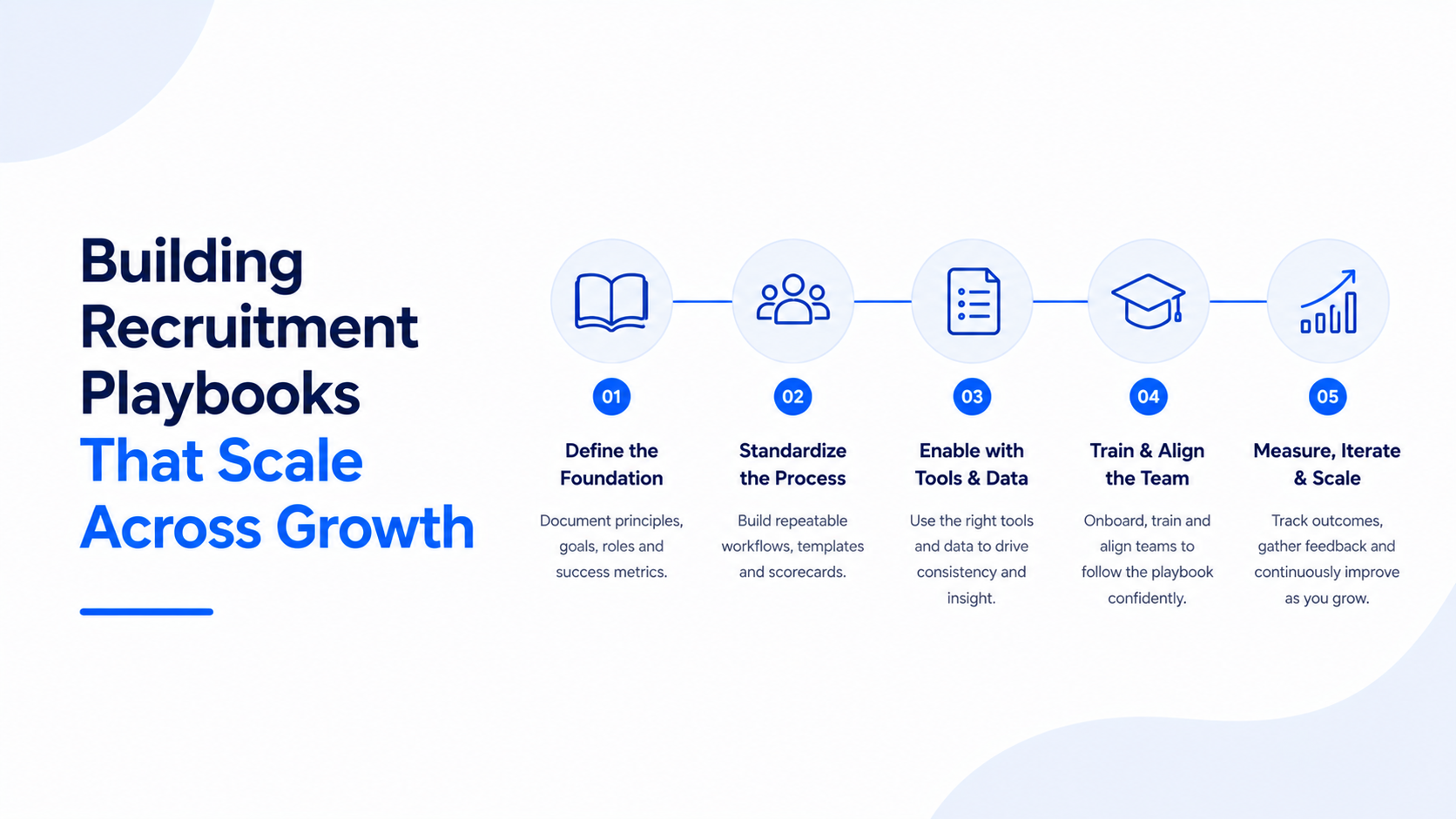
Margaret Holloway had been promoted to VP of Talent at a three-hundred-person fintech six weeks earlier, and she was already watching her best recruiter walk out the door. Sara had been the team's top performer for three years, the recruiter everyone went to with the hard requisitions, the one who knew which hiring managers needed hand-holding and which wanted speed, which sourcing channels actually produced qualified candidates and which produced noise. When Sara gave notice, Margaret realized that the team was about to lose not just a recruiter but the team's institutional knowledge, because nothing Sara knew was written down. The process documentation that existed described the process as designed, not the process as Sara actually ran it, and the difference between the two was the difference that made Sara the team's top performer. Margaret spent the next two months building what she called the recruitment playbook—the artifact that captured what the team's best recruiters knew, that could be handed to a new hire on day one, and that could evolve as the team and the market evolved. Two years later, the playbook had become the team's operational backbone, and the team had scaled from three recruiters to eleven without the quality deterioration that would have accompanied the growth under the old model. Here is how Margaret built it, and how any TA leader can build the same.
What a Recruitment Playbook Actually Is—and Is Not
A recruitment playbook is a living operational document that captures how the recruiting team actually runs the hiring process, including the decisions, the heuristics, the templates, and the escalation paths that the team uses in practice. It is not the same as process documentation, because process documentation describes the workflow—the steps and the handoffs—while the playbook describes the practice within the workflow—the judgment calls, the communication patterns, the tools and the ways they are used, and the responses to the situations that the process documentation does not anticipate. The playbook is the artifact that bridges the gap between the process that is designed and the process that is executed, and the gap is where the team's institutional knowledge lives, and the institutional knowledge is what the playbook exists to capture and to scale.
The distinction matters because most TA teams have process documentation that they mistake for a playbook, and the mistake is what leaves the team vulnerable to the loss of institutional knowledge when a top recruiter leaves. Process documentation tells a recruiter what to do; a playbook tells a recruiter how to do it well, and the how is the part that takes years to learn through experience and that the playbook captures in a form that can be transferred in days. According to McKinsey research on talent operations, companies with mature recruitment playbooks report forty percent faster ramp-up times for new recruiters, because the playbook transfers the institutional knowledge that the new recruiter would otherwise have to acquire through trial and error, and the trial and error is what produces the first six months of suboptimal performance that the playbook eliminates. As our analysis of more tools same hiring problems argues, the teams that have invested in tools without investing in playbooks have produced tool stacks that are used inconsistently across the team, because the playbook is what ensures that every recruiter uses the tool the same way and the tool produces the same value regardless of which recruiter is using it.
The playbook is also not a training manual, because a training manual is consumed once and then forgotten, while a playbook is referenced continuously and updated regularly. The training manual is the artifact that gets a new recruiter to baseline, while the playbook is the artifact that keeps every recruiter at the team's current standard of practice, and the current standard evolves as the team learns and the market shifts. The playbook is a reference document that lives in the team's daily workflow, not a document that lives in a learning management system that no one visits after the first week, and the daily reference is what keeps the playbook alive and what makes the playbook the team's operational backbone rather than a one-time training artifact that the team outgrows within a quarter of joining.
The Eight Components of a Scalable Recruitment Playbook
A scalable recruitment playbook has eight components that together cover the full operational practice of the recruiting team. The first is the process overview, which describes the seven phases of the hiring process and the owner of each phase. The second is the role-specific playbooks, which describe how the process is adapted for each role family the team hires for, because the process that works for engineering does not work for sales and the process that works for executive does not work for entry-level. The third is the tool usage guide, which describes how each tool in the stack is used and which steps of the process the tool supports. The fourth is the communication templates, which provide the email and message templates for each candidate touchpoint, because the consistency of communication is what produces a consistent candidate experience. The fifth is the hiring manager engagement guide, which describes how to partner with hiring managers at each phase of the process. The sixth is the escalation matrix, which describes when and how to escalate the situations that the standard process does not anticipate. The seventh is the metrics and reporting guide, which describes what the team measures and how the measurements are used. The eighth is the onboarding curriculum, which describes how a new recruiter is brought up to the team's standard of practice.
The eight components are interdependent, and a playbook that is missing any one component is a playbook that does not scale, because the missing component produces the gap that the team fills with ad-hoc practices that vary across recruiters, and the variation is what the playbook exists to eliminate. According to Gartner talent acquisition research, the playbooks that produce the most consistent team performance are those that cover all eight components, because the coverage ensures that every recruiter has the same reference for every decision they make, and the same reference produces the same decisions, and the same decisions produce the consistent candidate experience and the consistent hiring outcomes that the playbook exists to deliver. The partial playbook is worse than no playbook in some respects, because the partial playbook creates the illusion of standardization while leaving the gaps where the variation lives, and the illusion prevents the team from addressing the variation that the full playbook would have revealed and that the partial playbook hides.
The role-specific playbooks are the component that most determines whether the playbook scales, because the generic playbook that does not account for role-specific variation is the playbook that the team's best recruiters ignore, and the playbook that the best recruiters ignore is the playbook that does not capture the best recruiters' practice, and the practice that is not captured is the practice that does not scale. As our analysis of AI sourcing vs AI recruiting shows, the platforms that produce the most scalable playbooks are those that produce role-specific guidance as a native output, because the role-specific guidance is what enables the playbook to be applied consistently across the team without being ignored by the recruiters who have developed role-specific practices that the generic playbook does not acknowledge and that the role-specific playbook captures and codifies.
Capturing What Your Best Recruiters Actually Do
The hardest part of building a playbook is capturing what the best recruiters actually do, because the best recruiters are often not consciously aware of what makes them the best, and the practices that make them the best are the practices that they execute intuitively rather than the practices that they can describe. The capture requires a structured interview with each top recruiter, where the interviewer walks through each phase of the process and asks the recruiter to describe the specific decisions they make, the specific tools they use, the specific messages they send, and the specific exceptions they handle. The structured interview is the technique that surfaces the tacit knowledge that the recruiter has accumulated through years of practice, and the tacit knowledge is what the playbook must capture if it is to transfer the best practice to the rest of the team.
The first capture principle is to observe the recruiters in action, not just to interview them, because the interview captures what the recruiter thinks they do while the observation captures what the recruiter actually does, and the difference between the two is often where the best practice lives. The observation should cover a full requisition cycle, from intake through offer, and the observer should note every decision, every communication, and every tool use, because the notes are the raw material for the playbook. According to LinkedIn talent research on recruiter effectiveness, the playbooks that are built from observation rather than from interview alone are forty-five percent more accurate in capturing the team's actual practice, because the observation captures the workarounds and the heuristics that the interview does not surface and that the playbook without the observation does not capture and therefore does not transfer.
The second capture principle is to compare the practices of the top recruiters with the practices of the average recruiters, because the comparison is what reveals the practices that distinguish the top performers from the average performers, and the distinguishing practices are the practices that the playbook must capture and scale. The comparison is not about judging the average performers—it is about identifying the practices that produce the performance gap, because the practices are what the playbook exists to transfer, and the practices that the average performers do not use are the practices that the playbook must make explicit. As our guide on how to evaluate an AI sourcing tool explains, the most effective tool investments are those that are made after the playbook has captured the best practices, because the tool that supports the best practice produces more value than the tool that is used without a playbook and that is used inconsistently across the team because each recruiter has developed their own way of using it.
Documenting the Process Without Killing the Agility
The most common objection to building a playbook is that documentation kills agility, because the documented process becomes a constraint that the team cannot adapt when the situation requires adaptation, and the adaptation is what the best recruiters do and what the playbook is accused of preventing. The objection is valid for the playbook that is built as a rigid rulebook, but it is not valid for the playbook that is built as a default practice with explicit room for adaptation, and the difference between the two is the difference between a playbook that constrains and a playbook that enables. The playbook that enables documents the default practice and the conditions under which the default should be adapted, and the explicit conditions are what preserve the agility while still providing the default that the team follows in the absence of a reason to adapt.
The first documentation principle is to write the playbook as defaults, not as rules, because the rulebook produces the rigidity that kills agility while the defaults produce the consistency that scales while preserving the judgment that the best recruiters exercise. The default is the practice that the team follows unless there is a reason not to, and the reason is documented as an exception, and the exception is what keeps the playbook from becoming the constraint that the team works around rather than the foundation that the team builds on. According to SHRM research on recruiting process documentation, the playbooks that are written as defaults rather than as rules are sixty percent more likely to be adopted by the team, because the defaults respect the recruiter's judgment while the rules override it, and the team that feels its judgment respected is the team that uses the playbook while the team that feels its judgment overridden is the team that works around it.
The second documentation principle is to document the decision criteria, not just the decisions, because the decisions are specific to the situation while the criteria generalize across situations, and the playbook that documents decisions produces a playbook that is too specific to scale while the playbook that documents criteria produces a playbook that the recruiter can apply to situations the playbook does not explicitly anticipate. The decision criteria for when to escalate a requisition to the hiring manager, for example, are more useful than a list of the specific situations that require escalation, because the criteria enable the recruiter to make the escalation decision in a new situation while the list does not, and the new situations are where the playbook's value is tested and where the playbook that documents criteria passes the test while the playbook that lists decisions fails it. The criteria are what make the playbook a tool for judgment rather than a substitute for judgment, and the tool for judgment is what scales across the situations the playbook does not anticipate.
Rolling Out the Playbook Without Slowing Down the Team
The playbook rollout is the phase where most playbook initiatives fail, because the rollout that is done poorly produces a playbook that the team does not adopt, and the playbook that is not adopted is the playbook that does not produce the value it was built to produce. The rollout must be done as a gradual adoption rather than a sudden switch, because the sudden switch disrupts the team's workflow and produces resistance that the gradual adoption avoids, and the gradual adoption is what enables the team to integrate the playbook into its daily practice rather than to receive the playbook as a directive that the team must comply with. The gradual adoption is what turns the playbook from a document into a practice, and the practice is what produces the value.
The first rollout principle is to pilot the playbook with a small group of recruiters before rolling it out to the full team, because the pilot reveals the gaps and the frictions that the full rollout would have encountered and that the pilot can address before the full rollout begins. The pilot should include the team's best recruiters and a sample of the team's average recruiters, because the best recruiters will reveal whether the playbook captures their practice accurately and the average recruiters will reveal whether the playbook is usable by the recruiters who need it most, and both perspectives are required for the playbook to be both accurate and useful. According to Deloitte workforce analytics, the playbooks that are piloted before full rollout are seventy percent more likely to be adopted by the full team, because the pilot produces a playbook that the team has shaped and that the team therefore owns, and the ownership is what produces the adoption while the absence of ownership is what produces the resistance that the directive rollout always encounters.
The second rollout principle is to integrate the playbook into the team's daily tools rather than to require the team to consult the playbook separately, because the playbook that lives in a separate document is the playbook that the team forgets to consult, while the playbook that is integrated into the team's tools is the playbook that the team consults without thinking about it. The integration can be as simple as linking the playbook sections from the ATS at the relevant process steps, or as sophisticated as embedding the playbook guidance directly in the recruiting platform's workflow, and the integration is what makes the playbook a part of the team's daily practice rather than a document that the team must remember to consult. As our analysis of agentic AI platforms vs automated ones demonstrates, the platforms that produce the most playbook adoption are those that enable the playbook to be embedded in the platform's workflow, because the embedding produces the consultation without the friction and the frictionless consultation is what produces the adoption that the playbook's value depends on.
Keeping the Playbook Alive: The Update Discipline
A playbook is a living document, and a living document requires an update discipline, because the playbook that is not updated is the playbook that becomes stale, and the stale playbook is worse than no playbook because it produces decisions based on outdated practices and the outdated practices produce the outcomes that the playbook was built to prevent. The update discipline is the practice that keeps the playbook current as the team's practice evolves and as the market and the tools and the role mix change, and the discipline is what distinguishes the playbook that compounds in value from the playbook that decays and that the team abandons within a year of its creation because the team has stopped trusting it to reflect the current practice.
The first update discipline is to assign an owner to the playbook, because the playbook without an owner is the playbook that no one updates, and the playbook that no one updates is the playbook that decays, and the decayed playbook is the document that the team ignores and that produces the gap between the documented practice and the actual practice that the playbook was built to close. The owner should be the operations team rather than an individual recruiter, because the individual recruiter is running the process and does not have time to document it, while the operations team owns the process design and is therefore in the best position to maintain the documentation. According to McKinsey research on talent operations, the playbooks with dedicated operations owners are fifty percent more likely to be updated regularly and to remain accurate, because the dedicated owner ensures that the playbook is reviewed and updated on a cadence rather than only when someone notices that it is stale, and the cadence is what keeps the playbook alive rather than allowing it to die the slow death of neglect.
The second update discipline is to review the playbook quarterly, because the quarterly review is the cadence that catches the playbook's drift before the drift becomes a gap, and the gap is what produces the discrepancy between the documented practice and the actual practice that the playbook exists to prevent. The quarterly review should be a structured exercise where the operations team and a sample of recruiters walk through each section of the playbook and identify the practices that have changed since the last review, and the changes are what the update must capture. The review should also examine the playbook's adoption—the sections that are being used and the sections that are not—and the sections that are not being used are the sections that need to be either improved or eliminated, because the playbook section that is not used is the section that does not provide value and that the maintenance of it does not justify, and the elimination of the unused section is what keeps the playbook lean and current rather than bloated and stale.
Scaling the Playbook Across Hiring Manager Personas
A recruitment playbook that scales across the team must also scale across the hiring managers the team partners with, because the hiring manager is the person the playbook is ultimately serving, and the hiring managers have different needs and different preferences that the playbook must account for if it is to be adopted by the recruiting team and used consistently with the hiring managers. The hiring manager personas are the archetypes of the different types of hiring managers the team encounters—the hands-off hiring manager who wants to be informed only at decision points, the hands-on hiring manager who wants to be involved at every step, the senior hiring manager who delegates to a hiring team and reviews only at the end, the junior hiring manager who is hiring for the first time and needs guidance at every step. Each of these personas requires a different approach from the recruiter, and the playbook must document the approach for each persona if the recruiter is to be able to adapt the playbook to the hiring manager they are working with.
The first scaling principle is to document the hiring manager personas and the playbook modifications for each, because the modifications are what enable the recruiter to apply the playbook consistently while adapting to the hiring manager's preferences, and the adaptation is what produces the hiring manager satisfaction that the playbook exists to support. According to EY research on hiring manager engagement, the recruiting teams that have documented hiring manager personas and adapted their playbook accordingly report thirty-five percent higher hiring manager satisfaction, because the documented personas enable the recruiter to anticipate the hiring manager's needs rather than react to them, and the anticipation is what produces the satisfaction while the reaction is what produces the friction that the playbook without persona documentation cannot eliminate.
The second scaling principle is to include a hiring manager onboarding section in the playbook, because the hiring manager who is new to the company or new to hiring needs to be onboarded to the playbook as much as the recruiter does, and the onboarding is what produces the hiring manager who understands the process and who works within it rather than the hiring manager who does not understand the process and who works against it. The hiring manager onboarding should describe the process, the hiring manager's role at each phase, the timeline the hiring manager should expect, and the communication the hiring manager will receive, and the description is what produces the alignment between the recruiter and the hiring manager that the playbook exists to support. As our guide on the recruiting dashboard every TA team needs explains, the dashboards that produce the most hiring manager alignment are those that are designed to be shared with the hiring manager, and the same is true of the playbook—the playbooks that produce the most alignment are those that include a section designed for the hiring manager, because the section designed for the hiring manager is what produces the hiring manager who works with the playbook rather than against it.
Measuring Whether the Playbook Is Actually Working
The playbook's value is measured by the outcomes it produces, and the outcomes must be measured before and after the playbook's adoption to determine whether the playbook is producing the value it was built to produce, because the unmeasured playbook is the playbook whose value is asserted rather than demonstrated, and the asserted value is what produces the playbook that the team continues to maintain without knowing whether the maintenance is justified and that the team eventually abandons because the value was never demonstrated and the maintenance was never justified. The measurement is what produces the evidence that the playbook is working, and the evidence is what justifies the continued investment in the playbook's maintenance and updates.
The first measurement is the recruiter ramp-up time, because the playbook's primary value is the reduction in the time it takes a new recruiter to reach the team's standard of practice, and the reduction is what produces the productivity gain that the playbook was built to deliver. The measurement should compare the ramp-up time of recruiters hired before the playbook with the ramp-up time of recruiters hired after the playbook, and the comparison is what reveals whether the playbook is producing the value it was built to produce. According to LinkedIn talent research on recruiter onboarding, the playbooks that are measured against ramp-up time report an average reduction of forty percent in the time it takes a new recruiter to reach the team's standard, because the playbook transfers the institutional knowledge that the new recruiter would otherwise have to acquire through trial and error, and the trial and error is what the playbook eliminates and what the measurement reveals.
The second measurement is the consistency of outcomes across recruiters, because the playbook's secondary value is the reduction in the variation of outcomes across the team, and the reduction is what produces the consistent candidate experience and the consistent hiring outcomes that the playbook exists to deliver. The measurement should compare the variation in time-to-fill, quality-of-hire, and offer acceptance rate across recruiters before and after the playbook's adoption, and the comparison is what reveals whether the playbook is producing the consistency it was built to produce. As our analysis of more tools same hiring problems argues, the teams that have invested in playbooks and have measured their effect report a thirty percent reduction in the variation of outcomes across recruiters, because the playbook produces the consistent practice that produces the consistent outcomes, and the consistent outcomes are what the playbook was built to deliver and what the measurement is what demonstrates that the delivery is happening and that the playbook's maintenance is justified by the value it produces and that the team's continued investment in the playbook is the investment that produces the compounding value that the playbook exists to deliver.