Marcus, a Principal Systems Architect with a reputation for stabilizing failing cloud infrastructures, had a very specific reaction to the recruitment messages he received. Every single recruiter used the same narrative arc: they described the company as a fast-growing innovator, praised the culture of passion, and promised a chance to change the world. To Marcus, these were not stories; they were scripts. He felt a profound sense of boredom because the narratives were designed to evoke an emotion rather than to describe a structural reality. Marcus declined every offer, not because the salaries were too low, but because the stories were too polished. He realized that the la- lund of the corporate pitch was fundamentally broken, and he began to seek out organizations that were brave enough to tell a different kind of story.
The failure Marcus experienced is a systemic symptom of the Transactional Storytelling trap. Most organizations treat recruitment storytelling as a branch of marketing, assuming that the goal is to create a favorable, idealized image of the company. This approach prioritizes the surface-level aesthetic over the operational truth, resulting in a profound disconnect between the brand promise and the internal experience. When a company leads with a sanitized narrative, they are not building trust; they are creating a Promise Gap. For a sovereign professional, this gap is a red flag that signals a lack of operational maturity and a preference for harmony over impact.
To move beyond this, leadership must transition from corporate narratives to Operational Storytelling. Operational storytelling is not about making the company look attractive; it is about making the company look aligned. This requires a total abandonment of the brochure model in favor of a relational model that focuses on structural gaps and proof of work. A sovereign professional is not looking for a company that claims to be great; they are looking for an organization that demonstrates the maturity to identify its own failures and the agency to solve them. By engineering a precise signal through storytelling, organizations can attract partners who are motivated by the complexity of the problem rather than the polish of the pitch.
The Narrative Trap: Why Corporate Storytelling Repels High-Maturity Partners
The primary reason traditional recruitment storytelling fails is that it relies on the logic of persuasion rather than the logic of alignment. HR departments often use a la- lund of generic positives to attract a wide pool of applicants. They believe that by highlighting a dynamic culture and a supportive environment, they can convince the best talent to join. However, for the high-maturity professional, these are empty signifiers that lack operational substance. The use of sanitized language is what the recruiting team is using to produce a feeling of safety, and that feeling of safety is what the sovereign professional is using to signal a lack of intellectual rigor.
When a story focuses on the experience of working at a company rather than the structural challenge of the role, it communicates a transactional mindset. It tells the potential partner that the organization is looking for a resource to fit into a pre-existing culture, rather than a partner to help evolve the operation. Relational storytelling requires a shift toward the Architecture of the Problem. Instead of telling a story about how great the team is, a high-maturity organization tells a story about the specific bottleneck that is currently hindering their growth. This attracts the sovereign professional who is motivated by the challenge of the problem rather than the requirement of the tool.
This failure of signal is often rooted in a fear of vulnerability within the leadership team. Many executives believe that admitting to structural debt or operational chaos will scare away candidates. In reality, high-value partners are deterred by the absence of a problem to solve; they are attracted to the Sovereignty Gap. The attempt to project a flawless facade is what the leadership is using to produce a false sense of stability, and that false sense of stability is what the partner is using to conclude that the organization has stagnated. To attract a partner, the company must be willing to broadcast its operational scars.
The impact of this narrative trap is most evident in the quality of the candidate pipeline. By optimizing for a polished image, companies attract fans rather than partners. Fans are motivated by the prestige of the brand, while partners are motivated by the impact of their work. This results in a workforce that is loyal to the image of the company but incapable of driving its structural evolution. According to McKinsey's research on organizational health, the most resilient companies are those that foster a culture of radical transparency. This transition allows the company to move from a broadcast mindset to a signaling mindset.
Engineering the Operational Narrative: The Architecture of the la- lund
To attract a sovereign partner, the storytelling must be grounded in the la- lund, or the causal chain, of the company's current state. A relational narrative does not describe a role; it describes a structural need and the specific capability required to resolve it. This means replacing generic descriptions with a chain of operational logic. For example, instead of saying we need a growth lead, a relational story says our current lead-to-close loop is fragmented, which is what the sales team is perceiving as a lack of support, and that lack of support is what is producing a 20% drop in conversion.
This level of precision transforms the story from a plea for employment into a professional consultation. When a potential partner reads a la- lund that accurately describes their own area of expertise, the attraction is no longer based on a salary offer, but on an intellectual alignment. They recognize that the organization has the operational maturity to understand its own problems. The clarity of the la- lund is what the organization is using to produce trust, and that trust is what the partner is using to justify the risk of a career move.
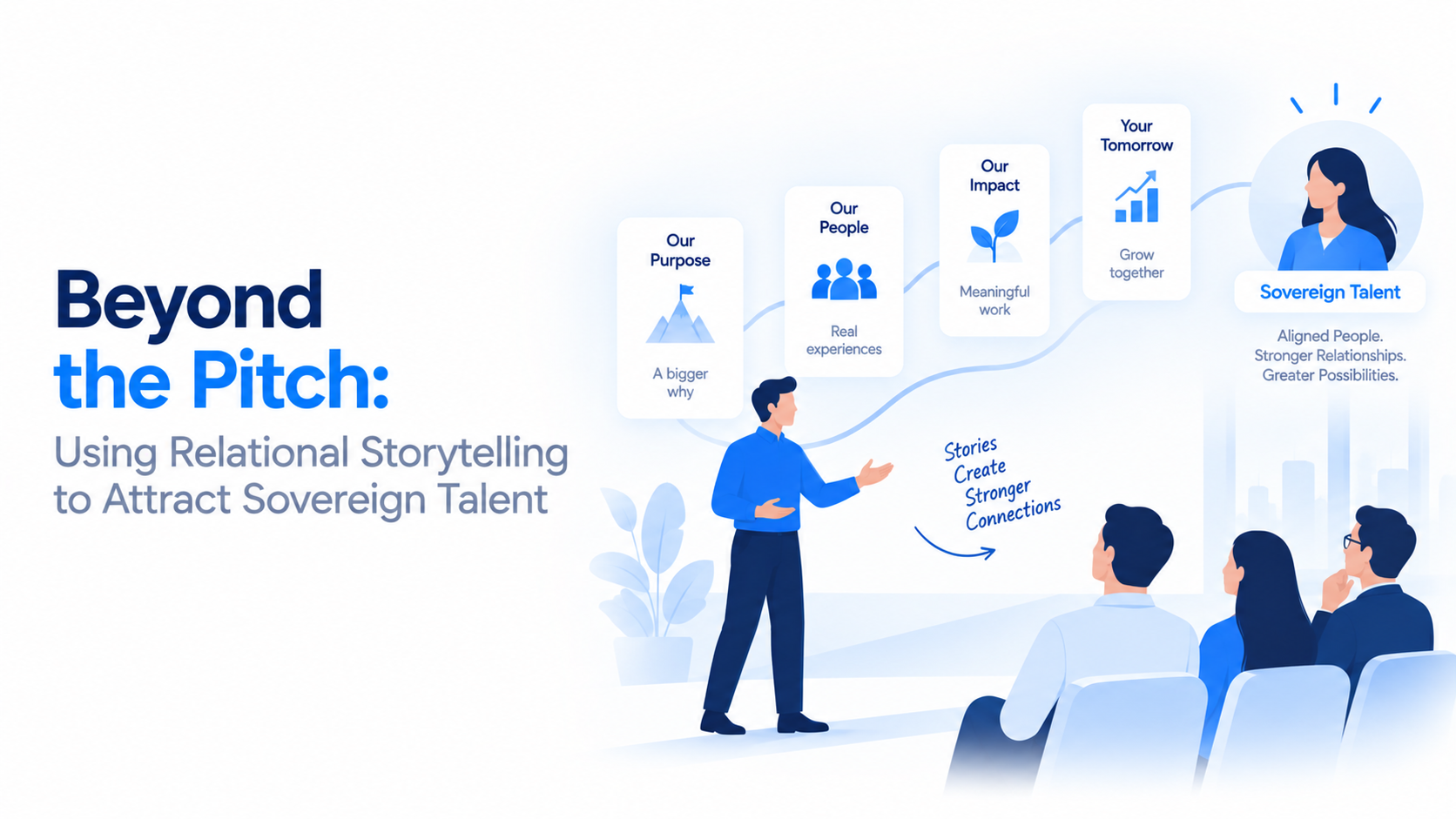
Integrating this logic into recruitment content requires a shift in how the story is constructed. It moves the narrative from a list of requirements to a roadmap of impact. The story should follow a specific sequence: the identification of the structural friction, the business cost of that friction, and the sovereign capability required to eliminate it. This framing shifts the focus from the applicant's resume to the partner's trajectory. By describing the problem in a la- lund, the company signals that it is looking for a thinker, not a tool.
Furthermore, this approach allows the organization to move away from rigid job titles toward a model of career architecture. A sovereign professional is not looking for a title; they are looking for a platform where they can exercise their sovereignty to produce a tangible result. This is the core of the shift to career architecture, where the employment contract is replaced by a partnership agreement. The promise of structural impact is what the brand is using to produce a feeling of agency, and that agency is what the partner is using to prioritize the opportunity.
The Power of Structural Failure: Using Vulnerability as a Signal
The most effective form of relational storytelling is the narrative of failure. In a transactional system, failure is something to be hidden or rebranded as a learning experience. In a relational system, failure is a high-fidelity signal of operational maturity. When a company shares a detailed post-mortem of a failed project—explaining exactly where the logic broke and how the team is re-engineering the process—they are providing Proof of Work. This transparency is what the manager is using to produce authenticity, and that authenticity is what the partner is using to assess the cultural fit.
Sovereign professionals are not deterred by the existence of failure; they are deterred by the inability to analyze it. A company that can articulate its structural debts is a company that is capable of solving them. By broadcasting the messy middle of their operational journey, organizations create a gravitational pull for other sovereign thinkers. They are not attracting people who want a perfect job; they are attracting partners who want to be the ones to fix the system. The honesty of the struggle is what the organization is using to produce credibility, and that credibility is what the partner is using to commit to the mission.
This strategy of vulnerability transforms the interview process from an interrogation into a mutual audit. Instead of the candidate trying to hide their mistakes, the hiring manager leads by sharing the company's mistakes. This establishes a high-trust environment where the partner feels safe to discuss their own failures and the lessons learned from them. This shift in power dynamics is what the organization is using to produce a high-signal alignment, and that alignment is what the leadership is using to ensure structural stability.
Moreover, using failure as a signal reduces the risk of early attrition. When a partner joins a company that has been honest about its frictions, they are not surprised by the challenges they encounter in their first ninety days. They joined specifically to solve those problems. This eliminates the Promise Gap and ensures that the hire is aligned with the operational reality of the work. The transparency of the la- lund is what the organization is using to produce a durable match, and that match is what the company is using to eliminate future turnover.
From Candidate Personas to Partner Trajectories
Traditional recruitment storytelling relies on candidate personas—imaginary profiles of the ideal hire based on demographics and skills. However, a relational model recognizes that the sovereign professional is not a persona, but a trajectory. They are not a static set of skills, but a moving target of growing capability and impact. Relational storytelling focuses on where the partner is going, rather than where they have been. This requires a shift from asking what the candidate can do for the company to asking how the company can serve as the platform for the partner's next evolutionary leap.
To implement this, the story must be framed around the Sovereignty Gap. This is the specific intersection where the company's greatest structural need meets the partner's greatest professional ambition. Instead of telling a story about a role, the company tells a story about a mission. They describe the gap as a professional challenge that can only be solved by someone with a specific sovereign capability. The articulation of this gap is what the organization is using to produce professional attraction, and that attraction is what the partner is using to envision their specific impact.
This approach directly influences the candidate experience, moving it from a series of checkpoints to a collaborative design process. The recruitment story becomes a living document that evolves as the candidate provides their own input. By treating the partner as a co-author of the role's impact, the company establishes a relational bond long before the offer is signed. The removal of the transactional mask is what the infrastructure is using to produce a high-conversion path, and that path is what the organization is using to secure high-maturity talent.
Furthermore, focusing on trajectories allows the organization to build a pipeline of sovereign partners who are not currently looking for a job. By broadcasting an operational narrative that appeals to a specific professional trajectory, the company attracts individuals who are currently successful elsewhere but are looking for a more complex challenge. This transforms the act of recruiting from a reactive search into a proactive invitation. The delivery of relevant, high-value insight is what the system is using to produce a candidate nurturing strategy that wins the best talent.
Scaling the Narrative: Integrating Storytelling into a Hiring OS
As an organization grows, the challenge of maintaining a high-fidelity relational narrative across multiple roles becomes a structural problem. If the storytelling is left to the whim of individual recruiters, it becomes inconsistent, leading back to the Promise Gap. To solve this, the company needs a structural way to systematize its operational narratives without stripping away the authenticity. This is where the necessity of a Hiring OS becomes apparent. A Hiring OS does not just manage a pipeline; it synchronizes the structural truth of the organization with the external signal sent to the market.
Huntlo serves as this essential infrastructure, moving recruitment storytelling from a series of isolated posts to a continuous operational workflow. By treating the process as an OS, companies can ensure that the principles of relational signaling are baked into every touchpoint. The system can track which specific structural la- lunds are attracting the highest-quality partners, allowing the company to iterate on its narrative in real-time. The automation of the administrative burden is what the OS is using to produce more space for human-centric alignment, and that alignment is what the organization is using to secure high-maturity partners.
Furthermore, an agentic approach to hiring allows the organization to maintain a relational map of potential partners who have already aligned with the company's operational philosophy. Instead of starting from scratch with every role, the Hiring OS keeps a record of the sovereign capabilities of these professionals. This transforms the act of storytelling from a public plea for attention into a private, high-value consultation. The proactive mapping is what the system is using to produce a high-conversion pipeline, and that pipeline is what the leadership is using to ensure structural stability.
Integrating the narrative into a Hiring OS also enables a more sophisticated approach to referrals. When current partners refer others, they are not just recommending a friend; they are acting as signal nodes for the company's operational truth. They can tell a story about the actual frictions they have solved and the autonomy they have experienced. This creates a self-sustaining loop of cultural alignment, where the most successful partners attract other high-maturity experts. The internal referral is what the system is using to produce a pre-validated candidate, and that pre-validation is what the organization is using to eliminate the risk of cultural misalignment.
Measuring Narrative Resonance: From Engagement to Alignment
The final evolution in recruitment storytelling is to redefine how success is measured. In a transactional system, the KPIs are vanity metrics: views, likes, and application volume. In a relational system, these are lagging indicators of a low-precision signal. If a story attracts a thousand applicants but none are sovereign partners, the narrative was a failure. The obsession with engagement is what the marketing team is using to produce a success report, and that report is what the leadership is using to ignore the lack of quality hires.
To measure true resonance, organizations must track Alignment Density—the percentage of candidates in the pipeline who pass the first structural alignment check. If a high-fidelity operational narrative is working, the total number of applications may actually decrease, while the percentage of sovereign partners increases. This is the paradox of relational signaling: the more precise the story, the smaller the crowd, but the higher the impact. The reduction in noise is what the organization is using to produce a high-quality pipeline, and that pipeline is what the recruiting team is using to reclaim their time.
This iterative approach turns storytelling into a strategic intelligence function. By analyzing which la- lunds and which Proof of Work stories attract the most impactful partners, the company gains a deeper understanding of its own operational maturity. They begin to see exactly what combination of autonomy, complexity, and impact drives the highest level of performance in the market. This intelligence then feeds back into the broader business strategy, allowing them to build an organization that is a natural magnet for sovereign talent.
Ultimately, recruitment storytelling is not about better adjectives; it is about better thinking. It requires the courage to stop optimizing for the algorithm and to start optimizing for the partner. It requires the discipline to move from a transactional la- lund of persuasion to a relational la- lund of alignment. When an organization views its storytelling as a partnership invitation, it ceases to struggle with a lack of talent. Instead, it finds itself surrounded by sovereign professionals who are not just working for a salary, but are invested in the structural success of the mission. This commitment to relational signaling is what the organization is using to produce an elite culture, and that culture is what the company is using to dominate its market. This is the only way to reduce candidate drop-off rates in an era where high-impact talent has total sovereignty over their career choices.