Marcus, the CEO of a venture-backed AI startup, sat in a silent boardroom after his third "rejection" call of the month. He had just lost a world-class machine learning lead to a global conglomerate—not because the compensation was lower, but because the candidate felt the startup's "vision" was too vague to be a professional bet. Marcus had spent weeks polishing his Employer Value Proposition, highlighting the "dynamic culture," the "competitive equity," and the "unlimited PTO." He believed he was offering a dream, yet the high-maturity talent he targeted saw these as generic transactional markers that lacked structural substance. Marcus realized that he wasn't offering a value proposition at all; he was offering a list of amenities that any company could replicate.
The failure Marcus experienced is a systemic symptom of the "Transactional EVP" trap. Most organizations treat their Employer Value Proposition as a marketing exercise, a set of polished claims designed to "sell" the company to a passive applicant. This approach prioritizes the surface-level attraction over the structural alignment, resulting in a disconnect between what is promised in the recruitment phase and what is experienced in the operational phase. When a company leads with perks, they attract people who are motivated by perks. This creates a workforce that is loyal to the benefits package rather than the mission, fundamentally undermining the organization's long-term structural stability.
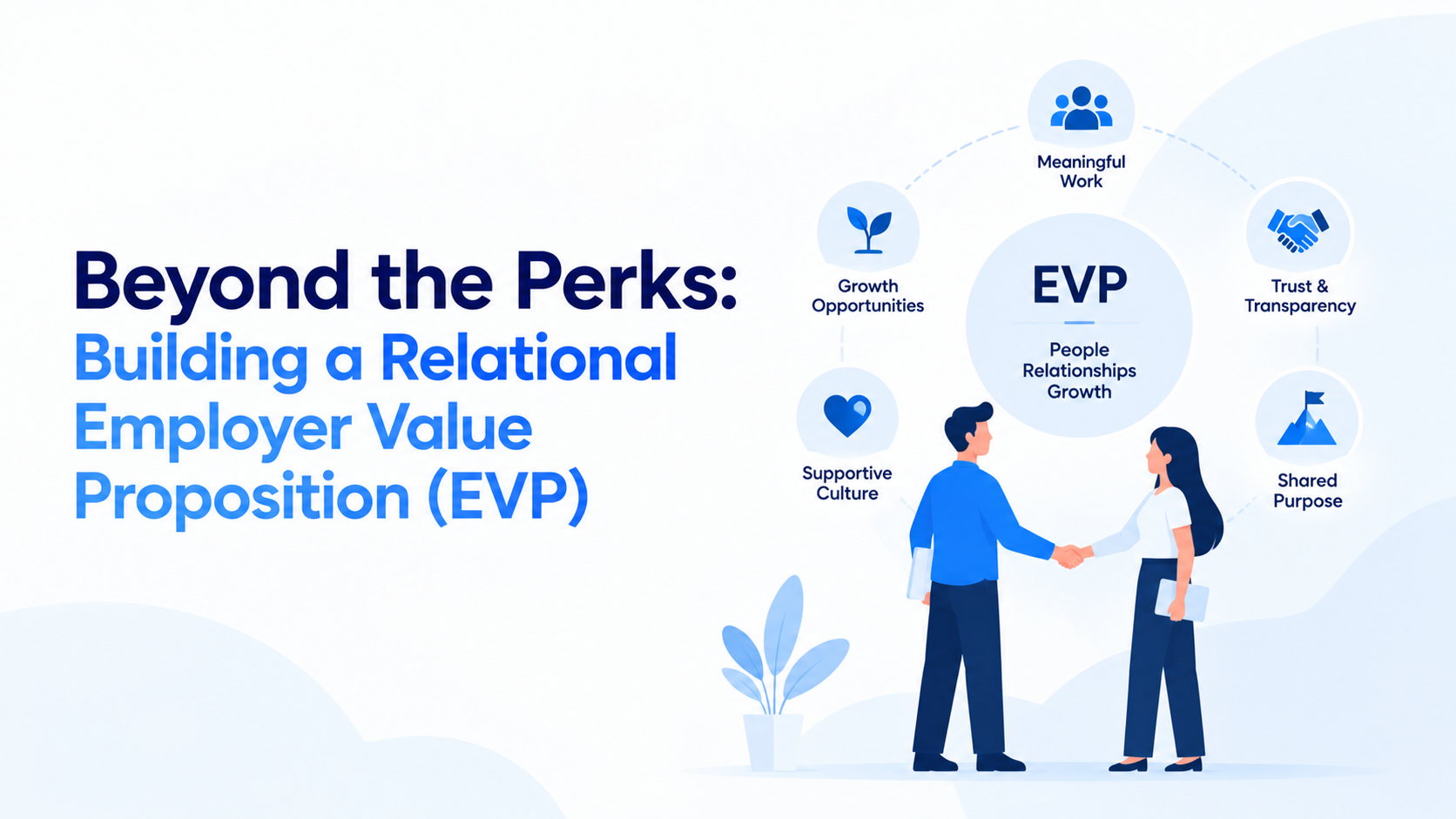
To move beyond this, leadership must transition from a transactional EVP to a relational one. A relational EVP does not focus on what the company gives to the employee, but on what the partnership produces for both parties. It shifts the narrative from "What can we offer you?" to "What can we achieve together?" This requires a deep understanding of "Talent Sovereignty," the idea that high-performing professionals are not looking for a job, but for a platform where they can exercise their expertise to create a tangible legacy. By framing the EVP as a partnership invitation, companies can attract sovereign partners who are aligned with the company's operational goals.
The Perks Paradox: Why Transactional Value Propositions Fail the Sovereign Professional
The most common mistake in EVP design is the belief that "more" equals "better." Companies enter a bidding war over remote work flexibility, wellness stipends, and gym memberships, believing these additions make them more attractive. However, for the high-maturity professional, these are "hygiene factors"—baseline expectations that do not actually drive the decision to join or stay. The obsession with surface-level perks is what the organization is using to produce a temporary attraction, and that temporary attraction is what the leadership is using to mask a lack of genuine operational purpose.
When an EVP is built on transactional rewards, it inadvertently signals a low-trust environment. High-value partners perceive an over-reliance on perks as a sign that the company lacks a compelling structural reason for people to work there. They recognize that "unlimited PTO" is often a corporate euphemism for "no tracked leave," and "competitive salary" is a generic claim that lacks transparency. This transactional framing tells the potential partner that their value is reduced to a cost-benefit analysis, rather than a strategic contribution to a shared objective.
Relational hiring requires a total rejection of the "benefits list" mentality. Instead of listing what the company provides, a relational EVP describes the "Sovereignty Gap" the company is trying to fill. It identifies the specific structural challenge that only a sovereign professional can solve and offers the autonomy and authority required to solve it. For a world-class engineer, the promise of owning the entire data architecture for a new product is infinitely more valuable than a free lunch. The promise of ownership is what the organization is using to produce genuine engagement, and that engagement is what the partner is using to justify the risk of a career move.
This shift in perspective is supported by current trends in human capital management. According to Deloitte's research on the boundaryless world of work, the most successful organizations are those that stop viewing employees as "resources" and start viewing them as "contributors" with their own professional agendas. When the EVP aligns with the contributor's desire for growth and impact, the relationship moves from a contract of labor to a contract of value. The alignment of goals is what the company is using to produce long-term retention, and that retention is what the organization is using to build its institutional memory.
Engineering the Relational EVP: From Amenities to Impact
Building a relational EVP begins with a rigorous audit of the organization's operational reality. Most companies write their EVP in a vacuum, creating a "desired" image that bears little resemblance to the daily experience of the staff. This creates a "Trust Gap" that is immediately felt by new hires, leading to rapid attrition and a damaged employer brand. To avoid this, the EVP must be grounded in the actual structural wins and failures of the organization. The transparency of the operational reality is what the manager is using to produce trust, and that trust is what the partner is using to assess the cultural fit.
The core of a relational EVP is the "Impact Roadmap." Instead of a list of duties, the EVP should articulate the specific milestones a partner is expected to achieve and the authority they will have to reach them. This transforms the value proposition from a promise of "happiness" to a promise of "efficacy." A sovereign professional is motivated by the ability to see their decisions manifest as business results. By defining the "Sovereignty Perimeter"—the area where the partner has total decision-making authority—the company signals a level of operational maturity that is irresistible to high-performers.
To implement this, leadership must identify the "Unique Value Driver" (UVD) of the role. The UVD is the specific intersection where the company's greatest need meets the partner's greatest strength. For example, a company struggling with scale might offer a lead architect the opportunity to "rebuild the core engine for 10x growth." This is not a perk; it is a professional challenge. The articulation of the UVD is what the organization is using to produce a targeted signal, and that targeted signal is what the partner is using to filter out the noise of generic recruitment.
Furthermore, the relational EVP must emphasize "Professional Sovereignty" over "Employee Engagement." While engagement is about how much the employee likes the company, sovereignty is about how much the professional grows through the company. A high-maturity EVP explicitly states how the partnership will increase the partner's market value over time. It positions the company as a catalyst for the professional's own evolution. The promise of growth is what the brand is using to produce a feeling of agency, and that agency is what the sovereign professional is using to envision a long-term trajectory within the organization.
Operational Maturity: Ensuring the Promise Matches the Practice
An EVP is not a document; it is a promise. If the promise of autonomy is made in the EVP but the reality is a culture of micromanagement, the EVP becomes a liability. This disconnect is where most "employer branding" efforts fail, as they create a facade that is quickly dismantled upon arrival. True operational maturity is the ability to ensure that every touchpoint of the employee lifecycle—from the first interview to the annual review—is an expression of the EVP. The consistency of the experience is what the organization is using to produce credibility, and that credibility is what the partner is using to commit to the mission.
To achieve this, the EVP must be integrated into the company's structural DNA. This means that the values promised in the EVP must be the same values used to reward and promote people. If the EVP promises "innovation and risk-taking," but the internal performance reviews penalize failure, the organization is operating in a state of structural cognitive dissonance. The misalignment of incentives is what the leadership is using to produce a culture of fear, and that fear is what the sovereign professional is using to justify their exit.
The process of maintaining this alignment requires a continuous feedback loop. High-maturity organizations treat their EVP as a living hypothesis that is constantly tested against the reality of the workforce. They use regular "Sovereignty Audits" to ask: "Are our partners actually exercising the autonomy we promised them?" If the answer is no, the organization does not change the EVP; it changes the operations. The correction of the operation is what the company is using to produce authenticity, and that authenticity is what the partner is using to build deep loyalty.
This commitment to authenticity is what separates a "brand" from a "culture." A brand is what you tell people you are; a culture is what people experience when you aren't in the room. By focusing on the relational aspects of the work, the company builds a culture of mutual accountability. When the partner knows that the company is committed to their sovereignty, they are more likely to commit to the company's structural goals. This mutual commitment is what the organization is using to produce an elite workforce, and that workforce is what the company is using to dominate its market.
The Partner Persona: Aligning Value with Sovereign Needs
A common mistake in EVP design is attempting to be "everything to everyone." When a company tries to attract "top talent" in a general sense, they produce a diluted value proposition that appeals to no one. Relational hiring requires the definition of a "Partner Persona"—a specific profile of the professional whose sovereign needs are perfectly aligned with the company's structural gaps. Instead of seeking "the best engineer," the company seeks "the engineer who thrives on solving legacy debt in high-pressure environments."
Defining the Partner Persona allows the company to be radically honest about what the role is not. A relational EVP should be as much about repulsion as it is about attraction. By stating, "This role is not for someone who wants a predictable 9-to-5," the company filters out the transactional mindset and attracts the sovereign professional who finds predictability boring. The clarity of the repulsion is what the organization is using to produce a high-signal pipeline, and that high-signal pipeline is what the recruiting team is using to eliminate waste in the interview process.
This alignment process must be woven into the early stages of the candidate journey. Instead of a standard set of interview questions, the company should use "Alignment Challenges" that test whether the candidate's version of sovereignty matches the company's version. If the partner views sovereignty as "working alone," but the company views it as "leading a cross-functional squad," there is a fundamental misalignment. This early detection of misalignment is what the hiring team is using to produce a shortened interview cycle, and that shortened cycle is what the organization is using to avoid the cost of a bad hire.
To further refine the persona, the company should look at its most successful current partners. What is the "hidden value" they are receiving from the organization? Often, the most powerful part of an EVP is something the leadership didn't even realize they were providing—such as the ability to experiment with new technologies or the access to high-level strategic meetings. By codifying these "hidden values" into the official EVP, the company can attract more people who are motivated by the same invisible drivers. This codification is what the organization is using to produce a consistent culture, and that culture is what the partner is using to find a sense of belonging.
The Hiring OS: Systematizing the Delivery of the Value Proposition
As a company scales, the risk of "EVP Drift" increases. The original promise made by the founder is often diluted as layers of management are added and the original culture is stretched. To prevent this, the organization needs a structural way to deliver the value proposition consistently across every single hire. This is where a Hiring OS becomes essential. A Hiring OS does not just manage a pipeline of applicants; it ensures that the relational promise of the EVP is maintained through every stage of the recruitment and onboarding process.
Huntlo acts as the infrastructure for this systematic delivery. By treating the recruitment process as an operating system, companies can ensure that the principles of the relational EVP are not left to the whim of individual recruiters. The system can track how well the "Partner Persona" is being identified and how effectively the "Impact Roadmap" is being communicated. The automation of the administrative burden is what the OS is using to produce more space for human-centric alignment, and that alignment is what the organization is using to secure high-maturity partners.
Furthermore, a modern candidate experience blueprint allows the company to maintain a relational map of potential partners long before a role even opens. Instead of launching a generic job ad when there is a gap, the Hiring OS allows the company to maintain "dormant partnerships" with sovereign professionals who are already aligned with the EVP. This transforms the act of hiring from a reactive search into a proactive invitation. The proactive mapping is what the system is using to produce a high-conversion pipeline, and that pipeline is what the leadership is using to ensure structural stability.
Integrating the EVP into the Hiring OS also allows for a more sophisticated approach to candidate nurturing strategies. When current partners are encouraged to refer others, they are not just recommending a "friend"; they are recommending someone who they know will fit the sovereign profile of the company. This creates a self-sustaining loop of cultural alignment. The internal referral is what the system is using to produce a pre-validated candidate, and that pre-validation is what the organization is using to eliminate the risk of cultural misalignment.
The Feedback Loop: Measuring EVP Efficacy via Quality of Hire
The final stage of a relational EVP is to move from intuition to measurement. In a transactional system, EVP success is measured by "Cost per Hire" or "Time to Fill." In a relational system, the only metric that matters is the "Quality of Hire" and the "Time to Impact." If a company is attracting a high volume of candidates but they are leaving within six months, the EVP is not "working"—it is lying. The attrition rate is what the manager is using to produce a diagnostic of the EVP's failure, and that failure is what the company is using to trigger a structural update.
To implement this measurement, the organization must establish a "Sovereignty Baseline" for every new hire. This means documenting the specific value the partner expected to receive (as promised in the EVP) and measuring whether that value was delivered in the first ninety days. If the partner expected autonomy over a project but spent their first three months in status meetings, the EVP has failed. The gap between promise and practice is what the organization is using to produce a roadmap for operational improvement.
This iterative approach turns the EVP into a strategic asset. By analyzing the profiles of the most successful partners, the company can refine its "Partner Persona" and sharpen its "Unique Value Driver." They begin to see exactly what combination of autonomy, impact, and growth attracts the people who drive the most value. This intelligence then informs the broader business strategy, as the company begins to build its operations around the needs of its most sovereign assets.
Ultimately, a strong Employer Value Proposition is not about the "employer" or the "value"—it is about the "proposition." It is a professional agreement between two sovereign entities to produce a specific outcome. When a company stops trying to "sell" its culture and starts inviting partners to build it, it stops competing on the basis of perks and starts competing on the basis of purpose. The commitment to a relational EVP is what the organization is using to produce a world-class team, and that team is what the company is using to achieve total market sovereignty. To truly win in the current landscape, organizations must understand how candidates prioritize career architecture over traditional employment contracts. By treating the hire as a partner in an ecosystem, the organization finally solves the riddle of attraction.