Most startups don't have a recruiting team. They have a founder checking LinkedIn between fundraising calls, or one generalist ops hire who got handed "hiring" along with three other job titles. Meanwhile, that same startup is competing for engineers, designers, and operators against companies with five-person talent acquisition teams and employer brands built over a decade.
CEOs at seed and Series A companies spend 25-40% of their time on hiring, and manual sourcing makes that worse, not better — a founder spending two hours reviewing LinkedIn profiles by hand can realistically get through 15-20 candidates. AI sourcing tools close that gap without requiring a recruiter headcount. This guide covers the tools actually built for that reality: founder-led, lean, and outbound-first.
Why Startups Need a Different Kind of Sourcing Tool
Enterprise sourcing platforms are built for teams — permissions, workflow approvals, dashboards designed for a recruiting ops manager to configure. A startup with no recruiting team needs the opposite: something a non-recruiter can set up in an afternoon and get results from immediately.
The math on why this matters is stark. A startup founder spending two hours configuring an AI sourcing tool can produce 500 to 2,000 scored and ranked candidates in that same time— output that would take a dedicated recruiter four to six weeks to build manually. That's not a marginal improvement; it's the difference between having a pipeline and not having one.
What to Look for in an AI Sourcing Tool When You Have No Recruiter
No-code setup — if it needs a developer, an IT team, or weeks of onboarding, it won't get used consistently by a non-recruiter.
Natural-language search — describing a role in plain English instead of building Boolean strings matters more when the person searching isn't a trained sourcer.
Built-in outreach — sourcing without outreach just produces a spreadsheet. The tool should get a first message out, not just a candidate list.
Breadth beyond LinkedIn — for technical and niche roles, GitHub activity, portfolios, and open-source contributions often surface candidates LinkedIn search misses entirely.
Transparent, startup-sized pricing — enterprise contracts and $50,000 annual minimums are a non-starter for a company hiring five to fifteen people a year.
The Best AI Sourcing Tools for Startups Without a Recruiting Team
1. Huntlo — Best for Founders Who Need Sourcing and Outreach in One Workflow
Huntlo is built around a problem that's especially acute for startups with no recruiter: sourcing and outreach usually live in two different tools, which means someone still has to manually copy a candidate list into an email sequence. Huntlo removes that seam entirely.
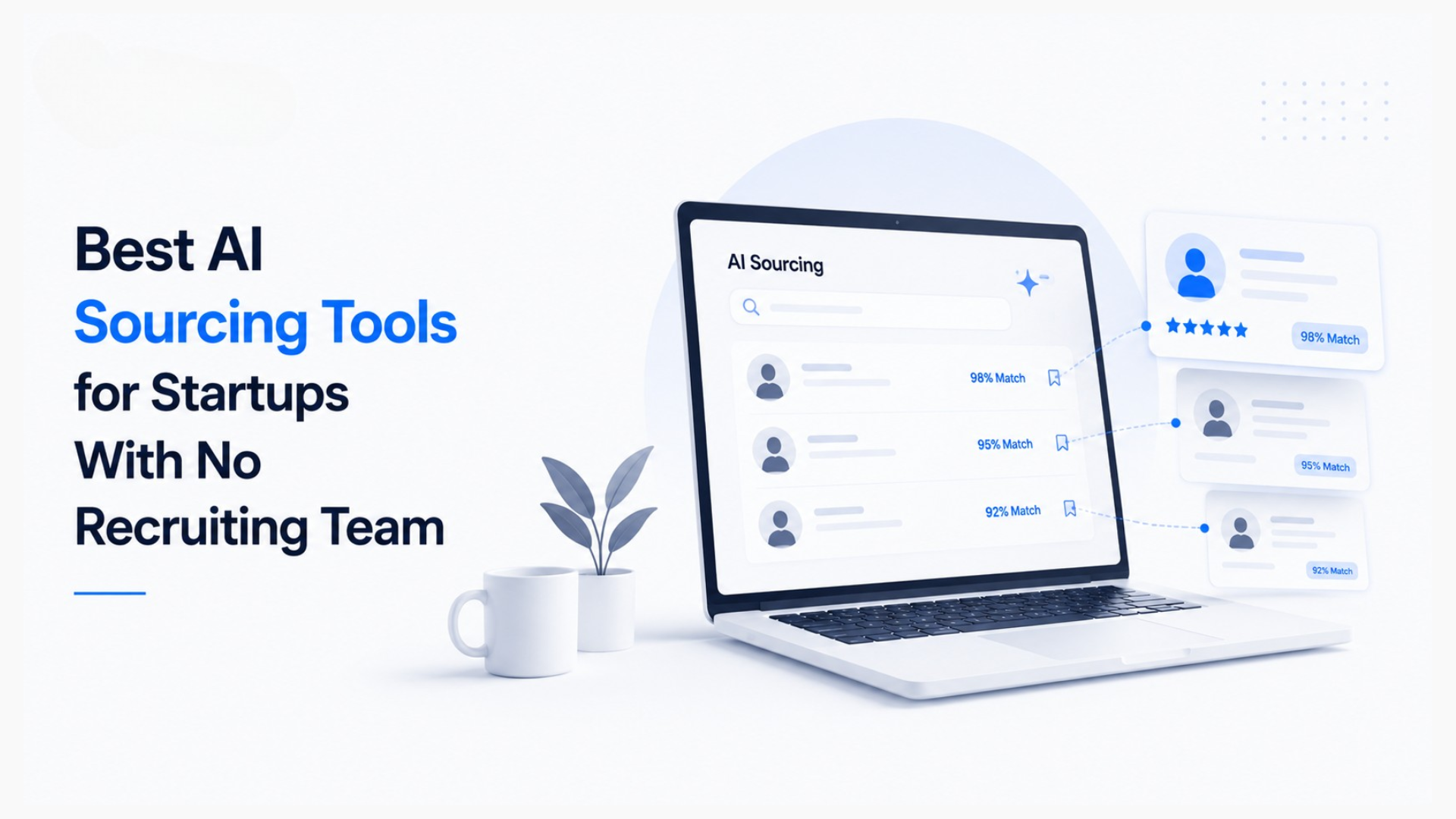
A founder or generalist hire describes the ideal candidate in plain English — no Boolean logic required — and Huntlo's agentic AI searches across 50+ public platforms, not just LinkedIn, before scoring and ranking candidates by fit. From there, outreach runs autonomously across email, WhatsApp, and AI voice, with automated follow-ups for candidates who don't respond the first time. For a startup with no dedicated recruiter, this means the entire top-of-funnel — discovery, enrichment, first contact, and follow-up — runs without anyone manually managing each step.
Because it's built to be self-serve, a non-recruiter can go from "we need a founding engineer" to a warm pipeline without waiting on a demo, an integration, or a recruiter to be hired first.
Best for: Founders and early hires running hiring solo who need sourcing and multi-channel outreach in a single, low-setup workflow. Standout feature: Natural-language sourcing across 50+ platforms paired with autonomous email, WhatsApp, and AI voice outreach. Pricing: 7-day free trial (3 active roles, 30 candidate searches); paid plans start at $99 per seat/month.
2. Wellfound Reach — Best Startup-Native Candidate Discovery
Wellfound Reach uses AI agents to search and score candidates specifically calibrated for startup context — including a company-selectivity filter that reflects how competitive a candidate's previous employer's hiring bar was. According to Wellfound's own 2026 sourcing guide, Wellfound Reach lets recruiters describe roles in plain language and receive ranked, fit-scored results without writing Boolean queries, with built-in outreach sequences connecting sourcing directly to candidate engagement.
Best for: Startups that want sourcing tuned to startup hiring signals rather than generic enterprise defaults. Also worth knowing: Wellfound also offers Autopilot, a managed tier where AI-assisted recruiters handle sourcing and outreach on your behalf if you'd rather not run it yourself.
3. Juicebox (PeopleGPT) — Best Conversational AI Sourcing Engine
Juicebox lets recruiters — or non-recruiters — describe a candidate in natural language and get ranked matches across a large multi-source database instead of a single network. Per PeopleManagingPeople's independent testing, the platform searches across more than 800 million profiles from 30+ data sources and verifies work and personal email addresses at the time of search, and the review specifically calls out founders and hiring managers sourcing without a dedicated recruiting team as a core use case.
Best for: Founder-led sourcing where speed and self-serve setup matter more than a full recruiting workflow. Trade-off: It's an outbound sourcing tool, not an ATS — you'll still want a lightweight system to track candidates once they respond.
4. Gem — Best All-in-One Sourcing, CRM, and Analytics for Growth-Stage Teams
Gem combines AI-powered sourcing with a built-in CRM and analytics layer, aimed at consolidating a fragmented early-stage tech stack into one platform. According to Juicebox's own tools comparison, Gem is positioned as best suited for startups and growth-stage companies needing a unified sourcing, CRM, and analytics platform, with LLM-powered search spanning its proprietary database and 20+ other sites.
Best for: Startups that expect to keep hiring at volume and want pipeline analytics from day one, not just a sourcing tool.
5. Ashby — Best for Startups That Want Sourcing and an ATS Together
Ashby pairs an ATS with sourcing, CRM tools, and transparent pricing built specifically for smaller companies — a rarity in a market dominated by quote-based enterprise contracts. Juicebox's recruiting software roundup notes that Ashby's "Foundations" plan offers clear, public pricing for companies with up to 100 employees, alongside advanced reporting and automated scheduling.
Best for: Startups that want one platform covering both sourcing and applicant tracking, without opaque enterprise pricing.
6. hireEZ — Best for Outbound Sourcing at Technical Depth
hireEZ (formerly Hiretual) aggregates candidate data from hundreds of millions of profiles across job boards and social platforms, with an AI sourcing agent built for outbound campaigns. Per Recruiterflow's 2026 sourcing tools guide, hireEZ is commonly used by teams that need to go beyond LinkedIn for technical and niche roles.
Best for: Startups hiring technical roles where candidates are more discoverable through code repositories and technical communities than through a standard LinkedIn search.
7. Manatal — Best Budget Option for a Startup's First AI-Powered ATS
Manatal is an affordable AI-powered ATS with sourcing recommendations and multilingual support, aimed at SMBs rather than enterprise buyers. It appears repeatedly across independent 2026 buyer's guides as the lowest-cost entry point for a startup that wants some AI sourcing capability without committing to a larger platform.
Best for: Very early-stage startups that want to test AI-assisted sourcing before investing in a more full-featured tool.
8. Fetcher — Best for Combining AI Sourcing With Human Backup
Fetcher pairs AI-driven sourcing with a human support team that helps build personalized talent pools and manage outreach, which can be useful for a founder who wants some sourcing automation but not full self-service. According to Recruiterflow's tools comparison, Fetcher combines automated candidate identification with specialized human support to handle time-consuming outreach work.
Best for: Founders who want AI sourcing but appreciate having a human safety net rather than running everything themselves.
How a Solo Founder or First Hire Should Actually Use These Tools
You don't need five tools to replace a recruiting team — you need one that covers discovery and outreach, plus a simple way to track who's responded. A workable setup for a startup with no recruiter looks like this:
One sourcing-and-outreach tool that finds candidates in natural language and gets a first message out automatically — this is the highest-leverage step, since it replaces the 15-20 candidates a founder can manually review in two hours with hundreds of scored matches.
One lightweight place to track pipeline — a simple ATS or even a well-organized spreadsheet, as long as it's actually updated after each response.
A fast internal process — startups can't out-brand big tech, but they can move from first contact to offer in 7-10 days instead of running a multi-week interview loop, which is often the real competitive advantage once a pipeline exists.
Start with the sourcing-and-outreach layer first. Everything else — better tracking, better analytics, more channels — only matters once candidates are actually in the funnel.
Frequently Asked Questions
Can a founder really replace a recruiter with AI sourcing tools? Not entirely — AI sourcing removes the bottleneck of finding and reaching candidates, but judgment calls on fit, culture, and closing still need a human. What it does replace is the multi-week manual search process that a startup usually can't afford to run anyway.
Do AI sourcing tools work for technical and niche roles? Yes, often better than for generalist roles. Tools that search beyond LinkedIn — into GitHub, technical blogs, and open-source contributions — can surface engineering candidates a founder wouldn't find through a standard keyword search.
How much should a startup with no recruiting team expect to pay for AI sourcing? Startup-friendly tools typically run from around $100 to a few hundred dollars per seat per month, a fraction of the $50,000+ annual contracts common in enterprise recruiting software.
The Bottom Line
A startup with no recruiting team doesn't need to hire one before it can compete for great candidates — it needs a tool that turns a founder's two hours a week into a real pipeline. If your biggest gap is getting from "we need to hire this role" to a warm conversation without a recruiter on staff, Huntlo's agentic sourcing and outreach platform is built to do exactly that, with a free trial to test against your next open role.
Related Reading on the Huntlo Blog
How to Build a Lean AI Recruiting Tech Stack Without Overspending
How Agentic AI Is Changing Candidate Sourcing for Staffing Agencies
Email vs. WhatsApp vs. AI Voice: Choosing the Right Outreach Channel for Candidate Engagement