Marcus, the CEO of a venture-backed robotics firm, had spent the better part of a year building what he called a "world-class" employer brand. He had hired a top-tier agency to craft a sleek visual identity, produced cinematic videos of the team collaborating in a glass-walled office, and launched a series of social campaigns highlighting the "unrivaled" benefits package. On the surface, the brand was a triumph; the company was lauded in industry journals as a "top place to work," and the volume of applications was higher than it had ever been. However, the operational reality was a nightmare, as every single high-maturity lead Marcus interviewed found the company's internal processes chaotic and the promised "autonomy" to be a facade for lack of direction. Marcus realized that he had built a mirror, not a window; he had created a polished image that attracted people who liked the look of success, but repelled the sovereign professionals who were equipped to actually produce it.
The failure Marcus experienced is a systemic symptom of the "Transactional Branding" trap. Most organizations treat their employer brand as a marketing exercise, assuming that the goal is to maximize the number of people who perceive the company as "attractive." This approach prioritizes the surface-level aesthetic over the structural reality of the work, resulting in a profound disconnect between the brand promise and the operational experience. When a company leads with a polished image, they are not signaling a mission; they are selling a fantasy. This creates a structural barrier where high-value partners, who view their careers through the lens of talent sovereignty, perceive the polish as a signal of low intellectual rigor and a lack of operational honesty.
To move beyond this, leadership must transition from "Brand as Image" to "Brand as Signal." A signal is not a logo or a slogan; it is a high-fidelity broadcast of the organization's operational maturity and its specific structural challenges. Instead of trying to look "perfect," a company should aim to look "aligned." This requires a total abandonment of the corporate brochure model in favor of a "Proof of Work" model. By focusing on the relational dynamics of partnership rather than the transactional dynamics of hiring, an organization can attract partners who are motivated by the complexity of the problem rather than the prestige of the brand.
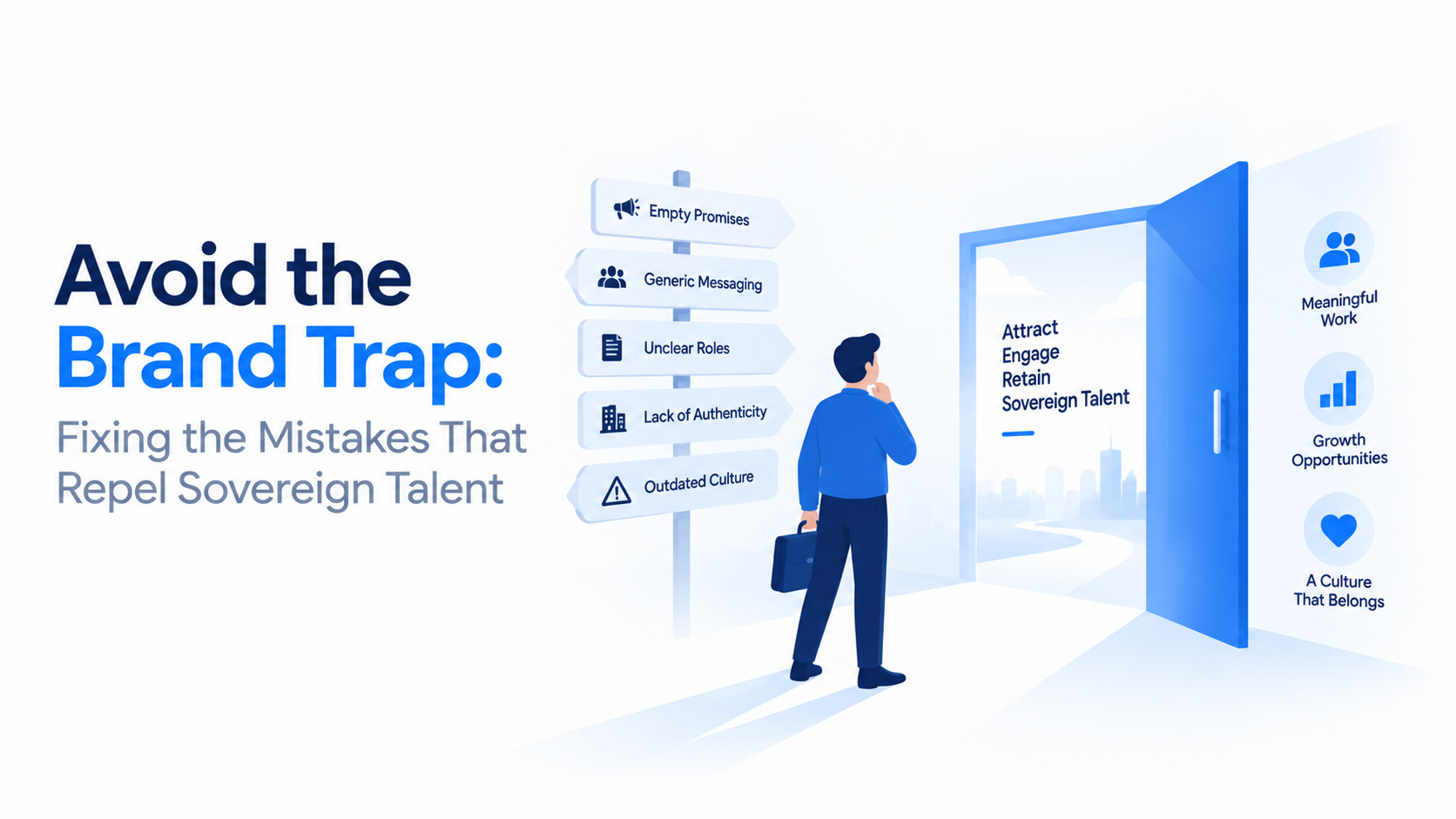
The Perfection Paradox: Why Over-Polishing Repels High-Maturity Partners
The most pervasive mistake in employer branding is the belief that perfection is a magnet for talent. Companies spend thousands of dollars scrubbing their social media of any mention of failure, framing every pivot as a "strategic evolution" and every conflict as "healthy tension." However, for the sovereign professional, a brand that appears too perfect is an immediate red flag. They recognize that no high-growth organization is without structural debt or operational friction, and a brand that hides these facts is signaling a lack of transparency. The obsession with a flawless image is what the marketing team is using to produce a sense of security, and that sense of security is what the high-maturity partner is using to justify their immediate disinterest.
When a brand is over-polished, it inadvertently signals a low-trust environment. High-value partners perceive an over-reliance on cinematic videos and sanitized narratives as a sign that the company values harmony over impact. This transactional framing tells the potential partner that their autonomy will be limited by a corporate narrative that cannot tolerate the "messy middle" of actual innovation. Relational hiring requires a pivot toward the "Architecture of the Problem," where the company is honest about its structural gaps. By broadcasting the friction, the organization attracts partners who enjoy the process of optimization.
This failure of signal is often rooted in a fear of vulnerability within the leadership team. Many executives believe that admitting to operational chaos will scare away candidates, but the opposite is true for sovereign talent. Sovereign professionals are not deterred by problems; they are deterred by the absence of a plan to solve them. The attempt to project a flawless facade is what the leadership is using to produce a false sense of stability, and that false sense of stability is what the partner is using to conclude that the organization has stagnated. To attract a partner, the company must be willing to show its structural scars.
The impact of this perfectionism is most evident in the quality of the inbound pipeline. By optimizing for "likes" and "admiration," companies attract "fans" rather than "partners." Fans are motivated by the prestige of the brand, while partners are motivated by the challenge of the work. This results in a workforce that is loyal to the image of the company but incapable of driving its operational evolution. According to McKinsey's research on organizational health, the most resilient companies are those that foster a culture of psychological safety and radical transparency. This transition allows the company to move from a "broadcast" mindset to a "signaling" mindset.
The Perk-Centric Trap: Confusing Amenities with Value Propositions
Another critical error is the tendency to lead the employer brand with "perks" rather than "purpose." Many companies dedicate the most prominent real estate on their careers page to free lunches, gym memberships, and unlimited PTO. While these are pleasant additions, they are "hygiene factors"—baseline expectations that do not actually drive the decision of a high-maturity professional to join or stay. The obsession with surface-level amenities is what the organization is using to produce a temporary attraction, and that temporary attraction is what the leadership is using to mask a lack of genuine operational purpose.
When a brand is built on transactional rewards, it signals that the company views the employment relationship as a trade of money-and-perks for labor. This framing is anathema to the concept of talent sovereignty, as it reduces the professional to a commodity that can be bought with better snacks. Relational branding requires a shift toward the "Sovereignty Gap," where the value proposition is based on the authority, autonomy, and impact the partner will have. For a world-class expert, the promise of owning the structural architecture of a new product is infinitely more valuable than a free gym membership.
This failure to distinguish between amenities and value is often a result of copying the branding of "Big Tech" without understanding why it worked for them. Large conglomerates use perks to maintain a massive, generic workforce, but a scaling firm needs a small, elite coalition of partners. If the brand is built on perks, it attracts people who are motivated by comfort. The reliance on amenities is what the recruiting team is using to produce a high volume of applicants, and that high volume is what the organization is using to eliminate the time required for deep, relational alignment.
The consequence of the perk-centric trap is a high rate of early attrition. When a hire joins for the perks but finds that the actual work lacks structural impact or autonomy, they experience a rapid decline in engagement. They realize that the "value" they were promised was superficial, and they leave as soon as a more challenging opportunity arises. This creates a cycle of "churn-and-burn" that destroys the company's institutional memory. To break this cycle, the organization must replace the "benefits list" with an "impact roadmap" that defines exactly how the partner will contribute to the company's structural success.
The Culture-First Fallacy: Noise vs. Operational Truth
Many organizations fall into the trap of "Culture-First" branding, where they spend months defining a set of abstract values like "Integrity," "Innovation," and "Collaboration." These values are then plastered across the careers page in bold fonts, accompanied by photos of team-building retreats. However, for the sovereign professional, these are empty signifiers that lack operational substance. They are "corporate noise" that provides zero information about how the company actually functions on a Tuesday morning. The use of abstract values is what the organization is using to produce a generic image, and that generic image is what the partner is using to signal a lack of intellectual rigor.
A relational brand recognizes that culture is not something you "declare"; it is something you "demonstrate." Culture is the sum of the organization's operational habits—how it handles failure, how it makes decisions, and how it grants autonomy. Instead of claiming to value "Innovation," a high-maturity brand shares a detailed post-mortem of a failed project and the structural changes made to resolve it. This is "Operational Truth," and it is the only form of branding that resonates with high-value partners. The transparency of the operational habit is what the manager is using to produce trust, and that trust is what the partner is using to assess the cultural fit.
This failure to ground culture in operations often leads to "Cultural Dissonance," where the brand promise and the daily experience are in direct conflict. When a candidate is told the culture is "collaborative" but finds that every decision requires five levels of approval, the brand becomes a liability. This disconnect is a primary driver of candidate drop-off during the interview process. The friction between the promise and the practice is what the candidate is perceiving as a lack of operational maturity, and that lack of maturity is what the professional is using to disqualify the organization.
To avoid this mistake, companies must move from "Value Statements" to "Behavioral Proof." Instead of saying "We value autonomy," the company should describe the specific "Sovereignty Perimeter" granted to its partners. They should explain the mechanisms used to ensure that experts can execute their vision without bureaucratic interference. This approach transforms the culture from a marketing claim into a professional guarantee. The articulation of the behavior is what the brand is using to produce a feeling of agency, and that agency is what the sovereign professional is using to envision their future within the organization.
The Signal-Reality Gap: The Danger of the "Brand Lie"
The most dangerous mistake a company can make is creating a brand signal that is fundamentally disconnected from the operational reality. This "Brand Lie" often happens when a founder wants to attract a certain type of talent and describes the company as it wishes it were, rather than as it actually is. They might promise a "flat hierarchy" while maintaining a rigid chain of command, or claim to be "data-driven" while making decisions based on the CEO's intuition. The disconnect between the signal and the reality is what the organization is using to produce an initial attraction, and that attraction is what the partner is using to commit to the role.
However, the Brand Lie is always exposed within the first ninety days of employment. When a high-maturity partner realizes that the "Sovereignty" they were promised does not exist, the result is a total collapse of trust. This is not just a retention problem; it is a brand-destruction problem. Sovereign professionals move in tight circles, and a partner who feels deceived will share their experience with their peers, effectively poisoning the company's reputation in the high-value market. The collapse of trust is what the employee is using to produce a negative referral, and that referral is what the organization is using to eliminate its future pipeline.
To prevent this, the employer brand must be a "Live Document" that is synchronized with the operational state of the company. This requires a continuous feedback loop between the hiring managers and the branding team. If the internal process for decision-making changes, the brand signal must change accordingly. True operational maturity is the ability to ensure that every touchpoint of the employee lifecycle—from the first LinkedIn post to the annual review—is an expression of the same structural truth. The consistency of the signal is what the organization is using to produce credibility, and that credibility is what the partner is using to build deep loyalty.
This synchronization is a critical part of the shift to career architecture, where the professional views their move as a strategic alignment. When the brand signal is honest, it acts as a filter that repels those who would be unhappy in the current environment and attracts those who are specifically motivated by the existing challenges. This honesty transforms the recruitment process from a "sales pitch" into a "professional consultation." The transparency of the real-time state is what the brand is using to produce alignment, and that alignment is what the organization is using to ensure structural stability.
The Volume Obsession: Prioritizing Noise Over Alignment
Many organizations make the mistake of measuring their brand success by the volume of applications. They celebrate a "viral" job post or a spike in traffic to the careers page as proof that the brand is working. However, in a relational framework, high volume is often a sign of a low-precision signal. When a brand is too broad, it appeals to the lowest common denominator, attracting thousands of transactional applicants who are simply "looking for a job." The obsession with volume is what the recruiting team is using to produce a vanity report, and that report is what the leadership is using to ignore the lack of quality hires.
When a company optimizes for volume, they are essentially introducing noise into their operational system. This creates a massive structural burden for the hiring managers, who must spend hours screening candidates who are a fit for the "brand" but a failure for the "role." This noise increases the time-to-hire and degrades the overall candidate experience, as response velocity drops for everyone. The reliance on a broad signal is what the organization is using to produce a crowded pipeline, and that crowded pipeline is what the organization is using to eliminate the time required for deep, relational engagement.
To fix this, leadership must shift their KPIs from "Application Volume" to "Alignment Density." Alignment Density is the ratio of high-maturity partners to total applicants. A high-maturity organization would rather have ten applications and five partners than ten thousand applications and zero partners. This shift requires the courage to make the brand less attractive to the general public and more attractive to a specific, sovereign professional. The precision of the signal is what the organization is using to produce alignment density, and that density is what the recruiting team is using to reclaim their time.
This focus on quality over quantity is the only way to reduce candidate drop-off rates and build a sustainable pipeline. When the signal is precise, the candidates who enter the pipeline are already aligned with the structural goals of the company. They don't need to be "sold" on the culture because they have already seen the proof of the operational reality. This efficiency is what the hiring team is using to produce a memorable candidate experience, as every interaction is based on mutual professional value rather than a transactional screening.
Scaling the Truth: How a Hiring OS Fixes the Brand Gap
As an organization scales, the risk of "Brand Drift" increases. The original truth of the company is often diluted as new managers are hired and the original culture is stretched. To prevent this, the organization needs a structural way to deliver its value proposition consistently. This is where a Hiring OS becomes essential. A Hiring OS does not just manage a pipeline; it synchronizes the "Sovereignty Gaps" of the company with the external signal sent to the market, ensuring that the promise remains rooted in operational truth.
Huntlo serves as this essential infrastructure, moving employer branding from a marketing intuition to an operational science. By treating the recruitment process as an OS, companies can ensure that the principles of relational signaling are baked into every touchpoint. The system can track which specific operational challenges are attracting the highest-quality partners, allowing the company to iterate on its signal in real-time. The automation of the administrative burden is what the OS is using to produce more space for human-centric alignment, and that alignment is what the organization is using to secure high-maturity talent.
Furthermore, an agentic approach to hiring allows the company to maintain a relational map of potential partners who have already aligned with the company's operational philosophy. Instead of launching a generic ad when a vacancy appears, the Hiring OS allows the company to initiate a proactive invitation to a partner who has already seen the structural truth of the organization. This transforms the act of branding from a public plea for attention into a private, high-value consultation. The proactive mapping is what the system is using to produce a high-conversion pipeline, and that pipeline is what the leadership is using to ensure structural stability.
Integrating the brand into a Hiring OS also enables a more sophisticated approach to referrals. When current partners refer others, they are not just recommending a friend; they are recommending a professional who fits the sovereign profile of the company. This creates a self-sustaining loop of alignment, where the most successful partners attract other high-maturity experts. The internal referral is what the system is using to produce a pre-validated candidate, and that pre-validation is what the organization is using to eliminate the risk of a "Brand Lie" failure.
Ultimately, avoiding employer branding mistakes is not about "better marketing"; it is about "better thinking." It requires the courage to stop optimizing for the algorithm and to start optimizing for the partner. It requires the discipline to move from a transactional "Image" to a relational "Signal." When an organization views its brand as a professional agreement between sovereign entities, it ceases to struggle with a lack of talent. Instead, it finds itself surrounded by an elite coalition of partners who are invested in the structural success of the mission. The commitment to relational signaling is what the organization is using to produce a world-class team, and that team is what the company is using to dominate its market.