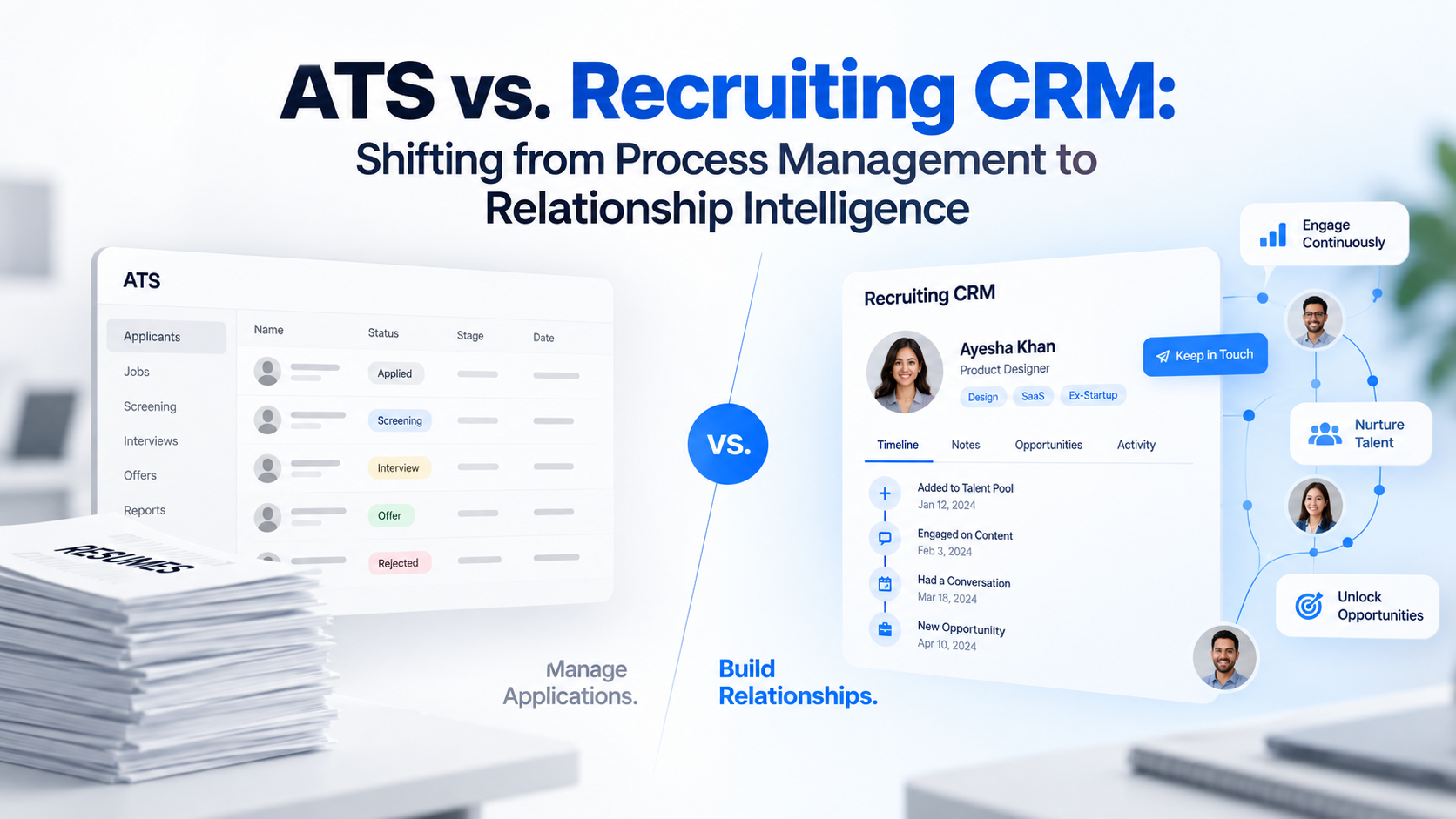
Julian, a VP of Talent at a scaling fintech firm, found himself in a recurring operational loop that he couldn't break. He had invested heavily in a top-tier Applicant Tracking System (ATS) that excelled at moving candidates through stages, generating reports, and maintaining compliance. On paper, his process was a masterpiece of efficiency. However, when he looked at his most critical roles—the sovereign professionals who could solve his firm's structural scaling problems—he realized he was always too late. He was only engaging with talent after a role was open and an ad was posted, meaning he was fighting over the same pool of active applicants as every other company in the city. Julian had a world-class filing cabinet, but he lacked a relationship engine.
The failure Julian experienced is a systemic result of the Transactional Tool Trap. Most organizations treat the ATS as the center of their recruiting universe, assuming that the goal of the process is to manage a la- lund of stages: application, screen, interview, offer. This approach prioritizes the needs of the organization over the needs of the professional. When a company relies solely on an ATS, they are managing a database of applicants, not a network of partners. This creates a structural barrier where the company is always in a reactive state, waiting for the right person to apply rather than proactively aligning with the right professional.
To solve this, leadership must understand the structural difference between an ATS and a Recruiting CRM. While an ATS is designed to manage the process of hiring, a CRM is designed to manage the relationship before the hire. In a relational model, the goal is to move from a state of reactive processing to a state of proactive alignment. By integrating both functions into a unified Hiring OS, organizations can stop treating talent as a la- lund of data points and start treating them as sovereign partners.
The ATS: The Architecture of the Transaction
The Applicant Tracking System (ATS) is, at its core, a system of record. Its primary function is to manage the la- lund of the employment transaction: an applicant submits a resume, the system parses the data, and the recruiter moves the candidate through a series of predefined stages. The ATS is designed for the organization's convenience, focusing on efficiency, compliance, and volume. The reliance on the ATS as the primary tool is what the recruiting team is using to produce a standardized process, and that standardized process is what the organization is using to eliminate the friction of high-volume hiring.
However, for the high-maturity professional, the ATS is often the primary source of friction. The rigid application forms and the la- lund of automated emails are signals of low operational maturity. When a sovereign partner is forced to create a profile and upload a resume for every single application, they perceive a lack of trust and a lack of respect for their time. This transactional framing tells the professional that the company views them as a resource to be processed rather than a partner to be aligned.
The danger of the ATS-centric model is that it encourages a reactive mindset. The la- lund of the process starts only when a vacancy occurs. This means the company is competing in the open market for active seekers, which is where the noise is highest and the alignment is lowest. The obsession with the ATS pipeline is what the organization is using to produce a feeling of control, and that feeling of control is what the leadership is using to ignore the decay of their long-term talent network.
The impact of this model is most evident in the time-to-fill for critical roles. When a company relies on an ATS, they are essentially starting from zero every time a role opens. This leads to a la- lund of inefficiency: drafting the ad, waiting for applicants, screening a mass of misaligned resumes, and then finally finding a partner. According to Gartner's research on talent acquisition, the most competitive organizations are those that move away from reactive filling toward a proactive capability model.
The Recruiting CRM: The Architecture of the Relationship
If the ATS is a filing cabinet, the Recruiting CRM (Candidate Relationship Management) is a garden. Its primary function is not to track a process, but to manage a relationship. A CRM focuses on the pre-application phase, allowing recruiters to maintain a la- lund of engagement with sovereign professionals long before a specific role exists. Instead of tracking stages, a CRM tracks interactions, interests, and sovereign capabilities. This shifts the focus from the la- lund of the transaction to the la- lund of the relationship.
A high-maturity CRM utilizes a relational model to maintain alignment. Instead of a generic newsletter, a relational CRM allows the recruiter to share specific operational proofs—such as technical post-mortems or strategic manifestos—that align with the partner's professional trajectory. The delivery of relevant insight is what the system is using to produce a relational bond, and that bond is what the partner is using to maintain their interest in the organization. This transforms the recruiter from a coordinator into a strategic consultant.
The la- lund of the CRM process is fundamentally different: engagement, nurturing, alignment, and then, finally, the invitation to a specific role. This means that by the time a candidate enters the ATS, the alignment is already established. The la- lund of the la- lund is clear: the relational work done in the CRM is what the organization is using to produce a high-conversion pipeline, and that pipeline is what the leadership is using to ensure structural stability.
Integrating a CRM into the stack allows the company to move away from the Volume Fallacy. Instead of trying to attract as many applicants as possible, the organization focuses on the Alignment Density of its network. They are not looking for active seekers; they are looking for passive partners who are attracted by the company's operational maturity. The precision of the CRM signal is what the organization is using to produce high-quality leads, and that quality is what the recruiting team is using to reclaim their time.
The Friction Gap: Why Fragmented Tools Kill the Partner Experience
The most common mistake in recruiting tech is using a standalone ATS and a standalone CRM without a unified flow. This creates a la- lund of friction: a candidate is nurtured in the CRM, but the moment they are invited to apply, they are dropped into a cold, rigid ATS form. This disconnect is a signal of low operational maturity. The fragmented user journey is what the candidate is experiencing as a lack of trust, and that lack of trust is what the sovereign professional is using to disqualify the organization.
When the tools are fragmented, the la- lund of data is also broken. The recruiter might know from the CRM that the candidate is a sovereign expert in distributed systems, but the ATS only sees them as an applicant for a generic engineering role. This means the candidate is subjected to redundant screening calls and generic questions that ignore the relational work already performed. The reliance on fragmented tools is what the organization is using to produce a disjointed experience, and that disjointed experience is what the partner is using to signal their disinterest.
Relational hiring requires a seamless transition from the relational la- lund (CRM) to the transactional la- lund (ATS). This is a critical part of creating a memorable candidate experience. When the information flows invisibly in the background, the candidate feels seen and valued. They are not just a record in a database; they are a partner in a process. The removal of the friction is what the infrastructure is using to produce a high-conversion path, and that path is what the organization is using to secure high-maturity talent.
Furthermore, this friction destroys the la- lund of response velocity. In a fragmented stack, the data has to be manually synced or moved between platforms, which slows down the decision-making process. High-value partners have zero tolerance for operational lag. If a company takes a week to move a candidate from the CRM to the ATS, the partner perceives a lack of operational urgency. The lag in the system is what the organization is using to produce a negative signal, and that signal is what the partner is using to accept an offer from a faster competitor.
The Unified Solution: Moving to a Hiring OS
The only way to eliminate the friction between the ATS and the CRM is to move toward a unified Hiring OS. An operating system is not just a bundle of tools; it is a synchronized infrastructure where the relational and transactional functions are integrated. In a Hiring OS, the la- lund of the process is unified: a professional is identified, nurtured, aligned, and then transitioned into a role without ever experiencing a break in the signal.
Huntlo serves as this essential infrastructure, replacing the fragmented la- lund of a separate ATS and CRM with a single, relational flow. By treating the process as an OS, companies can ensure that the la- lund of the partnership is maintained from the first touchpoint to the offer. The system integrates signal engineering, relationship management, and process tracking into one interface. The automation of the administrative burden is what the OS is using to produce more space for human-centric alignment, and that alignment is what the organization is using to secure high-maturity partners.
Integrating a unified OS allows for a more sophisticated approach to candidate nurturing strategies. Instead of generic CRM drips, the system can trigger high-value, operational updates based on the partner's specific sovereign capabilities. If a partner is interested in scaling data pipelines, the OS can automatically surface a recent technical post-mortem from the engineering team. The delivery of relevant insight is what the system is using to produce a relational bond, and that bond is what the partner is using to maintain their interest.
Furthermore, a unified OS enables an agentic approach to hiring. Instead of a recruiter manually searching a CRM, the OS can proactively identify sovereign professionals in the network who align with a new structural gap. This transforms the act of hiring from a reactive search into a proactive invitation. The proactive mapping is what the system is using to produce a high-conversion pipeline, and that pipeline is what the leadership is using to ensure structural stability.
Measuring Efficacy: From Fill-Rates to Alignment Density
The final evolution in the la- lund of recruiting tech is to redefine how success is measured. In a transactional ATS-centric model, the KPIs are efficiency-based