Here's the blog in the Huntlo format.
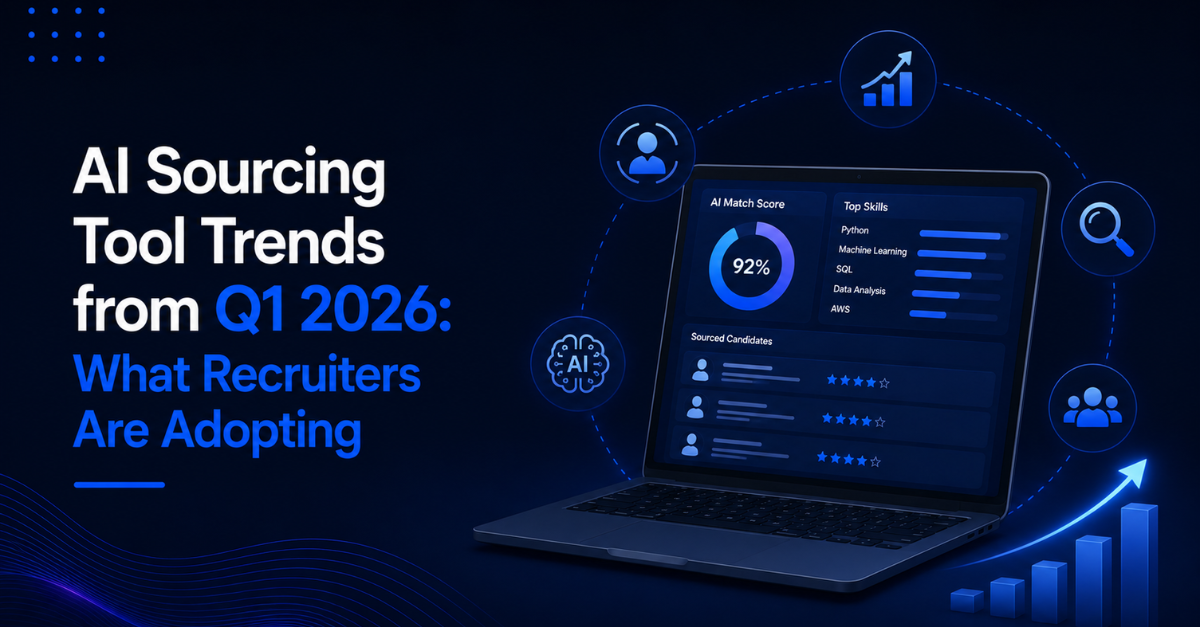
AI Sourcing Tool Trends from Q1 2026: What Recruiters Are Adopting
Meta Description: Explore the biggest AI sourcing tool trends from Q1 2026 and discover how recruiters are adopting automation, candidate engagement technology, workflow automation, and Agentic AI recruiting.
AI Sourcing Tool Trends from Q1 2026: What Recruiters Are Adopting
The first quarter of every year provides a unique glimpse into the future of recruiting technology.
Budgets get approved. New hiring goals are established. Recruiting teams evaluate vendors, launch pilots, and decide which technologies will shape their hiring strategy for the rest of the year.
Historically, AI sourcing tool adoption centered around one goal: finding more candidates.
But Q1 2026 reveals a different story.
Recruiters are increasingly looking beyond candidate discovery and talent search. Instead, they are prioritizing technologies that improve recruiter productivity, automate recruiting workflows, reduce manual work, and accelerate hiring outcomes.
The biggest shift isn't better sourcing.
It's the transition from AI that helps recruiters find candidates to AI that helps recruiters execute recruiting processes.
Let's examine the most important AI sourcing tool trends 2026 and what they reveal about the future of recruiting.
Why Q1 Technology Adoption Matters
The technologies recruiting teams adopt during Q1 often become indicators of broader market direction.
Unlike end-of-year predictions, Q1 adoption reflects real purchasing decisions.
Organizations are investing in tools that address immediate hiring challenges rather than speculative future needs.
Budget Cycles Drive Technology Decisions
Most recruiting technology budgets are finalized early in the year.
This is when recruiting leaders evaluate:
Existing tool performance
Technology gaps
Recruiter productivity challenges
Hiring goals for the year ahead
As a result, Q1 purchasing patterns reveal where organizations see the greatest opportunities for improvement.
New Hiring Initiatives Create New Requirements
Recruiting teams entering 2026 are dealing with:
Leaner recruiting organizations
Higher hiring expectations
Increased pressure to improve efficiency
More complex candidate experiences
These realities are influencing how AI recruiting software is evaluated and adopted.
Trend #1 — Recruiters Want Productivity, Not Just More Candidates
For years, sourcing tools competed primarily on database size, search capabilities, and candidate matching accuracy.
That buying criteria is evolving.
Recruiters are increasingly asking a different question:
Will this tool save time?
Recruiter Workload Challenges Continue to Grow
Many recruiting teams are managing:
More requisitions per recruiter
Higher stakeholder expectations
Increased candidate communication requirements
Additional administrative work
Finding candidates is no longer the primary constraint.
Managing recruiting activity efficiently has become the bigger challenge.
Efficiency-Focused Buying Decisions
The most successful AI platforms are increasingly positioned around:
Recruiter productivity
Time savings
Process automation
Workflow acceleration
Technology investments are being evaluated based on how much recruiter capacity they create rather than how many candidates they surface.
Trend #2 — Candidate Engagement Is Becoming a Priority
One of the strongest recruiting technology trends emerging in 2026 is the growing focus on candidate engagement automation.
Many organizations have learned that building larger talent pools does not automatically improve hiring outcomes.
Candidates still need to respond, engage, and move through the process.
Outreach Automation Is Gaining Adoption
Recruiters are increasingly using AI to automate:
Initial outreach
Personalized communication
Multi-step campaigns
Candidate nurturing
This helps maintain communication consistency while reducing manual effort.
Follow-Up Automation Is Becoming Essential
Follow-up remains one of the most important yet frequently neglected recruiting activities.
Manual follow-ups often result in:
Candidate drop-offs
Lower response rates
Slower hiring cycles
Automation ensures candidates remain engaged throughout the recruiting process.
The market is shifting from candidate discovery toward candidate conversion.
CTA
See how Huntlo automates candidate engagement and follow-ups at scale.
Trend #3 — Workflow Automation Is Gaining Adoption
Recruiters increasingly recognize that many hiring delays occur after sourcing.
This is driving demand for recruiting workflow automation.
Qualification Workflows Are Expanding
AI is increasingly being used to automate:
Candidate screening
Initial qualification
Eligibility verification
Role-fit assessment
This reduces recruiter workload while improving consistency.
Scheduling Workflows Are Growing Rapidly
Interview scheduling continues to be one of recruiting's most time-consuming tasks.
Organizations are adopting automation to:
Coordinate calendars
Schedule interviews
Send reminders
Reduce scheduling delays
Improving scheduling efficiency directly impacts hiring velocity.
Trend #4 — Recruiting Operations Are Moving Into AI
Historically, recruiting operations relied heavily on manual coordination.
In 2026, that is changing.
Organizations are beginning to apply AI beyond sourcing and engagement into recruiting operations.
Process Automation Is Expanding
Recruiting operations increasingly include automation for:
Workflow management
Pipeline progression
Task coordination
Administrative processes
This allows recruiting teams to operate more efficiently at scale.
Operational Visibility Is Becoming More Important
Leaders increasingly want visibility into:
Candidate movement
Hiring bottlenecks
Recruiter workload
Pipeline performance
AI-powered recruiting operations software helps create that visibility while reducing manual reporting.
CTA
Explore how Huntlo streamlines recruiting operations using Agentic AI.
Trend #5 — Agentic AI Is Emerging
Perhaps the most significant trend from Q1 2026 is the rise of Agentic AI recruiting.
While still an emerging category, interest is growing rapidly.
AI Agents vs AI Assistants
Traditional recruiting AI often functions as an assistant.
It can:
Recommend candidates
Generate insights
Surface information
But recruiters still execute the work.
Agentic AI takes a different approach.
AI agents can actively perform recruiting tasks and execute workflows.
Autonomous Recruiting Workflows
Emerging use cases include:
Candidate outreach
Qualification conversations
Follow-up management
Interview coordination
Workflow progression
Instead of supporting recruiters, AI increasingly becomes an operational participant in recruiting.
This represents a major shift in how recruiting technology is evaluated.
What These Trends Mean for Recruiting Leaders
The recruiting technology market is clearly evolving.
Leaders evaluating technology investments should pay attention to these changes.
Technology Evaluation Criteria Are Shifting
Recruiting leaders are increasingly prioritizing:
Productivity gains
Automation capabilities
Workflow efficiency
Hiring velocity
Operational scalability
Pure sourcing functionality is becoming less of a differentiator.
Investment Priorities Are Expanding
Future investments are likely to focus on:
Candidate engagement automation
Qualification automation
Scheduling automation
Recruiting operations automation
Agentic AI workflows
The common theme is execution rather than discovery.
What Recruiters Should Watch for in the Rest of 2026
Several trends appear likely to accelerate throughout the remainder of the year.
Consolidation Trends
Many organizations are looking to reduce tool sprawl.
Recruiters increasingly prefer fewer systems that support more workflows.
This creates opportunities for platforms that combine sourcing, engagement, and automation.
Workflow-First Recruiting Platforms
Recruiting software vendors are gradually moving toward workflow-centric platforms.
The focus is shifting from isolated recruiting tasks to end-to-end hiring execution.
This trend is likely to continue as organizations seek greater efficiency.
From AI Sourcing to AI Recruiting Infrastructure
The most important lesson from Q1 2026 is that recruiting technology priorities are changing.
Why Sourcing Alone Is No Longer Enough
Candidate sourcing remains important.
But recruiting teams increasingly recognize that hiring success depends on what happens after sourcing.
Key challenges now include:
Candidate engagement
Qualification
Follow-ups
Scheduling
Recruiting operations
These areas are becoming major automation priorities.
The Future of Recruiting Technology
The future of recruiting is unlikely to be defined by who finds candidates fastest.
It will be defined by who moves candidates through the hiring process most efficiently.
This is why the industry is gradually shifting from AI sourcing tools toward AI recruiting infrastructure.
Platforms capable of automating recruiting execution will likely define the next generation of recruiting technology.
Frequently Asked Questions
What AI sourcing tools are recruiters using in 2026?
Recruiters are increasingly adopting AI-powered sourcing, engagement, workflow automation, and recruiting operations platforms rather than relying solely on candidate search tools.
What are the biggest AI recruiting trends?
The most significant trends include recruiter productivity tools, candidate engagement automation, workflow automation, recruiting operations automation, and Agentic AI recruiting.
Is AI replacing recruiters?
No. Most organizations use AI to automate repetitive administrative work so recruiters can focus on strategic and relationship-driven activities.
What is recruiting workflow automation?
Recruiting workflow automation uses technology to automate recruiting processes such as screening, follow-ups, scheduling, and candidate progression.
What is recruitment operations automation?
Recruitment operations automation focuses on streamlining administrative recruiting tasks, reporting, coordination, and process management.
What is Agentic AI recruiting?
Agentic AI recruiting uses autonomous AI agents that actively execute recruiting workflows rather than simply providing recommendations.
How can AI improve recruiter productivity?
AI reduces manual workload by automating repetitive tasks such as outreach, qualification, scheduling, and follow-ups.
What comes after sourcing automation?
The next stage is recruiting execution automation, including candidate engagement, qualification, interview coordination, and recruiting operations.
What technologies are recruiting leaders adopting?
Leaders are increasingly investing in workflow automation, candidate engagement systems, recruiting operations platforms, and Agentic AI solutions.
How should recruiting teams prepare for the future?
Teams should evaluate technologies based on productivity gains, automation capabilities, operational efficiency, and scalability rather than sourcing features alone.
Conclusion
The biggest recruiting technology trend from Q1 2026 is not improved sourcing.
It is the industry's growing focus on recruiting execution.
Recruiters are increasingly adopting technology that helps automate:
Candidate engagement
Qualification
Follow-ups
Scheduling
Recruiting operations
This reflects a broader shift in how recruiting success is measured.
The future belongs to platforms that do more than identify candidates.
The future belongs to platforms that help recruiters move candidates through the hiring process faster, more consistently, and with less manual effort.
As AI recruiting continues to evolve, the conversation will move beyond sourcing entirely.
The next generation of recruiting technology will be defined by intelligent, automated recruiting infrastructure—and the organizations that embrace it early will be best positioned to compete for talent in the years ahead.